The DFS Keeps Changing Workers. Your Guide Shouldn't.
You've been caring for your niece since March. Or maybe you're a nurse in Rankin Inlet thinking about fostering. Either way, you've probably discovered the same thing: the Government of Nunavut's foster care information is scattered across broken website links, an outdated 2011 manual, and a social worker who may have already moved south.
The Department of Family Services has been flagged by the Auditor General four times — in 2011, 2014, 2023, and again in 2025. Social workers cycle through communities so fast that by the time you get an answer, the person who gave it may no longer work there. And the families who need to foster the most — kinship caregivers already raising a relative's child — are the ones most likely to miss out on the financial supports they're entitled to.
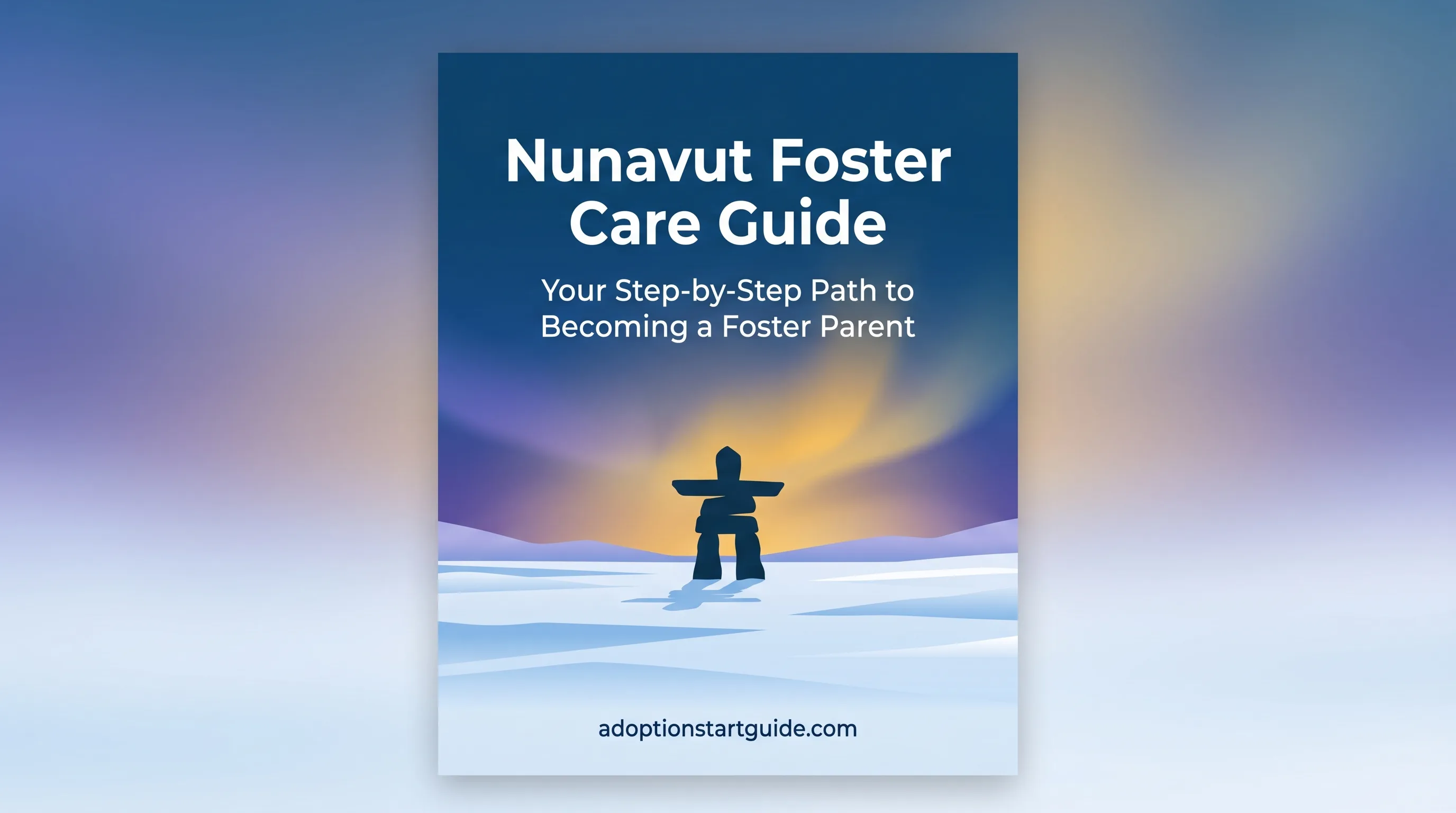
The Nunavut Foster Care Guide is the Arctic Navigation System for the territorial child welfare process. It's a permanent, offline-ready reference that gives you the real application steps, the actual housing rules for social housing, and the funding pathways (ICFI, Jordan's Principle) that the system rarely explains clearly — all written specifically for Nunavut's 25 communities, not adapted from a southern Canadian template.
What's Inside
The DFS Regional Map — Nunavut's foster care system runs through three regional offices: Pangnirtung (Qikiqtaaluk), Rankin Inlet (Kivalliq), and Cambridge Bay (Kitikmeot). The guide tells you exactly who to contact based on your community, including what to do when the local CSSW position is vacant — which happens more often than the department admits.
Housing Standards That Reflect Reality — Generic Canadian guides assume one child per bedroom and an attached garage. In Nunavut, 60% of families live in social housing and 45% of those units are overcrowded. The guide explains how DFS actually assesses homes — safety-based, not square-footage-based — and how the Nunavut Housing Corporation's MOU with Family Services can work in your favour.
The ICFI and Jordan's Principle Funding Roadmap — The Inuit Child First Initiative covers traditional parkas, country food, cultural camp fees, and specialized services for Inuit children in care. Jordan's Principle fills gaps in health, education, and social supports. But ICFI is a "payer of last resort" — apply to the wrong program first and you'll be rejected. The guide maps out the exact funding hierarchy so your first application goes to the right place.
Inunnguiniq Training Explained — Nunavut doesn't use the southern PRIDE training model. Instead, you'll complete 19 sessions of Inunnguiniq — "the making of a human being" — covering naming practices, isummaksaiyuq communication, colonial healing, and land-based learning. The guide prepares you for what each session covers so nothing catches you off guard.
The Kinship Formalization Pathway — If you're already caring for a relative's child through customary caring, formalizing through DFS unlocks per diem payments, ICFI funding, and housing priority — without disrupting the care you're already providing. The guide walks you through the transition step by step.
Cultural Responsibilities for Non-Inuit Caregivers — Over half of Inuit foster children in Canada live in non-Inuit homes. If you're Qallunaat, the guide covers your specific obligations: maintaining the child's connection to Inuktitut or Inuinnaqtun, respecting naming relationships, providing country food access, and supporting on-the-land activities through Regional Inuit Associations.
Remote Community Strategies — In hamlets like Naujaat, Whale Cove, Grise Fiord, and Kugaaruk, the local CSSW position may be empty for months. The guide explains how to bypass community-level gaps and work directly with regional directors to complete your application remotely.
Legal Framework in Plain English — The Child and Family Services Act, Bill C-92, the Aboriginal Custom Adoption Recognition Act (ACARA), the Family Abuse Intervention Act, and the Representative for Children and Youth Act — all broken down into what they mean for you as a caregiver, with a quick-reference table.
Who It's For
- Kinship caregivers already raising a relative's child who want to formalize care and access the per diem and ICFI funding they've been missing
- Government workers, nurses, teachers, and RCMP in the North who want to foster but need to understand their cultural obligations to Inuit children
- Community members who've been asked by a social worker to take an emergency or short-term placement
- Families in remote hamlets where there's limited or no local DFS presence
- Anyone in Nunavut — Qikiqtaaluk, Kivalliq, or Kitikmeot — who wants the real steps, not the broken website version
Why Not the Free Government Resources?
The Government of Nunavut publishes a Foster Family Manual — dated 2011. It doesn't cover the Inuit Child First Initiative's current funding model, the Matrix case management system launched in 2023, or the Inunnguiniq training curriculum that replaced PRIDE. The GN website regularly breaks, and the manual isn't consistently available in community social services offices.
Community word-of-mouth fills some gaps, but it's often wrong about per diem rates, housing rules, and ICFI eligibility. And the Regional Inuit Associations (QIA, KivIA, KitIA) provide cultural camp funding but don't offer a how-to guide for the foster care application itself.
The Nunavut Foster Care Guide exists in the space between the outdated manual and the overwhelmed social worker. It's accurate, it's current, and it works offline on any phone — because we know satellite internet in the Kivalliq and Kitikmeot isn't always cooperating.
What You Get
- The Complete Guide — 13 chapters covering every step from first inquiry to placement matching, including financial supports, legal framework, cultural responsibilities, and templates
- Home Safety Checklist — Northern-specific items: CO detectors for fuel oil heating, knife storage (ulu/hunting knives), water delivery schedules, 72-hour emergency kit for Arctic conditions
- First Placement Arrival Checklist — N-Number, naming information, country food preferences, language needs, and emergency contacts
- Daily Log Template — For tracking meals, activities, medical needs, and family visits
- Training Log — Track your Inunnguiniq sessions and ongoing professional development hours
— Less Than a Case of Formula in Iqaluit
In Nunavut, a case of infant formula costs over $60. A bag of fresh apples can run $15. The guide costs a fraction of one week's grocery run — and it helps you access per diem payments and ICFI funding that cover exactly those costs for the child in your care.
Every purchase includes free updates as territorial policy changes — because in Nunavut, policy changes frequently and your guide should keep up even when the social worker can't.
Start with the free checklist
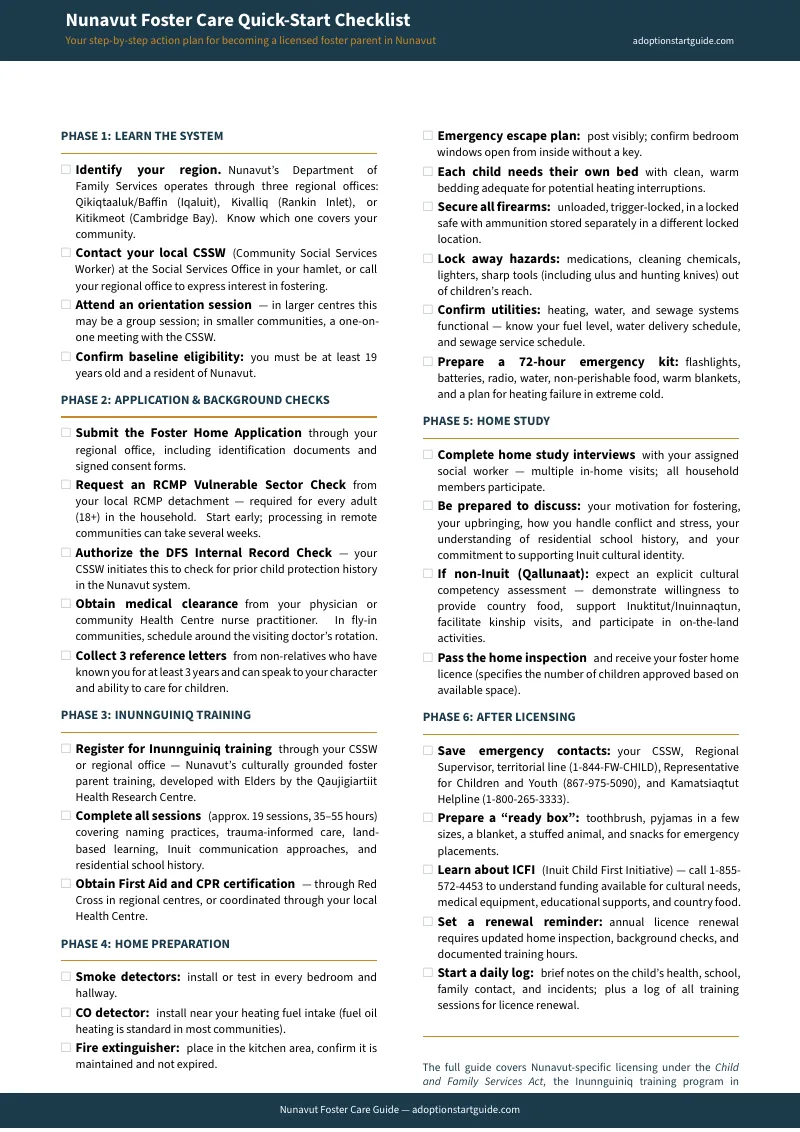
Not sure yet? Download the Nunavut Foster Care Quick-Start Checklist — a 20-item action plan organized by phase, with key DFS contacts and the ICFI phone number. It's the fastest way to see what you'll need before committing to the full guide.