You love this child like your own. The state still calls you "temporary."
You passed the home study. You sat through the PRIDE training. You've been up at 3 AM with a child who screams when you try to hold them, who hoards food under the bed, who calls you by your first name because a caseworker told them not to get attached. You've done all of this while a court decides whether the person who hurt this child deserves another chance.
And the orientation you attended? It covered fire extinguisher placement and mandated reporter obligations. It did not cover what to do when a judge orders six more months of reunification visits with a birth parent who hasn't completed a single service. It did not cover how to love a child fully when the system tells you to keep one foot out the door. It did not cover the hollow, specific loneliness of being the most important adult in a child's life while having zero legal standing in the courtroom that decides their future.
The books on the shelf are not much better. The clinical texts explain trauma neuroscience but assume you have a stable legal situation. The memoirs tell beautiful stories but skip the eighteen months of uncertainty that preceded the happy ending. The agency pamphlets say "reunification is always the goal" and leave you to figure out how to survive that sentence emotionally.
There is a gap between what the system trains you for and what the system actually puts you through. This guide fills it.
The Permanency Playbook: A Foster-to-Adopt System Survival Manual
The Permanency Playbook is built for the grey zone — the months or years between the day a child is placed in your home and the day a judge signs the adoption decree. It is not a parenting book. It is not a legal textbook. It is the operational manual for surviving and succeeding inside a system that was designed for children, not for the adults who love them.
The core framework is called the Grey Zone Protocol — a structured approach to the four stages every foster-to-adopt family passes through: Placement, Limbo, Transition, and Permanency. Each stage has its own legal realities, emotional patterns, and concrete actions. The guide maps all four so you always know where you are, what is likely coming next, and what you can actually control.
What's inside
- The Legal Risk Decoder — How to read a case plan and understand the real probability of reunification before you say yes to a placement. What "concurrent planning" actually means in practice. The specific language caseworkers use when a case is shifting toward termination, and the language they use when it is not. You should never have to guess where you stand.
- The TPR Roadmap — A plain-language walkthrough of the Termination of Parental Rights process, from the initial petition through the hearing, the 30-day appeal window, and finalization. Includes the ASFA "15 of 22" rule, state-by-state variations in grounds for involuntary termination, and what happens when a birth parent appeals after you thought it was over.
- The Bonding Paradox — Clinical research says you must attach fully for the child's brain development. The system says the child might leave tomorrow. This chapter gives you a real framework for navigating that contradiction — not by "protecting your heart" (which harms the child) but by building what psychologists call "resilient attachment." Includes the survival brain model, why trauma-exposed children reject affection, and the developmental reprocessing concept that explains why your 8-year-old acts like three different kids in the same afternoon.
- The 3 AM Behavioral Field Guide — Concrete, TBRI-informed strategies for the behaviors that agency training never prepared you for: food hoarding, sensory meltdowns, the attachment wall, compulsive lying, regression after visits, and aggression toward siblings or pets. Each behavior mapped to its trauma origin with a specific response protocol. Not theory. Tools.
- Co-Parenting with the State — How to advocate for your child in court reviews and team meetings without being labeled "too attached" or "uncooperative." The specific phrases that get caseworkers on your side. How to request information the agency is required to share but rarely volunteers. How to document everything without becoming adversarial.
- Birth Family Contact Protocols — Managing visits with birth parents who may be actively unstable, including safety boundaries, handoff logistics, and what to do when a child's behavior spirals after contact. How to support the child's relationship with their biological family while protecting your household. Post-adoption contact agreements explained: which states make them enforceable, which do not, and how to negotiate terms that work for everyone.
- The Financial Survival Map — Foster care stipends, adoption assistance subsidies (Title IV-E), Medicaid continuation, non-recurring expense reimbursement, and the federal Adoption Tax Credit (up to $17,280 in 2025, now partially refundable). The hidden indirect costs nobody warns you about: specialized therapy, travel for out-of-state placements, career disruption from court dates. How to negotiate your adoption subsidy and why you should never accept the first offer.
- ICPC Navigator — If you are adopting across state lines, the Interstate Compact on the Placement of Children adds weeks of bureaucratic delay. This chapter covers the packet requirements, realistic timelines, and how to avoid the most common paperwork mistakes that restart the clock.
- The Finalization Countdown — The post-TPR waiting period, the adoption petition, the six-month supervision period, and the finalization hearing itself. What to expect, what to bring, and how to celebrate a day that is simultaneously the best of your life and grounded in another family's loss.
- Sibling and Bio-Child Protection Plan — How to prepare biological children for a foster sibling who may leave. How to maintain sibling connections when brothers and sisters are placed in different homes. The federal mandate for sibling placement and what to do when agencies ignore it.
Printable standalone worksheets included
- Grey Zone Timeline Tracker — Map your placement against the four stages with date fields for every legal milestone. Print it, update it after every court review, and always know where you stand.
- Case Plan Decoder Worksheet — A fill-in tool for analyzing the legal risk disclosure and case plan updates your agency provides. Turns bureaucratic language into clear probabilities.
- Behavioral Response Quick-Reference — The 3 AM Field Guide condensed to a single laminate-ready page. Behavior on the left, trauma origin in the middle, response protocol on the right.
- Financial Planning Worksheet — Stipend, subsidy, tax credit, and hidden cost calculations in one printable sheet. Take it to your financial planning conversation or your subsidy negotiation.
Who this guide is for
- Foster parents with a child whose case goal is shifting toward adoption — The caseworker said something like "we're starting to think about permanency." You need to know what happens next, what your rights are, and how to prepare for the legal process without derailing the one that's still technically underway.
- Prospective parents entering the system specifically to adopt — You chose the foster-to-adopt path because private adoption costs $40,000 to $60,000 and you believe a child already in the system deserves a permanent home. You need to understand what "legal risk placement" actually means before you sign the disclosure form.
- Families in the post-TPR waiting period — Parental rights have been terminated. You thought you were done. But the appeal window, the six-month supervision period, and the adoption petition are still ahead. This guide covers the ground between TPR and the moment the judge signs the decree.
- Kinship foster parents pursuing formal adoption — You took in a grandchild, niece, or nephew during a crisis. You assumed it would be simpler because you're family. The background checks, home study, and legal process are the same. The emotional complexity is different. This guide addresses both.
- Families caring for children with prenatal substance exposure — Many foster-to-adopt placements involve newborns or infants with Neonatal Abstinence Syndrome. The guide includes NAS care protocols, the Finnegan scoring system, and what long-term developmental outcomes actually look like based on current clinical data.
Why the free resources aren't enough
Your state agency's website lists the steps. It does not tell you what the steps feel like, which ones have hidden traps, or how to recover when one goes sideways. Agency orientations are recruiting tools. They're designed to get you into the system, not to keep you sane once you're in it.
The foster parent subreddits are brutally honest. They'll tell you the wait is devastating and the system is broken. What they can't do is give you a structured framework for navigating it. Anecdotes validate your pain. They don't reduce it.
Clinical books like The Connected Child and Parenting the Hurt Child are essential reading. But they assume legal stability. They assume the child is staying. They don't address what happens to your trauma-informed parenting when you're doing it under the threat of reunification.
The Permanency Playbook sits in the gap between all of these. It's the guide your caseworker can't give you, your lawyer won't write, and your support group doesn't have time to assemble. It treats you as what you actually are: the most important person in this child's life, operating inside a system that will never fully acknowledge that.
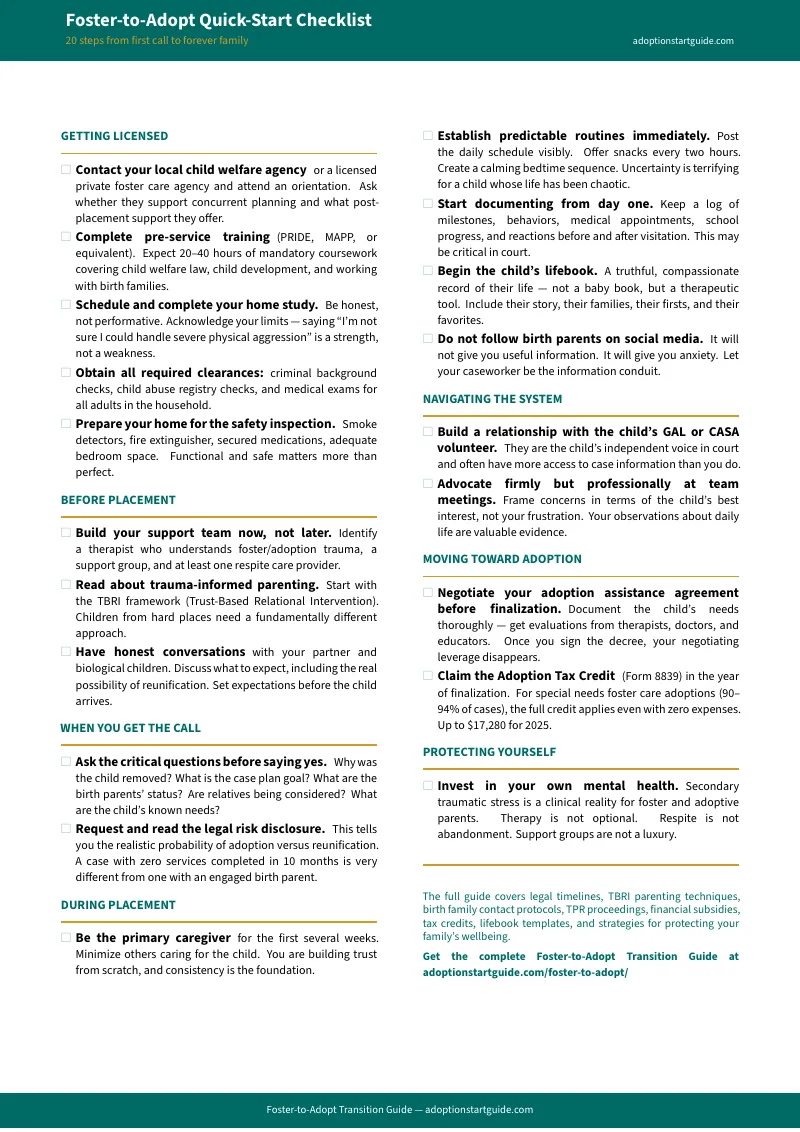
The free Quick-Start Checklist
Download the Foster-to-Adopt Quick-Start Checklist for a condensed overview of the key milestones from placement to finalization. Free, no commitment. If you want the full Permanency Playbook with the Grey Zone Protocol, behavioral field guide, legal roadmap, financial planning tools, and printable worksheets, click the button in the sidebar.
— less than one hour of a family law attorney's time
A single consultation with a family law attorney runs $250 to $400 per hour. Most foster-to-adopt families spend the first two sessions covering foundational questions about TPR timelines, subsidy negotiations, and post-adoption contact agreements. The Permanency Playbook doesn't replace your attorney. It makes sure you don't pay your attorney to teach you the basics.
If the guide doesn't deliver, reply to your download email at any time for a full refund. No forms. No justification required.