
You love your child completely. But love doesn't teach you how to do their hair, answer a stranger's intrusive question, or explain racism to a seven-year-old who just experienced it for the first time.
You've read the adoption forums. You've lurked on r/Adoption and r/transracialadoptees. You've seen adult adoptees describe growing up in white families that meant well but left them feeling like strangers in their own homes — parents who said "I don't see color" when what the child needed was someone who saw their color, understood what it meant in the world, and prepared them for it. You don't want to be that parent. But the gap between good intentions and actual competence is enormous, and nothing you've found so far closes it.
The books help you understand the problem. Nicole Chung's All You Can Ever Know and Angela Tucker's You Should Be Grateful show you what it feels like to be the transracial adoptee. But they don't hand you a script for Thanksgiving dinner when your father-in-law says something ignorant about your child's birth culture. They don't give you a checklist for evaluating whether your neighborhood, your school district, and your social circle provide the racial mirrors your child needs every day — not just during Heritage Month. They explain the "why" brilliantly. They leave you alone with the "how."
Pact, An Adoption Alliance, offers the gold standard in transracial adoption support. Their consultations run $120-$200 per hour, or $500-$900 for a five-session package. That depth is real and valuable. But it's not accessible to every family — especially families already stretched thin by agency fees that can reach $20,000-$60,000. And the free resources from organizations like NACAC and Creating a Family tend to be either academic papers aimed at social workers or single-topic courses that cover one slice of a problem that touches every part of your daily life.
What's missing is the operational layer. The unified set of tools that sits between "I understand why race matters" and "I know exactly what to do about it at bedtime, at the school gate, at the hair salon, at the family reunion, and in the car after my child was called a slur for the first time."
The Cultural Confidence Toolkit
The Transracial & Transcultural Adoption Resource Kit is not another book about why transracial adoption is complicated. You already know that. This is the practical toolkit — the scripts, checklists, audit frameworks, and care guides — that turns your understanding into daily action. Every tool in the kit is grounded in what adult transracial adoptees say they needed from their parents, what adoption-competent therapists recommend, and what the research on biracial identity development confirms. It is built to be used, not just read.
What's inside
- The Script Library — Word-for-word responses for the situations that catch you off guard. What to say when a stranger asks "Where is she really from?" in front of your child. How to respond when a teacher describes your son as "so well-spoken." How to address a family member who insists they "don't see color." How to talk to your child about racism at age four, age eight, and age fourteen — because the conversation changes as they grow. These aren't theoretical suggestions. They are tested phrases you can use tonight.
- The Community Audit Framework — A structured assessment of your child's daily environment. Does your neighborhood have families that look like your child? Does your school have teachers of color? Does your bookshelf include authors and characters that reflect your child's heritage? Does your social circle include adults of your child's race who are friends, not consultants? This audit walks you through every layer of your child's world — home, school, neighborhood, social life, media — and identifies the gaps before your child has to point them out.
- Hair and Skin Care Mastery Guide — The practical care chapter that white parents need and same-race families learn from their own parents. Product recommendations from Black and Brown-owned brands. Technique guides for protective styles, moisture routines, and scalp care specific to your child's hair type. Skin care for melanin-rich skin, including sunscreen requirements that differ from what you use yourself. This is not a list of tips from other white adoptive parents. It is sourced from the communities and professionals who actually know.
- The Colorblindness Self-Assessment — A guided, private reflection tool that helps you examine where you might be defaulting to "I don't see race" without realizing it. Not a guilt exercise. A calibration tool. It walks you through common scenarios — choosing a school, selecting children's books, responding to your child's questions about their skin color — and shows you where colorblind reflexes hide in well-meaning decisions. Adult adoptees consistently name colorblindness as the single most damaging parenting stance. This tool helps you catch it early.
- Age-by-Age Identity Roadmap — Your child's relationship with their racial identity is not static. A three-year-old who says "I want your skin" needs a different response than a twelve-year-old who refuses to attend culture camp because it feels performative. This roadmap covers the developmental stages of biracial and transcultural identity from infancy through young adulthood, what to expect at each stage, and the specific actions that support healthy identity formation at every age. It includes the milestones that same-race families navigate instinctively but that transracial families must approach with deliberate preparation.
- The Advocacy and Protection Toolkit — Templates for advocating for your child in schools, medical settings, and interactions with law enforcement. How to file a complaint when your child is disciplined more harshly than their white peers. How to work with your child's school to update a curriculum that ignores their heritage. How to prepare your child — age-appropriately — for the reality that your white privilege does not extend to them. These are not abstract discussions about systemic racism. They are fillable templates and step-by-step action plans.
- Cultural Socialization Planner — A framework for building genuine cultural connection that goes beyond the annual festival, the one children's book about Chinese New Year, or the single trip to the "ethnic" restaurant. This planner helps you identify mentors, community organizations, language resources, cultural practices, and ongoing relationships that make your child's heritage a living part of their daily life — not a performance for the home study social worker.
- The "Tough Conversations" Decision Trees — Flowchart-style guides for the conversations you dread. When your child asks why they don't look like you. When they say they hate being adopted. When they want to search for their birth family. When they accuse you of not understanding what it's like. Each decision tree maps out the child's likely emotional state, the responses that help, the responses that harm, and the follow-up actions that build trust over time.
Printable standalone worksheets included
- Family Environment Audit Worksheet — Assess your home, school, neighborhood, media consumption, and social network for racial and cultural representation. Print it, work through it honestly, and identify the three highest-priority changes you can make this month.
- Hair and Skin Care Tracker — Log products, routines, stylist contacts, and what works for your child's specific needs. Bring it to salon appointments. Update it as your child's hair and skin change with age.
- Identity Milestone Tracker — Record your child's questions, reactions, and identity-related moments as they grow. Not a baby book. A longitudinal tool that helps you notice patterns, anticipate needs, and share context with therapists or school counselors if needed.
- Conversation Preparation Worksheet — Structured prompts to help you prepare for difficult conversations before they happen, including your own emotional triggers and backup plans for when the conversation doesn't go as expected.
Who this guide is for
- Pre-adoptive families in the home study phase — You're being evaluated on your racial awareness and cultural competence right now. This kit gives you the frameworks that demonstrate genuine preparation, not rehearsed answers. It also prepares you for the daily realities that no home study can fully simulate.
- Newly placed families (children ages 0-5) — The early years set the foundation. You're navigating hair care for the first time, fielding questions from strangers, and making decisions about neighborhood, childcare, and social connections that will shape your child's sense of belonging for decades. This kit makes those decisions informed instead of improvised.
- Families with school-age children (ages 6-12) — Your child is encountering racism outside your home. They're comparing themselves to peers. They may be the only child of color in their classroom. You need advocacy tools, conversation frameworks, and a plan for the identity questions that intensify every year.
- Families with teenagers — Identity exploration peaks during adolescence. Your teenager may reject cultural activities, challenge your parenting, or begin searching for birth family connections. This kit helps you support their autonomy while maintaining the trust you've built.
- International and transcultural adopters — Whether your child was adopted from China, Korea, Ethiopia, Colombia, India, or any other country, the cultural preservation and identity development challenges are parallel. The tools in this kit are designed to work across racial and cultural lines, not for one specific heritage.
Why the free resources aren't enough
The adoption forums — r/Adoption, Facebook groups, agency message boards — give you emotional support from other parents in the same situation. But the advice is anecdotal, unstructured, and often wrong. A white parent sharing their "mixed hair routine" in a Facebook group is not the same as a guide sourced from Black and Brown hair care professionals. A Reddit thread about handling racist comments is a collection of individual reactions, not a tested script library organized by situation and child's age. And the forums can't give you what a structured toolkit can: a systematic audit of your child's environment, a developmental roadmap that anticipates problems before they arrive, and fillable worksheets that turn reflection into documented action.
The books — and the good ones are genuinely excellent — give you the intellectual and emotional foundation. Read them. But a memoir doesn't include a printable checklist for evaluating school districts. A research paper on biracial identity development doesn't come with conversation decision trees. And a $20 online course that covers "transracial adoption basics" in 60 minutes cannot address the hair care, school advocacy, family dynamics, identity milestones, and community-building that this kit covers across eight focused sections with standalone worksheets for each.
Pact consultations and adoption-competent therapists remain the highest level of support. If you can access them, do. This kit is not a replacement for professional guidance — it's the daily operating system you use between sessions. The scripts, audits, trackers, and planners that keep the work moving forward on Tuesday night, not just during a scheduled appointment.
The free Quick-Start Checklist
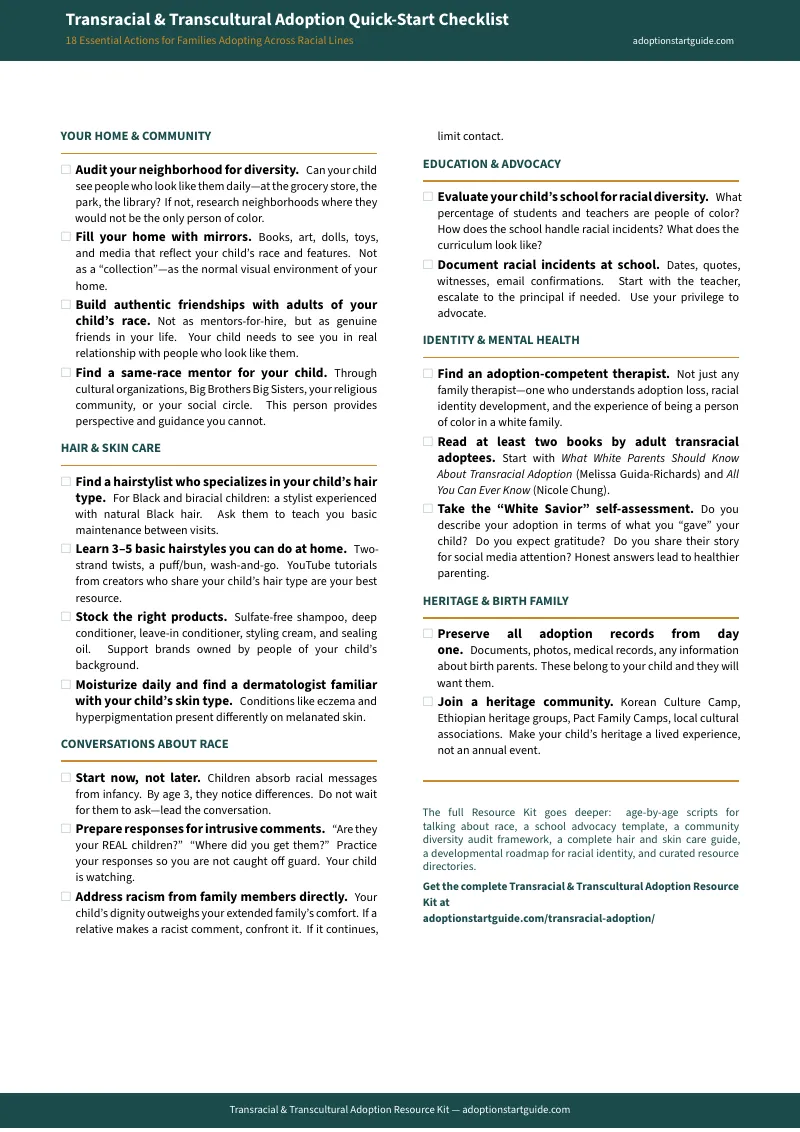
Download the Transracial & Transcultural Adoption Quick-Start Checklist for a single-page overview of the essential actions across cultural socialization, community building, personal care, identity support, and advocacy. Free, no commitment. If you want the full kit with the script library, community audit framework, hair and skin care mastery guide, age-by-age identity roadmap, conversation decision trees, advocacy templates, and printable worksheets, click the button in the sidebar.
— less than one hour with an adoption-competent therapist
The typical transracial adoptive family spends years assembling guidance from books, forums, blog posts, Instagram accounts, and occasional professional consultations. They learn about the colorblindness trap after they've already been doing it for three years. They discover the importance of racial mirrors after their child has spent kindergarten as the only Brown face in the room. They figure out the hair care through trial and error that their child remembers as embarrassment. This kit puts the frameworks, scripts, audits, and care guides in your hands before those moments arrive — so you're prepared, not scrambling.
If the kit doesn't deliver, reply to your download email at any time for a full refund. No forms. No justification required.