You've read the ACT Government website three times. You still don't know what happens after you submit a $1,000 Expression of Interest.
You decided to adopt. Maybe after years of IVF that ended with grief instead of a baby. Maybe because you've been fostering a child in the ACT for over a year and the permanency consultation confirmed what you already felt — this child is yours, and the law should say so. Maybe a family connection brought a child into your home and you want to give them the legal certainty that Enduring Parental Responsibility cannot. Whatever brought you here, you went looking for a clear, honest starting point.
What you found was the ACT Government's "Adopting a Child" page. It told you who can adopt, the types of adoption available, and the fact that the Adoption and Permanent Care Team manages all applications. Then it told you to "contact the APCT to express your interest." No detail on what the Suitability Panel is actually evaluating. No guidance on how to present your life history during the assessment interviews. No transparent breakdown of how much intercountry adoption costs beyond the $1,000 EOI fee. And buried in the statistics, a figure that stops most prospective parents cold: three local adoptions in the ACT over a four-year period.
Then you searched further. Intercountry Adoption Australia covers the national framework, but it doesn't tell you how the ACT's dual-vetting process works — how the territory's requirements layer on top of the partner country's criteria and what that means for your timeline. The Community Services Directorate publishes fact sheets on known-child adoption for carers, but they read like compliance documents, not guides for families making the biggest decision of their lives.
So you tried the forums. Canberra Reddit. Facebook groups. You read stories from people who waited years on the Register of Suitable People and were never matched. You read advice from carers who adopted and lost their financial allowance overnight. Some of it was helpful. Most of it was contradictory, emotionally charged, or years out of date. None of it told you the thing you actually need to know: given your specific situation, what are the concrete steps, costs, and realistic timelines for adoption in the ACT in 2026?
The ACT Adoption Readiness System
This guide is built for the Australian Capital Territory adoption process and nobody else's. Every chapter, every checklist, every reference is grounded in the Adoption Act 1993 (ACT), ACT Supreme Court filing requirements, and the operational realities of the Adoption and Permanent Care Team within Children, Youth and Families. It covers the gap between what the government publishes and what you actually need to know to move from "researching adoption" to "submitting your Expression of Interest" without a rejected application, a blindsided assessment interview, or years of silent waiting on a register you don't understand.
What's inside
- Suitability Panel Blueprint — The assessment process involves interviews with you, your partner, your children, and any adults living in your home. A psychologist and social worker will evaluate your childhood history, relationship stability, trauma awareness, and parenting philosophy. This chapter explains what the panel is actually looking for — not a perfect past, but evidence of insight, resilience, and the capacity to parent a child whose early life was defined by loss. You'll know how to prepare your "life story" narrative so it works for you instead of becoming the reason you're deferred.
- Adoption vs. EPR Decision Framework — In the ACT, Enduring Parental Responsibility gives you parental authority until the child turns 18 but does not change the child's birth certificate, legal identity, or surname. Adoption transfers all rights permanently, but you lose the carer allowance. This chapter lays out the legal, financial, and emotional trade-offs side by side, including the Supreme Court process for each, so you make the decision that's right for your family instead of the one the system defaults you into.
- Total Cost Breakdown — The EOI fee is over $1,000. Intercountry adoption can run from $10,000 to $40,000 when you include agency fees, translation, travel, immigration processing, and the costs that never appear on the official fee schedule. Domestic adoption has its own hidden expenses: legal representation for the Supreme Court order, the "family time" assessment period, and the financial gap when your carer subsidy stops. This chapter consolidates every cost across domestic, intercountry, and known-child pathways so you can build a realistic five-year budget before committing a dollar.
- Intercountry Adoption Navigation — ACT residents face a dual-vetting process. You must meet the territory's eligibility criteria (25 years or older, three-year domestic partnership, ACT residency) and then separately satisfy the partner country's requirements, which are often stricter on age, family size, health, and income. This chapter maps the process from the mandatory two-day education seminar through to the Commonwealth's role via Intercountry Adoption Australia, so you understand exactly where the ACT process ends and the international process begins.
- Open Adoption Contact Planning — The ACT mandates open adoption with a contact plan filed at the Supreme Court. In a city where the separation between families is closer to two degrees than six, this creates real privacy concerns. This chapter provides practical strategies for negotiating contact frequency, managing overlapping social circles, and building a contact plan that satisfies the court while protecting your family's daily life.
- Known-Child Adoption Pathway — If you're a foster carer with a child who has been in your care for over 12 months, or a kinship carer formalising an existing arrangement, the pathway to adoption is different from the general register process. This chapter covers the permanency consultation, the Director-General's consent requirements, and how to navigate the transition from carer to legal parent — including the financial impact of losing carer payments and the steps to secure the child's new birth certificate.
- Register of Suitable People Explained — After your assessment is approved, you're placed on the register and you wait. The ACT doesn't publish how matching works, how long families typically wait, or what influences priority. This chapter explains the register process, what the APCT considers during matching, and how to stay engaged during a waiting period that can last years — without losing hope or losing your approved status.
- Supreme Court Filing Checklist — Every adoption in the ACT is finalised by order of the ACT Supreme Court. This chapter walks you through the filing requirements: the application itself, supporting affidavits, the family report, the contact plan, and the name change process. You'll know exactly what documentation the court requires and how long each stage takes, so the final legal step doesn't become one more source of uncertainty.
Printable standalone worksheets included
- Expression of Interest Preparation Checklist — Every document and form you need before submitting your EOI to the APCT: police checks, Working with Vulnerable People registration, medical reports, financial disclosures, and referee details. Organised by stage so nothing is missed.
- Home Study Self-Assessment — Room-by-room walkthrough of the physical and safety requirements for an ACT adoptive household. Complete it before your first home visit so corrections happen on your schedule, not the assessor's.
- Assessment Interview Tracker — Track every interview session — dates, topics covered, questions asked, and your notes. Bring it to each meeting.
- Cost Planning Worksheet — All fees, legal costs, and hidden expenses for domestic, intercountry, and known-child adoption, with columns for estimated and actual amounts. Build your budget on paper before you commit financially.
- Contact Plan Template — A working template for the open adoption contact plan required by the ACT Supreme Court: contact type, frequency, location, participants, and review dates.
- Required Documents Checklist — Every form and supporting document organised by pathway (domestic, intercountry, known-child) and by stage (pre-EOI, assessment, court filing, post-order).
Who this guide is for
- Prospective adoptive parents stuck in the research phase — You've read the ACT Government website, the IAA fact sheets, and half the Canberra Reddit threads on adoption. You've thought about calling the APCT but you're not confident you know what to expect from the assessment, how much it will actually cost, or whether your situation makes you a strong candidate. You need the full picture before you invest $1,000 in an Expression of Interest.
- Foster carers considering adoption — A child in your care has been with you for over a year. The permanency consultation is on the horizon, or it's already happened. You want to give this child your name, your legal protection, and a relationship that doesn't expire when they turn 18. But you need to understand what adoption means financially and legally compared to EPR before you decide.
- Kinship carers formalising an existing arrangement — A grandchild, niece, nephew, or family friend's child came into your care after a Child Safety intervention. The child is already yours in every way that matters. Now you want to make it permanent in a way that changes their birth certificate and survives any future legal challenge.
- Families exploring intercountry adoption — You've accepted that domestic infant adoption in the ACT is exceptionally rare. You're willing to navigate the dual bureaucracy, the international travel, and the significant expense. But you want a consolidated view of the full process, timeline, and realistic costs before attending the mandatory education seminar.
Why the free resources fall short
The ACT Government website tells you the rules. It lists who can adopt, the types of adoption available, and the fees. It does not tell you what the Suitability Panel evaluates during your interviews, how to present your life history in a way that demonstrates resilience rather than risk, or why three families were matched with local children in four years while hundreds of others were not. It's a compliance document, not a preparation guide.
Intercountry Adoption Australia provides a national overview of overseas adoption, but it doesn't cover ACT-specific Supreme Court procedures, the territory's suitability assessment criteria, or the practical realities of managing open adoption contact in a city of 460,000 people. It gives you the framework. It doesn't give you the strategy.
Facebook groups and Reddit threads provide emotional reality. They tell you what it feels like. But the dominant voices are often carers who are exhausted, parents whose applications stalled, or people sharing advice that was accurate five years ago and isn't today. Reading them increases your anxiety without increasing your readiness.
The free Quick-Start Checklist
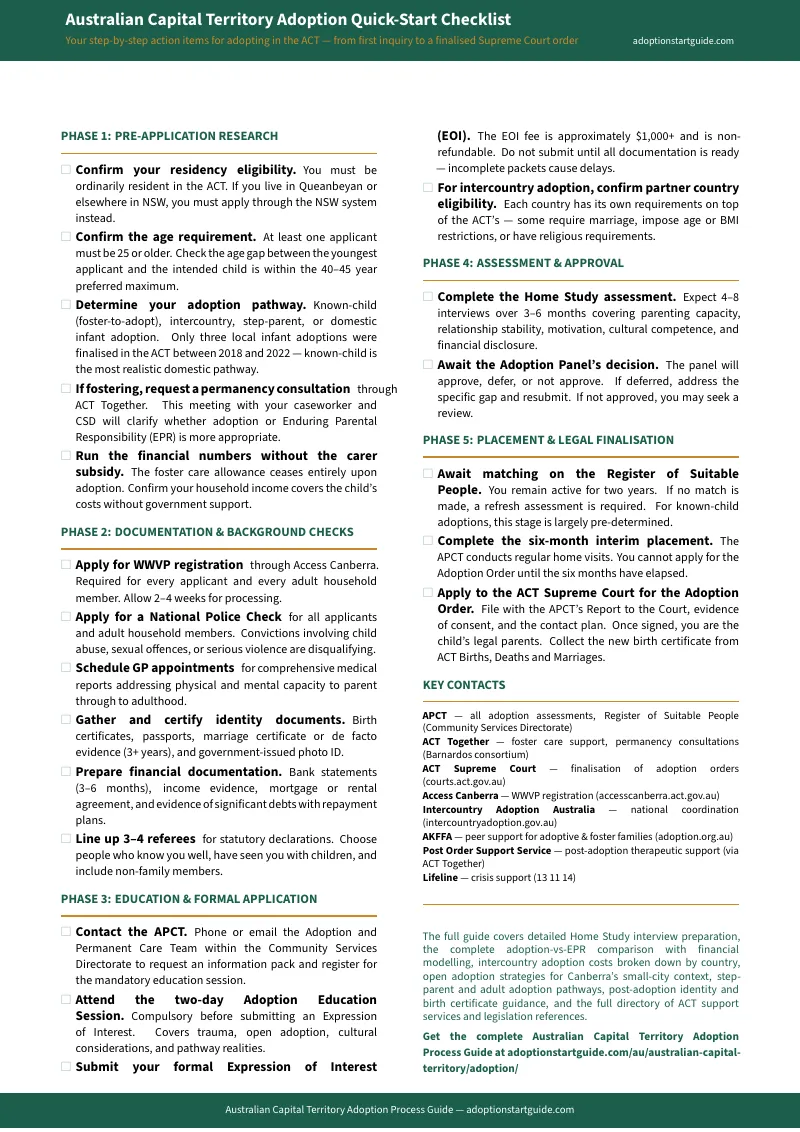
Download the Australian Capital Territory Adoption Quick-Start Checklist for a phase-by-phase overview of the adoption process, from your first contact with the APCT through to the Supreme Court order. Free, no commitment. If you want the full guide with the Suitability Panel preparation, cost breakdown, Adoption vs. EPR framework, intercountry navigation, contact plan template, and all six printable worksheets, click the button in the sidebar.
— less than one percent of your Expression of Interest fee
A rejected Expression of Interest costs you $1,000 and months of preparation. An assessment interview you weren't ready for doesn't necessarily fail you, but it shakes your confidence at the moment you need it most. A misunderstanding about the difference between adoption and EPR can lock you into a legal arrangement that doesn't give your child the permanence you intended. The families who make it through this process aren't luckier or more deserving than the ones who withdraw. They're better prepared.
If the guide doesn't deliver, reply to your download email at any time for a full refund. No forms. No justification required.