You want to adopt in the Northern Territory. The government website gave you eligibility rules. It didn't give you a plan.
You've been on the Territory Families website. You've read the Expression of Interest page and the list of eligibility criteria. You know you need to be in a relationship for at least two years. You know there's a two-day training course. You know there's something called the Aboriginal and Torres Strait Islander Child Placement Principle. And you still have no idea what to actually do next.
The NT government website tells you the rules. It doesn't tell you how many families are ahead of you, what the assessment panel actually looks for, how much the legal fees cost, or whether local adoption is even realistic in a jurisdiction where some years see zero infant placements. That gap between "here are the requirements" and "here is how to prepare" is where families lose months, confidence, and sometimes give up entirely.
There are no private adoption agencies in the Northern Territory. Everything runs through the Adoption Unit at Territory Families, Housing and Communities. That means the same department that recruits you also assesses you. It's a system that works, but it creates a specific kind of anxiety: you can't ask your assessor for coaching on how to pass their assessment. You can't call the Adoption Unit and say, "What should I say during my home study?" They're the gatekeeper and the guide, and those two roles don't mix well when you're trying to prepare.
An adoption lawyer in Darwin or Alice Springs charges $295 or more for an initial consultation. Much of that first hour is spent covering foundational questions about eligibility, consent rules, and court requirements. Adopt Change provides a national overview, but their NT page lacks the costs, timelines, and cultural guidance that Territory families specifically need. Facebook groups give you anecdotes from families in New South Wales and Victoria who navigated systems with private agencies and infant waitlists — systems that don't exist here.
The NT Adoption Roadmap
This is a complete, Northern Territory-specific adoption guide written for the way adoption actually works in the Territory. Not a repurposed national handbook. Not a generic Australian overview that assumes you have private agencies to choose from. Every chapter, every cost figure, every timeline is grounded in the Adoption of Children Act 1994 (NT), the Care and Protection of Children Act 2007 (NT), and the real-world experience of families navigating the TFHC Adoption Unit in Darwin, Alice Springs, and Katherine.
What's inside
- Four-pathway comparison table — Local relinquishment, adoption from out-of-home care, known-child/step-parent adoption, and intercountry adoption mapped side by side. Costs, timelines, eligibility, and the realistic probability of each pathway in the NT. Local infant adoption may be near-zero some years — the guide tells you which pathways are actually active and which ones lead to years of waiting with no placement.
- Suitability assessment preparation — What the TFHC Adoption Panel actually evaluates when they review your file. The attitudes and responses that score positively during social worker interviews. How to structure your motivations around the child's interests, not your own. How to prepare for questions about discipline, cultural identity, and openness to birth-family contact. This is the section the government website will never publish, because the people who write the website are the ones conducting the assessment.
- NT cost breakdown — The financial reality the government pages don't cover. Legal representation for the Supreme Court order runs $2,000 to $5,000 or more. Intercountry programs add $5,000 to $6,000 in TFHC administrative fees, plus overseas program costs and travel. The Ochre Card application, medical reports, reference letters — every expense mapped out so you can budget before you commit.
- The ATSICPP cultural safety guide — A practical walkthrough of the Aboriginal and Torres Strait Islander Child Placement Principle: its five elements, the placement hierarchy, and what it means for non-Indigenous families. This chapter helps you understand the Principle as a framework for supporting a child's identity, not as a barrier to adoption. Includes guidance on developing a cultural connection plan that demonstrates genuine commitment to your case manager.
- The 30-day consent period explained — Birth parents in the NT have 30 days to withdraw consent after signing. This chapter walks you through what happens during those 30 days, how to manage the emotional uncertainty, and what legal protections exist on both sides. The consent timeline is the single most anxiety-producing element of NT adoption, and this guide gives you the complete picture instead of one paragraph on a government page.
- Permanent Care Orders vs. adoption — In the NT, Permanent Care Orders are more common than formal adoption, especially for Aboriginal children. This chapter explains the legal differences: guardianship rights, financial support (carers under PCOs receive fortnightly allowances; adoptive parents generally don't), birth certificate changes, and implications for land rights. If permanency matters more to you than the legal title of "adoption," this comparison could change your entire strategy.
- Intercountry adoption from the NT — How to adopt through Australia's Hague Convention partner countries as an NT resident. TFHC acts as your State Central Authority. The guide covers the additional training modules, country-specific requirements, the Subclass 102 Adoption Visa, and the realistic 3- to 4-year timeline from approval to placement.
- Supreme Court finalization walkthrough — What happens during the 12-month placement period, how TFHC monitors the family, and exactly what the court requires to issue the adoption order. New birth certificate, name change, inheritance rights — every legal outcome explained in plain language.
Who this guide is for
- Couples who have finished fertility treatment — You've spent years and thousands of dollars trying to conceive. You're ready to pursue adoption but you need to know whether it's even realistic in the NT before you invest more emotional energy in a process that may not lead anywhere. This guide gives you the honest picture.
- Foster carers pursuing permanency — The child in your care can't return to their biological family. You want to know whether adoption or a Permanent Care Order is the better path, what each one means for financial support and legal rights, and how your existing relationship with the child affects the assessment.
- Step-parents and relatives — You've been parenting this child for years. The formal adoption process still requires a full assessment, background checks, and court approval. This guide covers the specific requirements for known-child adoption in the NT so you don't waste time on steps that don't apply to your situation.
- Families considering intercountry adoption — You've accepted that local infant adoption in the NT is extremely rare. You want to understand how the intercountry pathway works when your Central Authority is a small government unit in Darwin, not a large state department with dozens of staff.
- Non-Indigenous families navigating the ATSICPP — You want to adopt or provide permanency for an Aboriginal child, but you're worried about doing it wrong. You need practical guidance on what cultural connection actually looks like in day-to-day life, not just a statement of principles.
Why the free resources aren't enough
The Territory Families website hosts the EOI forms and lists the eligibility criteria. It doesn't tell you what the assessment panel looks for, what the process costs, how long it realistically takes, or how to prepare for the home study. It's a portal for applications, not a guide for families.
Adopt Change provides a national overview with an NT-specific landing page, but it lacks the granular detail you need: the NT Local Court filing process, the specific financial differences between PCOs and adoption, the ATSICPP cultural connection plan requirements, and the realistic probability of each pathway in the Territory.
SNAICC offers essential information about the Child Placement Principle and Indigenous children's rights. Their focus is policy and advocacy, not step-by-step guidance for prospective adoptive parents navigating the Western legal process.
Facebook groups give you stories from families in Queensland, NSW, and Victoria — jurisdictions with private agencies, higher adoption volumes, and different legislative frameworks. In the NT, where there are no private agencies and the entire system runs through one government unit, advice from other states can actively mislead you.
No free resource anywhere provides a unified NT cost breakdown, a realistic pathway comparison with probabilities, a cultural safety guide for the ATSICPP, or preparation guidance for the suitability assessment.
What you get
Your download includes two PDFs:
- The Complete Guide (12 chapters) — Four-pathway comparison with costs and timelines, suitability assessment preparation, NT cost breakdown, ATSICPP cultural safety guide with self-assessment framework, 30-day consent timeline, Permanent Care Order comparison, intercountry pathway, and Supreme Court finalization walkthrough.
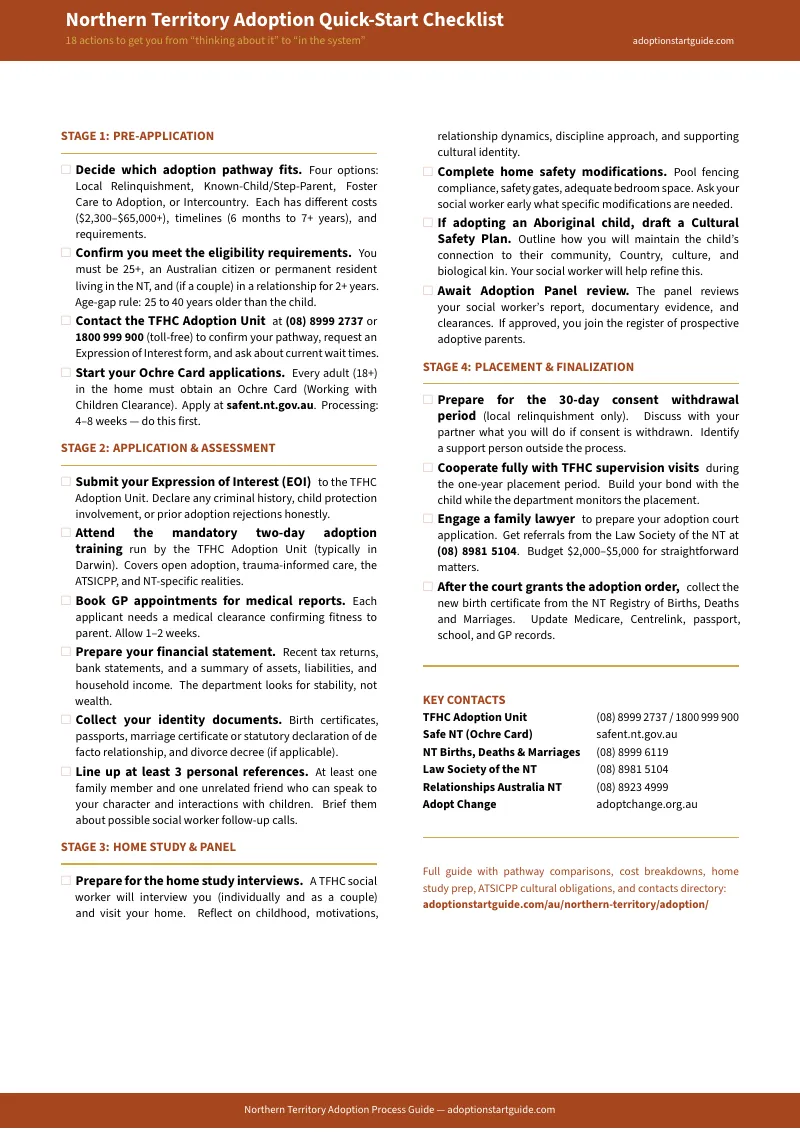
- Quick-Start Checklist — A printable step-by-step reference covering every stage from EOI to court order. Check items off as you go.
The free Quick-Start Checklist
Download the Northern Territory Adoption Quick-Start Checklist for a one-page overview of the key steps from first inquiry to court finalization. Free, no commitment. If you want the full roadmap with pathway comparisons, cost breakdown, assessment preparation, ATSICPP guidance, and court walkthrough, click the button in the sidebar.
— less than one hour with a Darwin adoption lawyer
An initial consultation with a family lawyer in Darwin or Alice Springs starts at $295 per hour. Families routinely spend that first session asking foundational questions about eligibility, consent timelines, and court requirements — questions this guide answers in the first two chapters. The NT Adoption Roadmap doesn't replace your lawyer. It makes sure you don't pay your lawyer to teach you the basics.
Satisfaction guarantee, no time limit. If the guide doesn't save you time and confusion, reply to the confirmation email for a full refund.