You've been thinking about fostering for months. You've visited the DECYP website three times. You still don't know what happens after you click "Enquire Now."
You decided to foster. Maybe the Commission of Inquiry findings hit you hard. Maybe your own kids are older now and you have the room, the patience, and the conviction that a child in Tasmania deserves better than another placement breakdown. Maybe a family member's child was removed by Child Safety and you got the call on a Tuesday night. Whatever brought you here, you went to the DECYP website looking for a clear starting point.
What you found was a recruitment pitch. "Fostering is enriching and fulfilling." "You don't need to be perfect." Warm photographs of smiling families. And then, when you looked for the actual process, a vague reference to the "Step by Step" assessment, a link to the Registration to Work with Vulnerable People, and the phrase "contact the Child Safety Service to express your interest." No timeline. No document list. No explanation of what happens during the six to eight home visits that will examine your childhood, your marriage, and your capacity to care for a child who may scream through every bedtime for the first three months.
So you downloaded the FKAT Handbook. All 90-plus pages of it. It covers everything from the Children, Young Persons and Their Families Act 1997 to Individual Education Plans and the Care Concern process. It's thorough, technically dense, and written for carers who are already approved. If you're still at the "considering" stage, reading it feels like studying for a final exam when you haven't enrolled in the course yet.
Then you tried Facebook. You found the carer groups, posted your question, and got two kinds of responses: horror stories about Child Safety Officers who never return calls and the system being "crisis-driven and defensive," or cheerful encouragement from agency recruitment pages that felt like they were selling you something. Neither gave you what you actually need: a plain-language walkthrough of what the Tasmanian system requires, in what order, and how long it takes in your region.
The Tasmanian Insider Map
This guide is built for the Tasmanian foster care system and nobody else's. Every chapter, every checklist, every reference is grounded in DECYP policy, the current post-Commission of Inquiry reforms, and the operational realities of the three regions that serve this state: the South (Hobart), the North (Launceston), and the North-West (Burnie and Devonport). It covers the gap between what the government publishes online and what you actually need to know to get from "interested" to "approved" without a failed RWVP application, a blindsided assessment interview, or six months of silence from a Child Safety Service that never explained the next step.
What's inside
- RWVP Registration Checklist — The Registration to Work with Vulnerable People is your first administrative hurdle, and the one most likely to waste your time. You start online, but you must complete the identity verification at a Service Tasmania centre within 21 days or your application expires and you restart from scratch. This chapter lists the exact ID combination you need across the "Commencement," "Primary," and "Secondary" document tiers so you walk into Service Tas once and walk out registered. No second trips. No expired applications.
- "Step by Step" Assessment Preparation — The assessment involves six to eight home visits of roughly two hours each, and it's the stage where most prospective carers drop out. Not because they fail, but because they don't know what the assessor is looking for. This chapter translates the assessment competencies into plain English: what "Reflective Practice" actually means (not a perfect past, but the ability to explain how your past made you resilient), what "Affect Management" scenarios they'll present, and how to prepare your household so the process builds your confidence instead of destroying it.
- "Who Can Say OK" Simplified — Once a child is placed, the single biggest source of daily frustration for Tasmanian carers is not knowing what decisions they can make on their own. Can you cut the child's hair? Approve a sleepover? Take them interstate for a holiday? The DECYP "Who Can Say OK" reference guide answers these questions, but it's a bureaucratic decision tree. This chapter turns it into a practical quick-reference so you know exactly where your parenting authority ends and the Child Safety Officer's begins.
- Allowance and Payment Breakdown — Tasmania provides a fortnightly tax-free allowance, but the difference between the Standard Board rate, the Establishment Payment, the Intensive Needs Loading, and Respite Payments is rarely explained until after you're approved. This chapter lays out the current payment tiers, what each one covers, and how to access the Establishment Payment for initial costs like bedding, car seats, and furniture without having to "fight the system" for reimbursement.
- Regional Support Comparison — What a family in suburban Hobart experiences is fundamentally different from what a family in Burnie or Scottsdale faces. Southern Tasmania has higher agency density (Anglicare, Life Without Barriers, Key Assets, Baptcare) and shorter wait times for specialist services. The North-West has fewer options, longer travel to Service Tasmania centres, and critical shortages of after-hours therapeutic support. This chapter maps the three regions so you choose an agency and plan for support based on where you actually live, not where the system assumes you do.
- Small-Town Privacy Protocols — In a state of 570,000 people, the birth family of the child in your care may live in your suburb, shop at your Woolworths, or have children at your school. This geographic proximity creates a daily privacy concern that the DECYP website barely acknowledges. This chapter provides concrete strategies for managing contact events, school drop-offs, and community encounters when there is no geographic buffer between your family and the child's family of origin.
- Agency Comparison Guide — You don't have to go through DECYP's Child Safety Service directly. Anglicare Tasmania, Life Without Barriers, Baptcare, and Key Assets are authorised to recruit and support foster carers on the department's behalf, often with smaller caseloads, dedicated training programs like "Prepare to Care" and "Therapeutic Crisis Intervention," and 24/7 clinical guidance. This chapter compares your options across all three regions so you make an informed choice before committing.
- Kinship Care Pathway — If a grandchild, niece, nephew, or family friend's child was placed with you after a Child Safety removal, you're already caring for the child under an emergency arrangement. You didn't choose this timeline. This chapter explains provisional approval, which requirements can be expedited for kinship placements, and how to move from emergency caregiver to fully supported kinship carer without navigating the full standard assessment from scratch.
- Post-Inquiry Reform and Your Rights — The Commission of Inquiry exposed systemic failures that are now driving a three-phase reform plan. This chapter explains what the reforms mean for you as a new carer entering the system in 2026: the transition toward NGO-led service delivery, the creation of the Office of the Independent Regulator, and how to use the Child Advocate when you feel unheard by the department.
Printable standalone worksheets included
- RWVP Document Checklist — Every identity document you need, organised by the Commencement, Primary, and Secondary tiers. Print it, gather the documents, and bring it to Service Tasmania.
- Home Safety Self-Assessment — Room-by-room walkthrough of the physical requirements for a Tasmanian foster care household: smoke detectors, pool fencing, medication storage, sleeping arrangements, and property safety.
- Assessment Interview Tracker — All six to eight "Step by Step" sessions listed with space to record dates, topics covered, and your notes. Bring it to every visit.
- Required Documents Checklist — Every form and supporting document organised by stage: before your first enquiry, with your application, for the assessment, and for ongoing compliance.
- Care Team Contact Sheet — Child Safety Officer, agency support worker, child's school, GP, paediatrician, therapist, respite provider, FKAT contact, Strong Families Safe Kids Advice Line — all on one printable page.
- "Who Can Say OK" Quick Reference — The simplified decision authority card. Print it, stick it on your fridge. Know at a glance which decisions you can make and which require CSO approval.
Who this guide is for
- Prospective foster carers stuck in the consideration phase — You've visited the DECYP website, maybe downloaded the FKAT Handbook, and mentioned fostering to your partner. But the assessment process feels opaque and the information gap between "interested" and "approved" has kept you waiting for six months or longer. You need someone to lay out the process in plain language and tell you what to do this week.
- Kinship carers — A child in your family was removed by Child Safety and placed with you. The child is already in your home. You didn't plan for this. Now you need to understand provisional approval, access allowances, and navigate a system you never expected to enter.
- Regional and North-West families — You have the home, the stability, and the heart, but you live hours from the nearest Anglicare office and your local service options are limited. The need for foster homes in your region is acute. This guide shows you what support is actually available where you live.
- Families motivated by the Commission of Inquiry — The findings shook you. You read the headlines about children failed by the system and felt that you could do something concrete about it. The conviction is there. This guide handles the administrative navigation so your commitment doesn't stall in a bureaucratic maze.
Why the free resources fall short
The DECYP website is a recruitment tool. It tells you fostering is "rewarding" and "life-changing" and invites you to express interest. It does not tell you what the assessor is evaluating during the six to eight home visits, why your RWVP application will expire if you don't visit Service Tasmania within 21 days, or how the Intensive Needs Loading works for children with complex trauma. It is designed to get you into the pipeline, not to prepare you for what's inside it.
The FKAT Handbook is the opposite problem. At over 90 pages, it covers the Children, Young Persons and Their Families Act, the Care Concern process, IEPs, and the legislative framework behind every policy. It is an essential reference for experienced carers. For someone who hasn't started the assessment, it's a wall of technical detail that makes the system look even more intimidating than it already feels.
Facebook groups fill the emotional gap but create a new one. The dominant voices are carers who are exhausted, under-supported, and venting about a system they describe as "crisis-driven." Their experiences are real and important. They are also a deeply skewed sample. A prospective carer reading those threads gets the impression that fostering in Tasmania is a guaranteed path to burnout. It isn't — but you need accurate preparation, not just encouragement or warning.
The free Quick-Start Checklist
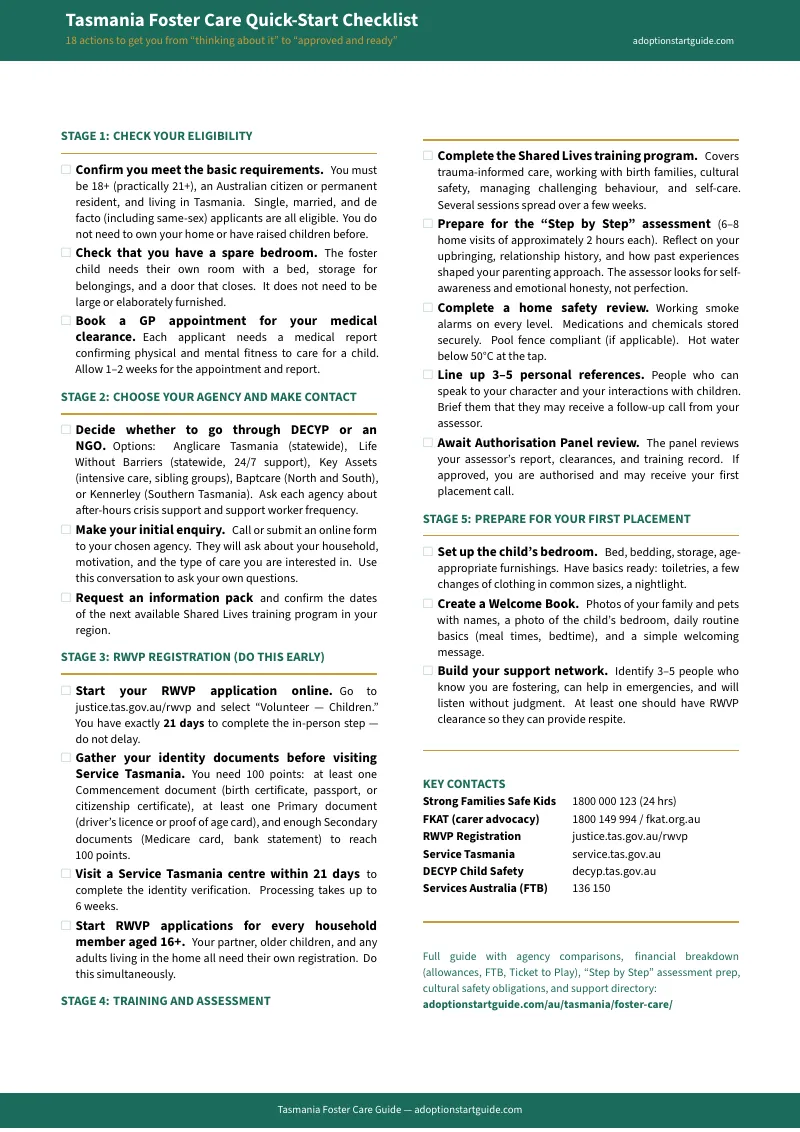
Download the Tasmania Foster Care Quick-Start Checklist for a phase-by-phase overview of the approval process, from your first enquiry through to your first placement. Free, no commitment. If you want the full guide with the RWVP checklist, assessment preparation, financial breakdown, regional support comparison, privacy protocols, and all six printable worksheets, click the button in the sidebar.
— less than one visit to a Service Tasmania centre
A failed RWVP application because you brought the wrong identity documents costs you 21 days and a second trip to Service Tas. An assessment interview you weren't prepared for doesn't fail you outright, but it shakes your confidence at the exact moment you need it most. The difference between families who make it through the process and families who quietly withdraw after the third home visit isn't character or commitment. It's preparation.
If the guide doesn't deliver, reply to your download email at any time for a full refund. No forms. No justification required.