Manitoba has 28 foster care agencies spread across four Authorities. Nobody tells you which one to call first.
Manitoba is the only province in Canada where child welfare is governed by four separate Authorities: the General Authority, the Southern First Nations Network of Care, the First Nations of Northern Manitoba Authority, and the Metis Authority. Each one operates its own mandated agencies. Combined, that's 28 distinct organizations delivering foster care services across the province. The system was designed to ensure culturally appropriate care. What it actually creates for new applicants is a maze with no map.
The Department of Families website gives you the legal framework. It links to the 500-page Child and Family Services Manual. It tells you that prospective foster parents must complete PRIDE training, pass a SAFE home study, and clear three background checks. What it doesn't tell you is which Authority your application should go through, how the Authority Determination Protocol works, or that 91% of the 9,172 children currently in care are Indigenous — a fact that shapes every placement decision, training requirement, and cultural obligation you'll encounter as a licensed foster parent in this province.
The Kinship and Foster Family Network of Manitoba is an excellent resource for families who are already licensed. Their support line, peer networking, and advocacy work are genuinely helpful — once you're in the system. If you're still at the stage where you don't know the difference between a Vulnerable Sector Check and a Child Abuse Registry search, or you can't figure out whether to call Winnipeg CFS, the Metis CFS Agency, or your local Southern Authority agency, KFFNM assumes a baseline of knowledge you haven't built yet.
Generic Canadian foster care guides on Amazon describe a national process that doesn't exist. They don't know about the four-Authority model. They skip the Authority Determination Protocol entirely. They describe training programs designed for Ontario or Alberta and won't mention PRIDE's 27-to-35-hour Manitoba format or the Southern Authority's 12-week virtual delivery model. A guide written for a national audience will tell you to contact your local Children's Aid Society. Manitoba doesn't have one.
The Four-Authority Navigator: Your Plain-Language Guide to Manitoba Foster Care
This guide is built for Manitoba's four-Authority system and nobody else's. Every chapter, every checklist, every recommendation is grounded in the Child and Family Services Act, the Foster Homes Licensing Regulation, the 2025 maintenance rate increases, and the cultural safety requirements that come with fostering in a province where Indigenous child welfare is not a footnote — it's the defining feature of the entire system. This is not a repurposed national handbook. It's the operational layer that sits between what the Department of Families posts online and what you actually need to know to get licensed.
What's inside
- Four-Authority Navigator — The General, Southern, Northern, and Metis Authorities each serve different populations and operate through different agencies. This chapter maps all four Authorities and their 28 mandated agencies, explains the Authority Determination Protocol in plain English, and helps you identify which Authority and agency to contact based on where you live and who you are. If you're non-Indigenous and wondering whether to apply through the General Authority or a community-specific agency, this chapter gives you a straight answer.
- PRIDE Training Walkthrough — Manitoba uses the PRIDE model for pre-service training, but delivery varies dramatically by Authority. The General Authority often runs in-person sessions through regional offices. The Southern Authority uses a 12-week virtual-facilitator model. The Northern Authority provides specialized orientation materials. This chapter covers all five core competency areas — protecting and nurturing children, meeting developmental needs, supporting birth family relationships, working as a professional team, and child welfare system navigation — with specific guidance on what your facilitator is evaluating and how to prepare.
- SAFE Home Study Preparation — The Structured Analysis Family Evaluation is where most applicants feel the most anxiety. This chapter explains what your resource worker is actually assessing during the in-home interviews: family history, relationship stability, parenting philosophy, and your understanding of trauma and attachment. It also addresses the Prior Contact Check directly — the single biggest source of fear for applicants who had any childhood interaction with social services. A prior contact does not automatically disqualify you. This chapter explains how the assessment actually works.
- Three Background Checks Explained — Manitoba requires three separate clearances: a Criminal Record Check with Vulnerable Sector Search (through RCMP or Winnipeg Police Service), a Child Abuse Registry check, and an Adult Abuse Registry check. All adults 18 and older in your household must clear all three. This chapter walks through each one — where to apply, what identification you need, expected processing times, fee waivers available to foster applicants, and what a flag on any of these checks actually means for your application.
- Home Safety Standards — A room-by-room walkthrough of every requirement under the Foster Homes Licensing Regulation: bedroom minimums (7 square metres single, 5.6 square metres per person shared), age and sex restrictions for room sharing, egress windows, smoke and CO alarms, firearm storage, medication lockup, water safety for pools and hot tubs, and the second-hand smoke policy. Catch structural issues before your resource worker's inspection — a failed inspection delays your license by months.
- Financial Reality Breakdown — Manitoba's basic maintenance rates were increased 10% in February 2025 — the first increase since 2012. Daily rates now range from $24.32 for infants to $34.72 for teens, depending on region. This chapter covers the full financial picture: basic maintenance, five specialized care level supplements ($589 to $870 per month), clothing allowances, school supply supplements ($124 annually), holiday and birthday allowances, medical and dental coverage, and CRA tax treatment. It also covers the expenses nobody mentions at orientation: transportation for birth family visits, childcare gaps during court dates and team meetings, and the rising grocery costs that make the per diem tighter than the numbers suggest.
- Indigenous Cultural Obligations — When 91% of children in care are Indigenous, cultural safety is not optional. This chapter covers what foster parents are expected to do in practice: facilitating attendance at pow-wows, feasts, and ceremonies; supporting traditional language use; maintaining connections with extended family and home communities; and understanding Customary Care agreements. It explains Bill C-92 and what federal jurisdiction transfer means for your day-to-day obligations, and covers Jordan's Principle — the child-first mechanism that ensures First Nations children access services without jurisdictional funding delays.
- Kinship Care and Extension of Care — If a child was placed with you because you're a relative or family friend, you're already caregiving. But emergency placement and full licensing are different things, and only licensed caregivers access full financial support and services. This chapter explains the kinship care pathway, the process for formalizing your arrangement, and Manitoba's extension of care provision under CFSA Section 50.1 — which allows care and maintenance to continue for young adults aged 18 to 21 as they transition to independence.
Printable standalone worksheets included
- Licensing Timeline Tracker — Every milestone from initial Authority inquiry through license approval, with fill-in date fields. Print it, update it after every agency contact, and always know where you stand in the six-to-twelve-month process.
- Home Safety Inspection Checklist — Room-by-room walkthrough of every physical requirement under the Foster Homes Licensing Regulation. Walk your house with this before the resource worker visits.
- Document Organization Sheet — Vulnerable Sector Search, Child Abuse Registry, Adult Abuse Registry, medical clearance, four personal references, financial disclosures, and PRIDE training records — every document you need, in the order you need it.
- Financial Planning Worksheet — Maintenance rates by age group, specialized care level supplements, clothing and school supply allowances, and hidden costs in one printable sheet. Take it to your household budget conversation.
Who this guide is for
- First-time prospective foster parents in Winnipeg — You've been thinking about fostering for months. You attended an orientation or heard about the need at church. You went to the Department of Families website and found yourself facing four Authorities, 28 agencies, and a 500-page manual. You need someone to explain the system in plain language and tell you what to do first.
- Kinship caregivers — A grandchild, niece, nephew, or family friend's child was placed with you under emergency approval. The child is already in your home. Now you need to get formally licensed to access full maintenance payments and support services, and you're navigating a process you never planned for on a timeline you didn't choose.
- Rural and northern Manitoba families — You have the space, stability, and desire to foster, but you're hours from Winnipeg and unsure whether the system works for families outside the capital region. It does — and northern and rural areas have the highest unmet need for placements. This guide shows you how to work with your regional agency and access training regardless of distance.
- Newcomer families — Manitoba's growing newcomer communities — Filipino-Canadian families especially — bring strong traditions of multi-generational care and community support. If you're navigating the Canadian child welfare system for the first time and the legal terminology feels foreign, this guide translates the process into clear, step-by-step language.
- Foster-to-adopt families — You're entering the foster care system with the hope of eventually providing a permanent home. You need to understand how Manitoba handles the transition from foster placement to Crown wardship, concurrent planning, and the pathway to adoption under The Adoption Act.
Why the free resources fall short
The Department of Families website publishes the Child and Family Services Manual. It's 500 pages of regulatory language designed for social workers, not applicants. It tells you what the rules are. It does not tell you which rules trip people up, how the four Authorities differ in practice, or what your resource worker is actually evaluating during the SAFE home study.
KFFNM provides peer support, advocacy, and a helpline for foster families. If you're still in the pre-licensing phase — the most confusing six-to-twelve-month window of the journey — their resources assume you already understand the system you're trying to enter.
Authority-specific websites describe their own agencies and services. If you're still deciding which Authority to apply through, you need to cross-reference four separate portals to compare them. Nobody has synthesized them into a single, plain-language resource.
National foster care books on Amazon describe a process that doesn't exist in Manitoba. They don't know about the Authority Determination Protocol, the Prior Contact Check, PRIDE training variations by Authority, or the cultural obligations that come with fostering in a province where Indigenous children are 91% of the children in care.
The free Quick-Start Checklist
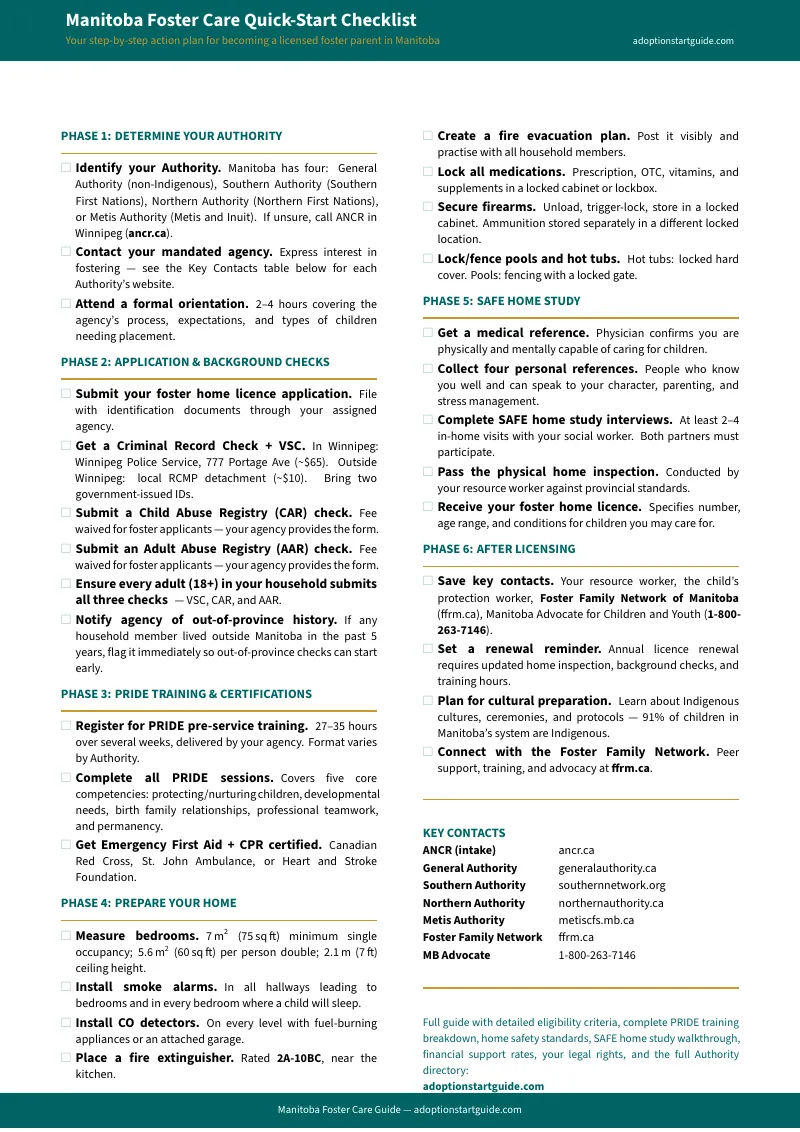
Download the Manitoba Foster Care Quick-Start Checklist for a six-phase overview of the licensing process, from Authority determination through post-licensing obligations. Free, no commitment. If you want the full guide with the Four-Authority Navigator, PRIDE training walkthrough, SAFE home study preparation, financial breakdown, and printable worksheets, click the button in the sidebar.
— less than a family dinner at The Forks
The typical Manitoba applicant spends weeks piecing together the licensing process from four Authority websites, scattered agency handouts, and the 500-page Child and Family Services Manual. This guide distills the most critical steps into a weekend-ready roadmap. A failed home inspection due to a safety issue you could have caught — incorrect bedroom dimensions, missing smoke alarms, unlocked medication — delays your license by months. One checklist prevents that.
If the guide doesn't deliver, reply to your download email at any time for a full refund. No forms. No justification required.