Nova Scotia has five adoption pathways, two parallel child welfare agencies, and zero resources that explain which one applies to you.
You started on the DCS website. You found a page titled "Agency Adoption" that lists the difference between a "licensed agency" and a "licensed private practitioner" without explaining what either one does in practice. You found a page on Mi'kmaw adoption that mentions MFCS but doesn't tell you whether an off-reserve Mi'kmaw family should call Shubenacadie or Halifax. You found an FAQ that says "any adult over 19 may apply" but doesn't mention the six-month fertility treatment waiting period that will hold up your application before it begins. You may have called your regional DCS office. If you reached a social worker, they told you to attend an information session. They didn't tell you that the wait for PRIDE training in your region could be six months to two years, or that you could spend that entire time productively preparing documents that the system will eventually demand.
And the real complexity hasn't started yet. Section 68 private adoption exists in Nova Scotia, but there are almost no private adoption agencies in the province — which means you're relying on "approved private practitioners" that DCS doesn't list publicly. Crown ward adoption has $0 fees but a 2-to-3-year timeline that nobody walks you through step by step. International adoption runs $25,000 to $50,000 and requires coordination between DCS, federal immigration, and a foreign government. Kinship and step-parent adoption involve consent law that most families only learn about when a lawyer charges $300 an hour to explain it. And if the child is Mi'kmaw, a separate placement hierarchy governed by MFCS and the emerging MKK Customary Code determines who can adopt — with cultural and linguistic requirements that the provincial system doesn't cover.
Generic Canadian adoption books use Ontario language — "Children's Aid Society" — that doesn't apply here. They don't cover the DCS vs. MFCS dual stream, Section 68 agreements in a province with almost no private agencies, African Nova Scotian cultural placement requirements, or the 2022 open records shift that changed how every adoption in the province handles disclosure. And the lawyers who do understand Nova Scotia's system charge $300 to $500 for an initial consultation — before you've even decided which pathway to pursue.
The Nova Scotia Adoption Roadmap: Your Five-Pathway Guide to Adoption in Nova Scotia
This guide is built for Nova Scotia's adoption system — the DCS regional offices, the MFCS parallel stream, the Children and Family Services Act, and the five distinct pathways that determine your timeline, your costs, and the children you'll be matched with. Every chapter is grounded in the current CFSA, the 2022 Adoption Information Act amendments, the 2025 federal tax credit data, and the on-the-ground realities of a province where PRIDE training wait times and DCS caseloads shape the process more than the statute does. It's not a repurposed national handbook. It's the operational layer between what the DCS website posts and what you actually need to know to adopt — through your pathway, under current conditions.
What's inside
- Five-Pathway Decision Map — Public (Crown Ward), Private (Section 68), International, Kinship, and Step-Parent adoption each have different costs, timelines, and legal mechanisms. Public adoption costs $1,000 to $3,000 in legal fees with everything else covered by DCS. Section 68 private adoption runs $5,000 to $10,000 in a province with almost no private agencies, making the "approved private practitioner" route your only realistic option. International adoption runs $25,000 to $50,000. This chapter maps all five pathways side by side so you choose correctly before spending months on the wrong track.
- DCS vs. MFCS Dual-Stream Guide — Nova Scotia has two parallel child welfare systems, and which one applies to you depends on whether the child is Mi'kmaw. MFCS operates from Shubenacadie and Eskasoni with its own placement hierarchy — kinship first, then home community, then another Mi'kmaw family — and language requirements that the provincial stream doesn't address. Off-reserve Mi'kmaw families working through DCS can still access MFCS healing services. This chapter explains both systems so you contact the right agency on your first call.
- PRIDE Training and Wait-Time Strategy — PRIDE training is 12 mandatory modules that serve as both education and assessment. Wait times for a training seat range from 6 months to over 2 years depending on your region. This chapter breaks down what each module covers, what the trainers are evaluating, and exactly what you should be completing during the wait — background clearances, medical exams, your autobiography, financial documentation — so you don't lose months sitting idle while the queue moves.
- Home Study Preparation Kit — The home study is a 3-to-6-month qualitative assessment conducted by a DCS social worker (free for public adoption) or a private practitioner ($2,500 to $3,000 for private or international adoption). This chapter covers the five document categories you need to assemble, the autobiography that forms the foundation of your interviews, the physical home inspection requirements (fire safety, medication storage, firearms, water features), and guidance for writing reference letters that actually help your case.
- African Nova Scotian and Cultural Placement Requirements — Nova Scotia has documented history of racist child protection policies affecting African Nova Scotian families. Current practice requires culturally appropriate placements, including assessment of the adoptive family's plan for hair and skin care, sickle cell monitoring, anti-racism advocacy, and community connection. This chapter explains what the Association of Black Social Workers looks for and what non-Black families must demonstrate.
- Mi'kmaw Customary Adoption and the MKK Code — The Maw-Kleyu'kik Kikmanaq Customary Code is being developed to formalize traditional Mi'kmaw adoption practices through community-issued certificates rather than provincial court orders. Federal Bill C-92 affirms Indigenous jurisdiction over child welfare. This chapter explains the current state of customary adoption, how it differs from the provincial court process, and what it means for Mi'kmaw families considering both pathways.
- Court Finalization Walkthrough — Every adoption in Nova Scotia is finalized in the Supreme Court (Family Division). This chapter lists the exact court forms (FD 1, FD 2A, FD 12, Form 11, Form 12), the consent requirements including child consent at age 12, the legal standard for dispensing with absent parent consent, and what actually happens in the courtroom on finalization day.
- 2025-2026 Financial Framework — Cost breakdown for all five pathways, plus the Assisted Adoption Benefits (per diem rates of $14.64 to $21.02 for special needs placements), the federal adoption expense tax credit (up to $19,580 per child on Line 31300), provincial employment protections, and EI parental benefits for adoptive parents. One chapter covers every dollar — incoming and outgoing.
Printable standalone worksheets included
- Adoption Timeline Tracker — Every milestone from initial DCS inquiry through court finalization order, with fill-in date fields. Print it, update it after every agency contact, and always know where you stand in the process.
- Home Study Document Checklist — All five document categories (identity, clearances, medical, financial, references) organized in the order the social worker expects them, with checkboxes for each item.
- Post-Placement Supervision Log — Track medical visits, school integration, attachment milestones, birth family contact, and behavioral observations during the mandatory 6-to-12-month supervision period before court finalization.
- Financial Planning Worksheet — Costs by pathway, Assisted Adoption Benefits eligibility, federal tax credit calculation, and EI benefits in one printable sheet for your household budget conversation.
Who this guide is for
- Families transitioning from fertility treatment — You've been told about the six-month waiting period before DCS will accept your application. You want to use that time productively — gathering documents, writing your autobiography, understanding the home study — so you're ready to move the day the wait ends, not starting from scratch.
- Foster parents pursuing Crown Ward adoption — You've been caring for a child in Permanent Care and Custody and you want to make it permanent. You need to understand the Assisted Adoption Benefits negotiation (which happens before finalization and is difficult to adjust afterward), the home study update process, and how the court weighs the emotional bond you've already built.
- Mi'kmaw families navigating DCS and MFCS — You're trying to understand whether to work through the provincial system or the MFCS stream, what customary adoption looks like under the emerging MKK Code, and how Bill C-92 changes the legal landscape. You need a resource that respects both systems and explains the practical differences.
- Single applicants — The law says any adult over 19 can adopt. But you've heard the myth that couples are prioritized, and you want to know how a single-income household is actually assessed — support network, financial stability, contingency planning — so you can prepare a strong application.
- Kinship and step-parent families — A child is already in your life and you need to formalize the relationship. You want to know the consent requirements, the process for dispensing with consent when a biological parent is absent, and the court filing sequence — without paying $300 an hour to a lawyer for information you could have prepared in advance.
Why the free resources aren't enough
The DCS website publishes eligibility criteria and agency descriptions — what the rules are in broad strokes. It does not tell you which pathway matches your timeline, how to prepare for PRIDE training during the wait, what the home study social worker is actually evaluating, or how to navigate the dual DCS/MFCS system if the child is Mi'kmaw. The pages haven't been updated to reflect the practical implications of the 2022 open records shift or the evolving Mi'kmaw jurisdiction under Bill C-92.
National Canadian adoption books describe a generic process that uses Ontario terminology and misses Nova Scotia's specific mechanisms — Section 68 agreements in a province with almost no private agencies, the MFCS parallel stream, African Nova Scotian cultural placement requirements, and the Assisted Adoption Benefits per diem structure. They cover "adoption in Canada." They don't cover adoption in Nova Scotia.
Reddit and Facebook groups offer emotional support from families who have been through the system. But advice from a Halifax family pursuing Crown Ward adoption doesn't apply to a Cape Breton family navigating MFCS, and neither applies to a newcomer in HRM trying to understand why Section 68 private adoption works differently here than in Ontario. Crowdsourced guidance mixes pathways, regions, and legal mechanisms without distinguishing between them.
The free Quick-Start Checklist
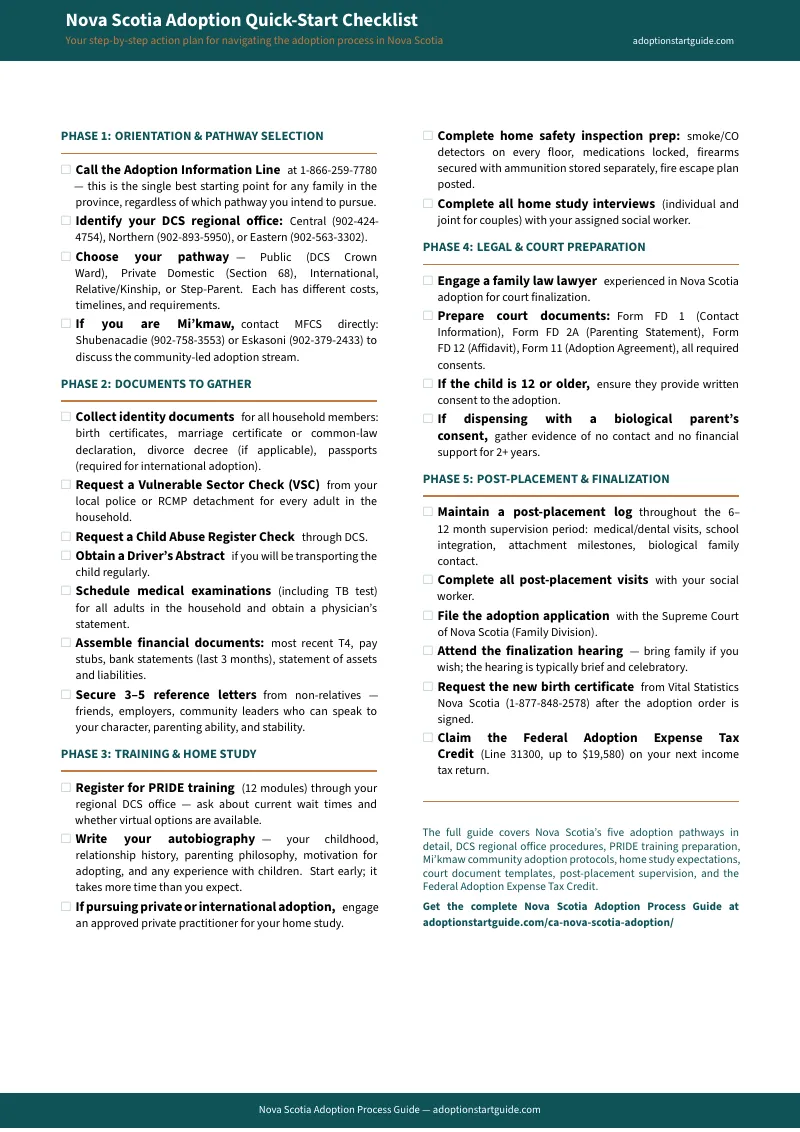
Download the Nova Scotia Adoption Quick-Start Checklist for a one-page overview of the adoption process, from initial inquiry through court finalization. Free, no commitment. It includes the five-pathway decision and the DCS vs. MFCS first-call question — the two items that cause the most confusion. If you want the full guide with the PRIDE module breakdown, home study preparation kit, cultural placement requirements, court finalization walkthrough, financial framework, and printable worksheets, click the button in the sidebar.
— less than fifteen minutes with an adoption lawyer
Nova Scotia adoption lawyers charge $300 to $500 for an initial consultation. That buys you one hour of general advice — not a step-by-step walkthrough of the five pathways, not a PRIDE preparation strategy, not a home study document checklist, and not the financial framework that maps every dollar from application through court finalization. This guide puts the entire Nova Scotia adoption system in your hands for a fraction of what a single legal consultation costs. Families who understand the process before they begin move faster, prepare stronger applications, and avoid the months of confusion that come from navigating a system designed for social workers, not parents.
If the guide doesn't deliver, reply to your download email at any time for a full refund. No forms. No justification required.