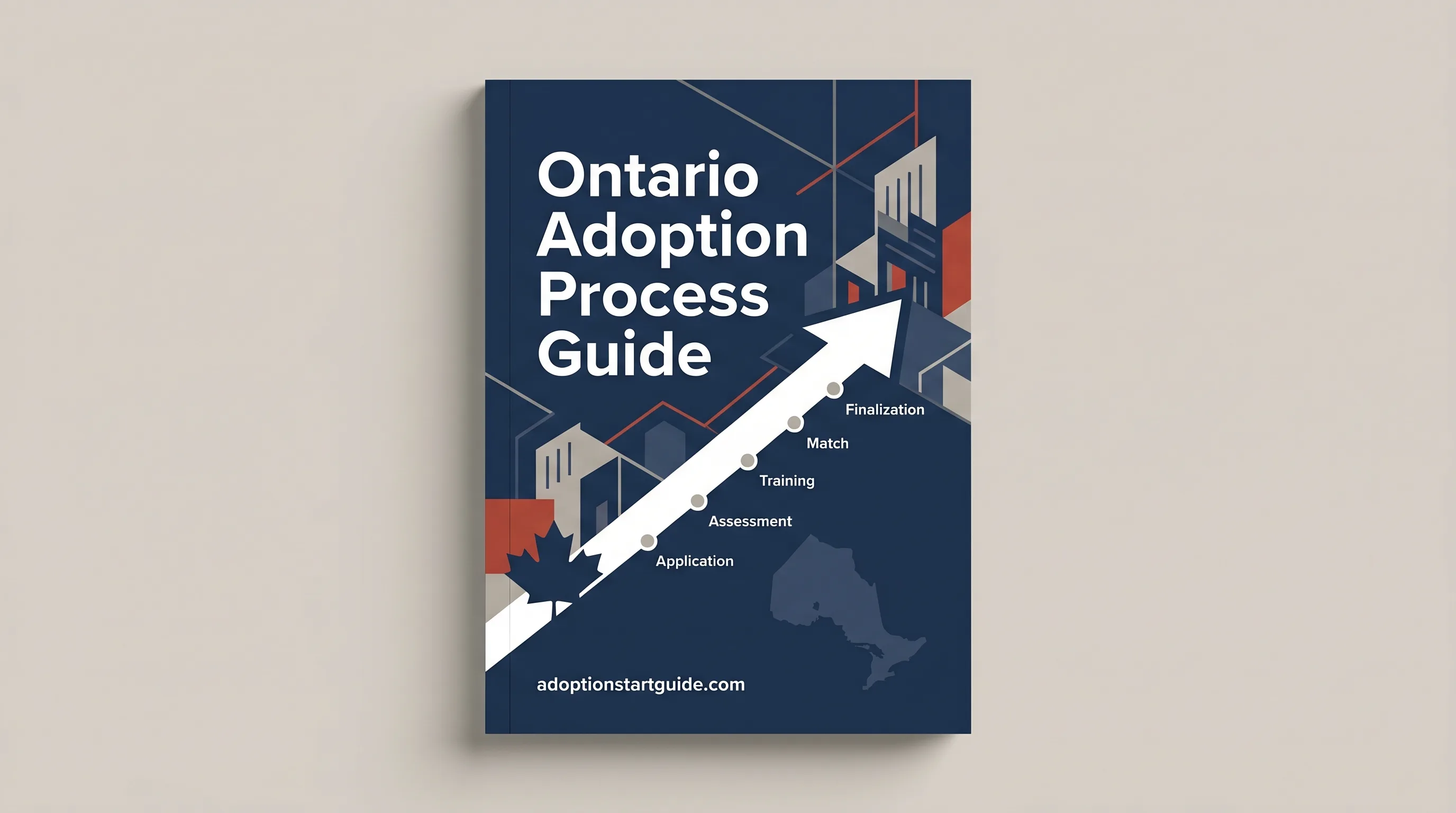
You want to adopt in Ontario. You just didn't expect the system to have 50 different front doors.
Ontario has more than 50 Children's Aid Societies, each with its own intake process, its own waitlist, and its own interpretation of "adopt-ready." The Ministry of Children, Community and Social Services publishes eligibility rules but not strategy. The Ontario Association of Children's Aid Societies directs you to your local CAS office, which may take weeks to return your call. The Adoption Council of Ontario has deep clinical resources, but you'll pay $85 for a one-day seminar pass before you learn what questions to ask. AdoptOntario's photolisting shows children waiting for families, but the non-identifying profiles don't tell you enough to know if you're the right match.
And then there's the law. In 2017, Ontario replaced the Child and Family Services Act with the Child, Youth and Family Services Act. "Crown wardship" became "Extended Society Care." The consent rules changed. The privacy framework shifted. If you've been researching with books or websites published before 2017, you're navigating with an outdated map. Even some CAS workers still use the old terminology in conversation, which doesn't help when you're trying to understand what's actually happening with your file.
Meanwhile, PRIDE training waitlists stretch 12 to 18 months through public CAS offices. The SAFE model home study is a psychological deep dive into your childhood, your relationships, and your parenting philosophy, and no government website will tell you what the assessor is actually looking for. Private adoption in Ontario costs $15,000 to $30,000, and the birth parent has 21 days to revoke consent after the 8th day following the child's birth. That window is terrifying if you don't understand how it works.
Nobody in the system is working against you. But your CAS worker's job is child protection, not applicant education. Your adoption lawyer bills $300 to $500 per hour, and much of that first consultation covers basics you could have learned on your own. The licensed adoption practitioner assesses your readiness; they don't coach you through it. This guide is the one resource built entirely around your perspective as a prospective parent in Ontario.
The Ontario Adoption Navigator
This is a complete, Ontario-specific adoption guide written for the current legal framework. Not a repurposed national overview. Not a generic Canadian handbook that mentions "Crown wards" and "private agencies" as though every province works the same way. Every chapter, every checklist, every cost figure is grounded in the CYFSA 2017, current MCCSS policies, and the real-world experience of families who have navigated Ontario's system.
What's inside
- Three-pathway decision framework — Public (Extended Society Care), Private Domestic, and International adoption compared side by side. Costs, timelines, eligibility, and the realistic wait for each pathway. Public adoption is free and comes with subsidies up to $1,035 per month. Private domestic runs $15,000 to $30,000 with a multi-year infant waitlist. International varies by country program. This chapter prevents you from spending months on the wrong path before discovering the one that fits your family.
- CAS selection strategy — Ontario's 50+ Children's Aid Societies are not interchangeable. Some have more children available for adoption, some have shorter PRIDE waitlists, and some are more responsive to initial inquiries than others. This chapter explains how to identify the right CAS for your situation and what to do if your local CAS is unresponsive, including when and how to work with a CAS outside your catchment area.
- SAFE model home study preparation — What the assessor actually evaluates across the five interview stages, the 20+ documents you need assembled before the first visit, the attitudes that score positively, and the red flags that can delay your file. The SAFE model is a psychological assessment of your readiness to parent a child who has experienced trauma. No government brochure tells you how to prepare because the people who write those brochures are the ones doing the assessing.
- PRIDE training navigator — The mandatory Parent Resources for Information, Development, and Education training, broken down by module. How to handle the 12-to-18-month public CAS waitlist by going to a licensed private practitioner instead (costs $1,500+ but gets you trained in weeks instead of years). What to expect from the curriculum, how solo applicants handle the partnership exercises, and how PRIDE connects to your "adopt-ready" status.
- The 21-day consent window decoded — In private domestic adoption, the birth parent's consent is not valid until the 8th day after the child's birth, and it can be revoked for 21 days after that. This chapter explains exactly how the clock works, what happens if the birth parent becomes unreachable during the window, the role of the Office of the Children's Lawyer, and how to manage the post-placement period both legally and emotionally.
- Openness agreements vs. Openness Orders — Ontario encourages post-adoption contact between adoptive families and birth families, but the legal enforceability depends entirely on which instrument you use. An Openness Agreement is a handshake. An Openness Order is a court order. This chapter explains when each applies, how to negotiate terms that protect your family, and what recourse exists if the other party stops cooperating.
- Ontario cost map — A realistic breakdown from $0 (public CAS adoption with subsidies) to $30,000+ (private domestic with legal fees). Includes the costs families don't expect: SAFE home study updates if you move or change jobs ($500 to $1,500), private PRIDE training, independent legal advice for birth parents (which you may be expected to cover), and travel costs for international adoption. No other free or paid resource in Ontario puts all these numbers in one place.
- Financial assistance and tax credits — The Ontario adoption subsidy ($1,035/month for children adopted from ESC), the income eligibility threshold ($97,856 and how the clawback works above it), the federal Adoption Expenses Tax Credit (up to $15,551), and which receipts you need to save from day one. Most families don't learn about the subsidy until after finalization, when it's too late to negotiate the rate.
- CYFSA terminology decoder — A plain-language glossary mapping old terms to current ones: Crown Ward to Extended Society Care, Society Ward to Interim Society Care, CAS to Children's Aid Society (unchanged but with new mandate), and the privacy framework changes under the 2009 open records amendments. Stop second-guessing every term in your paperwork.
- Court finalization walkthrough — What happens at the Ontario Court of Justice hearing, the documentation your lawyer needs, the role of the Office of the Children's Lawyer, and the post-adoption birth certificate process through ServiceOntario. Written in plain language, not legalese.
Who this guide is for
- Couples moving from infertility to adoption — You've spent years and tens of thousands of dollars on IVF at Mount Sinai or TRIO. This guide shows you the fastest path to "adopt-ready" status so you can reclaim some control over a timeline that has felt out of your hands for too long.
- Foster parents pursuing permanency — The child in your care just received an Extended Society Care order. You need to understand the legal shift from temporary caregiver to permanent parent and how your existing relationship with the child shapes the matching process and court application.
- Single applicants — Ontario is fully open to single adopters. No legal barrier. But the SAFE home study has specific questions for solo applicants about financial stability, backup care plans, and support networks. This guide addresses those directly.
- LGBTQ+ families — Ontario has permitted joint adoption by same-sex couples since 2000. The law is clear. But some families still report navigating subtle bias from individual practitioners. This guide covers how to find affirming agencies and what protections the CYFSA provides.
- Newcomer and immigrant families in the GTA — You're navigating a child welfare system that may be fundamentally different from your country of origin. The SAFE model's emphasis on disclosing your own childhood experiences can feel culturally intrusive. This guide explains what the assessor is looking for and how to present your family's strengths within the Ontario framework.
- Kinship and relative applicants — You took in a grandchild, niece, or nephew during a family crisis. You assumed the process would be simpler because you're family. Ontario requires the same background checks and SAFE assessment regardless of biological connection.
Why the free resources aren't enough
The MCCSS website is accurate, but it reads like legislation. It tells you what the rules are without explaining how to navigate them. It won't tell you how to find a licensed adoption practitioner or how to position yourself as a strong candidate in the matching process.
The OACAS focuses on child protection. Their adoption information is high-level and directs you to your local CAS office, which may take weeks to respond to an initial inquiry and won't coach you through the SAFE process.
The Adoption Council of Ontario provides the deepest clinical content in the province, but their best resources are gated behind an $85 seminar pass or membership fees. Their focus is therapeutic parenting and trauma-informed care, not the logistical roadmap of how to actually move through the system.
AdoptOntario's photolisting is a vital tool, but the "Kids Korner" profiles are deliberately non-identifying. You can't assess fit from a paragraph that omits medical history, trauma background, and specific needs.
Reddit and Facebook groups give you anecdotes: "we waited three years," "our CAS worker ghosted us." They don't give you context about which CAS offices have more children available, how to skip the 18-month PRIDE waitlist, or why some families get matched faster than others. Advice from families in BC or Alberta is actively misleading because those provinces have completely different legal frameworks.
Generic Amazon adoption books cover Canada nationally. Most were published before the 2017 CYFSA overhaul. They still reference "Crown wardship" and miss the current consent rules, the new privacy framework, and the subsidy amounts that changed in recent budgets.
Printable standalone worksheets included
The guide comes with printable standalone PDFs designed for real-world use:
- Pathway Comparison Card — Public, Private Domestic, and International adoption side by side on one page. Costs, timelines, and eligibility at a glance. Print it, sit down with your partner, and make the decision that shapes everything else.
- SAFE Document Checklist — Every document your assessor needs, organized in the order they'll request them. Background checks, medical reports, financial records, reference letters, and home safety items. Bring it to your first meeting so nothing is missing.
- Ontario Cost Map — Every expense for every pathway in one printable sheet. Take it to your financial planning conversation.
- Court Filing Checklist — Every document your lawyer needs for the Ontario Court of Justice application. Hand it over and save yourself a billable hour of preliminary questions.
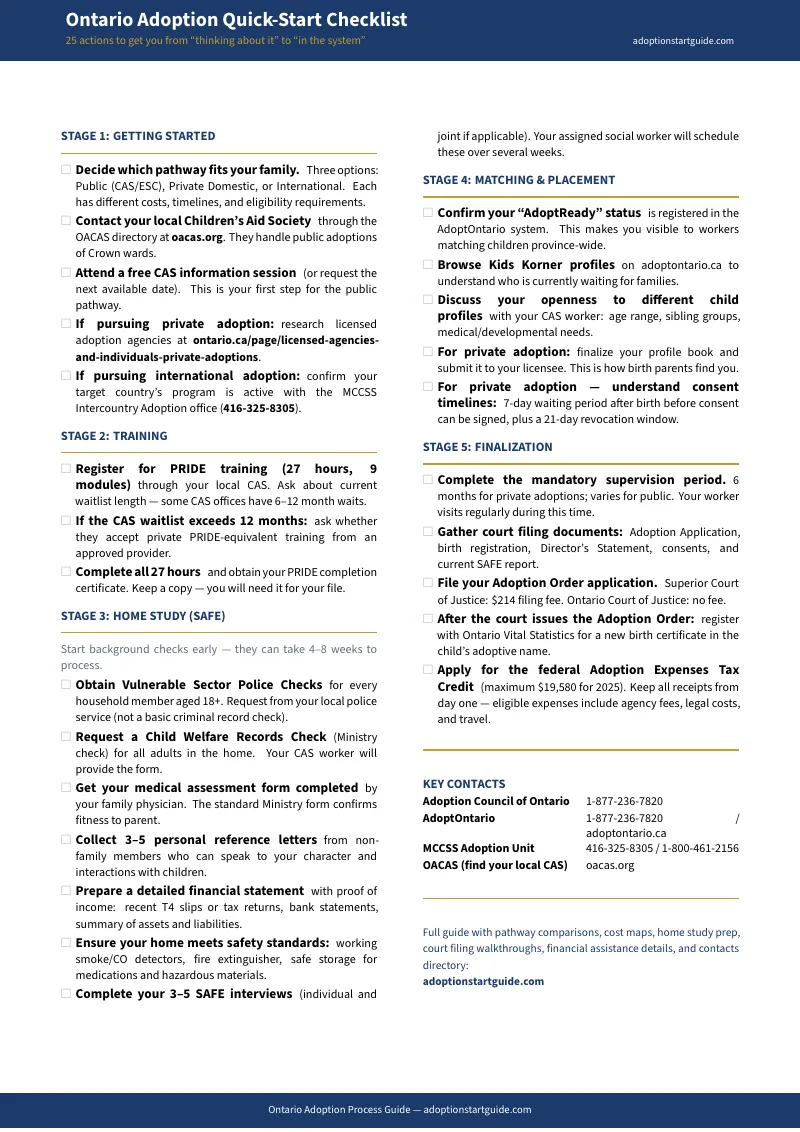
The free Quick-Start Checklist
Download the Ontario Adoption Quick-Start Checklist for a one-page overview of the key steps from first CAS contact to court finalization. Free, no commitment. If you want the full roadmap with pathway comparisons, cost maps, SAFE preparation, CYFSA decoder, and financial assistance details, click the button in the sidebar.
— less than five minutes of an Ontario adoption lawyer's time
A single consultation with an adoption lawyer in Toronto or Ottawa starts at $300 to $500 per hour. Families routinely spend the first billable hour covering foundational questions this guide answers on page one. The Ontario Adoption Navigator doesn't replace your lawyer. It makes sure you don't pay your lawyer to teach you the basics.