Quebec adoption runs on the Code civil, not the Adoption Act. Every Canadian guide you've read so far was written for the wrong legal system.
You've been researching adoption for weeks, maybe months. You found the quebec.ca page. You read about the DPJ. You Googled "Banque mixte" and got results in French. You tried Educaloi, which gave you a clean summary but stopped short of telling you what actually happens in the psychosocial assessment. You found a generic Canadian adoption guide on Amazon for $35 and realized halfway through that it describes Ontario's Children's Aid Societies and Alberta's casework model. Quebec doesn't use either. Quebec doesn't even use common law.
This is the part that trips up every English-speaking family in the province: adoption in Quebec is governed by the Code civil du Quebec, Articles 543 to 584. It's a civil law jurisdiction, like France or Louisiana, not a common law jurisdiction like the rest of Canada. The rules about consent, filiation, and parental authority come from a completely different legal tradition. A guide written for "Canada" is not written for Quebec.
And then there's the language barrier. The CISSS/CIUSSS information sessions are conducted in French. The psychosocial assessment interviews are conducted in French. The forms from the DPJ are in French. If you're an anglophone in Montreal's West Island, an allophone family in Laval, or an English speaker in the Eastern Townships, you can manage daily life in English, but the moment you enter the adoption system, everything shifts. You're not just learning a new legal process. You're learning it in your second language, under the highest emotional stakes of your life.
Outside Montreal, the situation is worse. Batshaw Youth and Family Centres is the one English-language institution in the province that handles adoption services directly. If you don't live in their catchment area, your regional CISSS may not have a single English-speaking social worker on the adoption team. Nobody tells you this upfront.
The Civil Code Navigator: Your English-Language Roadmap to Quebec Adoption
This guide was written for one legal system and one audience. Every chapter, every checklist, every explanation is grounded in the Code civil du Quebec, the Youth Protection Act, the reforms of Bill 113 and Bill 2, and the administrative realities of the DPJ and SASIE. It is not a Canadian adoption guide with a Quebec chapter tacked on. It's the operational document that sits between what quebec.ca publishes online and what you actually need to know before your first meeting with a social worker.
What's inside
- Code civil foundations in plain English — Quebec adoption changes your child's filiation, the legal bond of kinship recorded in the civil registry. This chapter explains what filiation means, why it matters, and how Articles 543 to 584 govern every step of the process. If you've been researching adoption using Ontario or U.S. frameworks, this chapter resets your understanding to the legal system that actually applies to you.
- Adoption plénière vs. adoption simple decoded — Quebec is the only place in North America where you choose between two forms of adoption. Plenary adoption severs all ties with the biological family and creates a new birth certificate. Simple adoption adds a new parental bond without erasing the original one. Most English-language resources don't explain this distinction at all, and the ones that mention it make simple adoption sound like a risk. This chapter lays out the legal consequences of each path, the situations where each applies, and the questions to ask your notary or lawyer before deciding.
- The Banque mixte program from registration to judgment — The Banque mixte is the primary engine for domestic adoption in Quebec. You register as both a foster family and a prospective adoptive family. If the child placed with you is eventually declared eligible for adoption, you have priority. But you also accept the possibility that the child may return to their biological family. This chapter covers the dual evaluation process, the permanency timeline, how the Laurent Commission reforms shifted the system toward the child's best interest, and how to manage the emotional weight of concurrent planning.
- The psychosocial assessment: what evaluators actually measure — Quebec doesn't use the SAFE home study model from other provinces. It uses an evaluation psychosociale conducted by a regulated social worker or psychoeducator. This chapter explains the 4-to-8-session clinical framework: the autobiography and genogram, the exploration of your infertility journey if applicable, your parenting philosophy, your understanding of trauma and attachment, and your transcultural competency for transracial placements. You'll know what to prepare before the first session, not after.
- International adoption through the SASIE — Quebec has its own central authority for international adoption, the Secrétariat aux services internationaux à l'enfant. No international adoption can proceed without SASIE authorization. This chapter explains the role of organismes agrees, which country programs are currently open or suspended, the costs ($25,000 to $60,000+), and the federal immigration steps that follow the Quebec judgment.
- Financial reality: costs, subsidies, and tax credits — Public adoption through the DPJ costs as little as $1,500 to $3,500 in legal fees. Stepparent adoption runs $2,000 to $7,000. International adoption can exceed $60,000. This chapter covers the full picture: Quebec's adoption subsidy for children with special needs, the Supplement for Handicapped Children (~$284/month), the federal and provincial Adoption Expense Tax Credits, and QPIP parental insurance for adoptive parents. It also covers the costs nobody mentions at orientation: translation fees, notarized documents, and the months of unpaid waiting between approval and placement.
- Bill 113, Bill 2, and the end of secrecy — Quebec adoption used to operate under total secrecy. Bill 113 (2017) opened birth records for adult adoptees and introduced communication agreements between adoptive and biological families. Bill 2 (2024) expanded the right to search for origins. This chapter explains your obligations and options under the current law, including what "contact vetoes" mean and how openness agreements work in practice.
- Court finalization in the Youth Division — Every adoption in Quebec ends with a judgment from the Court of Quebec. This chapter walks through the placement order, the 6-month trial period, the motion for final judgment, and the issuance of the new birth certificate by the Directeur de l'etat civil. If the legal terminology makes the process sound adversarial, this chapter will show you it's not.
Printable tools included
- Psychosocial assessment document checklist — Birth certificates, medical exams, Vulnerable Sector Check, financial disclosures, and 3 to 5 reference letters: every document you need, in the order you'll need it. Print it and check items off as you go.
- Adoption pathway decision worksheet — Public (DPJ), private (stepparent/family), or international (SASIE): a structured comparison of timelines, costs, and legal outcomes to help you and your partner choose your path before your first appointment.
- Financial planning worksheet — Subsidies, tax credits, QPIP benefits, and out-of-pocket costs in one printable sheet. Take it to your household budget conversation.
Who this guide is for
- Couples transitioning from fertility treatment to adoption — Your IVF cycles at the MUHC or a private clinic didn't work. You've made the decision to adopt. But the emotional shift from patient to prospective parent is disorienting, and the Quebec system feels nothing like the process you imagined. This guide gives you the legal and administrative framework in English so you can move forward with clarity, not confusion.
- Banque mixte foster parents considering adoption — You're already fostering a child through the DPJ. You love this child. You want to know when and how the adoption becomes possible, what the permanency timeline looks like, and what happens if the biological family re-enters the picture. This guide maps the transition from foster care to adoption under the current law.
- Allophone and immigrant families in Montreal — You speak English as your primary or secondary language. You've attended a CISSS information session in French and left with more questions than answers. The cultural assumptions embedded in Quebec's system, the secular legal framework, the role of the DPJ, don't map to your home country's approach. This guide bridges that gap.
- Single adopters — Quebec fully supports single-parent adoption. But the psychosocial assessment for solo applicants evaluates your support network, your emotional resilience, and your plan for work-life balance more intensively than for couples. This guide tells you what evaluators look for so you can present your strongest case.
- Anglophones outside Montreal — You live in the Eastern Townships, Outaouais, or another region where English-language adoption services are scarce. You may be hours from Batshaw. This guide helps you navigate the system remotely and identify bilingual professionals in your region.
Why free resources fall short
The quebec.ca website provides a correct but clinical overview. It explains what the DPJ does and lists the regional CISSS contacts. It does not explain what the psychosocial evaluator is actually measuring, how long the Banque mixte waitlist really is, or what adoption simple means for your child's inheritance rights. Educaloi is excellent for high-level legal summaries, but it stops short of the practical details that matter when you're in the process.
Batshaw serves the English-speaking community in Montreal, but their website assumes you already understand the system you're trying to enter. Regional CISSS websites range from minimal to non-existent in English. Some regions don't have a single English page on adoption services.
Generic Canadian guides describe a system that doesn't exist in Quebec. They reference Children's Aid Societies that Quebec doesn't have, training programs designed for other provinces, and common law concepts that the Code civil doesn't recognize. A $35 book about adoption in Canada is $35 wasted if you live in Quebec.
A preliminary consultation with a family lawyer in Quebec costs $125 to $500. This guide doesn't replace a lawyer. But it gives you the foundational knowledge to use those expensive hours asking the right questions instead of learning basics you could have read at home.
The free checklist to start tonight
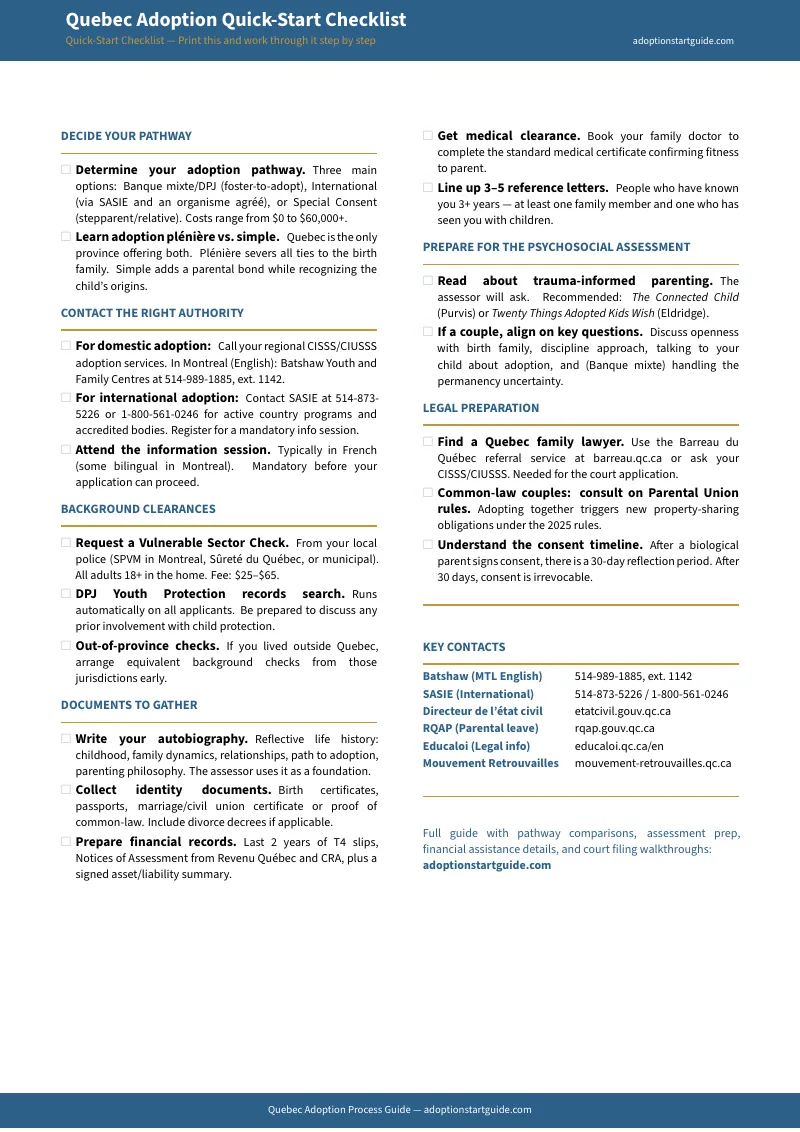
Download the Quebec Adoption Quick-Start Checklist for a compact overview of the process, from eligibility requirements through court finalization. Free, no commitment. If you want the full guide with the Code civil foundations, the Banque mixte roadmap, psychosocial assessment preparation, financial breakdown, and printable worksheets, click the button in the sidebar.
— less than a parking fee at the Montreal courthouse
English-speaking families in Quebec spend weeks assembling the adoption process from scattered CISSS pages, French-language government documents, and generic Canadian guides that don't apply here. This guide puts the entire Quebec-specific process into one document you can read in a weekend. A psychosocial assessment you walk into unprepared can set your timeline back by months. A misunderstanding about adoption simple versus plenary can shape your child's legal identity for life. One guide prevents both.
If the guide doesn't deliver what it promises, reply to your download email at any time for a full refund. No forms. No justification required.