You've spent six months researching international adoption. You still don't know which countries are actually open.
You started with a Google search. Maybe it was "how to adopt from China" — and you discovered the program closed in 2024. So you pivoted to Colombia, then India, then Bulgaria. Each country led to a different agency website with a different fee schedule, a different wait time estimate, and a different definition of "healthy child available." You joined the Reddit forums. You read the State Department notices. You called three agencies and got three conflicting answers about whether South Korea is accepting new applications.
Somewhere around month four, you hit a wall. Not an emotional wall — an information wall. You have too much data and no way to evaluate it. The agency says India is "wide open" but Reddit parents say the CARA wait is four years. The State Department lists 90 countries as Hague Convention partners, but only a handful are actually processing cases. You've seen fee schedules ranging from $25,000 to $65,000 for what appears to be the same service. And every source you consult has a financial interest in the answer they give you — except Reddit, which has no structure at all.
This is what researchers call Information Insolvency: the point where the volume of conflicting data exceeds your ability to make a decision. Agency websites are sales collateral. Government sites are factual but not strategic. Forums are honest but chaotic. And the books on Amazon are either memoirs from the 2004 boom (when 22,988 children were adopted internationally — a number that has since dropped 95% to 1,172 in 2024) or academic critiques written for policymakers, not parents sitting at the kitchen table trying to figure out their next step.
There is no independent source that brings together current program stability data, agency vetting criteria, USCIS immigration requirements, financial planning, and post-arrival preparation in one place, written for the family — not the agency, not the government, not the academic. Until now.
The Adoption Wayfinding System: An Independent Intercountry Adoption Guide
The International Adoption Navigation Guide is built around what we call the Adoption Wayfinding System — a structured decision framework that takes you from "we're thinking about international adoption" to "our child is home and we know what comes next." It is not an agency brochure. It is not a memoir. It is the operational intelligence document that sits between you and every other source of information in this process, helping you evaluate what you're being told and by whom.
The core principle: every decision in international adoption is a bet against instability. Countries close programs. Agencies lose accreditation. Referrals contain incomplete medical information. Court dates get postponed by political crises on the other side of the world. The guide doesn't pretend this instability away. It gives you the tools to assess it, plan around it, and protect your family — financially and emotionally — when things change.
What's inside
- The Country Stability Index — Current data on which intercountry programs are genuinely processing cases and which are "technically open" but functionally stalled. India, Colombia, Bulgaria, the Philippines, Ukraine, South Korea, and two dozen other programs assessed on five dimensions: processing volume, political risk, ethical track record, wait time reliability, and special needs prevalence. Because one political crisis can freeze $20,000 in sunk dossier costs overnight, and the agency that sold you on a country has no incentive to tell you it's wobbling.
- The Agency Vetting Protocol — 80+ questions to ask any Hague-accredited adoption service provider before you sign a contract or pay a non-refundable deposit. How to check accreditation status through the Department of State (not just the agency's own website). How to read complaint histories. How to identify agencies currently under investigation or corrective action. The specific fee structures that signal transparency — and the ones that signal you're about to get nickel-and-dimed for four years. If you're comparing Holt International, Lifeline, Nightlight, Children's House, or any other agency, this is the chapter that protects your money.
- The USCIS Immigration Roadmap — A plain-language walkthrough of the I-800A (Hague) and I-600A (non-Hague) petition processes, from initial filing through biometrics, approval, and the immigrant visa interview at the U.S. embassy abroad. Which forms to file when, what "advance processing" means, how long approval actually takes versus what the website says, and the most common mistakes that restart the clock. If terms like "I-800A," "Article 5 letter," and "IR-3 vs. IR-4 visa" currently make your head spin, this chapter translates all of it.
- The Dossier Assembly Guide — Every document you'll need, apostilled and authenticated, organized by category: identity, financial, medical, legal, and personal. Country-specific variations mapped out so you're not scrambling when Colombia asks for documents India doesn't require. Realistic timelines for each step — because "allow four to six weeks" actually means "allow four to six weeks if nothing goes wrong, and something always goes wrong." Includes a printable Dossier Tracker worksheet.
- The "Special Needs" Reality Check — The term "healthy child" has functionally disappeared from international adoption. Most available children have medical, developmental, or emotional conditions — some well-documented, some not. This chapter explains how to read a foreign medical referral, what "orphanage developmental delay" actually means (and how it differs from a permanent disability), the "file review" versus "blind referral" distinction, and how to get an independent medical evaluation before you accept. Written to help you make an informed decision, not to scare you and not to minimize.
- The Hague Convention Decoder — What the Hague Convention on Intercountry Adoption actually requires, in language a non-lawyer can understand. Why it matters. What protections it gives you. What happens when you adopt from a non-Hague country (there are still several viable ones). The Central Authority system, the subsidiarity principle, and why these legal abstractions directly determine how long your adoption takes and how secure it is.
- The Financial Architecture — Total cost breakdowns for the top sending countries, covering agency fees, foreign court costs, travel, document processing, and post-placement supervision. The 2025 federal Adoption Tax Credit ($17,280, now partially refundable — meaning even families with zero tax liability can receive up to $5,000 back). Adoption grants from organizations like the National Adoption Foundation, Show Hope, and Gift of Adoption Fund. Employer adoption benefits (which Fortune 500 companies offer them and how to apply). Adoption loans. The "finalization rule" that determines when you can claim expenses. A printable Financial Planning Worksheet that puts every line item in one place.
- The Travel Preparation Protocol — What to expect during your one or two in-country trips: embassy interviews, court appearances, bonding time in a hotel room with a child who doesn't speak your language. Packing lists informed by actual adoptive families (not travel bloggers). Visa and passport requirements for your child. How to handle the flight home with a child who may be terrified. Country-specific cultural briefings so you don't accidentally offend the judge who's deciding your case.
- The Ethical Adoption Framework — South Korea and Guatemala investigations. Swedish and Dutch national inquiries into historical adoption fraud. The "orphan myth" — why many children in institutional care are not actually orphans. This chapter isn't designed to talk you out of adoption. It's designed to ensure you're doing it in a way that protects the child's origin story, respects the sending country's sovereignty, and won't leave you — or your child — dealing with revelations of fraud twenty years from now.
- Post-Arrival and Attachment — What happens after your child comes home. The "honeymoon period" and the crash that follows. Trauma-informed bonding strategies for children who have spent years in institutional care. The "orphanage effect" on development and what it actually predicts (less than you fear, more than you hope). When to seek professional help and what kind. Re-adoption in your home state: why it matters and how to do it. This chapter bridges you to the long road ahead.
Printable standalone worksheets included
- Country Comparison Matrix — Side-by-side evaluation of your top program choices across cost, timeline, age range, special needs prevalence, travel requirements, and stability rating. Fill it in as you research. Bring it to your agency consultation.
- Agency Vetting Scorecard — The 80+ questions from the Agency Vetting Protocol condensed into a printable evaluation sheet. Score multiple agencies on the same criteria so your comparison is apples-to-apples.
- Dossier Tracker — Every document, every apostille, every authentication — tracked by status with due dates. The single sheet that keeps your $3,000 dossier from falling apart because one notarization expired.
- Financial Planning Worksheet — All costs, all funding sources, the tax credit calculation, and your net out-of-pocket projection in one printable page.
Who this guide is for
- Families in the research phase who haven't chosen a country or agency yet. You're comparing India, Colombia, Bulgaria, and maybe one or two others. You've talked to agencies but you're not sure whose numbers to trust. You need an independent assessment of program stability and agency credibility before you commit $5,000 to $15,000 in non-refundable fees.
- Faith-driven families who see adoption as a calling. Your church community supports you. Your motivation is deep and real. But spiritual conviction doesn't protect you from an agency that overpromises or a country program that closes mid-process. This guide respects your calling and gives it the practical foundation it needs.
- Heritage families with a connection to a specific country. One parent was born in Colombia, or you have family ties to the Philippines, or you grew up in a Korean-American community. Some countries offer expedited processing for heritage families. This guide covers which ones, how to qualify, and whether the advantage is meaningful or mostly symbolic.
- Couples and individuals who've come to adoption after infertility. You've been through IVF cycles, or donor attempts, or years of trying. International adoption is your next step, but it's a completely different process with completely different risks. The emotional resilience you've built is an asset. The guide helps you channel it into a process that rewards preparation, not optimism.
- Single parents and LGBTQ+ families. Not every country accepts single applicants. Fewer accept same-sex couples. The guide is direct about which programs are genuinely open to you, which have unofficial barriers, and which are closed. No sugarcoating, no false hope — just the current landscape so you don't waste years pursuing a program that was never going to say yes.
- Older prospective parents. Many countries have age limits for adoptive parents — some strict, some flexible. If you're over 45 or 50, certain programs are off the table. The guide specifies which ones and identifies the programs where your age and life experience are considered strengths, not liabilities.
Why the free resources aren't enough
The Department of State website is the authoritative source on country-specific adoption notices, accredited agency lists, and immigrant visa statistics. It is essential reading. It is also a collection of facts without a framework. It tells you India processed 202 adoptions in 2024. It does not tell you whether that number is trending up or down, what it means for your wait time, or how India's processing speed compares to Colombia's. Facts without context are not strategy.
Adoption agencies provide detailed information — after you've signed a contract. Before that, you're getting the marketing version: the best-case timeline, the lowest-plausible cost, the most favorable interpretation of a country's stability. Agencies have a structural conflict of interest. They need you to commit to generate revenue. An independent guide has no country to sell you and no contract to sign. The incentive is different, and so is the information.
Reddit and Facebook groups are where adoptive families tell the truth. The wait was longer than promised. The referral was incomplete. The agency ghosted them after placement. These accounts are invaluable. They are also unstructured, anecdotal, and impossible to verify. A post from 2019 about Colombia's process may bear no resemblance to the 2025 reality. The guide takes the raw honesty of the forums and puts it inside a framework you can actually act on.
Books on international adoption are either outdated (written when China was processing 7,000 cases a year), academic (written for researchers, not families), or memoir-based (beautiful but not actionable). The guide is none of these. It is a current, practical, decision-focused tool built for families making this choice right now.
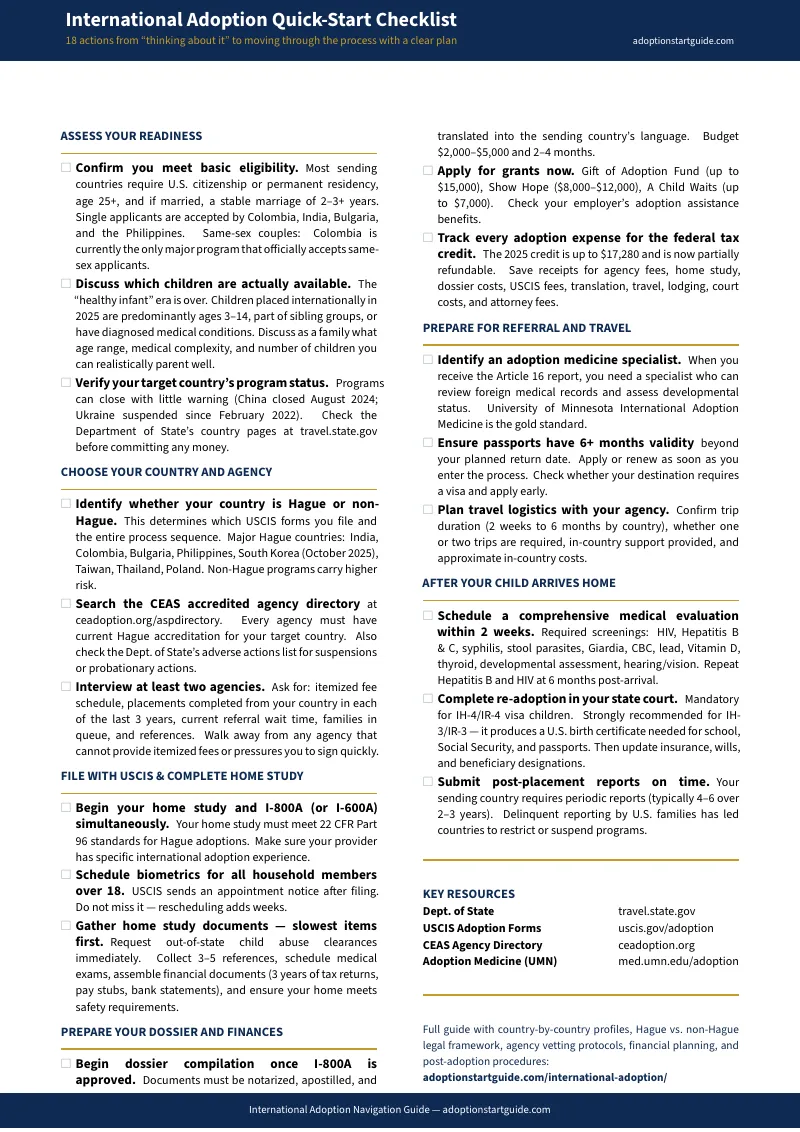
The free Quick-Start Checklist
Download the International Adoption Quick-Start Checklist for a condensed overview of the key milestones from initial research through finalization. Free, no commitment. If you want the full International Adoption Navigation Guide with the Country Stability Index, Agency Vetting Protocol, USCIS roadmap, dossier tracker, financial planning tools, and printable worksheets, click the button in the sidebar.
— less than one hour of an adoption attorney's time
A single consultation with an adoption attorney runs $200 to $500 per hour. Most families spend their first two sessions asking foundational questions about Hague requirements, USCIS petitions, and which countries are actually viable. The International Adoption Navigation Guide doesn't replace your attorney. It makes sure you don't pay your attorney to teach you the basics — and it helps you show up to that first consultation with the right questions instead of starting from zero.
In a process where total costs routinely exceed $50,000 and a single wrong decision — the wrong agency, the wrong country, a dossier mistake that restarts a six-month clock — can cost thousands, the guide is a rounding error in your adoption budget. It exists to protect everything else you're about to spend.
If the guide doesn't deliver, reply to your download email at any time for a full refund. No forms. No justification required.