New Zealand runs fewer than 20 infant adoptions a year — and nobody tells you that until you've already started the process.
You went to the Oranga Tamariki website looking for a clear path to adoption. What you found was a policy overview written for social workers, not families. It mentions the Adoption Act 1955 but doesn't explain that this nearly 70-year-old law still operates on a "clean break" model where the birth parents' names are erased from the birth certificate — even though every modern adoption in New Zealand is conducted as an open adoption in direct contradiction to the statute. It references a suitability assessment without telling you what the social worker actually asks, how long it takes, or what trips people up. And it doesn't mention the number that changes everything: fewer than 10-20 domestic infant placements happen per year across the entire country. Birth parents choose. You wait.
If you're a step-parent trying to formalise a relationship you already live every day, you discovered that the process is nothing like the formality you expected. You need the other biological parent's consent — and if they refuse, dispensing with consent under Section 8 requires proving abandonment or persistent neglect, a legal bar that catches most families off guard. Meanwhile, the Family Court is increasingly asking whether guardianship under the Care of Children Act 2004 would achieve the same practical outcome without permanently severing the other parent's legal ties. Nobody laid out that decision for you before you started gathering documents.
And if you're pursuing intercountry adoption, the Adoption Amendment Act 2025 changed the rules mid-stream. Overseas adoptions from non-exempt countries now face immigration barriers that didn't exist 12 months ago. Schedule 1AAB — the new "whitelist" of countries whose adoption systems meet New Zealand's safety standards — determines whether a child you adopt abroad can even enter the country for citizenship purposes. The Oranga Tamariki fact sheet covers this in bureaucratic language. It doesn't tell you what to do if the country you were considering isn't on the list.
The Aotearoa Adoption Navigator: Your Complete Guide to Adoption in New Zealand
This guide is built for New Zealand's adoption system and nobody else's. Every chapter, every checklist, every legal reference is grounded in the Adoption Act 1955, the 2025 Amendment Act, Oranga Tamariki practice standards, and the Family Court procedures that determine whether your adoption takes 12 months or five years. It's not a repurposed international handbook. It's the operational layer between what the government posts online and what you actually need to know — for your pathway, under current law.
What's inside
- The 1955 Act Decoded — The Adoption Act 1955 was written when adoption meant secrecy, severance, and a new birth certificate that pretended the child was born to you. The law hasn't been replaced. But the practice has changed completely. This chapter translates the gap between statute and reality into plain language, explains what each section of the Act actually means for your application, and covers the related legislation you'll encounter — the Adult Adoption Information Act 1985, the Care of Children Act 2004, and the Marriage Amendment Act 2013 that enabled same-sex couples to adopt jointly.
- The Four Pathways Mapped — Domestic stranger adoption, step-parent adoption, intercountry adoption, and whāngai each have different eligibility criteria, timelines, costs, and emotional realities. This chapter lays out all four side by side so you can see which pathway fits your situation before you commit months to the wrong one. It covers the eligibility matrix — minimum age (25, or 20 for relatives), the 20-year age gap requirement, residency rules, and the gender restriction that technically still bars single men from adopting girls without "special circumstances."
- Home Study Deep-Dive — The suitability assessment is the most anxiety-inducing phase for every applicant. A social worker interviews you over 4-6 months across 4-5 sessions, probing your childhood, your relationship dynamics, your financial stability, your home environment, and your attitude toward open adoption and cultural identity. This chapter breaks down exactly what social workers assess, the common questions you should prepare for, how to prepare your referees so they help rather than hinder, and the five mistakes that damage applications most often — starting with trying to appear perfect.
- Step-Parent Adoption: The 14-Document Checklist — Step-parent adoption is the most common form of adoption in New Zealand, but the document requirements catch every family off guard. Birth certificate, marriage certificate, divorce decree, medical clearance with HIV and Hepatitis B screening, police vetting, income proof, reference letters, and the consent of the other biological parent — or an application to dispense with it. This chapter gives you the complete filing checklist, explains the consent crisis and how to navigate it, and addresses when guardianship is the smarter legal option.
- Intercountry Adoption Under the 2025 Reforms — The Adoption Amendment Act 2025 suspended automatic recognition of overseas adoptions from non-exempt countries. This chapter explains Schedule 1AAB and the exempt country list, walks through the six active country programmes (Chile, Hong Kong, India, Lithuania, Philippines, Thailand), covers the Article 15 Certificate and Adoption Visitor Visa requirements, and breaks down the realistic cost structure — approximately $7,750 NZD in domestic fees alone, plus $12,000-$47,000 in overseas costs, travel, legal fees, and document authentication.
- Māori Adoption and Whāngai — Whāngai is not a version of legal adoption. It is a fundamentally different concept rooted in tikanga Māori, where the child's whakapapa is preserved and the birth parents remain legal guardians. But the 1955 Act explicitly says "adoptions according to Māori custom" have no legal standing — meaning whāngai carers cannot consent to medical treatment, enrol children in school, or apply for passports without a separate guardianship order. This chapter covers the legal gap, the practical solutions, and Section 7AA obligations that prioritise whānau-led care for Māori tamariki in the state care system.
- Costs of Adoption in New Zealand — From free (domestic application through the Family Court) to $55,000+ NZD (intercountry adoption with travel and overseas agency fees), the cost range is enormous. This chapter breaks down each pathway's costs line by line, including the hidden expenses that orientation sessions skip: counselling, travel for court hearings in other regions, time off work for weekday appointments, and document authentication for intercountry applications.
- Open Adoption and Contact Arrangements — Open adoption is the standard, but it exists on a spectrum from annual letterbox exchanges through Oranga Tamariki to regular family visits. The critical fact: open adoption agreements are not legally enforceable in New Zealand. Once the final order is made, adoptive parents hold sole legal authority over contact. This chapter helps you understand the spectrum, set honest expectations, and manage the relationship dynamics that determine whether openness works long-term.
- Post-Adoption: Records, Rights, and Reunion — Your child will have the right to access their original birth certificate at age 20 under the Adult Adoption Information Act 1985. Understanding this from day one shapes how you parent. This chapter covers the new birth certificate process, the veto system for pre-1986 adoptions, how to access full court files through Section 23 applications, and the search and reunion services that Oranga Tamariki provides when your child is ready.
Printable standalone worksheets included
- Adoption Pathway Decision Matrix — Work through eligibility, timeline, cost, and emotional readiness for each of the four pathways. Print it, fill it in with your partner, and clarify your direction before contacting Oranga Tamariki.
- Document Organisation Checklist — Every document required for domestic, step-parent, and intercountry adoption, organised by phase with checkboxes and notes on processing times.
- Home Study Preparation Worksheet — Structured prompts for the autobiographical narrative, relationship reflection, and cultural competence questions the social worker will ask. Complete it before your first interview.
- Open Adoption Contact Plan — A framework for discussing and documenting contact expectations with the birth family before the arrangement begins.
Who this guide is for
- Prospective domestic adopters — You want to adopt an infant or young child through Oranga Tamariki. You need to understand the reality of the numbers, the assessment process, and how to create a family profile that resonates with birth parents who hold 100% of the choosing power.
- Step-parents in blended families — You already parent this child every day. You want the legal recognition to match. But you need to know whether adoption or guardianship is the right path, what documents to gather, and how to handle consent from the other biological parent.
- Intercountry adoption families — You're considering adopting from overseas and need to understand the 2025 reforms, the exempt country list, the realistic costs, and the immigration pathway that brings a child home to New Zealand.
- Whāngai carers seeking legal recognition — You're raising a child under a whāngai arrangement and need practical guidance on guardianship orders, parenting orders, or formal adoption — and the trade-offs each option carries for whakapapa and tikanga.
- Same-sex couples and single applicants — New Zealand law allows you to adopt. But the 1955 Act has quirks — including a gender restriction on single male applicants — and your experience may vary depending on the social worker and the pathway. This guide addresses those realities directly.
Why the free resources aren't enough
The Oranga Tamariki website publishes policy-level information designed for the system, not for you. It tells you that adoption exists. It tells you to attend an information session. It does not tell you that domestic infant adoption is a low-probability endeavour with fewer than 20 placements per year, that your family profile is the single most important document in the domestic pathway, or that ordering your police vetting and medical report in the wrong sequence can add months to your timeline.
Facebook groups like "Adoption in New Zealand" and "NZ Adopters" provide emotional support from families who have been through it. But advice that was correct for a domestic adoption in 2023 may be wrong for an intercountry adoption in 2026, because the Adoption Amendment Act 2025 changed the rules. And advice from an Auckland-based step-parent doesn't account for the specific consent challenges a family in Christchurch might face with a different judge.
Adoption Action NZ publishes excellent advocacy analysis of the 1955 Act's deficiencies, but their focus is law reform, not individual applications. Community Law centres offer free legal advice, but a 30-minute consultation can't cover the full assessment process, document sequencing, and post-adoption planning you need to navigate. And the private agencies that do understand the system — Adoption First Steps, Compassion for Orphans — charge $750 just for registration before the real costs begin.
The free Quick-Start Checklist
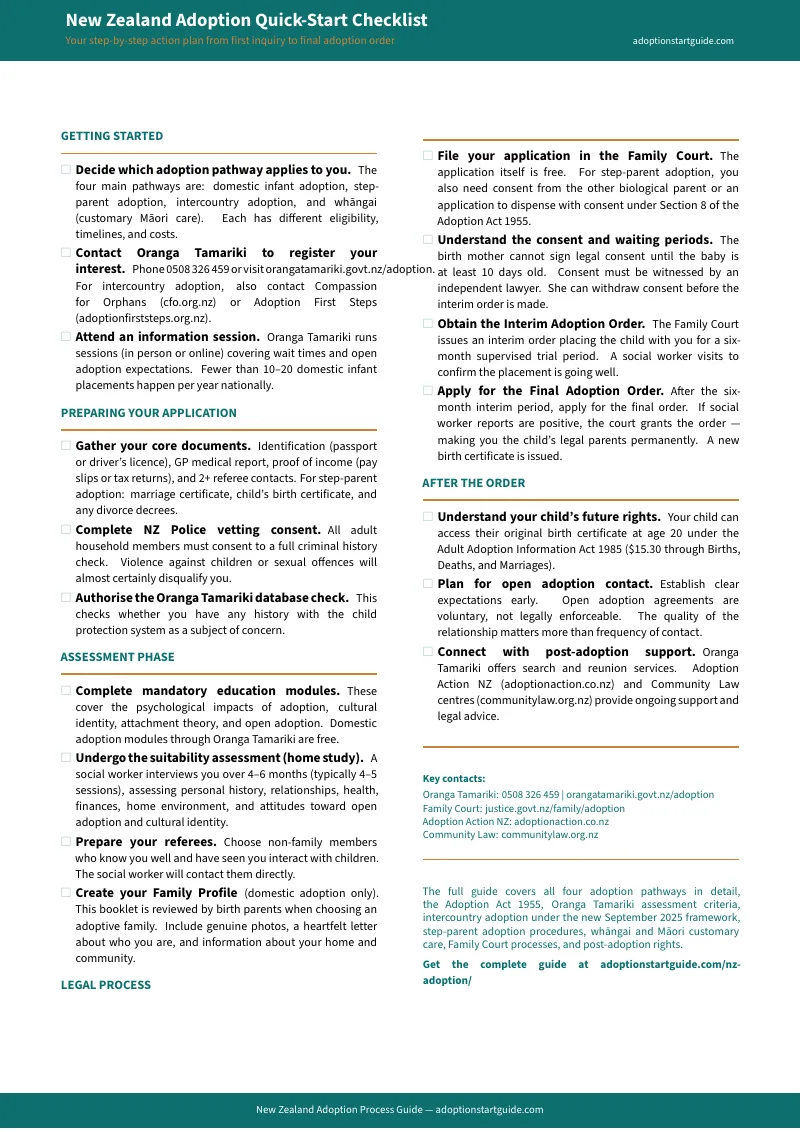
Download the New Zealand Adoption Quick-Start Checklist for a 17-step overview of the adoption process, from choosing your pathway through post-adoption rights and support. Free, no commitment. If you want the full guide with the 1955 Act decoded, four-pathway analysis, home study deep-dive, step-parent document checklist, intercountry 2025 reforms, cost breakdowns, and printable worksheets, click the button in the sidebar.
— less than one hour with a family lawyer
The typical New Zealand adoption applicant spends months piecing together the process from the Oranga Tamariki website, Facebook groups, Community Law consultations, and phone calls to social workers who handle hundreds of cases. They discover the domestic scarcity problem after they've already invested emotionally. They learn about the consent crisis in step-parent adoption after the other parent has already refused. They find out about Schedule 1AAB after they've paid a foreign agency's registration fee. This guide puts the critical decisions, realistic timelines, and legal requirements in front of you before you spend a dollar or a month on the wrong pathway.
If the guide doesn't deliver, reply to your download email at any time for a full refund. No forms. No justification required.