Arkansas has over 3,000 children in state care and ten DCFS area offices that each run the licensing process differently. Nobody publishes which office does what.
You felt the pull to foster. Maybe it started at church, maybe it started when you saw the news about kids sleeping in DCFS offices because there weren't enough homes. Either way, you went to the Arkansas Department of Human Services website to find out what to do next. What you found was the 2025 Code of Arkansas Rules database — a searchable but dense legal archive that replaced the old policy manuals in January 2025. You found PUB-30, the foster family handbook. You found references to TIPS-MAPP training, Minimum Licensing Standards, and background check requirements spread across multiple pages with no clear starting point.
What you didn't find was a plain-language answer to the question every Arkansas family asks first: what exactly do I need to do, in what order, and how long will it actually take in my county?
The DHS website gives you the rules. It doesn't tell you that Area 1 in Northwest Arkansas processes applications on a different timeline than Area 10 in the Delta. It doesn't mention that kinship caregivers can request non-safety waivers for things like bedroom square footage — waivers that DCFS staff rarely explain proactively. It doesn't help a gig worker or cattle farmer in Sebastian County figure out how to document "stable income" when their pay doesn't come in biweekly paychecks. And it certainly doesn't explain what to do when your assigned caseworker stops returning calls for three weeks, which happens routinely in a system where workers carry an average of 29 cases each.
Your church has the heart for this. The "Overflow" movement, Immerse Arkansas, the Arkansas Baptist Connected program — these communities are why you're here. But the spiritual calling and the state licensing process are two different conversations. Your pastor can encourage you to foster. Your pastor cannot tell you whether your spare bedroom meets the 50-square-foot-per-occupant rule or how to store your firearms so they pass the first home walkthrough.
The Silent Caseworker: Your Arkansas Foster Care Licensing Guide
This guide is built for the Arkansas DCFS system and nobody else's. Every chapter, every checklist, every recommendation is grounded in the 2025 Code of Arkansas Rules, the DCFS Minimum Licensing Standards, the current board rate schedule, and the operational realities of the ten area offices that serve this state. It covers the gap between what DHS posts online and what you actually need to know to get from "interested" to "licensed" without unnecessary delays, failed inspections, or months of waiting for information your area office never volunteered.
What's inside
- Area Office Navigator — Arkansas runs foster care through ten DCFS area offices, and each one operates with its own pace, training schedules, and informal expectations. This chapter maps the ten areas, explains how to identify your assigned office, and gives you the practical differences between offices in metro corridors like Little Rock and NWA versus rural regions like the Delta counties — where wait times for permanency can stretch past 50 months. Know what you're walking into before you make the first call.
- TIPS-MAPP Training Walkthrough — The mandatory 30-hour, 10-session TIPS-MAPP training is the single biggest source of attrition for Arkansas applicants. Families sign up, then drop out around meeting four when the time commitment starts straining a marriage or a work schedule. This chapter breaks down all ten sessions — from the orientation meeting through "Endings and Beginnings" — so you and your spouse can see the full 10-week commitment before you start. It explains what each session covers, what your trainer is evaluating, and how to schedule around it if you live in a rural county where classes are a two-hour drive away.
- Home Study Preparation — The home study is where families fail most often, and almost always because of something fixable. This chapter covers the physical requirements exhaustively: the 50-square-foot-per-occupant bedroom rule, the age-and-sex room-sharing restrictions (no sharing if either child is age 4 or older), emergency egress windows, smoke detector placement within 10 feet of every bedroom, and Arkansas's firearm storage standards — unloaded, locked, ammunition stored separately. It also covers the non-physical parts: what the caseworker evaluates about your family dynamics, your parenting philosophy, and your support network.
- Income and Financial Documentation — DCFS requires proof of "stable income" separate from the board rate, but the definition of stability varies between urban offices and rural offices where seasonal farming, cattle operations, and gig work are the norm. This chapter provides documentation templates for non-traditional income and breaks down the full financial picture: board rates from $451 per month for children ages 0-5 to $550 per month for teens, plus clothing allowances, school and personal needs stipends, initial clothing orders, and supplemental clothing orders for significant growth. If money is the reason you're hesitating, read this chapter first.
- Kinship Care Fast-Track — Arkansas law gives adult relatives first priority when a child is removed from a home. If a grandchild, niece, nephew, or family friend's child just landed in your care, you're already parenting — but you may not be licensed, which means you're not receiving full financial support. This chapter explains the provisional licensing pathway, which home safety requirements can be waived for relative placements (and which cannot), and how to move from emergency placement to full licensure without starting the process from scratch.
- Background Check and Document Roadmap — Arkansas requires criminal background checks, a Child Maltreatment Central Registry check, and an FBI fingerprint check for all adults in the household. This chapter lists every document you need — in order, with processing time estimates — so you can submit early and avoid the bottleneck that delays most families by weeks.
- Caseworker Communication and Escalation Path — With caseloads nearly double the national recommendation, Arkansas caseworkers are stretched thin. When your calls go unreturned for weeks, it's not personal — but it still stalls your application. This chapter gives you the escalation path within DHS that isn't published on the website: who to contact when your caseworker goes quiet, how to follow up without damaging the relationship, and how to keep your file moving through the system.
Printable standalone worksheets included
- Licensing Timeline Tracker — Every milestone from initial area office contact through license approval, with fill-in date fields. Print it, update it after every DCFS interaction, and always know where you stand in the 6-to-9-month process.
- Home Safety Inspection Checklist — Room-by-room walkthrough of every physical requirement under the Minimum Licensing Standards. Walk your house with this before the caseworker visits. Catch the smoke detector, the unlocked gun cabinet, the bedroom that's 48 square feet — before they become a corrective action plan that sets you back months.
- Document Organization Sheet — Background checks, medical clearances, income verification, personal references, TIPS-MAPP completion certificates — every document you'll need, in the order you'll need it.
- Financial Planning Worksheet — Board rates by age group, clothing and personal needs allowances, and your household expenses in one printable sheet. Take it to the kitchen table conversation with your spouse.
Who this guide is for
- First-time prospective foster parents — You've been thinking about this for months. You attended an orientation or your church ran a recruitment campaign. You went to the DHS website and found a regulatory database where you expected a step-by-step guide. You need someone to lay out the process in plain language and tell you what to do this week.
- Kinship caregivers — A grandchild, niece, nephew, or family friend's child was placed with you after a removal. The child is already in your home. You didn't plan for this. Now you need to get licensed to access full board payments and support services, and you're navigating a system you never expected to enter on a timeline you didn't choose.
- Rural and Delta families — You have the space, the stability, and the heart to foster, but you live two hours from the nearest training site and your area office doesn't always call back. The need for licensed homes in your region is acute — children in the Delta wait years longer for permanent placement than children in NWA. This guide shows you how to work with a rural area office and access training despite the distance.
- Faith-motivated families — Your church community, the Overflow movement, the Connected program, or your own reading of Scripture brought you here. The spiritual conviction is the engine. This guide is the GPS — it handles the regulatory navigation so your calling doesn't stall in a bureaucratic maze.
- Foster-to-adopt families — You're entering the foster care system with the hope of eventually providing a permanent home. You need to understand how Arkansas handles the transition from foster placement to termination of parental rights and adoption, and why the licensing step is the prerequisite for everything that follows.
Why the free resources fall short
The DHS website publishes the 2025 Code of Arkansas Rules — the official regulatory framework designed for attorneys and DCFS staff, not families sitting at the kitchen table trying to figure out if their house qualifies. It tells you what the rules are. It doesn't tell you which rules trip people up, how area offices differ in practice, or what your caseworker is actually evaluating during the home study.
The Arkansas Foster Parent Association provides peer support and advocacy for families who are already licensed. If you're still pre-licensing — stuck in the most confusing window of the entire journey — their resources assume a baseline of system knowledge you haven't built yet.
National foster care books on Amazon describe a generic process that doesn't account for Arkansas's ten area offices, the TIPS-MAPP training structure, the 2025 board rate schedule, or the firearm storage standards that apply in a state where gun ownership is the norm, not the exception. A guide written for a national audience will tell you to "contact your local agency." In Arkansas, that means figuring out which of ten area offices serves your county — and nobody's published that map in plain English.
The free Quick-Start Checklist
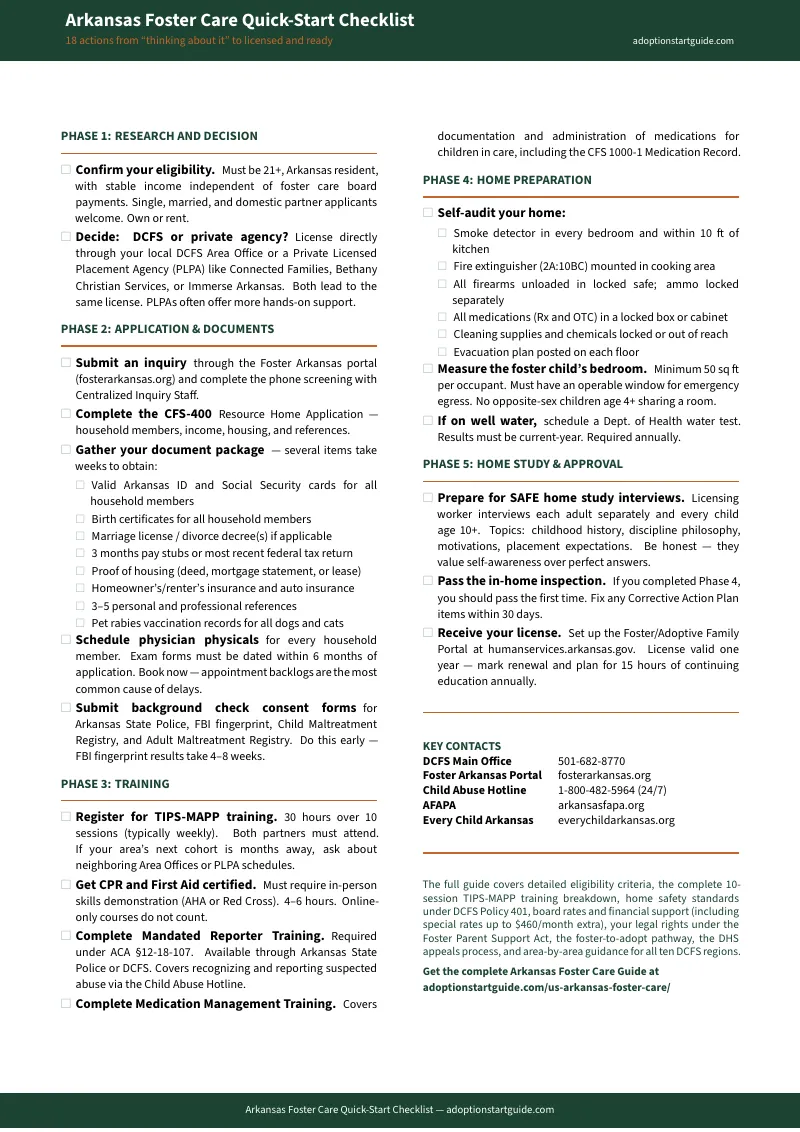
Download the Arkansas Foster Care Quick-Start Checklist for a five-phase overview of the licensing process, from initial area office contact through post-licensing obligations. Free, no commitment. If you want the full guide with the Area Office Navigator, TIPS-MAPP walkthrough, home study preparation, financial breakdown, kinship fast-track, and printable worksheets, click the button in the sidebar.
— less than one tank of gas to your area office
The typical Arkansas applicant spends weeks piecing together the licensing process from the Code of Arkansas Rules database, scattered DHS publications, and whatever their area office remembers to mention during the first phone call. A failed home inspection because of a safety issue you could have caught — an unlocked firearm, a bedroom two square feet too small, a missing smoke detector — delays your license by months. One checklist prevents that. One chapter on income documentation saves the gig worker or farmer from a rejection they never saw coming.
If the guide doesn't deliver, reply to your download email at any time for a full refund. No forms. No justification required.