California has 58 counties, 58 different wait times, and zero guides that tell you which one you're actually dealing with.
You went to the CDSS website looking for a clear path to becoming a foster parent. What you found was thousands of pages of Written Directives, eight versions of the RFA manual, and a system that assumes you already know the difference between a county Resource Family Approval and a Foster Family Agency certification. You don't. Almost nobody does at the start. And the orientation your county offers — if they have one scheduled this quarter — is a recruitment pitch, not a roadmap. You'll leave knowing fostering matters. You still won't know what to do on Monday morning.
Meanwhile, the system behind the curtain is fraying. Since 2024, more than two dozen Foster Family Agencies have shuttered across 13 counties after their liability insurer pulled coverage. Alameda County is running with a 34% vacancy rate among child welfare workers — meaning your assigned social worker might quit before your home study is finished. In Los Angeles, applicants report waiting nine to twelve months for approval against a state target of 90 days. In San Diego, it's three to six months. Your experience depends entirely on your county, and nobody maps that for you.
National foster care books on Amazon don't know that California replaced traditional foster licensing with Resource Family Approval in 2017. They describe training programs that don't exist here and skip the county-administered, 58-jurisdiction system that shapes every step of your application. A guide written for Ohio won't help you in Orange County. And the private consultants who do understand California's system charge $100 to $500 an hour for the same tactical knowledge you need before you've spent a dime.
The 58-County RFA Navigator: Your Strategic Guide to California Foster Care
This guide is built for California's Resource Family Approval system and nobody else's. Every chapter, every checklist, every recommendation is grounded in the current RFA Written Directives, Title 22 regulations, the Continuum of Care Reform framework, and the county-specific realities that determine whether your approval takes four months or fourteen. It's not a repurposed national handbook. It's the operational layer between what CDSS posts online and what you actually need to know to get approved — in your county, under current conditions.
What's inside
- County vs. FFA Decision Matrix — This is the single most consequential choice in the California foster care process, and nobody gives you a framework for making it. County approval gives you first-call priority for placements in your area. FFA certification gives you weekly in-home support and access to children with higher Level of Care needs — but the FFA insurance crisis has closed agencies in 13 counties since 2024. This chapter maps the tradeoffs by region so you choose the path that's actually stable and available where you live, not the one that sounds better on a website that hasn't been updated since the crisis started.
- Metro-Specific Timeline Guides — Los Angeles, the Bay Area, the Inland Empire, San Diego, and Sacramento each operate in functionally different realities. LA County processes the highest volume of applications in the country and has the longest delays. Alameda County's staffing crisis means your paperwork might sit untouched for weeks. San Diego has the lowest rate of out-of-home care among major counties and moves faster. This chapter gives you unfiltered, county-specific timelines so you can plan around reality rather than the state's 90-day fiction.
- LiveScan and Background Check Strategy — Every adult in your household must clear DOJ, FBI, and Child Abuse Central Index checks through LiveScan fingerprinting. A clean record clears in days. A single "hit" — even a dismissed misdemeanor from fifteen years ago — triggers the exemption process, and you have a 45-day window to submit character references on form LIC 301E with substantial evidence of rehabilitation. Most applicants don't learn about this window until the rejection letter arrives. This chapter tells you how to prepare your exemption package before you submit your fingerprints, so a routine background flag doesn't derail your approval by months.
- RFA Home Assessment Walkthrough — The RFA-03 checklist is what your county worker or FFA assessor uses to inspect your home against Title 22 standards. Pool fencing must be five feet high with self-closing, self-latching gates that swing away from the water. Firearms must be unloaded in a locked container with ammunition stored separately. Medications and cleaning products must be inaccessible to children. This chapter is a room-by-room walkthrough of every requirement, including the items that trip up California homes specifically — backyard pools, detached garage conversions, and the bedroom-sharing rules that limit four children per room.
- Kinship Emergency Placement Guide — When a child is removed and placed with a relative or Non-Relative Extended Family Member, you have five business days to submit forms RFA-01A and RFA-01B to secure emergency funding. Most kinship families don't know this deadline exists until it's passed. This chapter walks you through the emergency placement protocol, explains the difference between emergency approval and full RFA, and shows you how to access the financial support you're entitled to while the full approval process catches up.
- Financial Reality by Level of Care — California's foster care rates range from $1,301 per month at the basic level to $7,078 per month for Intensive Services Foster Care through an FFA. But the rate you receive depends on the child's assessed Level of Care, not your preferences. This chapter breaks down all five LOC tiers, the Specialized Care Increment for children with documented health or behavioral needs, Medi-Cal coverage through age 26, the Approved Relative Caregiver program for kin who don't meet federal eligibility, and the real out-of-pocket costs nobody mentions at orientation — transportation for birth family visits, childcare gaps during court dates, and the career disruption from Child and Family Team meetings scheduled during work hours.
- AB 12 and Non-Minor Dependents — California extends foster care to age 21 under the Fostering Connections to Success Act. Hosting a Non-Minor Dependent under a Supervised Independent Living Placement is a fundamentally different caregiving relationship than fostering a young child, with different expectations, different stipends, and different RFA-03 safety requirements. This chapter explains what AB 12 means in practice and how to qualify for the host family model.
- Cultural Obligations and Legal Protections — Cal-ICWA (AB 3176) imposes stricter requirements than federal ICWA for placements involving Native American children — California mandates "active efforts" toward family reunification that exceed the federal standard. AB 458 protects LGBTQ+ families from discrimination in the approval process. This chapter covers both the legal protections you have and the cultural responsibilities you'll carry, including what concurrent planning looks like when reunification with the birth family is the court's primary goal.
Printable standalone worksheets included
- Licensing Timeline Tracker — Every milestone from initial inquiry through RFA certificate, with fill-in date fields. Print it, update it after every county or FFA contact, and always know where you stand in the process.
- Home Safety Inspection Checklist — Room-by-room walkthrough of every RFA-03 requirement under Title 22. Walk your house with this before the assessor visits.
- Document Organization Sheet — RFA-01A, RFA-01B, LiveScan results, health questionnaire (RFA-07), personal references, CPR certification, and training records — every document you need, in the order you need it.
- Financial Planning Worksheet — Monthly rates by Level of Care, county vs. FFA rate comparison, Specialized Care Increments, and hidden costs in one printable sheet. Take it to your household budget conversation.
Who this guide is for
- First-time prospective foster parents — You've been researching for months. You attended a county orientation or heard about the need through your community. You went to the CDSS website and found Written Directives Version 8.0, a 58-county patchwork, and no clear answer to whether you should go through the county or an FFA. You need the system translated into plain language with a realistic timeline for your specific region.
- Kinship caregivers — A grandchild, niece, nephew, or family friend's child was removed and placed with you on an emergency basis. The child is already in your home. You need to file RFA-01A within five business days, navigate the background check process you never planned for, and get fully approved so you can access the financial support and services that emergency-only caregivers don't receive.
- Latino families considering foster care — More than half of Los Angeles County's foster youth are Latino, yet Latino resource families are severely underrepresented. If you want to provide a bilingual, culturally connected home and the bureaucratic process feels like it was designed to discourage you, this guide cuts through the paperwork in clear, practical steps.
- LGBTQ+ families — California's AB 458 protects you from discrimination in the RFA process. But legal protection and lived experience aren't always the same thing. This guide addresses the specific concerns LGBTQ+ applicants report — agency selection, social worker interactions, and how to advocate for yourself if protections aren't being honored.
- Foster-to-adopt families — You're entering foster care with the hope of eventually providing a permanent home. California's RFA approval simultaneously clears you for foster care, guardianship, and adoption — but the concurrent planning process, reunification timelines, and the emotional reality of supporting a child's return to their birth family while preparing for permanency require preparation that orientations don't provide.
Why the free resources aren't enough
The CDSS website publishes the RFA Written Directives — eight versions of regulatory language designed for county administrators, not applicants. It tells you what the rules are. It does not tell you which rules trip people up, how the 58 counties differ in practice, or what to do when your assigned social worker leaves mid-assessment and nobody picks up your case for six weeks.
County orientation sessions are recruitment events. They're designed to inspire you to apply, not prepare you to succeed. You'll hear statistics about the need. You won't get a checklist for passing the RFA-03 home inspection or a strategy for the LiveScan exemption window.
Facebook groups and Reddit threads provide emotional support, but an applicant in a San Diego group gets different advice on pool safety than one in Sacramento — because individual social workers interpret the same RFA-03 checklist differently. Crowdsourced guidance is well-intentioned and contradictory.
National foster care books describe a licensing process that California abolished in 2017. They don't know about Resource Family Approval, the county vs. FFA decision, Title 22 regulations, or the FFA insurance crisis that has reshaped the landscape since 2024. A guide written for a national audience will tell you to contact a private agency. In 13 California counties, that agency may no longer exist.
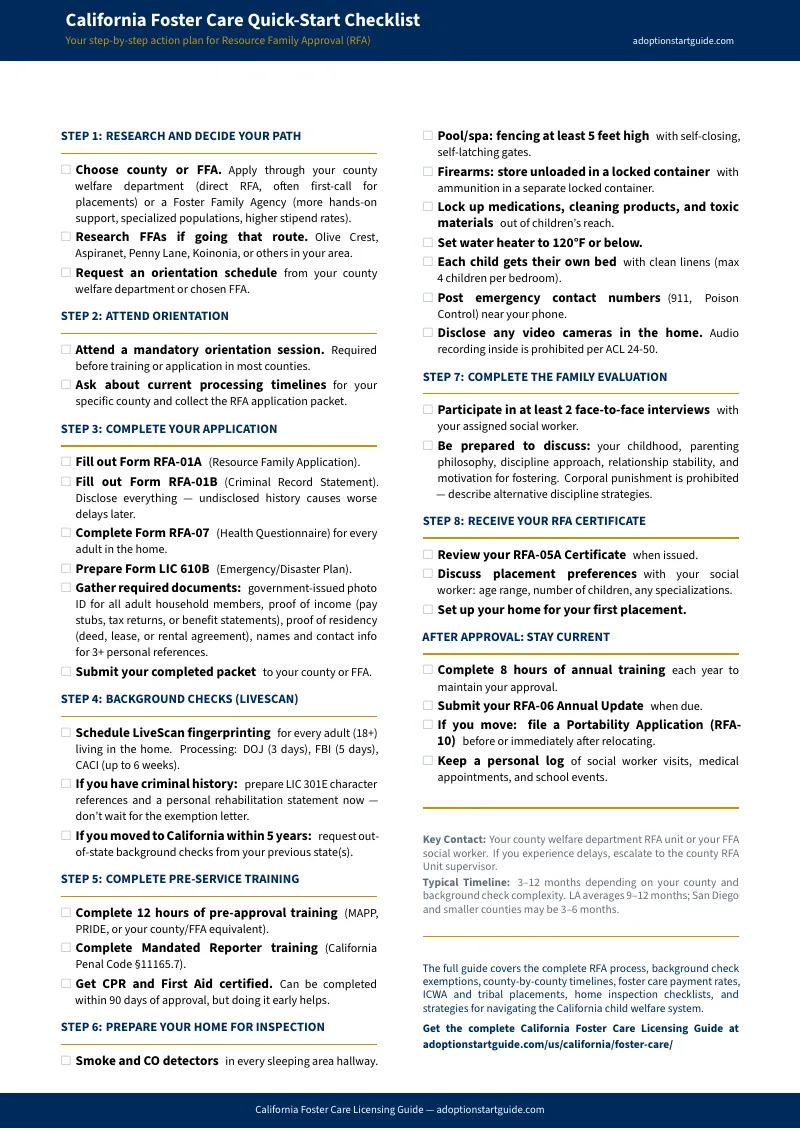
The free Quick-Start Checklist
Download the California Foster Care Quick-Start Checklist for a one-page overview of the RFA process, from initial inquiry through approval. Free, no commitment. If you want the full guide with the 58-County Navigator, LiveScan strategy, county-specific timelines, financial breakdown, and printable worksheets, click the button in the sidebar.
— less than parking at the courthouse
The typical California applicant spends 40 to 80 hours piecing together the RFA process from Written Directives, county websites, FFA brochures, and forum posts — and still doesn't know whether they chose the right path until months in. This guide distills the most critical decisions into a weekend-ready roadmap. A failed RFA-03 inspection because of an unlocked pool gate or incorrect firearm storage delays your approval by months. One checklist prevents that. A LiveScan hit you didn't prepare for burns your entire 45-day exemption window. One chapter prevents that.
If the guide doesn't deliver, reply to your download email at any time for a full refund. No forms. No justification required.