You're ready to adopt in Colorado. Then you discovered that CDHS, the county courts, and the Children's Code don't talk to each other.
Colorado is not like most states. It's an "agency state" where every placement must go through a licensed child placement agency or county Department of Human Services, even when you find the birth mother yourself. The designated adoption route still costs $5,500 in non-refundable counseling fees before your home study begins. Colorado has no putative father registry, unlike 32 other states, so a single gap in the "diligent inquiry" required under C.R.S. Section 19-5-105 can void a finalized adoption. And Marlo's Law, passed in 2022, lets families using assisted reproduction skip the home study entirely, but most generalist attorneys still default to the $3,000 SAFE process because they haven't read the statute.
You've already done the research. You found the CDHS website, which covers foster-to-adopt but says nothing about private or designated adoption. You found the Colorado Judicial Branch self-help page, which gives you blank JDF forms but no explanation of the sequence from petition to finalization hearing. You found the Colorado Bar Association, where Front Range adoption attorneys bill $321 per hour on average. And you found Facebook groups and Reddit threads where well-meaning strangers mix up Colorado law with Kansas and Nebraska statutes in the same comment.
The 2025 Child Protection Ombudsman report said it directly: there is "no central information portal that provides the public and adoptive families complete and clear information" about Colorado's adoption system. The information exists. It's scattered across CDHS fact sheets, CDPHE vital records pages, C.R.S. Title 19, county court procedural rules, and agency orientation packets. Piece it together yourself and you'll burn weeks reading documents that explain the rules but never tell you the order of operations as a parent.
The C.R.S. Title 19 Roadmap
This is a complete, Colorado-specific adoption guide built around the problem every family in this state hits: navigating a system where CDHS, the county courts, and licensed agencies each own a piece of the process but none of them explain how the pieces connect. Not a national overview. Not an agency brochure designed to funnel you into one program. Every chapter, every checklist, every cost figure is grounded in the Colorado Children's Code (C.R.S. Title 19), current CDHS policies, SAFE home study methodology, and the real-world experience of families who have adopted in Colorado.
What's inside
- Three-pathway comparison table -- Foster-to-adopt through county DHS, designated (private match) adoption through a licensed agency, and confirmatory adoption under Marlo's Law, mapped side by side. Costs, timelines, eligibility, and the realistic wait for each pathway so you choose the right one before investing months in the wrong direction. Foster-to-adopt runs $0 to $2,000. Designated adoption costs $25,000 to $70,000. Confirmatory adoption under Marlo's Law runs $1,500 to $3,500. That decision deserves more than a caseworker's one-sentence summary.
- The "agency state" decoder -- Colorado does not allow true independent adoption. Even when you find the birth mother yourself, a licensed agency must handle counseling, background checks, and post-placement supervision. This chapter explains the designated adoption process, breaks down the LFSRM and Adoption Alliance fee schedules ($10,900 to $12,300 base), and shows you where the non-refundable $5,500 counseling fee fits in. No agency website will give you this comparison because no agency has an incentive to.
- The putative father "diligent inquiry" navigator -- Colorado has no putative father registry. Instead, C.R.S. Section 19-5-105 requires the court to conduct a "diligent inquiry" to identify the birth father, including investigating cohabitation, informal acknowledgment of paternity, and formal filings. A missed step in this process is the number one legal vulnerability in Colorado adoptions. This chapter gives you the documentation checklist that prevents a future "fraud on the court" challenge.
- Marlo's Law confirmatory adoption guide -- Enacted in 2022 under C.R.S. Section 19-5-203.5, this pathway lets families using assisted reproduction bypass the SAFE home study, fingerprinting, TRAILS background checks, and in-person court appearances. Most generalist family attorneys still don't know about it. This chapter explains eligibility, the streamlined filing process, and how it can save $3,000 and six months of waiting.
- SAFE home study and TRAILS preparation -- The Structured Analysis Family Evaluation is Colorado's mandated home study methodology. This chapter covers the 27.5-hour certification training requirement, the 75-square-foot outdoor play space standard, and the 90-day fingerprint validity window that catches families who start too early. Includes the TRAILS background check process and how to prevent clearance expiration from stalling your timeline.
- County court process map -- From filing the JDF 503 Petition for Custodial Adoption to the finalization hearing, mapped by county. Includes the distinction between Denver Juvenile Court and Jefferson County District Court procedures, the post-placement supervision period, and the timeline from decree to amended birth certificate through CDPHE Vital Records.
- Open adoption contact agreements -- Colorado allows enforceable post-adoption contact agreements, but only if they are properly filed with the court before finalization. Agency "promises" of ongoing contact have no legal standing once the decree is signed. This chapter explains C.R.S. Section 19-5-203.5 on contact enforceability and how to protect the relationship you negotiated.
- LGBTQ+ and single-parent pathways -- Colorado's adoption code is fully inclusive, but Marlo's Law was written specifically for families using assisted reproduction. This chapter covers second-parent adoption, joint adoption, and the confirmatory pathway so non-biological parents secure legal recognition that holds up across state lines.
- Kinship and stepparent fast tracks -- C.R.S. Section 19-5-203 provides specific provisions for relatives adopting children already in their care. This chapter covers the 182-day residency waiver for stepparents, the preference given to grandparents under Section 19-5-104, and the kinship adoption process through county DHS when a relative's child enters the system due to substance abuse or neglect.
- Financial assistance and subsidies -- Colorado adoption assistance through CDHS, the federal adoption tax credit, Title IV-E subsidies for special-needs children, and the adoption grants available through Colorado-specific organizations. The critical rule: the Adoption Assistance Agreement must be signed before finalization or you lose eligibility permanently.
Who this guide is for
- Front Range professionals exploring private adoption -- You work in Denver, Boulder, or Fort Collins. You navigate complex systems for a living. But adoption involves a system where CDHS, licensed agencies, and the county courts each assume you already understand the other two. This guide is the briefing document you'd write for yourself if you had the time.
- Faith-based families answering the call -- You're connected through Project 1.27, LFSRM, or your Colorado Springs congregation. The calling is clear. The 27.5-hour training, the SAFE home study, and the county DHS process are not. This guide maps the foster-to-adopt pathway from first orientation to finalization hearing so the legal process doesn't derail your mission.
- Kinship caregivers who need legal security -- You've been raising your grandchild, niece, or nephew for months or years. You lack legal standing. The child's parent has abandoned them or is involved with DHS. This guide covers the kinship adoption pathway, the termination of parental rights process, and the subsidies you're entitled to.
- Stepparents adopting a spouse's child -- The absent parent hasn't been involved in years. C.R.S. Section 19-5-203 governs consent requirements, including the 182-day residency waiver and the conditions under which consent can be waived. This guide walks you through the home study, the consent or termination process, and the finalization hearing.
- LGBTQ+ families building through assisted reproduction -- Marlo's Law was written for you, but your attorney may not know it exists. This guide covers the confirmatory adoption pathway, second-parent adoption, and how to secure legal parentage that holds up in every state, not just Colorado.
- Families adopting from foster care -- The child in your care just had reunification ruled out. You've been told to "start the adoption paperwork," but the transition from foster license to adoption petition involves different documents, a mandatory supervision period, and an Adoption Assistance Agreement that must be executed before the judge signs the decree. This guide maps that transition.
Why the free resources aren't enough
CDHS's website is solid for the public foster-to-adopt pathway. It explains orientations, training, and county contacts. But it provides zero guidance on private or designated adoption. If you're not fostering first, CDHS has nothing for you.
The Colorado Judicial Branch self-help page offers downloadable JDF forms -- petitions, consent forms, relinquishment documents. But forms without narrative are like tax forms without instructions. They tell you what the court needs. They don't tell you when to file, in what order, or what happens after you submit.
The Colorado Bar Association connects you with adoption attorneys. It does not provide the educational baseline you need to make those $321-an-hour consultations efficient. Families routinely spend their first billable hour covering foundational questions this guide answers in Chapter 1.
Facebook groups and Reddit threads give you emotional support and anecdotal experience. They also mix Colorado law with neighboring states' statutes in the same thread, assume a putative father registry exists when it doesn't, and offer advice based on other people's counties and courts. In Colorado, where Jefferson County and Denver Juvenile Court follow different procedures, that distinction matters.
National adoption books mention "state adoption laws" without explaining that Colorado is an agency state where independent adoption isn't what you think it is. They reference putative father registries that Colorado doesn't have. They mention home studies but not the SAFE methodology or the TRAILS background check system. They reference "the court" without distinguishing between county district courts and Denver Juvenile Court.
Printable standalone worksheets included
The guide comes with printable standalone PDFs designed for real-world use:
- Pathway Comparison Card -- Three pathways side by side on one page. Print it, sit down with your partner, and make the decision that shapes everything else.
- Background Clearance Tracker -- CBI fingerprints, FBI checks, TRAILS background clearance, and county-specific requirements. Submit dates, follow-up dates, and the 90-day validity window that prevents your clearances from expiring before your home study is done.
- Court Filing Checklist -- Every document required for the Colorado adoption petition. Give it to your attorney and save yourself a billable hour of foundational questions.
- Post-Finalization Action Plan -- Amended birth certificate through CDPHE, Social Security update, insurance enrollment, estate planning. Every administrative step after the decree, in order, with contacts and the four-week CDPHE processing timeline.
The free Quick-Start Checklist
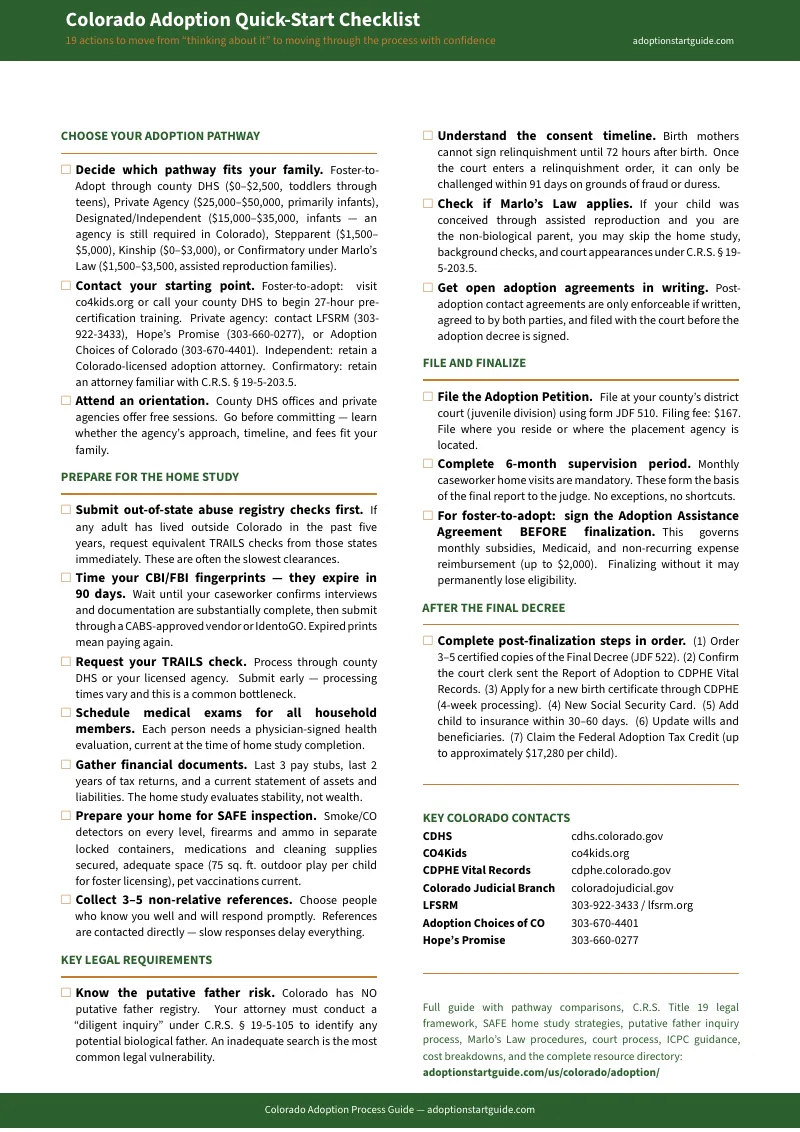
Download the Colorado Adoption Quick-Start Checklist for a one-page overview of the key steps from first inquiry to finalization. Free, no commitment. If you want the full guide with the three-pathway comparison, the agency state decoder, the putative father diligent inquiry navigator, Marlo's Law walkthrough, and all the printable worksheets, click the button in the sidebar.
-- less than three minutes of a Colorado adoption attorney's time
The average adoption attorney in Colorado bills $321 per hour. Denver partners charge $450 to $700. Families routinely spend their first billable hour covering foundational questions this guide answers in Chapter 1. The C.R.S. Title 19 Roadmap doesn't replace your attorney. It makes sure you don't pay your attorney to teach you the basics of the Colorado Children's Code.