
You're ready to adopt in D.C. Then you discovered that CFSA, the Superior Court, and the D.C. Code don't talk to each other.
Washington, D.C. is not a state. It's a singular jurisdiction with one court, one child welfare agency, and a legal code that differs from both Maryland and Virginia in ways that matter. The 14-day revocation window is not 30 days. The birthplace jurisdiction rule under D.C. Code Section 16-301 lets out-of-state families file in the District. The contracted agency model means CFSA will refer you to Barker or Catholic Charities before they'll answer your first question. And Superior Court Adoption Rules 1-70 govern a Show Cause process that can add months to your timeline if you don't understand it before your attorney starts billing.
You've already done the research. You found CFSA's website, which covers foster-to-adopt but says nothing about private or independent adoption. You found the D.C. Superior Court forms page, which gives you blank petitions but no explanation of the sequence from filing to Final Decree. You found the D.C. Bar referral service, where adoption attorneys bill $492 to $700 per hour. And you found Facebook groups and Reddit threads where well-meaning strangers mix up D.C. law with Maryland and Virginia statutes in the same paragraph.
The information exists. It's scattered across CFSA fact sheets, D.C. Code Title 16, Superior Court procedural rules, agency orientation packets, and the occasional forum post from someone in a different jurisdiction entirely. Piece it together yourself and you'll burn weeks reading documents that explain the rules but never tell you the order of operations as a parent.
The D.C. Superior Court Roadmap
This is a complete, District-specific adoption guide built around the problem every D.C. family hits: navigating a system where CFSA, the Superior Court, and private agencies each own a piece of the process but none of them explain how the pieces connect. Not a national overview. Not an agency brochure designed to funnel you into one program. Every chapter, every checklist, every cost figure is grounded in the D.C. Code (Sections 16-301 through 16-317), current CFSA policies, Superior Court Adoption Rules 1-70, and the real-world experience of families who have adopted in the District.
What's inside
- Three-pathway comparison table — Foster-to-adopt through CFSA, private agency, and independent (parental placement) adoption mapped side by side. Costs, timelines, eligibility, and the realistic wait for each pathway so you choose the right one before investing months in the wrong direction. Foster-to-adopt runs $0 to $2,000. Private agency costs $20,000 to $50,000. Independent runs $15,000 to $35,000. That decision deserves more than a caseworker's one-sentence summary.
- The contracted agency decoder — CFSA delegates recruitment, training, and home studies to private agencies like Barker, Catholic Charities, LSSNCA, and Adoptions Together (now Bethany Christian Services). This chapter explains why CFSA refers you out, how to evaluate which contracted agency fits your family, and what to expect from each. No agency website will give you this comparison because no agency has an incentive to.
- D.C. Code Section 16-301 jurisdiction navigator — Who can file in D.C. Superior Court, the birthplace jurisdiction rule that draws out-of-state families, and how ICPC applies when your baby is born at Inova Fairfax instead of Sibley Memorial. The DMV jurisdictional overlap trips up more families than any other single issue.
- The 14-day revocation rule explained — How voluntary relinquishment works in D.C., why the 14-day window differs from Maryland's 30 days and Virginia's immediate irrevocability, and exactly what happens if a birth parent revokes. Includes the distinction between agency relinquishment and direct consent in independent adoption.
- Show Cause process walkthrough — When the birth father is unknown or uncooperative, the court issues a Show Cause order under Adoption Rule 4. This chapter covers the timeline (21-35 days), constructive service by publication, and how to prevent the process from adding months to your finalization.
- LGBTQ+ parentage and second-parent adoption — D.C. offers the strongest protections in the country, but a clerical error in your second-parent adoption petition or Parentage Act filing can compromise federal recognition. This chapter covers the D.C. Human Rights Act, the Parentage Act, and the "belt-and-suspenders" approach that family attorneys recommend.
- Independent adoption expense rules — D.C. Code Section 16-305 makes independent adoption legal, but the expense limitations are strict. Medical, legal, and counseling costs only. This chapter explains the verified accounting requirement, what constitutes a prohibited payment, and how to stay on the right side of the law.
- Break Seal process and birth certificate access — D.C. is a "restricted" jurisdiction for adoption records. This chapter covers D.C. Code Section 16-311, the 2018 Vital Records Modernization Act, and the court petition process for adult adoptees seeking original birth certificates.
- Home study preparation for D.C. housing — Lead paint clearance for pre-1978 rowhouses in Capitol Hill, Logan Circle, and Petworth. Fire safety in multi-unit buildings. Renter-specific considerations. The CPR clearance backlog at CFSA and how to prevent it from stalling your timeline.
- Adoption subsidy and financial assistance — CFSA daily rates ($33.69 to $49.50 depending on category), Medicaid eligibility through age 21, non-recurring expense reimbursement up to $2,000, the federal adoption tax credit (approximately $17,280 for 2025), and federal employee adoption benefits up to $5,000. The critical rule: the Adoption Assistance Agreement must be signed before finalization or you lose these benefits permanently.
Who this guide is for
- Foster parents in the CFSA system — The child in your care just had reunification ruled out. You've been told to "start the adoption paperwork," but the transition from foster license to adoption petition involves a different set of documents, a mandatory six-month supervision period, and an Adoption Assistance Agreement that must be executed before the judge signs the decree. This guide maps that transition.
- LGBTQ+ families building in D.C. — D.C. is the most affirming jurisdiction in the country, but bureaucratic hurdles don't care about your orientation. Second-parent adoption, the Parentage Act, and joint adoption each follow different procedures with different federal implications. This guide covers all three so your legal security matches D.C.'s policy intentions.
- Professionals exploring private adoption — You work on K Street, the Hill, or at an NGO. You can navigate complex systems for a living. But adoption involves a system where CFSA, private agencies, and the Superior Court each assume you already understand the other two. This guide is the briefing document you'd write for yourself if you had the time.
- Stepparent and domestic partner adopters — The absent parent hasn't been involved in years. D.C. Code Section 16-304 governs consent requirements, including the conditions under which consent can be waived. This guide walks you through the home investigation, the Show Cause process, and the finalization hearing.
- Kinship caregivers — A family member's child entered CFSA custody and you stepped in. You assumed relative adoption would be simpler. D.C. requires the same background checks, the same home study, and the same court finalization regardless of your biological connection. This guide covers the kinship-specific path, including the subsidies you're entitled to.
- DMV residents confused by jurisdiction — You live in D.C., work in Virginia, and your partner commutes to Maryland. A birth at a hospital across the state line triggers ICPC requirements that can delay placement for weeks. This guide explains when D.C. law applies, when it doesn't, and how to make the District's singular court system work in your favor.
Why the free resources aren't enough
CFSA's website is excellent for the public foster-to-adopt pathway. It explains orientations, training, and the contracted agency system. But it provides zero guidance on private agency or independent adoption. If you're not fostering first, CFSA's website has nothing for you.
The D.C. Superior Court website offers downloadable forms — Petitions for Adoption, Break Seal motions, Vital Records forms. But forms without narrative are like tax forms without instructions. They tell you what information the court needs. They don't tell you when to file, in what order, or what happens after you submit.
The D.C. Bar Lawyer Referral Service connects you with adoption attorneys. It does not provide the educational baseline you need to make those $500-an-hour consultations efficient. Families routinely spend their first billable hour covering foundational questions this guide answers in Chapter 1.
Facebook groups and Reddit threads give you emotional support and anecdotal experience. They also mix D.C. law with Maryland and Virginia statutes in the same thread, confuse the CFSA contracted model with direct services, and offer advice based on other people's counties and courts. In D.C., there's only one court — but the people giving you advice online may not know that.
Generic adoption books on Amazon mention "state adoption laws" without distinguishing that D.C. is not a state. They reference a "30-day revocation period" that applies to Maryland, not the District's 14 days. They mention home studies but not the CFSA Child Protection Register backlog. They reference "the court" without mentioning Superior Court Rules 1-70 or the Show Cause process that governs birth father notification.
Printable standalone worksheets included
The guide comes with printable standalone PDFs designed for real-world use:
- Pathway Comparison Card — Three pathways side by side on one page. Print it, sit down with your partner, and make the decision that shapes everything else.
- Background Clearance Tracker — MPD criminal check, FBI fingerprints, CFSA Child Protection Register, and out-of-state registry checks. Submit dates, follow-up dates, and the order that prevents your home study from stalling.
- Court Filing Checklist — Every document required for the D.C. Superior Court adoption petition. Give it to your attorney and save yourself a billable hour of foundational questions.
- Post-Finalization Action Plan — New birth certificate, Social Security update, insurance enrollment, estate planning. Every administrative step after the Final Decree, in order, with contacts.
The free Quick-Start Checklist
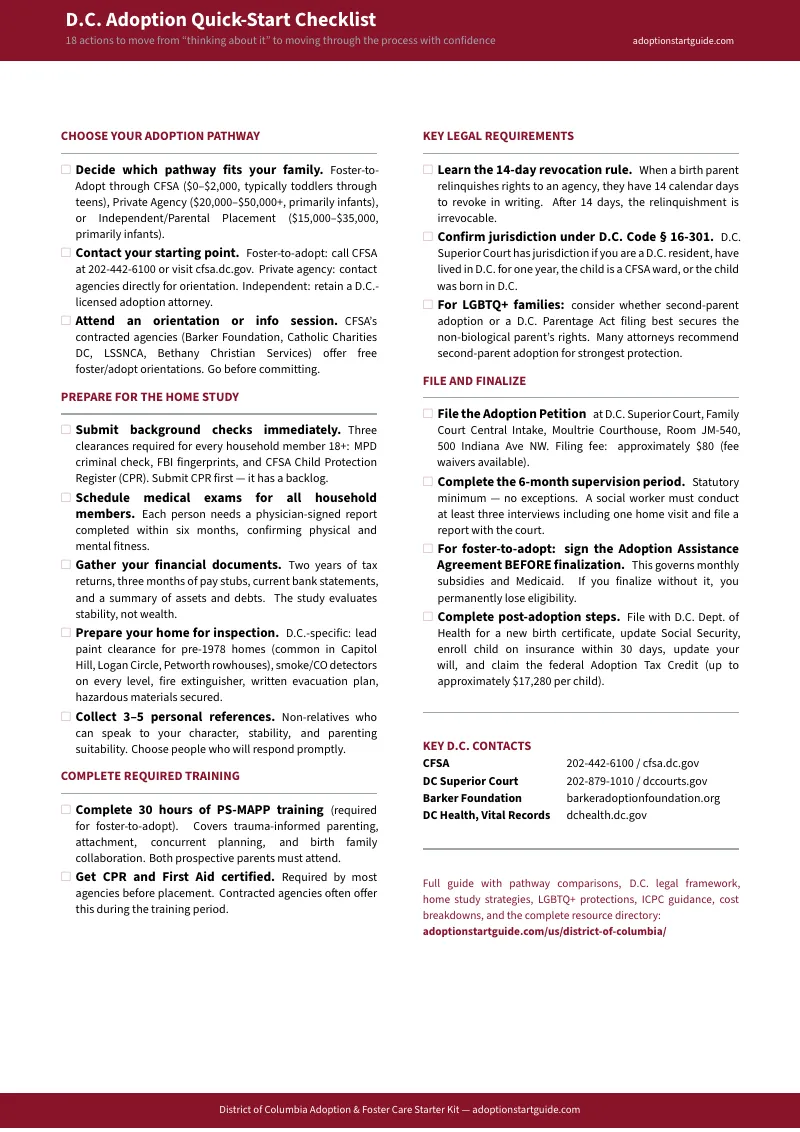
Download the District of Columbia Adoption Quick-Start Checklist for a one-page overview of the key steps from first inquiry to finalization. Free, no commitment. If you want the full guide with the three-pathway comparison, the contracted agency decoder, the 14-day revocation walkthrough, LGBTQ+ parentage protections, and all the printable worksheets, click the button in the sidebar.
— less than two minutes of a D.C. adoption attorney's time
A single consultation with an adoption attorney in the District starts at $492 per hour. Families routinely spend the first billable hour covering foundational questions this guide answers in Chapter 1. The D.C. Superior Court Roadmap doesn't replace your attorney. It makes sure you don't pay your attorney to teach you the basics of D.C. Code Section 16-301.