Iowa changed its foster care rules in 2026. The state forgot to tell you how to follow them.
Senate File 2096 replaced the old 30-hour PS-MAPP training with a competency-based model. That means there's no fixed class schedule to complete anymore. Instead, Iowa's Department of Health and Human Services now evaluates whether you can actually demonstrate the skills — attachment awareness, trauma-informed behavior management, birth family collaboration — before granting a license. The hours went down. The bar went up. And the official documentation still references the old system in places, creating a confusing patchwork of outdated handbooks and new requirements that haven't been fully reconciled.
Meanwhile, 2,427 children were referred to Iowa foster care in 2024. Only 1,734 licensed homes were available. That's a gap of nearly 700 families, and it's growing. In the Western Service Area around Sioux City and Council Bluffs, placement stability sits at 59.3%. Kids are sleeping in HHS offices because there aren't enough homes to put them in. The need is not abstract. It's happening in your service area right now.
The Iowa HHS website gives you the legal requirements. It does not explain how to meet them. The Iowa Foster and Adoptive Parents Association is an excellent resource for families who are already licensed — it's built for current foster parents, not applicants trying to figure out step one. Four Oaks orientations are informative but assume you already understand the terminology: Resource Family, fictive kin, NTDC, BHIS, TOP scores. If you walked in cold, you left with more questions than you came with.
Amazon books about foster care were written for a national audience. They don't know about Iowa Code Chapter 237 or Senate File 2096. They'll describe training programs that don't exist here and skip the five-service-area system that shapes every placement decision in the state. A guide written for Ohio won't help you in Polk County.
The Iowa Licensing Roadmap: Your Strategic Guide to Iowa Foster Care
This guide is built exclusively for Iowa's 2025–2026 regulatory environment. Every chapter, every checklist, every recommendation is grounded in current HHS requirements, Iowa Code Chapter 237, and the competency-based training standards signed into law under SF 2096. It is not a repurposed national handbook. It is the operational layer that sits between what HHS tells you and what you actually need to know to get licensed.
What's inside
- 2026 Competency Mastery Guide — The old PS-MAPP curriculum measured hours. The new model measures skills. This chapter maps all five required competency domains — attachment and loss, child welfare system overview, trauma and development, behavior management, and birth family collaboration — with plain-English explanations of what HHS assessors are looking for and how to demonstrate readiness using the professional skills you already have. Nurses, teachers, and social workers have transferable competencies. This chapter shows you how to connect them.
- Five Service Area Navigator — Iowa's foster care system is divided into five service areas: Western, Northern, Eastern, Cedar Rapids, and Des Moines. Each one has different caseload volumes, stability rates, and practical realities. The Des Moines metro processes the highest volume of applications and has the most bureaucratic friction. The Northern area has 85% placement stability and a tight-knit support community. This chapter maps each area so you know what to expect from yours.
- Home Study Preparation — What your HHS worker evaluates during the home study, the physical requirements under Iowa Code Chapter 237, and the specific questions they ask about discipline, trauma awareness, and your household's readiness. Includes bedroom requirements, egress window standards, electrical safety, and the rural farmhouse considerations that trip up families outside the metro — like what counts as "shared space" in a multigenerational home.
- Pre-Inspection Checklist — A room-by-room walkthrough of every physical requirement HHS checks. Fire extinguishers, smoke detectors, medication storage, firearm lockup, pool barriers, and the structural issues in older Iowa homes (ungrounded electrical, egress windows) that can delay your license by three to six months if you don't catch them first. Walk your house with this before the caseworker does.
- Kinship and Fictive Kin Fast-Track — When a child is removed and a relative or fictive kin is available, Iowa allows expedited placement under emergency approval standards. But the expedited process still requires background checks, and full licensing catches up with you. This chapter explains how emergency kinship placement works, the legal definition of "fictive kin" in Iowa, and why getting fully licensed matters even when the child is already in your home — including access to the full $600 monthly reimbursement and support services that unlicensed caregivers don't receive.
- Financial Reality Breakdown — Iowa's monthly reimbursement of approximately $600, the clothing allowance, specialized care rates for children with medical or behavioral needs, Medicaid coverage, and the federal Adoption Tax Credit (up to $17,280 in 2025). Plus the expenses the orientation doesn't mention: transportation for sibling visits, childcare gaps during court dates, and the career disruption from team meetings during work hours.
- Resource Family Co-Parenting Roadmap — Iowa uses the term "Resource Family" because your role extends beyond the child. You're expected to support the birth family's reunification plan, attend shared meetings, and maintain a collaborative relationship with biological parents. Most new foster families aren't prepared for this. This chapter provides a practical framework for co-parenting with birth families that turns the most emotionally challenging part of fostering into a structured process.
- Rural Placement Strategy — If you're two hours from Des Moines, you face challenges that metro families don't: limited training access, longer drives for supervised visits, fewer Area Education Agency resources. This chapter addresses the distance barrier directly, including how to complete competency training remotely, how to manage visitation logistics in rural counties, and how to leverage local AEA supports in your region.
Printable standalone worksheets included
- Licensing Timeline Tracker — Every milestone from initial inquiry through HHS approval with fill-in date fields. Print it, update it after every HHS contact, and always know where you stand in the process.
- Home Safety Inspection Checklist — Room-by-room walkthrough of every physical requirement under Iowa Code Chapter 237. Walk your house with this before the social worker visits.
- Document Organization Sheet — Background checks, physicals, references, financial disclosures, and training records — every document you need, in the order you need it. One page, no guesswork about what to gather next.
- Financial Planning Worksheet — Reimbursement rates, Medicaid coverage, tax credits, and hidden costs in one printable sheet. Take it to your household budget conversation.
Who this guide is for
- First-time prospective foster parents — You've been thinking about this for months or years. You attended a Four Oaks orientation or heard about the need at your church. Now you need to understand what the next six to twelve months actually look like in Iowa specifically, under the 2026 competency rules, in your service area.
- Kinship caregivers — A grandchild, niece, nephew, or family friend's child was removed by HHS and placed with you on an emergency basis. The child is already in your home. Now you need to get formally licensed to access full financial support and services, and the clock is running.
- Rural Iowa families — You have the space, the stability, and the desire to foster. You're worried that living two hours from the nearest HHS hub means the system won't work for you. It will, and your region needs homes the most. This guide shows you how to navigate the distance.
- Faith community responders — Your church ran a Foster Care Sunday or your pastor connected you with a local ministry like Foster Joy or Crossroads. You felt the call. Now you need the roadmap that turns conviction into a completed application.
- Foster-to-adopt families — You're pursuing foster care with the hope of eventually adopting. You need to understand how Iowa's "Resource Family" model handles the transition from temporary placement to permanency, including concurrent planning and TPR timelines.
Why the free resources aren't enough
The Iowa HHS website lists the legal requirements. It does not tell you which requirements trip people up, how the five service areas differ in practice, or how to demonstrate competency under the new SF 2096 framework. It's a rulebook, not a strategy guide.
IFAPA provides excellent peer support and legislative updates for licensed foster parents. If you're still in the pre-licensing phase — the most confusing six-month window of the entire journey — their resources assume a baseline of knowledge you don't have yet.
Four Oaks orientations introduce you to the system. They don't hand you a checklist for passing the home study or explain what "competency-based" actually means for your preparation. You leave knowing fostering is important. You still don't know what to do on Monday morning.
National books on Amazon describe a generic process that doesn't apply to Iowa. They don't know about the five service areas, the Resource Family model, the 2026 training reform, or Iowa Code Chapter 237. A guide written for a national audience will tell you to contact a private agency. Iowa's system runs through HHS and its contracted providers.
The free Quick-Start Checklist
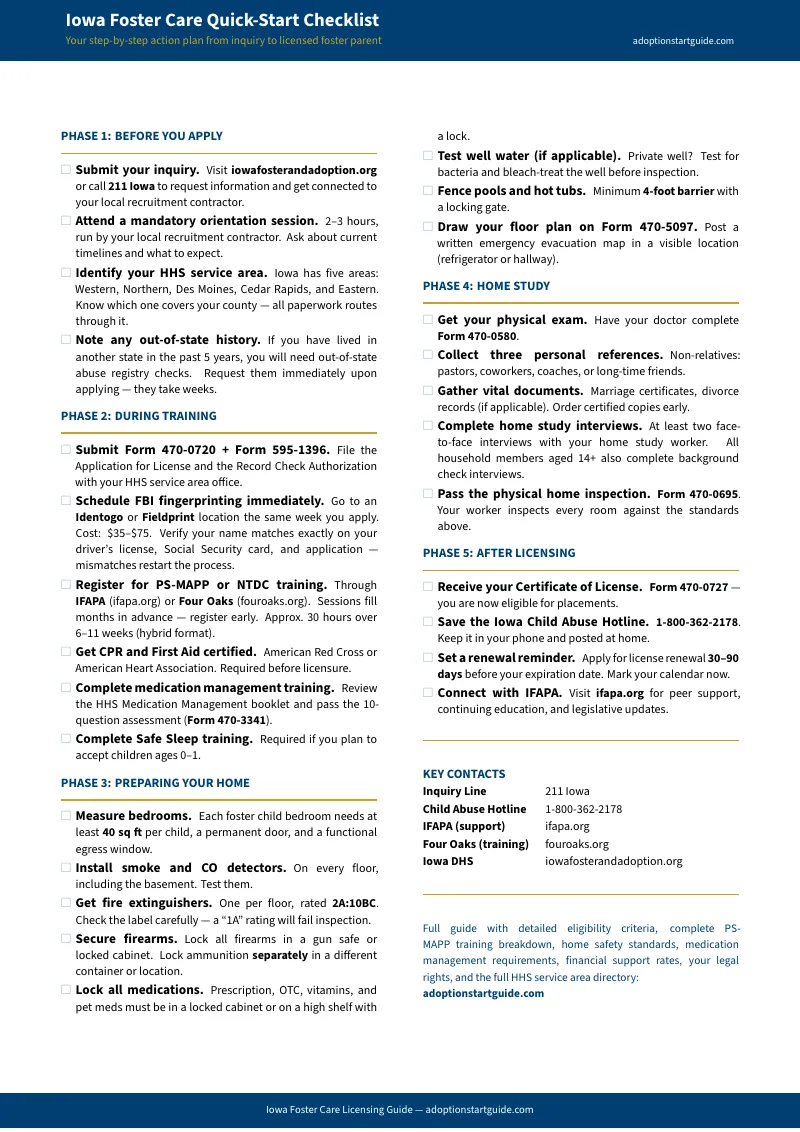
Download the Iowa Foster Care Quick-Start Checklist for a one-page overview of the key steps from initial inquiry through licensing approval. Free, no commitment. If you want the full guide with competency preparation, service area navigation, home study strategy, financial breakdown, and printable worksheets, click the button in the sidebar.
— less than what you'd spend at Culver's this week
The typical Iowa applicant spends 40 to 60 hours piecing together the licensing process from orientation materials, the HHS Employees' Manual, and scattered agency websites. This guide distills the most critical steps into a weekend-ready roadmap. A failed home study due to a structural issue you could have caught — ungrounded electrical in an older farmhouse, incorrect egress windows — delays your license by three to six months. One checklist prevents that.
If the guide doesn't deliver, reply to your download email at any time for a full refund. No forms. No justification required.