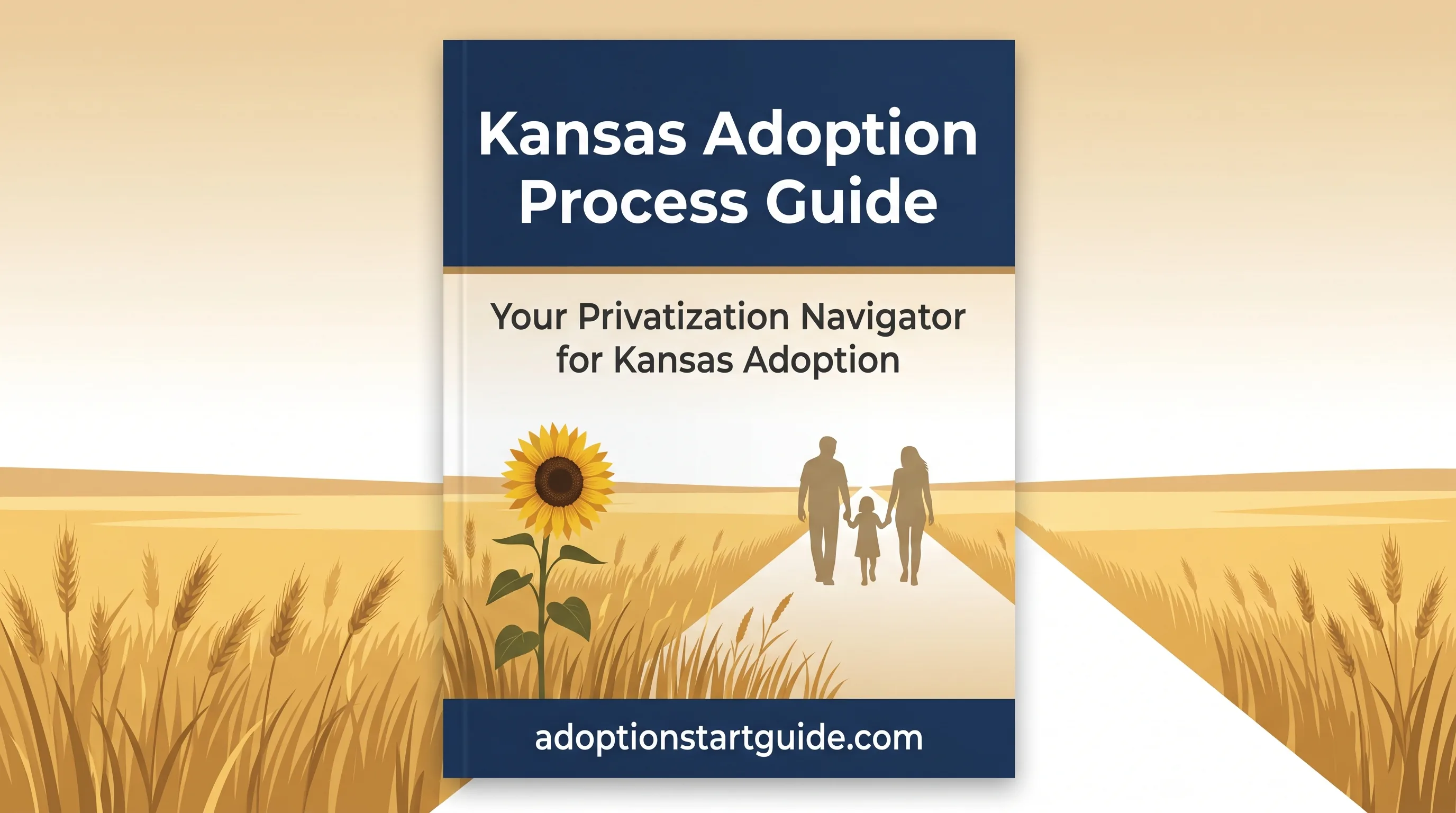
Kansas outsourced its entire child welfare system to private contractors. Nobody gave you a manual for navigating the result.
You called DCF. They told you to contact your regional contractor. You looked up which contractor covers your county and found a name — KVC Kansas, TFI, Cornerstones of Care, EmberHope — but no explanation of what that means for your adoption timeline, your caseworker's authority, or who actually makes decisions about your case. You found the DCF adoption assistance page, which says subsidies are "determined by the negotiation process" without explaining what is negotiable, how to ask, or what happens if you sign the agreement without pushing back. You may have attended an orientation through Adopt Kansas Kids and left with a folder of general information and a growing suspicion that the system expects you to figure out the rest on your own.
That suspicion is correct. Kansas is one of the few states in the country that fully privatized its foster care and adoption case management. Your caseworker is not a state employee. They work for a private contractor with their own caseloads, their own internal hierarchy, and their own documentation timelines. When your paperwork stalls, there is no single state office to call. When your caseworker leaves — and Kansas contractors have some of the highest turnover rates in child welfare — your case transfers to someone who may not have read your file. The $100 million technology overhaul currently underway at DCF means that the systems your contractor uses to track your adoption are actively being migrated, and delays tied to that transition are landing on families, not on the agencies. None of this is on the DCF website. None of it is in the orientation packet.
Private infant adoption has its own complexity. Kansas allows birth mothers to sign consent just 12 hours after delivery — one of the shortest windows in the country. That speed protects adoptive families from prolonged uncertainty, but it also means every legal detail must be in place before the baby arrives, not after. The Putative Father Registry is misunderstood by half the attorneys outside Kansas, and families using national facilitators regularly lose $15,000 to $25,000 on failed placements because nobody verified the birth mother's commitment before collecting agency fees. Stepparent and kinship adopters face a different wall: the Kansas "Two-Year Rule" allows adoption without an absent parent's consent, but proving the two-year absence requires documentation most families don't know they need until they're standing in front of a judge without it.
Generic adoption books describe a process where the state runs the system. In Kansas, the state oversees the system while private contractors run it — and that distinction changes everything about how you prepare, who you escalate to, and what documentation you control versus what your contractor controls. A guide written for Florida or Ohio will not mention catchment areas, contractor escalation paths, the EmberHope transition in Sedgwick County, or the fact that your adoption assistance agreement must be finalized before the decree is signed or you lose those benefits permanently.
The Privatization Navigator: Your Insider Roadmap to Kansas Adoption
This guide is built for the system Kansas families actually face — the privatized contractor network, the DCF oversight structure, the Kansas Revised Statutes that govern consent and termination, and the regional realities that determine whether your adoption takes twelve months or three years. Every chapter reflects the current contractor assignments, the 2025-2026 CCWIS technology transition, the specific financial programs Kansas families qualify for, and the on-the-ground strategies that experienced Kansas adoption attorneys use to move cases through the system. It is not a repurposed national handbook. It is the operational layer between what DCF posts online and what you actually need to know to adopt in Kansas — through your pathway, under current conditions, with the contractor assigned to your county.
What's inside
- Privatized System Roadmap — Kansas runs adoption through five regional contractors: KVC Kansas, TFI, Cornerstones of Care, EmberHope (replacing Saint Francis in Sedgwick County as of 2024), and Saint Francis Ministries. This chapter maps which contractor covers your county, explains the internal escalation hierarchy when your caseworker is unresponsive, identifies who at DCF has oversight authority over your contractor, and walks you through the documentation handoff process when your caseworker changes — including what to request from your case file before the transition happens.
- Subsidy Negotiation Templates — Kansas Adoption Assistance includes monthly subsidies, Medicaid coverage, and up to $2,000 in non-recurring legal expense reimbursement. But the subsidy amount is negotiated, not assigned — and most families accept whatever the contractor offers because nobody told them they could push back. This chapter includes the specific questions to ask, the "Guarded Prognosis" criteria that qualify a child for deferred assistance, and a fill-in negotiation template you can bring to the meeting with your DCF or contractor supervisor.
- Legal Framework Decoder — Kansas adoption law (K.S.A. 59-2111 through 59-2143) is written for attorneys. This chapter translates every relevant statute into plain English: consent requirements, the 12-hour post-delivery consent window for infant adoption, grounds for termination of parental rights, the Two-Year Rule for stepparent adoption without absent parent consent, and the legal standard the court applies when deciding whether to grant your petition.
- The 12-Hour Consent Rule Explained — Kansas allows a birth mother to sign relinquishment of parental rights just 12 hours after delivery. Once signed, the consent is virtually irrevocable — the legal standard for "duress" is extremely high. This chapter explains what the 12-hour window means for your pre-placement legal preparation, what your attorney must have ready before the birth, and how the Putative Father Registry intersects with the consent timeline.
- Putative Father Registry Decoded — The Kansas Putative Father Registry (K.S.A. 23-36,201) is one of the most misunderstood elements of Kansas adoption law. The statute does not require the registry to be searched before an adoption. DCF is under no obligation to notify a registrant. A father can only block an adoption through marriage, an Acknowledgment of Paternity, or a Court Order — not through the registry alone. This chapter eliminates the confusion and explains exactly what the registry can and cannot do.
- Home Study Preparation Guide — The home study is a multi-session assessment conducted by your contractor's social worker (foster-to-adopt) or a licensed agency (private adoption). This chapter covers what the social worker evaluates — home safety, financial stability, support network, parenting philosophy, trauma readiness — and provides a document preparation checklist so everything is assembled before the first visit, not scrambled together after.
- Financial Planning Framework — Cost breakdown by adoption pathway. Foster-to-adopt through a contractor costs $0 to $2,000 in legal fees. Private infant adoption through a Kansas agency runs $15,000 to $40,000. Stepparent adoption with an attorney runs $1,500 to $3,500. This chapter maps the federal adoption tax credit (up to $16,810 per child), Kansas-specific grants through KCSL and faith-based programs like the FAM Fund at Central Community Church in Wichita, and the non-recurring expense reimbursement that many families forget to claim.
- Kansas Attorney and Agency Directory — Vetted directory of Kansas adoption attorneys and licensed agencies organized by region. Wichita area: Rebecca Mann (Hinkle Law), Samaniego (Gibson Watson Marino), J. Joseph Weber. Kansas City area: Rundberg Law, ParksClevenger, The Henry Law Firm. Includes what to ask in a first consultation, typical fee structures, and which attorneys specialize in foster-to-adopt versus private infant versus stepparent cases.
- TPR Timeline Tracker — Termination of Parental Rights is the legal prerequisite for most foster-to-adopt cases. This fill-in tracker covers every milestone from the initial CINC (Child in Need of Care) filing through the TPR hearing, the 30-day appeal window, and the transition to the adoption petition — with space to record dates, caseworker contacts, and court hearing outcomes so you are never guessing where your case stands.
Printable standalone worksheets included
- Adoption Timeline Tracker — Every milestone from initial contractor contact through court finalization, with fill-in date fields. Print it, update it after every caseworker meeting, and always know where you stand.
- Home Study Document Checklist — Background clearances, medical exams, financial records, references, and home safety items organized in the order the social worker expects them.
- Subsidy Negotiation Worksheet — Fill-in template for your adoption assistance meeting: child's qualifying conditions, requested monthly rate, Medicaid coverage, non-recurring expense claim, and deferred assistance criteria.
- Financial Planning Worksheet — Costs by pathway, tax credit calculation, grant eligibility, and reimbursement tracking in one printable sheet for your household budget conversation.
Who this guide is for
- Foster parents pursuing adoption — You've been caring for a child under a reunification goal that just changed. Your contractor told you the "goal has shifted to adoption" but didn't explain the TPR timeline, the subsidy negotiation process, or what happens to your foster care payments during the transition. You need a roadmap for the path from foster parent to legal parent — including what your contractor is required to provide and what you need to handle yourself.
- Families pursuing private infant adoption — You're working with an agency or considering one. You want to understand the 12-hour consent rule, how to vet agencies to avoid failed placements, what the Putative Father Registry actually means for your case, and how to budget realistically for a process that national facilitators routinely underquote by $10,000 or more.
- Stepparent adopters — A child is already in your home and you want to make it legal. You need to know whether the Two-Year Rule applies, what documentation proves an absent parent's failure to support or contact, and how to file in Kansas probate court without paying $3,000 to an attorney for a process you can largely prepare yourself.
- Kinship and grandparent adopters — You stepped in when a child needed family. Now you need to formalize the arrangement before you hit a wall at the school enrollment office or the pediatrician's desk. You want to understand the difference between legal guardianship, permanent custodianship, and full adoption in Kansas — and which one gives you the authority you actually need.
Why the free resources fall short
The DCF website publishes policy manuals written for caseworkers, not families. The adoption assistance page says subsidies are negotiable but doesn't tell you what to negotiate for. The contractor portals — KVC, TFI, EmberHope — each present their own version of the process, and none of them acknowledge that their caseworker turnover rate is the single biggest risk to your adoption timeline. Adopt Kansas Kids runs excellent orientations for waiting children, but their role ends at the match — they don't walk you through finalization, subsidy negotiation, or court preparation.
National adoption books describe a system where the state manages your case. In Kansas, a private company manages your case, and the state oversees the company. That distinction changes who you call when something stalls, who has authority to approve your home study, and who signs off on your adoption assistance agreement. A book that doesn't understand Kansas privatization will give you a process that doesn't match your experience from day one.
Kansas adoption attorneys charge $250 to $400 per hour. A one-hour consultation buys you general advice about your specific pathway — not a complete walkthrough of the contractor system, not subsidy negotiation templates, not a TPR timeline tracker, and not a vetted directory of every adoption attorney and agency in the state. The guide puts the entire Kansas adoption system in your hands for a fraction of what a single legal hour costs.
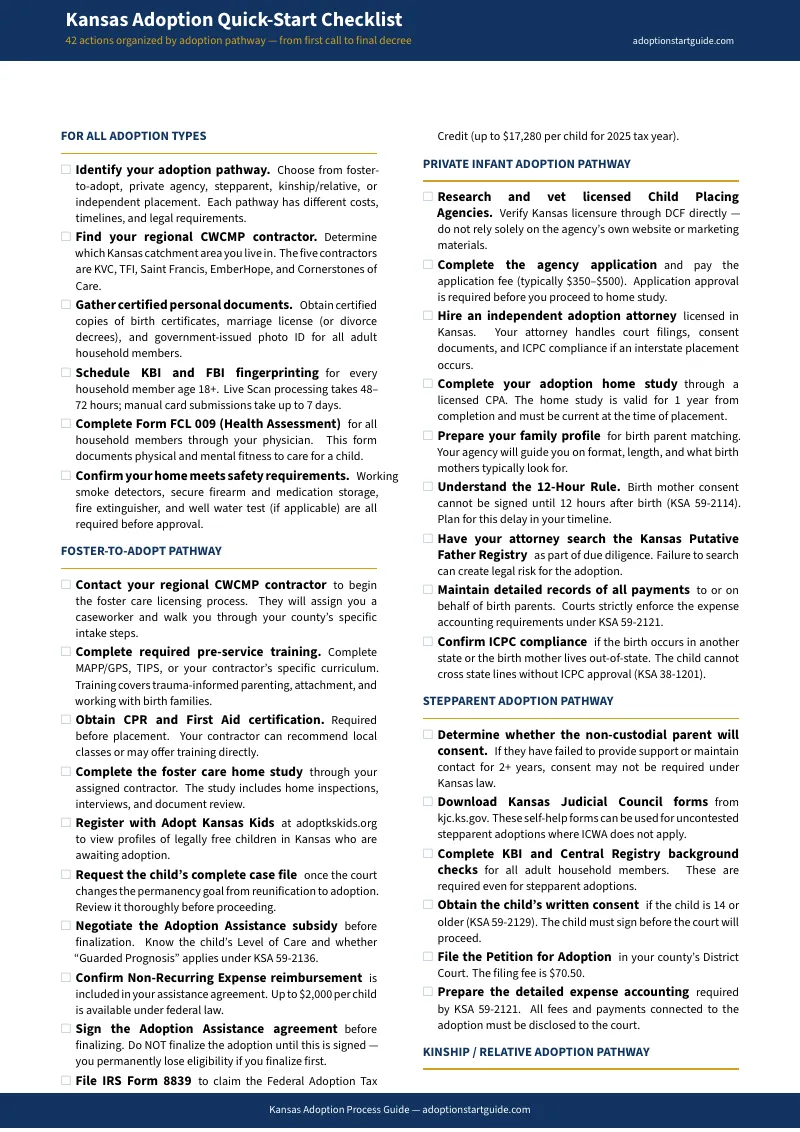
The free Quick-Start Checklist
Download the Kansas Adoption Quick-Start Checklist for a one-page overview of the adoption process, from identifying your catchment area contractor through court finalization. Free, no commitment. It includes the contractor lookup by county and the four-pathway decision — the two items that cause the most confusion in the Kansas system. If you want the full guide with the subsidy negotiation templates, legal framework decoder, attorney directory, TPR timeline tracker, and printable worksheets, click the button in the sidebar.
— less than ten minutes with a Kansas adoption attorney
Kansas adoption attorneys charge $250 to $400 per hour. Agency application fees start at $500. A failed placement with a national facilitator can cost $15,000 to $25,000. This guide puts the entire Kansas privatized adoption system — contractor navigation, subsidy negotiation, legal framework, financial planning, and a vetted attorney directory — in your hands for less than the cost of a single phone consultation. Families who understand the system before they enter it move faster, negotiate stronger subsidy agreements, and avoid the months of confusion that come from waiting for an overworked contractor caseworker to tell them what comes next.
If the guide doesn't deliver, reply to your download email at any time for a full refund. No forms. No justification required.