Maine has fewer than 2,000 children in state custody and a chronic shortage of licensed foster homes. The OCFS website tells you the rules. It doesn't tell you how to actually get licensed.
You decided to foster. Maybe your church ran a foster care awareness event. Maybe a grandchild or niece was just removed by DHHS and you got the call. Maybe you've been thinking about this for years and finally searched "how to become a foster parent in Maine." Whatever brought you here, you went to the maine.gov OCFS website looking for a clear starting point.
What you found was Chapter 16 and 15 of the Code of Maine Rules — a regulatory document written for caseworkers and licensing staff, not for a family sitting at the kitchen table trying to figure out if their spare bedroom qualifies. You found references to TIPS-MAPP training, background check forms, and home study requirements scattered across multiple pages. You found the phrase "contact your district office" repeated as though all eight OCFS districts operate the same way. They don't.
What you didn't find was a plain-language answer to the question every Maine family asks first: what exactly do I need to do, in what order, and how long will this take?
So you turned to Facebook. "MFAPA Community." "Fostering Maine." You posted your question and got the response that defines this system: "It depends — ask your caseworker." But you don't have a caseworker yet. That's the whole problem. You're in the gap between wanting to foster and knowing how to start — and nobody is meeting you there.
Adoptive and Foster Families of Maine (AFFM) does critical advocacy and support work, but their materials are built for families who are already licensed. If you haven't started TIPS-MAPP training yet, their discussion of Resource Family Support Services is several steps ahead of where you are. National foster care books on Amazon — The Connected Child, Another Place at the Table — will prepare your heart for fostering. They will not tell you whether your wood stove needs a shielding plan, what the current Maine board rates are by Level of Care, or how to navigate the Katahdin case management system when your caseworker has a 10% vacancy rate in their district.
The Maine Foster Care Roadmap
This guide is built for the Maine OCFS system and nobody else's. Every chapter, every checklist, every regulation reference is grounded in Chapter 16 and 15 of the Code of Maine Rules, the current DHHS licensing standards, and the operational realities of the eight OCFS district offices that serve this state — from Portland to Caribou. It covers the gap between what OCFS posts online and what you actually need to know to get from "interested" to "licensed" without unnecessary delays, failed inspections, or months of silence from a district office that never explained the next step.
What's inside
- Step-by-Step Licensing Process — Maine's licensing process has distinct stages, from initial inquiry through license issuance. This guide walks you through each one in order: orientation, application, TIPS-MAPP training, background checks, home study, and final approval. You'll know what's coming before your caseworker tells you — because in many districts, they won't tell you until you ask.
- TIPS-MAPP Training Walkthrough — The mandatory 30-hour, 10-session TIPS-MAPP (Trauma Informed Partnering for Safety and Permanence — Model Approach to Partnerships in Parenting) training is the single biggest time commitment in the process. This chapter breaks down all ten sessions, explains what your trainers are evaluating at each stage, and shows you how to prepare so the training deepens your readiness instead of overwhelming it. If you're in rural Aroostook County and worried about the drive to training, this chapter covers hybrid and community-based alternatives.
- Home Safety Inspection Checklist — Derived directly from Maine's licensing standards and Fire Marshal requirements. Smoke detector placement, carbon monoxide detectors on every level, the specific fire extinguisher rating you need (2A:10BC). The wood stove shielding rules that trip up rural Maine families — immovable screens or barriers to prevent contact with hot surfaces per NFPA 211. Egress window dimensions (20 inches wide by 24 inches high). Walk your house with this checklist before the licensing worker walks it for you. Catch the fix before it becomes a 30-day delay.
- Well Water Testing Requirements — If your home uses well water, Maine requires Division of Health Engineering standard tests before licensing. This chapter lists every contaminant tested — arsenic, coliform bacteria, nitrates, lead, fluoride — and tells you where to submit samples, how much testing costs, and what to do if results come back above safe limits. Many Maine families are surprised by this requirement. Don't let it delay your license by weeks.
- Home Study Preparation — The home study is the most personally intensive part of the process. This chapter explains what the licensing worker is actually evaluating — motivation, relationship stability, discipline philosophy, trauma-informed capacity, and support systems — and reframes it from an interrogation to what it really is: a process designed to rule families in, not rule them out.
- Financial Reality Breakdown — Current Maine board rates by Level of Care: Level A (basic) through Level E (intensive treatment). MaineCare coverage for every foster child. Child Care Assistance Program (CCAP) for working families. Clothing allowances, respite care benefits, and tax implications. The board payment is not income — it's a reimbursement for the child's expenses. Knowing the full financial picture is the difference between fostering sustainably and burning out.
- Kinship Care Fast-Track — If a grandchild, niece, nephew, or family friend's child was placed with you after a DHHS removal, you're already parenting under an emergency placement. You didn't plan for this, and you may not be receiving the full board payment because you're not fully licensed. This chapter explains the 120-day temporary kinship license, the path to full licensure, and the financial difference between TANF kinship payments and full board rates — so you can move from emergency caregiver to fully supported resource parent.
- Maine Indian Child Welfare Act (MICWA) — Maine has its own Indian Child Welfare Act providing protections beyond the federal ICWA. This chapter covers the "active efforts" standard, exclusive tribal jurisdiction for children on reservation, placement preferences for Wabanaki children (Penobscot, Passamaquoddy, Maliseet, and Micmac), and how to work with tribal child welfare units. If you're fostering near tribal communities or a child in your care may have tribal eligibility, this chapter is essential.
- Foster-to-Adopt Pathway — For families entering the system with adoption as their ultimate goal. How concurrent planning works in Maine, when a foster family receives first consideration for adoption, how Termination of Parental Rights (TPR) unfolds, and what the Adoption Assistance program provides. This chapter also addresses the hardest truth: reunification is the legal and philosophical priority, and you must genuinely support it even when your heart wants a different outcome.
- Specialized and Treatment Foster Care — Level C through Level E placements for children with behavioral health needs, developmental disabilities, or medical complexity. How to become a treatment foster parent, what additional training is required, and the higher board rates that come with specialized care. Also covers fostering teenagers — the population most in need and least likely to find placement.
- Working with Your Caseworker and OCFS — The 2024 OCFS reorganization created three new manager positions overseeing field operations, statewide programs, and strategy. Caseworker vacancies ran at 10.8% in late 2024. This chapter gives you the current OCFS structure so you know who to contact, how to escalate when communication stalls, and how to navigate the Katahdin digital system.
Printable standalone worksheets included
- Home Safety Self-Inspection Checklist — Room-by-room walkthrough of every physical requirement under Maine's licensing standards. Fire safety, wood stove shielding, sleeping arrangements, firearms storage, well water, hazardous materials. Walk your house with this before the licensing worker visits.
- Required Documents Checklist — Every form, clearance, and supporting document organized by when you need it: before orientation, with your application, for background checks, for the home study, and for ongoing post-licensing compliance.
- Background Check Tracking Log — State Bureau of Investigation criminal history, FBI national fingerprint (IdentoGO), CPS registry, sex offender registry, Adam Walsh Act out-of-state checks — track submission dates, result dates, and clearance status for every adult in your household.
- TIPS-MAPP Session Tracker — All ten sessions listed with space to record completion dates, key takeaways, and questions for your trainer.
- Monthly Caseworker Visit Log — Document every visit, every topic discussed, every concern raised. This log protects you and ensures continuity when caseworkers turn over — which in Maine's current staffing climate, they will.
- Key Contact Information Sheet — OCFS district office, licensing worker, child's caseworker, AFFM, Boys Town, Spurwink, tribal child welfare contacts, school, pediatrician, respite provider — all in one printable page.
Who this guide is for
- First-time prospective foster parents — You've been thinking about this for months or years. You attended an orientation, saw the news about children boarding in emergency rooms, or felt the calling. You went to the OCFS website and found a regulatory archive where you expected a step-by-step guide. You need someone to lay out the process in plain language and tell you what to do this week.
- Kinship caregivers — A grandchild, niece, nephew, or family friend's child was placed with you after a DHHS removal. The child is already in your home. You didn't plan for this. Now you need to get licensed to access full board payments and support services, and you're navigating a system you never expected to enter on a timeline you didn't choose.
- Foster-to-adopt families — You're entering the foster care system with the hope of eventually providing a permanent home. You need to understand how Maine handles the transition from foster placement to TPR and adoption, and why the licensing step is the prerequisite for everything that follows.
- Rural and northern Maine families — You have the space, the stability, and the heart to foster, but you live hours from the nearest training site in Aroostook County, the western mountains, or Downeast. The need for licensed homes in your area is acute. This guide shows you how to work with a smaller district office and access training despite the distance.
- Wabanaki and tribal families — If you're Penobscot, Passamaquoddy, Maliseet, or Micmac, or if a child in your care may have tribal eligibility, the MICWA chapter explains how state and tribal jurisdiction interact, what "active efforts" means in practice, and how to connect with tribal child welfare resources.
Why the free resources fall short
The OCFS website publishes Chapter 16 and 15 — the official regulatory framework designed for caseworkers and licensing staff, not for families trying to figure out if their home qualifies. It tells you what the rules are. It doesn't tell you which rules trip people up, how districts differ in practice, or what your licensing worker is actually evaluating during the home study.
AFFM provides essential peer support through Resource Family Support Services, but their materials assume you're already in the system. If you're pre-licensing — stuck in the most confusing window of the entire journey — their support network is several steps ahead of where you are.
Facebook groups are valuable for community, but the constant refrain is "ask your caseworker" — which is exactly what you can't do when you don't have a caseworker yet. National foster care books describe a generic process that doesn't account for Maine's eight OCFS districts, the wood stove shielding rules, the well water testing requirements, or MICWA's tribal protections that go beyond federal ICWA. A guide written for a national audience will tell you to "contact your local agency." In Maine, that means figuring out which of the eight OCFS district offices serves your county, understanding the 2024 reorganization that changed the leadership structure, and knowing what to say when you call — and nobody has published that in plain language.
The free Quick-Start Checklist
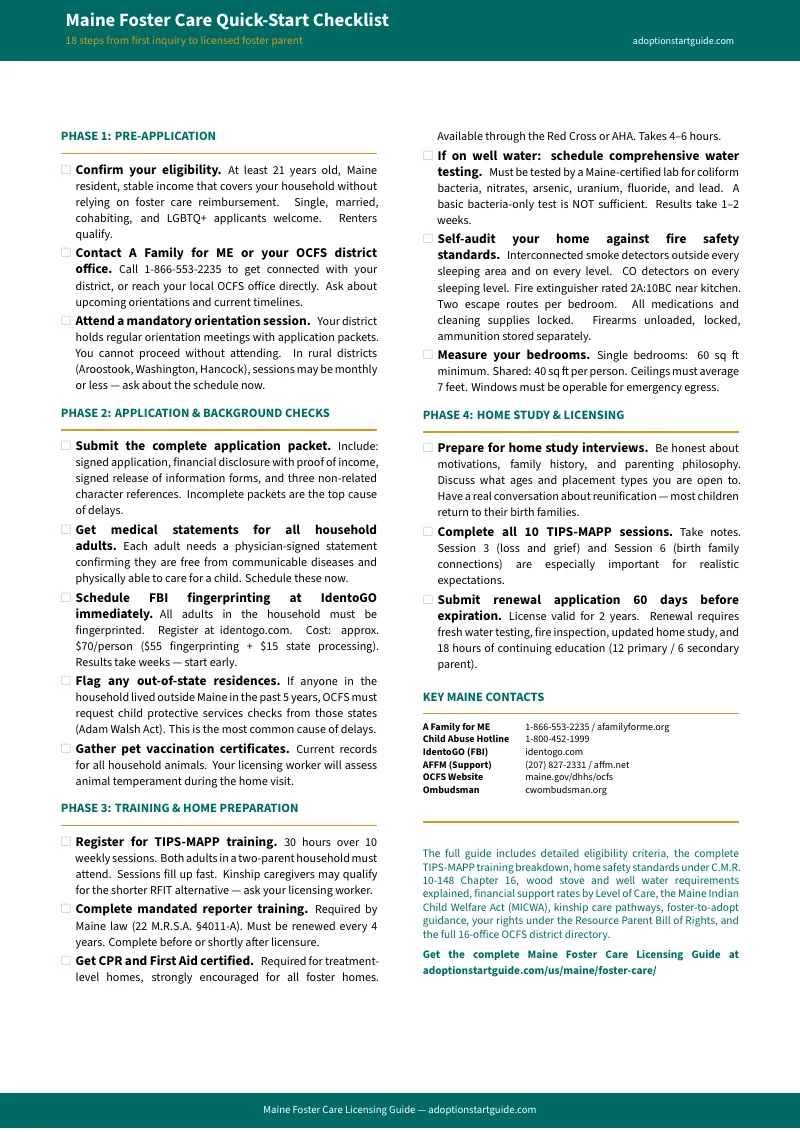
Download the Maine Foster Care Quick-Start Checklist for a four-phase overview of the licensing process, from your first OCFS inquiry through home study preparation. Free, no commitment. If you want the full guide with the TIPS-MAPP walkthrough, home study preparation, financial breakdown, kinship fast-track, MICWA chapter, wood stove safety rules, and all six printable worksheets, click the button in the sidebar.
— Less Than a Tank of Heating Oil
A failed home inspection because of a safety issue you could have caught — an unshielded wood stove, a missing fire extinguisher, a well water test you didn't know about — delays your first placement by 30 days or more. That's one month of board payments you didn't receive for a problem that costs a fraction of that to fix. One checklist prevents that. One chapter on the home study saves you the anxiety that makes good families quit before they finish.
If the guide doesn't deliver, reply to your download email at any time for a full refund. No forms. No justification required.