You're ready to adopt in Michigan. Then you discovered nobody can explain the two-court system.
Michigan runs adoption through two separate courts. Juvenile Court handles the termination of parental rights under MCL 712A. Probate Court (the Family Division of the Circuit Court) handles finalization under MCL 710. Your file has to cross from one to the other, and nobody's job is to make sure it doesn't stall in the gap. Caseworkers manage 15 or more cases. Your attorney bills $250 an hour in Grand Rapids and isn't going to call you to explain what a "deferred recommendation" on the MDHHS-5643 means. The MDHHS Adoption Services Manual runs over 500 pages and reads like it was written for other bureaucrats.
Meanwhile, Michigan has 12 federally recognized tribes and the Michigan Indian Family Preservation Act, which sets higher standards than federal ICWA. The Putative Father Registry under MCL 710.33 can torpedo an adoption if you skip the search. The adoption subsidy must be locked in before finalization or it's gone forever. And county procedures vary so much that families in Wayne County, Oakland County, and Kent County might as well be in different states.
The information exists. It's scattered across MDHHS policy manuals, MARE factsheets, Michigan Legal Help articles, agency orientation packets from Bethany and Judson Center, and the occasional Reddit thread from someone in a completely different county. Piece it together yourself and you'll burn weeks reading documents that explain the rules but never tell you how to navigate them as a parent.
The Michigan Two-Court Bridge
This is a complete, Michigan-specific adoption guide built around the problem every family hits: getting from one court to the other without losing time, benefits, or your sanity. Not a generic national overview. Not an agency brochure designed to funnel you into one program. Every chapter, every checklist, every cost figure is grounded in the Michigan Adoption Code (MCL 710), current MDHHS policies, and the real-world experience of families who have adopted in this state.
What's inside
- Five-pathway comparison table — Foster-to-adopt, private domestic infant, independent/direct placement, stepparent, and kinship adoption mapped side by side. Costs, timelines, eligibility, and the realistic wait for each pathway so you choose the right one before investing months in the wrong one. Foster-to-adopt runs $0 to $2,000. Private infant adoption costs $30,000 to $45,000. That decision deserves more than a caseworker's one-sentence summary.
- The two-court transition walkthrough — Exactly how your case moves from Juvenile Court TPR to Probate Court finalization. What triggers the handoff, who initiates the petition, which SCAO forms you need (PCA 301, PCA 302, PCA 307, PCA 347, DCH 0854), and how to prevent your file from sitting on a desk for three months during the transfer. County-by-county notes for Wayne, Oakland, Kent, Washtenaw, and Macomb.
- MDHHS-5643 deferred recommendation decoder — The Adoptive Family Assessment is the single document that moves your case forward or stalls it. This chapter covers the 10 most common reasons for a "deferred" recommendation, the missing documentation that triggers each one, and the verbal-reference workaround that caseworkers rarely mention. Includes a printable "Caseworker Nudge Checklist" so you know exactly what to follow up on and when.
- Putative Father Registry compliance — MCL 710.33 requires a registry search before any adoption can proceed. Skip it and the adoption can be overturned later. This chapter walks you through the search request process with MDHHS Vital Records, the fees, the timeline, and what happens if a putative father has registered.
- Michigan CPA comparison guide — Bethany Christian Services, Judson Center, D.A. Blodgett-St. John's, Wellspring, Samaritas, Catholic Social Services, and MDHHS-direct. Community profiles, geographic focus, denominational orientation, and what each agency's process actually looks like from the parent's side. No agency website will give you this comparison because no agency has an incentive to.
- Tribal sovereignty and MIFPA navigator — Michigan's 12 federally recognized tribes trigger the Michigan Indian Family Preservation Act, which requires "active efforts" beyond the federal ICWA standard. This chapter explains the notification process, the role of tribal courts, and how to document compliance so the adoption isn't vulnerable to a later challenge. Written for both Native and non-Native families.
- The subsidy cliff explained — Michigan's Adoption Support Subsidy provides $20.69/day for children 0-12 and $24.71/day for children 13+, plus Determination of Care supplements for special needs. But you must apply and sign the contract before the adoption is finalized. After the judge signs the order, these benefits are gone. This chapter gives you the timeline, the forms, and the conversation to have with your caseworker before you set a court date.
- Michigan cost map — A realistic breakdown from $0 (foster-to-adopt through MDHHS) to $45,000+ (private infant with legal fees). Includes the expenses nobody warns you about: the DHS-3190 physical exam, fingerprint-based FBI background checks, the birth parent's independent legal counsel that you may pay for, and court filing fees that vary by county. Printable cost reference included.
- Adoption records access under current law — Michigan still restricts original birth certificate access based on when parental rights were terminated, including the 1945-1980 "donut hole." This chapter explains the Central Adoption Registry clearance process under MCL 333.2882, the confidential intermediary route, why the 2024 reform bills (HB 5148/5149) died in the Senate, and what this means for adoptive families navigating open adoption conversations.
- Court finalization walkthrough — The six-month supervisory period, the monthly caseworker visits, the 72-hour consent rule for direct placements, and exactly what happens on finalization day. Written in plain language, not MCL citations, with county-specific notes on Wayne, Oakland, and Kent court procedures.
Who this guide is for
- Foster parents moving toward adoption — The child in your care just became a permanent ward of the state. You've been told to "start the adoption paperwork," but nobody explained that your case is about to jump from Juvenile Court to Probate Court. This guide maps that transition and makes sure your existing relationship with the child works in your favor during the MDHHS-5643 assessment.
- Families pursuing private infant adoption — You're working with a CPA in Grand Rapids or Metro Detroit and the costs are climbing past $30,000. This guide helps you understand what you're paying for, what you can handle yourself, and how the Putative Father Registry and 72-hour consent rules protect your placement.
- Kinship adopters — You took in a grandchild, niece, or nephew during a family crisis in Flint, Saginaw, or Pontiac. You assumed the process would be simpler because you're family. It isn't. Michigan requires the same background checks, the same MDHHS-5643 assessment, and the same court finalization regardless of your biological connection. This guide covers the kinship-specific path without the $250-per-hour price tag.
- Stepparent adopters — The absent parent hasn't paid support or visited in years. MCL 710.51(6) requires either voluntary consent or proof of two years of failed support and communication. This guide walks you through the involuntary termination process, the investigation report, and the hearing — including what to do if the absent parent suddenly resurfaces.
- Dearborn and Arab American families — If you're navigating Kafala considerations alongside Michigan's legal adoption framework, this guide addresses how faith-consistent care practices — including dietary needs, Ramadan observance, and cultural expectations — are evaluated during the home study. Your traditions are a strength, not a barrier, and the guide helps you present them that way.
Why the free resources aren't enough
The MDHHS Adoption Services Manual (ADM 0100 through ADM 1000) is technically accurate, but it's 500 pages of administrative procedure written for caseworkers, not parents. It doesn't tell you how to avoid a deferred recommendation on your family assessment or how to navigate the two-court handoff when your caseworker is managing 15 other cases.
Michigan Legal Help is excellent for stepparent adoption forms, but it lacks the CPA perspective that foster-to-adopt families need. It explains what the law requires. It doesn't explain how to work with Bethany versus Judson Center versus MDHHS-direct, or why that choice shapes your entire experience.
The Michigan Adoption Resource Exchange (MARE) is the best resource for finding waiting children, but its "how-to" section is designed to generate inquiries, not provide a procedural roadmap. AdoptUSKids Michigan points you right back to MARE.
Generic adoption books on Amazon cover federal ICWA but miss the Michigan Indian Family Preservation Act entirely. They mention home studies but not the MDHHS-5643 or the DHS-3190 physical exam form. They reference "the court" as if there's only one. In Michigan, there are two, and the handoff between them is where families lose months.
Agency websites — Bethany, D.A. Blodgett, Samaritas — are lead-generation tools for their own programs. They won't compare themselves to each other or explain the pathways they don't serve. Reddit threads on r/GrandRapids and r/Detroit give you anecdotes from one county that may be completely wrong for yours.
Printable standalone worksheets included
The guide comes with printable standalone PDFs designed for real-world use:
- Pathway Comparison Card — Five pathways side by side on one page. Print it, sit down with your partner, and make the decision that shapes everything else.
- MDHHS-5643 Prep Checklist — Every document the Adoptive Family Assessment requires, with the form numbers, where to get them, and the order that prevents deferrals. Hand it to your caseworker so you're both working from the same list.
- Cost Map Reference — Every expense for every pathway in one printable sheet. Take it to your financial planning conversation.
- Court Filing Checklist — Every SCAO form and supporting document you need for the Probate Court petition. Give it to your attorney and save yourself a billable hour of "what do we need?" questions.
The free Quick-Start Checklist
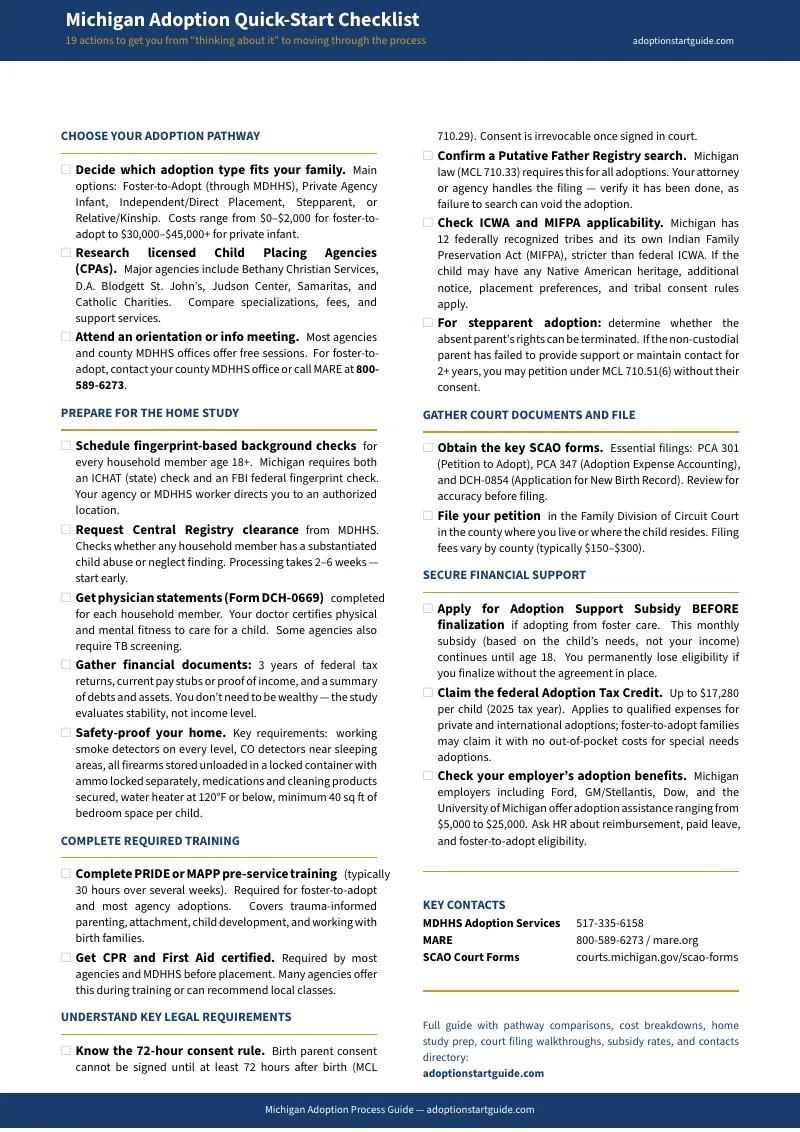
Download the Michigan Adoption Quick-Start Checklist for a one-page overview of the key steps from first inquiry to finalization. Free, no commitment. If you want the full guide with the two-court walkthrough, the MDHHS-5643 decoder, CPA comparisons, subsidy timelines, tribal compliance, and all the printable worksheets, click the button in the sidebar.
— less than four minutes of a Grand Rapids adoption attorney's time
A single consultation with an adoption attorney in Grand Rapids or Metro Detroit starts at $250 per hour. Families routinely spend the first billable hour covering foundational questions this guide answers on page one. The Michigan Two-Court Bridge doesn't replace your attorney. It makes sure you don't pay your attorney to teach you the basics.