Pennsylvania has 67 counties, 67 different caseworkers, and zero guides that tell you which clearance to file first.
You went to the PA Department of Human Services website looking for a clear path to becoming a foster parent. What you found was a maze of agency pages, county-specific orientation schedules, and a list of clearances — Act 33, Act 34, Act 114, FBI fingerprints — with no explanation of the order that actually matters. You figured out that you need TIPS-MAPP training, but nobody told you it's a 10-week mutual assessment where your caseworker is evaluating you while you're still learning what "resource family" means. And the county orientation you attended? It was a recruitment pitch. You left knowing children need homes. You still don't know what to do next Monday morning.
Meanwhile, the system behind the curtain varies wildly depending on your zip code. In Philadelphia, the DHS doesn't manage foster homes directly — they route everything through Community Umbrella Agencies based on your neighborhood, and your CUA determines your training schedule, your caseworker, and your timeline. In Allegheny County, a kinship-first culture means 65% of placements go to relatives through their partnership with A Second Chance Inc., and non-relative foster parents need a different strategy to get placements. In rural counties like Lancaster, York, or Forest, the process is more paper-based, less digital, and depends on a single CYS office that may schedule orientations quarterly. Your experience depends entirely on your county, and nobody maps that for you.
National foster care books on Amazon don't know that Pennsylvania runs a state-supervised, county-administered system with 67 different implementations. They describe training programs that may not match TIPS-MAPP, skip the three-clearance sequencing problem that delays more Pennsylvania applications than any other issue, and ignore the CUA model that governs Philadelphia entirely. A guide written for Ohio won't help you in Bucks County. And the private consultants who do understand Pennsylvania's system charge $150 to $500 an hour for the same tactical knowledge you need before you've spent a dime.
The 67-County Navigator: Your Strategic Guide to Pennsylvania Foster Care
This guide is built for Pennsylvania's county-administered foster care system and nobody else's. Every chapter, every checklist, every recommendation is grounded in current DHS regulations, the TIPS-MAPP framework, PACWRC standards, and the county-specific realities that determine whether your licensing takes 60 days or six months. It's not a repurposed national handbook. It's the operational layer between what the state posts online and what you actually need to know to get licensed — in your county, under current conditions.
What's inside
- Clearance Sequencing Roadmap — This is where most Pennsylvania applications stall, and nobody warns you in advance. You need three clearances — Act 33 (Child Abuse History from ChildLine), Act 34 (Criminal History from the State Police), and Act 114 (FBI Fingerprints). Each has a different processing time. If you order them in the wrong sequence, the first results expire before the last ones arrive, and you start over. This chapter gives you the exact order and timing to ensure all three results land in the same 30-day window, preventing the 8-to-12-week "clearance lag" that derails applications across the Commonwealth.
- County Navigation Framework — Pennsylvania doesn't run one foster care system. It runs 67. Philadelphia uses Community Umbrella Agencies assigned by zip code, so your CUA determines your training options, caseworker, and timeline. Allegheny County operates a kinship-first model through ASCI with aggressive 60-day licensing targets. Rural counties use direct CYS contact with less digital infrastructure and quarterly orientation schedules. This chapter maps the three operational zones — Philadelphia CUA, Allegheny Kinship-First, and Rural CYS — so you understand exactly how your county works before you fill out a single form.
- TIPS-MAPP Survival Guide — TIPS-MAPP is not just a training course. It is a 10-session mutual assessment where your facilitator is evaluating your readiness while you're learning. Most families are blindsided by the "Family Profile" or "Autobiographical Statement" due by Meeting 2 or 3 — a deeply personal document that requires you to reflect on your own childhood, parenting philosophy, and relationship history. The "Losses and Gains" module hits harder than anyone expects. This chapter breaks down all 10 modules, tells you what to prepare before each session, and explains how to approach the autobiographical narrative so it demonstrates the self-awareness caseworkers are looking for.
- 50-Point Home Safety Self-Audit — Your county worker will inspect your home against DHS standards, and the bar is higher than "clean and safe." Water temperature must be between 100 and 120 degrees Fahrenheit. Fire extinguishers must be rated 2A:10BC. Medications and cleaning supplies must be locked, not just stored high. Firearms must be unloaded, in a locked container, with ammunition stored separately. This chapter is a room-by-room walkthrough of every requirement, including the items that trip up Pennsylvania homes specifically — basement egress windows, wood-burning stove clearances, and the bedroom square footage minimums that catch families with smaller rooms off guard.
- Kinship Emergency Placement Guide — When a child is removed and placed with a relative, the timeline compresses dramatically. You may have a child in your home before you've begun any paperwork. This chapter walks kinship caregivers through the emergency approval protocol, explains the background check process you didn't plan for, and shows you how to access financial support and services while the full licensing process catches up. It covers the specific provisions for kinship families under Pennsylvania law, including when a kinship family can be licensed on an expedited basis and when they cannot.
- Financial Reality and Per Diem Rates — Pennsylvania's foster care reimbursement rates vary by county and by the level of care a child requires. Basic rates, specialized rates for children with medical or behavioral needs, and enhanced rates for therapeutic placements each have different structures. But you receive nothing until you are fully licensed — every week of delay is a week without support. This chapter breaks down the current rate tiers, explains how the level-of-care assessment works, covers medical assistance and insurance, and addresses the real out-of-pocket costs that orientation presentations skip — transportation for birth family visits, childcare gaps during court hearings, and the career disruption from child and family team meetings scheduled during work hours.
- Home Study Preparation Workbook — The home study is the most anxiety-inducing part of the process. A caseworker interviews you and every household member about your childhood, your marriage, your discipline philosophy, your finances, and your motivation for fostering. Most applicants walk in unprepared for the depth of these questions. This chapter provides structured prompts for the autobiographical narrative, explains what caseworkers are actually evaluating (self-awareness and honesty, not perfection), and includes coaching for your personal references so they know what the agency is looking for when they're contacted.
- Foster-to-Adopt Pathways — If you're entering foster care with the hope of eventually adopting, Pennsylvania's system prioritizes reunification with the birth family first. Concurrent planning — preparing for permanency while supporting reunification — is emotionally complex and procedurally specific. This chapter covers how the transition from foster care to adoption works in Pennsylvania, the legal timeline for termination of parental rights, the subsidies available for adoptive families, and what "concurrent" actually means in daily life when you're attached to a child whose plan is still return home.
Printable standalone worksheets included
- Licensing Timeline Tracker — Every milestone from initial county contact through certification, with fill-in date fields. Print it, update it after every caseworker interaction, and always know where you stand.
- Home Safety Inspection Checklist — Room-by-room walkthrough of every DHS safety requirement. Walk your home with this before the inspector arrives.
- Document Organization Sheet — HS 633, HS 2126, Act 33, Act 34, Act 114, medical reports, training records, reference letters — every document you need, organized by phase with checkboxes.
- Financial Planning Worksheet — Per diem rates by care level, county rate variations, medical assistance coverage, and hidden costs in one printable sheet for your household budget conversation.
Who this guide is for
- First-time prospective foster parents — You've been researching for months. You attended a county orientation or heard about the need through your church or community. You went to the DHS website and found clearance instructions, form numbers, and no clear answer to what order things should happen in. You need the system translated into plain language with a realistic timeline for your specific county.
- Kinship caregivers — A grandchild, niece, nephew, or family friend's child has been placed with you or is about to be. The child may already be in your home. You need to navigate the clearance process under time pressure, understand what financial support you're entitled to, and get fully licensed so your placement is stable and supported.
- Foster-to-adopt families — You're entering the foster care system with the hope of providing a permanent home. Pennsylvania prioritizes reunification, and concurrent planning requires preparation that orientations don't provide. You need to understand the legal timeline, the emotional reality, and the adoption subsidies available.
- Same-sex couples and LGBTQ+ families — Pennsylvania law allows LGBTQ+ individuals and couples to foster and adopt. But navigating agency selection and caseworker interactions in a 67-county system means your experience may vary by region. This guide addresses those realities directly and helps you identify inclusive agencies.
- Single adults — You're doing this alone, and the process feels designed for two-parent households. This guide covers the specific concerns single applicants face — proving financial stability, managing the training schedule solo, and demonstrating your support network to the home study evaluator.
Why the free resources aren't enough
The PA DHS "Keep Kids Safe" portal publishes clearance links and basic eligibility requirements — information designed for administrators, not applicants. It tells you what the three clearances are. It does not tell you which one to order first, what happens when your FBI fingerprint results arrive after your Act 33 clearance has expired, or how the 67 counties differ in the timeline they expect.
County orientation sessions are recruitment events. They exist to inspire you to apply, not to prepare you to succeed. You'll hear statistics about the 13,000 children in Pennsylvania's system. You won't get a checklist for passing your home inspection or a strategy for the TIPS-MAPP modules that catch families off guard.
Facebook groups and Reddit threads provide emotional support, but a family in a Philadelphia CUA gets different advice than one in rural Lancaster County — because the systems are structurally different. An answer that's correct for Allegheny County's kinship-first model could be wrong for your county entirely. Crowdsourced guidance is well-intentioned and geographically contradictory.
National foster care books describe a generic licensing process that doesn't account for Pennsylvania's 67-county structure, its three-clearance sequencing trap, the TIPS-MAPP mutual assessment model, or the CUA system that governs Philadelphia. A guide written for a national audience will tell you to contact your state agency. In Pennsylvania, your state agency will tell you to contact your county — and that's where the confusion starts.
The free Quick-Start Checklist
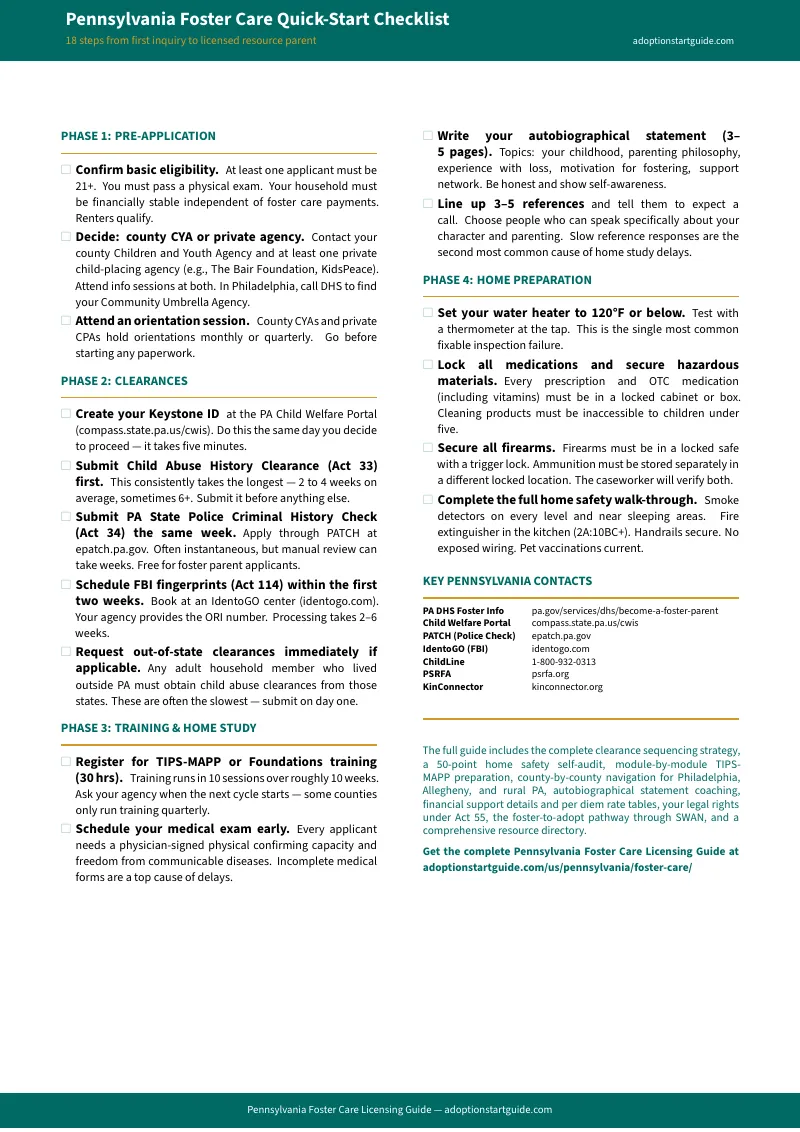
Download the Pennsylvania Foster Care Quick-Start Checklist for a one-page overview of the licensing process, from initial county contact through certification. Free, no commitment. If you want the full guide with the 67-County Navigator, clearance sequencing roadmap, TIPS-MAPP survival guide, 50-point home audit, financial breakdown, and printable worksheets, click the button in the sidebar.
— less than one hour of a foster care consultant's time
The typical Pennsylvania applicant spends weeks piecing together the process from county websites, DHS pages, Reddit threads, and phone calls to caseworkers who may or may not return the call — and still doesn't discover the clearance sequencing trap until it delays their application by two months. This guide distills the most critical decisions into a weekend-ready roadmap. A failed home inspection because your water heater was set to 130 degrees or your fire extinguisher had the wrong rating delays your licensing by months. One checklist prevents that. A clearance ordered in the wrong sequence burns eight weeks while you wait for everything to align. One chapter prevents that.
If the guide doesn't deliver, reply to your download email at any time for a full refund. No forms. No justification required.