
South Dakota has 74% Native American children in foster care, seven rural judicial circuits, and almost no plain-language adoption guidance. Nobody gave you a manual for this.
You called the Department of Social Services. They gave you a list of agencies — Lutheran Social Services in Sioux Falls, Catholic Social Services in Rapid City — and told you to contact them for next steps. You looked up the adoption page on dss.sd.gov and found a photolisting of waiting children, a mention of 30 hours of training, and a set of requirements that assume you already understand how the system works. You may have searched for "ICWA adoption" because someone mentioned that most children in South Dakota's foster system are Native American, and the search results gave you either legal statutes written for attorneys or emotional op-eds written for neither.
Here is what the DSS website doesn't tell you. Approximately 74% of children in South Dakota's foster care system are Native American, and the Indian Child Welfare Act governs nearly every aspect of those proceedings — tribal notification, a higher standard of "active efforts," a specific hierarchy of placement preferences, and the possibility that a tribal court may assume jurisdiction over your case. If you skip ICWA, you are skipping the defining feature of adoption in this state. And if you follow ICWA incorrectly — if you fail to notify the right tribal agent by registered mail, or document active efforts to the wrong standard — your adoption can be challenged or overturned years after the decree is signed.
Private infant adoption has its own challenges. South Dakota has fewer licensed child-placing agencies than most states, and nearly all of them are concentrated in Sioux Falls or Rapid City. If you live in western or central South Dakota, your nearest agency may be a three-hour drive. The five-day consent rule means a birth parent cannot sign until five days after delivery — slower than some states but more protective. The Putative Father Registry gives unmarried fathers just five business days to register, and families who don't check the registry before finalization are risking a legal challenge they could have prevented with a single search. Meanwhile, SDCL 25-6-4.2 makes it a felony to pay for anything beyond court-approved expenses — and most families don't realize this until they're already deep in negotiations with a birth parent.
Generic adoption books describe a process where a single state agency runs everything. South Dakota's system is more fragmented — DSS manages public adoptions while private agencies handle their own placements, the seven judicial circuits each have their own scheduling and practices, and tribal courts operate on parallel legal tracks that most non-tribal families have never encountered. A guide written for California or Texas will not mention the Oglala Sioux Tribe's Title IV-E agreement, the difference between "active efforts" and "reasonable efforts," or the fact that Post-Adoption Communication Agreements are not legally enforceable in South Dakota.
The ICWA-Ready Roadmap: Your Insider Guide to South Dakota Adoption
This guide is built for the system South Dakota families actually face — the DSS infrastructure, the limited agency landscape, the seven Circuit Courts, and the ICWA requirements that define more adoption cases in this state than in nearly any other. Every chapter reflects current South Dakota law (SDCL Chapter 25-6), current administrative rules (ARSD 67:42:05 and 67:14:32), the 2025 federal adoption tax credit with its new refundable portion, and the on-the-ground strategies that experienced South Dakota adoption attorneys use to move cases through the system. It is not a repurposed national handbook. It is the operational layer between what DSS posts online and what you actually need to know to adopt in South Dakota — through your pathway, under current law, in your judicial circuit.
What's inside
- ICWA Compliance Roadmap — The chapter most South Dakota families need and can't find anywhere else. Plain-language explanation of tribal notification requirements, the "active efforts" standard (and how it differs from "reasonable efforts"), the placement preference hierarchy, good cause deviations, tribal court jurisdiction and transfer, and Title IV-E agreements with the Oglala Sioux, Standing Rock Sioux, and other tribes. Includes a step-by-step ICWA compliance checklist and a directory of tribal ICWA directors.
- Adoption Pathway Comparison — Six pathways compared: foster-to-adopt through DSS, private agency, independent (attorney-facilitated), stepparent, kinship/relative, and tribal customary adoption. Each pathway includes eligibility requirements, realistic cost ranges, expected timelines, and the specific legal provisions that apply — so you choose the right path before you invest months in the wrong one.
- Home Study Preparation Guide — What South Dakota social workers actually assess under ARSD 67:42:05. Physical safety standards for firearms, swimming pools, well water, bedroom egress, smoke and CO detectors. Document preparation checklist covering DCI and FBI background clearances, medical examinations, financial records, and character references. Everything assembled before the first visit, not scrambled together after.
- Consent and Birth Parent Rights Decoder — The five-day post-birth consent rule (SDCL 25-5A-4), birth mother counseling requirements, irrevocability standards, involuntary TPR grounds, the beyond-reasonable-doubt evidence standard for ICWA cases versus clear-and-convincing for non-ICWA cases, and the Putative Father Registry — including the five-business-day registration window that most families don't know about until it's too late.
- Financial Planning Framework — Cost breakdown by pathway. Foster-to-adopt through DSS costs $0 to $2,500. Private agency adoption runs $20,000 to $50,000. Independent adoption costs $10,000 to $40,000. Stepparent adoption runs $500 to $3,000. This chapter maps the federal adoption tax credit (up to $17,280 per child with up to $5,000 now refundable), DSS monthly adoption subsidies ($640 to $769 matching foster care rates), Medicaid coverage for adopted children, the $2,000 non-recurring expense reimbursement, and the financial implications of South Dakota's no-state-income-tax environment.
- Circuit Court Walkthrough — Filing requirements across all seven judicial circuits, the six-month residency rule (SDCL 25-6-9), what happens at the finalization hearing, UJS forms, the $72 filing fee, and post-decree steps including the amended birth certificate through the Department of Health.
- Post-Adoption Rights — Adult adoptee access to original birth certificates under the July 2023 law (age 18+, $15 fee), sealed records and the petition process, and the practical reality that Post-Adoption Communication Agreements are not legally enforceable in South Dakota — which changes how you structure open adoption arrangements.
- South Dakota Directory — DSS regional offices, licensed child-placing agencies (Lutheran Social Services, Catholic Social Services, All About U Adoptions, New Horizons, Bethany Christian Services), tribal ICWA directors for every federally recognized tribe in the state, and adoption attorneys organized by judicial circuit.
Printable standalone worksheets included
- Adoption Timeline Tracker — Every milestone from initial DSS contact through court finalization, with fill-in date fields. Print it, update it after every caseworker meeting, and always know where you stand.
- Home Study Document Checklist — Background clearances, medical exams, financial records, references, and home safety items organized in the order the social worker expects them under ARSD 67:42:05.
- ICWA Compliance Tracker — Tribal notification dates, active efforts documentation, placement preference analysis, and expert witness requirements in one printable sheet for your case file.
- Financial Planning Worksheet — Costs by pathway, tax credit calculation, subsidy rates, and reimbursement tracking in one printable sheet for your household budget conversation.
Who this guide is for
- Foster parents pursuing adoption through DSS — You've been caring for a child under a reunification goal that just changed. Your caseworker told you the goal has shifted to adoption but didn't explain the TPR timeline, the subsidy negotiation process, or how ICWA affects every step of the journey from here. You need a roadmap for the path from foster parent to legal parent — including what DSS is required to provide and what you need to handle yourself.
- Tribal families formalizing kinship care — A relative's child is already in your home, and you want to understand how tribal court and state Circuit Court interact, what customary adoption means legally in South Dakota, and how to access Title IV-E funding and DSS subsidies for children in tribal custody.
- Families pursuing private infant adoption — You're working with an agency or considering one. You want to understand the five-day consent rule, how to vet the limited number of South Dakota agencies, what the Putative Father Registry actually means for your case, and how to budget for a process where unauthorized birth parent payments are a felony.
- Stepparents ready to make it official — A child is already in your home and you want to formalize the relationship. You need to know whether the non-custodial parent's consent is required, whether the home study is waived, and how to file in Circuit Court without paying $3,000 for a process that may cost under $1,000.
- Rural families outside Sioux Falls and Rapid City — You face geographic barriers to agencies, training, home study visits, and court access. You need a roadmap that accounts for the distance and builds extra time into every timeline.
Why the free resources fall short
The DSS website publishes requirements written for caseworkers, not families. The adoption FAQ answers basic questions but doesn't explain the Circuit Court process, the subsidy negotiation, or how ICWA shapes your case from the first phone call. National agencies like American Adoptions and Lifetime Adoption offer "free state guides" that are marketing funnels — they emphasize agency adoption while downplaying the foster-to-adopt and independent pathways that may cost you $0 to $2,500 instead of $30,000. Lutheran Social Services and Catholic Social Services provide thorough counseling but don't offer procedural checklists or financial planning tools.
South Dakota adoption attorneys charge an average of $252 per hour, with family law specialists reaching $492 per hour. A one-hour consultation buys you general advice about your pathway — not a complete ICWA compliance roadmap, not a home study preparation checklist, not a financial planning worksheet, and not a directory of every agency and tribal ICWA director in the state. The guide puts the entire South Dakota adoption system in your hands for a fraction of what a single legal hour costs.
The free Quick-Start Checklist
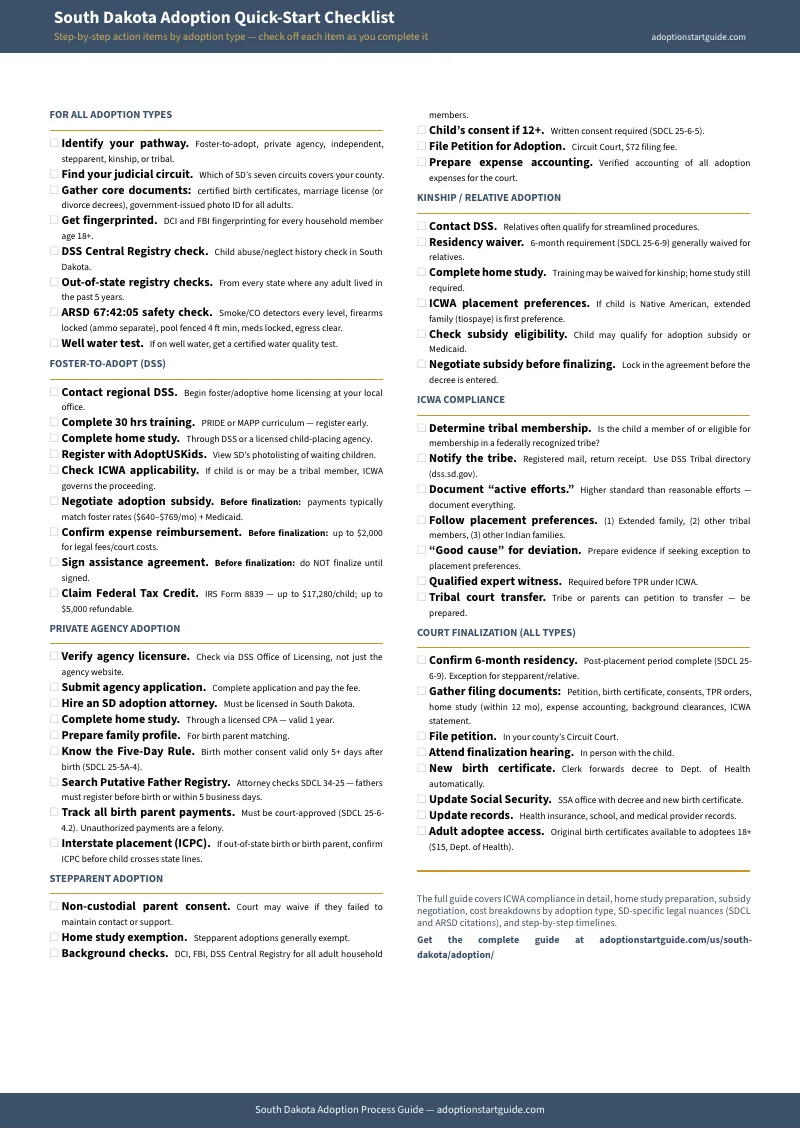
Download the South Dakota Adoption Quick-Start Checklist for a pathway-by-pathway overview of the adoption process, from identifying your judicial circuit through court finalization. Free, no commitment. It includes the ICWA compliance checklist and pathway-specific action items with SDCL statute references — the two things that cause the most confusion in the South Dakota system. If you want the full guide with the ICWA roadmap, home study preparation guide, financial planning framework, attorney directory, and printable worksheets, click the button in the sidebar.
— less than ten minutes with a South Dakota adoption attorney
South Dakota adoption attorneys charge $252 to $492 per hour. Agency application fees start at $500. A failed placement can cost $15,000 or more. This guide puts the entire South Dakota adoption system — ICWA compliance, home study preparation, consent rules, financial planning, and a vetted directory of agencies and tribal contacts — in your hands for less than the cost of a single phone consultation. Families who understand the system before they enter it move faster, negotiate stronger subsidy agreements, and avoid the months of confusion that come from waiting for an overworked caseworker to tell them what comes next.
If the guide doesn't deliver, reply to your download email at any time for a full refund. No forms. No justification required.