
Utah calls itself "adoption-friendly." Nobody mentioned the 5-day window that can void your entire case.
You started researching adoption in Utah and found a landscape that looks straightforward on the surface. DCFS has a clean website. The agencies present polished testimonials. Maybe someone at church mentioned LDS Family Services. You searched, found their adoption page, and read about counseling resources and spiritual support — but nothing about actually placing a child, because they stopped doing placements in 2014. You called an agency. They quoted you $25,000 to $50,000. You checked Reddit and found threads about birth fathers whose children were adopted without their knowledge, birth mothers flown in from other states, and an agency called Brighter Adoptions that collapsed in early 2026 after collecting over $575,000 from 14 families. You are now somewhere between committed and terrified, and every free resource you find either sells you on an agency or warns you away from the entire state.
Here is what the free resources will not tell you. Utah's Putative Father Registry operates on a window as short as five business days after a child is born. If your attorney does not search the registry correctly — or searches the wrong state when the birth mother came from out of state — a biological father can surface months later and challenge your adoption. That is not a theoretical risk. It is the specific legal mechanism that has disrupted finalized adoptions in Utah courts. Meanwhile, the 2026 HB 51 reforms have fundamentally changed the rules: birth mothers now have a 72-hour revocation period where none existed before, birth parent stipend regulations have tightened, and out-of-state placements now require a 90-day residency declaration with mandatory PFR searches in the birth mother's home state. Agencies that built their business model on fast-tracking out-of-state mothers are closing. Families who signed contracts six months ago are discovering that the process they were promised no longer exists under current law.
The DCFS website is excellent for foster care adoption but largely silent on private infant adoption. LDS Family Services provides counseling and referrals but no longer places children — and their website does not clearly explain what their referral network looks like in practice. Agency websites are promotional, not educational. They will not tell you that matching fees are non-refundable, that paying an unlicensed facilitator can result in a court refusing to finalize your adoption, or that the federal adoption tax credit became partially refundable in July 2025. Reddit is raw and often negative, skewing toward the worst outcomes without explaining how to prevent them. There is no consumer-grade resource that integrates the PFR mechanics, the HB 51 changes, the tax credit optimization, and the on-the-ground realities of Utah's post-2026 adoption landscape into a single, usable document.
The Utah Adoption Roadmap: Your Legal and Financial Navigator
This guide is built for families adopting in Utah under the 2026 legal framework. Every chapter reflects current law — including HB 51's revocation window, stipend regulations, and residency requirements — the actual scope of LDS Family Services today, the fee structures of Utah's licensed agencies, the specific mechanics of the Putative Father Registry, and the state and federal tax benefits that most families only learn about after they've filed their return without claiming them. It is not a national adoption handbook with a Utah chapter tacked on. It is the operational manual for navigating the system that Utah families face right now.
What's inside
- Putative Father Registry Decoded — The PFR is the legal backbone of adoption finality in Utah. This chapter explains the 5-day compliance window under Utah Code Section 81-13-213, the four procedural steps a biological father must complete to assert rights, how to verify that your attorney has obtained the correct registry certificate from Vital Records, and the new HB 51 requirement for multi-state PFR searches when the birth mother is from out of state. Includes the current Vital Records fee schedule ($18/hour paternity search, $25 registry access, $40 adoption processing) so you know exactly what to expect.
- HB 51 Reform Navigator — The 2026 reforms changed three things that every prospective parent must understand before signing an agency contract. This chapter covers the new 72-hour birth mother revocation window (replacing the old "final upon signing" standard), the tightened regulations on birth parent stipends that make previous "postpartum care" lump-sum arrangements illegal, and the 90-day residency disclosure requirement for out-of-state placements. Explains what these changes mean for your timeline, your contract, and your legal exposure.
- LDS Family Services Reality Check — The 2014 transition from full-service agency to counseling-and-referral model left thousands of Utah families confused about where to start. This chapter maps the current scope of LDS Life Help services, explains how their referral network connects to licensed private agencies, and gives you objective criteria for evaluating the agencies they recommend — including fee comparisons, placement success rates, and the questions to ask before signing any contract.
- Agency Vetting Framework — After the Brighter Adoptions collapse — where families lost up to $47,000 each on placements that were potentially fraudulent — agency vetting is not optional. This chapter explains the difference between a licensed Child-Placing Agency (CPA) and an unlicensed facilitator, why paying a facilitator can result in a court refusing to finalize your adoption, how to verify an agency's license through the Utah DHHS Office of Licensing, and the specific contract red flags that preceded Brighter's implosion.
- Home Study Preparation Guide — The home study is a multi-session assessment that evaluates your readiness, your home environment, and your support network. This chapter covers what the evaluator looks for, the documents you need assembled before the first visit (background clearances, medical exams, financial records, references), and how the process differs between DCFS foster-to-adopt assessments and private agency evaluations.
- Financial Planning Framework — Cost breakdown by adoption pathway. Foster-to-adopt through DCFS costs $0 to $2,000 in legal fees. Private infant adoption through a Utah agency runs $25,000 to $50,000. Stepparent adoption with an attorney runs $1,500 to $4,000. This chapter maps the federal adoption tax credit (up to $17,280 per child, with $5,000 now refundable), Utah's $3,500 refundable adoption expenses credit for families with AGI under $55,000, the $1,000 special needs credit, and the at-home parent credit — then shows you how to calculate your net cost after all credits are applied.
- Court Filing and Finalization Guide — Utah District Court adoption filings require specific petitions, PFR certificates, consent documents, and financial declarations. This chapter walks you through the MyPaperwork self-filing system, explains court filing fees ($360-$400), and covers the finalization hearing timeline — typically six months from placement, faster than most states.
- Utah Attorney and Agency Directory — Vetted directory of Utah adoption attorneys and licensed agencies organized by specialty. Covers private infant adoption, foster-to-adopt, stepparent, and kinship cases. Includes typical fee structures ($200-$400/hour for attorneys), what to ask in a first consultation, and which professionals specialize in interstate placements under the new HB 51 requirements.
Printable standalone worksheets included
- Adoption Timeline Tracker — Every milestone from initial agency or DCFS contact through court finalization, with fill-in date fields. Print it, bring it to every meeting, and always know where your case stands.
- Home Study Document Checklist — Background clearances, medical exams, financial records, references, and home safety items in the order the evaluator expects them.
- PFR Verification Checklist — Step-by-step confirmation that your attorney has searched the Putative Father Registry correctly, obtained the Vital Records certificate, and completed multi-state searches if required under HB 51.
- Financial Planning Worksheet — Costs by pathway, federal and Utah state tax credit calculations, grant eligibility, and a net-cost summary in one printable sheet.
Who this guide is for
- LDS families navigating the post-2014 landscape — You grew up hearing about families who adopted through LDS Family Services. You expected a clear, faith-guided path. Instead you found a referral model that points you to private agencies charging five to ten times what the old system cost, with no objective way to compare them. You need a guide that respects the LDS adoption mission while giving you the consumer-grade information to evaluate agencies, understand contracts, and protect your family financially.
- Non-LDS Utah families pursuing private adoption — You are navigating a market where the largest referral networks are faith-based and the secular alternatives are fragmented. You want a clear, pathway-specific roadmap that covers attorney-led independent adoption, agency selection without relying on religious networks, and the legal and financial mechanics that apply regardless of your faith background.
- Out-of-state families with Utah connections — You have heard that Utah's legal framework provides strong finality for adoptive families. You want to understand what HB 51 changed about out-of-state placements, how the Interstate Compact on the Placement of Children (ICPC) works with Utah's new 90-day residency disclosure, and whether Utah's reputation for fast, final adoptions still holds under current law.
- Stepparent and kinship adopters — A child is already in your home. You want to make it permanent. You need to understand the consent requirements when a biological parent is absent or uninvolved, how the Putative Father Registry applies to your case, home study requirements for kinship placements, and whether you can use the MyPaperwork system to reduce legal costs.
Why the free resources fall short
DCFS publishes solid information about foster care adoption — waitlists, training requirements, the Utah Adoption Exchange for waiting children. But if you are pursuing private infant adoption, independent adoption, or stepparent adoption, the DCFS website has almost nothing for you. It does not explain the PFR, the HB 51 changes, the facilitator-versus-agency distinction, or the financial planning that separates a $25,000 process from a $50,000 one.
Agency websites exist to sell you their services. They will tell you about their compassionate staff and their beautiful families. They will not tell you that their matching fees are non-refundable, that their quoted costs frequently exclude birth mother living expenses, or that the agency down the street charges $8,000 less for the same placement pathway. They will not mention Brighter Adoptions.
LDS Life Help provides emotional and spiritual counseling that many families find valuable. But it is not equipped to provide — and does not claim to provide — cost comparisons, legal risk analysis, or tactical guidance on navigating the private agency market. The referral is the starting point, not the map.
Utah adoption attorneys charge $200 to $400 per hour. A one-hour consultation gives you general advice about your specific situation — not a complete walkthrough of the PFR mechanics, not a tax credit optimization worksheet, not an agency vetting framework, and not a directory of every licensed adoption professional in the state. The guide puts the entire Utah adoption system in your hands for a fraction of what a single legal hour costs.
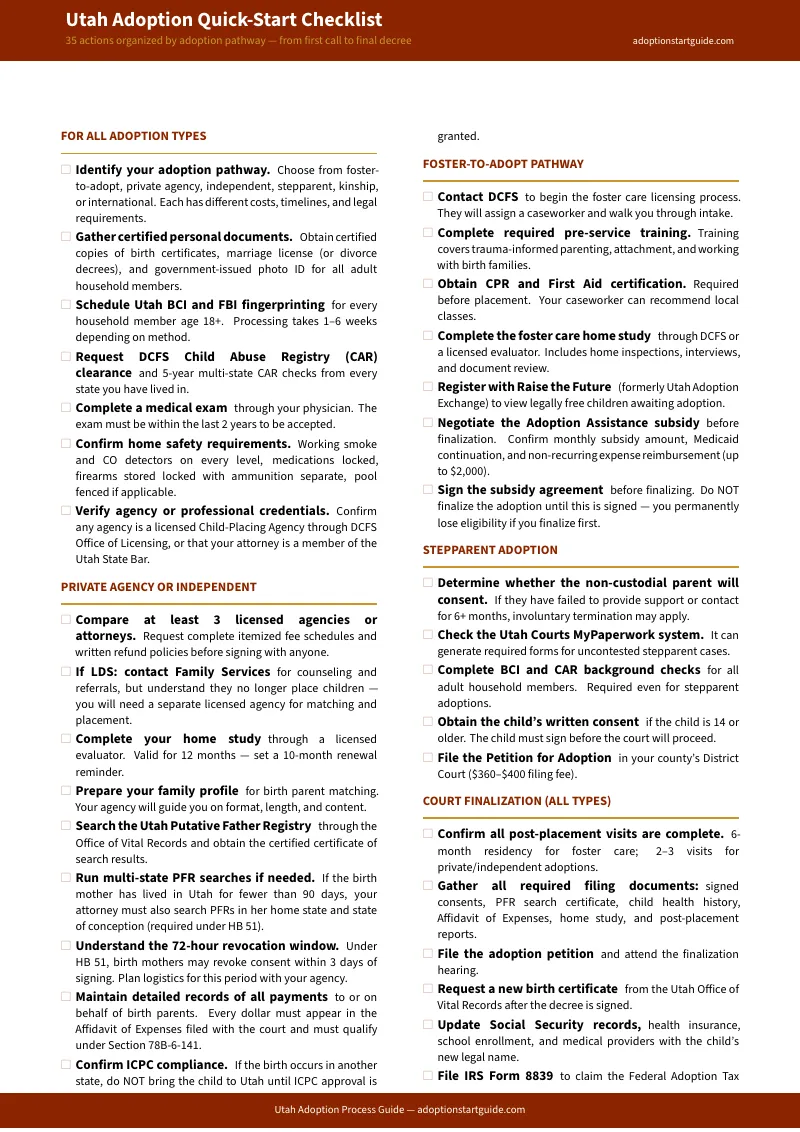
The free Quick-Start Checklist
Download the Utah Adoption Quick-Start Checklist for a one-page overview of the adoption process, from choosing your pathway through court finalization. Free, no commitment. It includes the four-pathway decision framework and the three most common first-step mistakes Utah families make. If you want the full guide with the PFR verification checklist, HB 51 navigator, agency vetting framework, tax credit worksheets, and attorney directory, click the button in the sidebar.
— less than fifteen minutes with a Utah adoption attorney
Utah adoption attorneys charge $200 to $400 per hour. Agency application fees start at $500. A failed match with an unvetted agency can cost $25,000 to $47,000. This guide puts the entire Utah adoption system — PFR mechanics, HB 51 compliance, agency vetting, financial planning, and a vetted attorney directory — in your hands for less than the cost of a single phone consultation. Families who understand the system before they enter it avoid the matching fee traps, claim the tax credits they qualify for, and move through court finalization without the months of anxiety that come from not knowing whether the Putative Father Registry was searched correctly.
If the guide doesn't deliver, reply to your download email at any time for a full refund. No forms. No justification required.