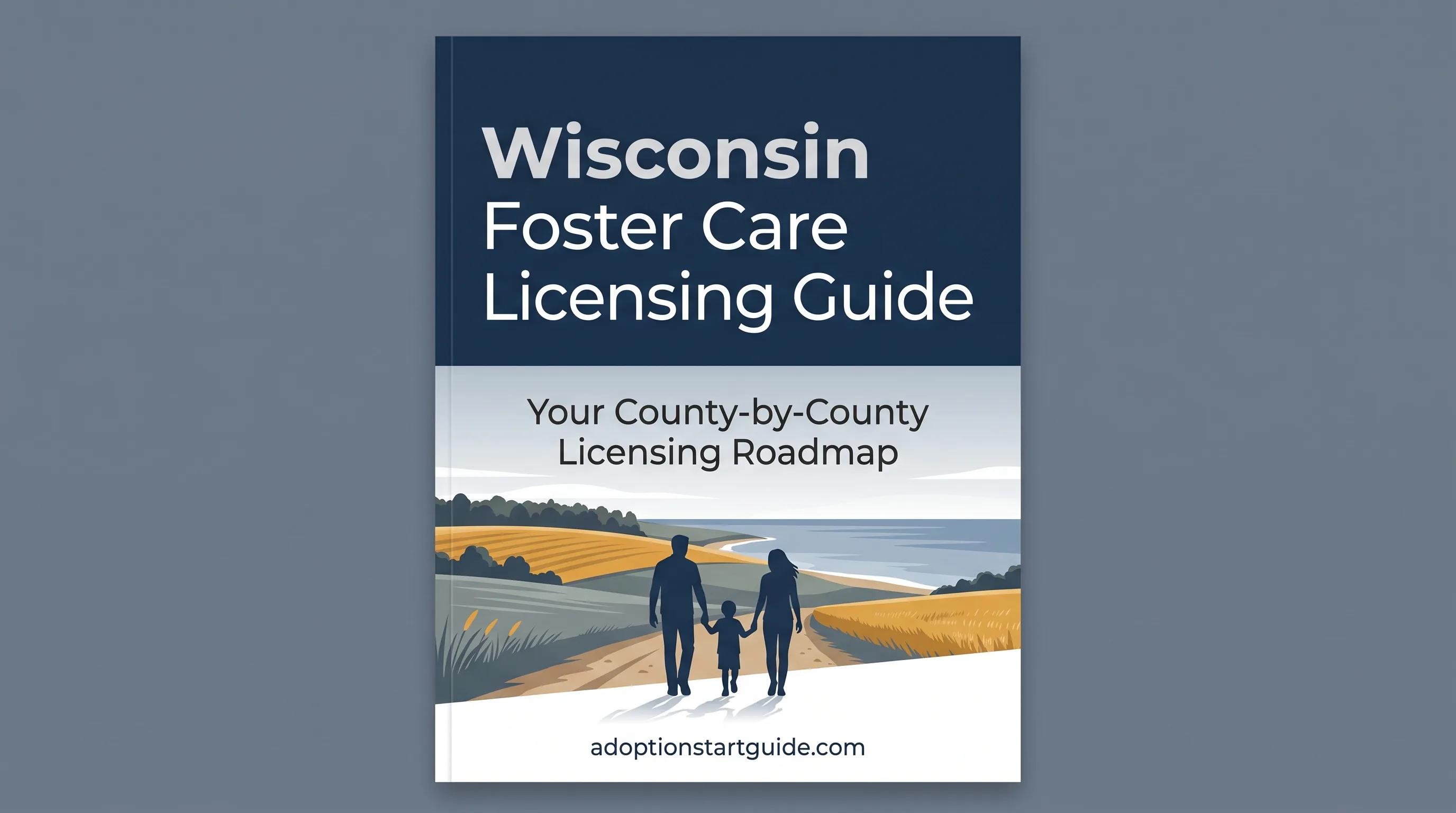
Wisconsin has 72 counties, one state-run exception in Milwaukee, and zero guides that tell you which door to walk through first.
You went to the DCF website looking for a clear path to becoming a foster parent. What you found was 60 pages of Administrative Code Chapter DCF 56, a county directory with 72 entries and no explanation of which one applies to you, and a background check process that requires forms to be filed in an exact sequence nobody spells out. You might have called your county's Department of Human Services. If you live in Milwaukee, that was your first mistake — Milwaukee is the only county in Wisconsin where foster care is run by the state through DMCPS, not by the county. The county office will tell you they don't handle foster care. They won't tell you who does. You'll spend two to four weeks figuring that out on your own.
Meanwhile, the technical requirements keep stacking up. The Background Information Disclosure form has to be entered into eWiSACWIS before the agency can generate the Fieldprint Reference ID you need to schedule fingerprinting. Families who walk into a Fieldprint location without that Reference ID waste $37.75 and start the process over. The home inspection includes items that national guides have never heard of — biennial wood-burning stove certifications, well water bacteria testing, pipe insulation checks in unheated crawl spaces, heating system documentation that proves your furnace can handle a Wisconsin January. And the Levels of Care system means your training commitment ranges from 6 hours to 30-plus hours depending on a decision most families don't know they're making until they've already committed to the wrong track.
National foster care books on Amazon don't know that Milwaukee operates under DMCPS instead of the county. They don't cover the BID-to-Fieldprint sequence, the DCF 56 cold-weather inspection items, WICWA placement preferences for Wisconsin's 11 federally recognized tribes, or the fact that choosing the wrong Level of Care can add months of unnecessary training to your timeline. And the private consultants who do understand Wisconsin's system charge $150 to $300 an hour for the same tactical knowledge you need before you've spent a dime.
The Wisconsin Licensing Roadmap: Your County-by-County Guide to Foster Care Certification
This guide is built for Wisconsin's 72-county system — and the one county that doesn't follow the rules — and nobody else's. Every chapter, every checklist, every recommendation is grounded in the current DCF 56 Administrative Code, Wisconsin Statutes Chapter 48, the 2025 rule revisions for relative and like-kin placements, and the county-specific realities that determine whether your licensing takes three months or twelve. It's not a repurposed national handbook. It's the operational layer between what the DCF website posts and what you actually need to know to get licensed — in your county, under current conditions.
What's inside
- Milwaukee vs. County First-Call Directory — This is the single most common wrong turn in Wisconsin foster care, and nobody warns you about it. If you're in Milwaukee, your licensing goes through DMCPS and its contracted private agencies — Wellpoint Care Network, Children's Wisconsin, or Professional Services Group — not the Milwaukee County DHS. If you're in any of the other 71 counties, you contact your county's Foster Care Coordinator directly. This chapter gives you the exact agency, the correct phone number, and what to say on your first call so you don't lose weeks to the wrong office.
- BID/Fieldprint Sequence Manual — The Background Information Disclosure (BID) form must be submitted and entered into eWiSACWIS before the agency generates your Fieldprint Reference ID. Only then can you schedule fingerprinting. Every adult in your household aged 18 and older needs this — and children 12 and older need a BID as well. This chapter maps the exact sequence from BID submission through DOJ and FBI clearance, explains what happens if results come back with a hit (absolute bars versus rehabilitative review), and tells you precisely when to book your Fieldprint appointment so you don't pay the $37.75 fee twice.
- DCF 56 Home Inspection Walkthrough — Room-by-room, item-by-item coverage of what the licensing specialist checks when they walk through your home. Every national guide covers smoke detectors and fire extinguishers. This chapter covers the Wisconsin-specific items that actually fail inspections — unvented space heater prohibition, wood-burning stove biennial certification by a fire safety expert, private well water testing for bacteria and nitrates, pipe insulation in basements and crawl spaces, heating system documentation proving your furnace was serviced this year, and basement egress requirements if you're using a lower level as a bedroom or play area. Walk your house with this chapter before the inspector arrives, not after.
- Levels of Care Pre-Assessment — Wisconsin's five-tier LOC system determines your training hours, the children you're matched with, and your monthly reimbursement rate. Level 1 requires only 6 hours of pre-placement training but is limited to child-specific placements where you already have a relationship. Level 2 is general foster care with 6 hours pre-placement plus 30 hours of Foundation Training in your first two years. Levels 3 through 5 are treatment foster care requiring years of experience and advanced specialized training. Most first-time families belong at Level 2 — but if you don't know that going in, you might commit to a CPA that only handles Level 3 placements and find yourself underwater with training requirements you didn't anticipate. This chapter walks you through the decision before you sign up.
- WICWA and Tribal Placement Guide — Wisconsin is home to 11 federally recognized tribes, and the Wisconsin Indian Child Welfare Act creates specific placement preferences and "active efforts" requirements that go beyond federal ICWA standards. If you're a non-Native family and a Native child is placed in your home, WICWA governs the case — including the possibility of transfer to tribal court. If you're a tribal member fostering through your nation's ICW department, the interplay between tribal sovereignty and state licensing standards shapes your entire process. This chapter explains both sides so you're prepared regardless of which direction the placement goes.
- County-by-County Timeline Expectations — Rural counties like Door or Clark often have faster home study completion but fewer training sessions per year. Urban centers like Madison (Dane County) have more frequent training cohorts but longer queues for home studies. Milwaukee operates on an entirely different timeline through DMCPS contractors. This chapter gives you realistic timelines by region so you can plan around reality instead of the generic "it varies" that every free resource offers.
- Financial Reality by Level of Care — Wisconsin's Uniform Foster Care Rate varies by the child's assessed Level of Care and the type of placement. This chapter breaks down monthly rates for Levels 1 through 5, the supplemental payments for children with exceptional needs, Kinship Care payments under the 2025 rule revisions, Medi-Cal coverage, and the real out-of-pocket costs nobody mentions — transportation for birth family visits, childcare gaps during court hearings, and the clothing and school supply needs that arise before the first reimbursement check arrives.
Printable standalone worksheets included
- Licensing Timeline Tracker — Every milestone from initial inquiry through foster home certificate, with fill-in date fields. Print it, update it after every agency contact, and always know where you stand.
- Home Safety Inspection Checklist — Room-by-room DCF 56 walkthrough including Wisconsin's cold-weather items. Walk your house with this before the licensing specialist visits.
- Document Organization Sheet — BID forms, Fieldprint receipts, DOJ/FBI clearance letters, health questionnaires, reference forms, training certificates, and CPR card — every document you need, in the order you need it.
- Financial Planning Worksheet — Monthly rates by Level of Care, county vs. CPA rate comparison, supplemental payments, and hidden costs in one printable sheet for your household budget conversation.
Who this guide is for
- Milwaukee families — You've been bounced between the county DHS, DMCPS, and contracted agencies like Wellpoint and Children's Wisconsin. Nobody told you the system works differently in Milwaukee than everywhere else in the state. You need the correct first contact, the right agency for your neighborhood, and a licensing roadmap that matches the DMCPS process — not the county one.
- Rural Wisconsin families — You live in a county where training sessions happen quarterly, the licensing specialist covers three counties, and your 1920s farmhouse has a wood-burning stove, a private well, and a basement that might not meet egress requirements. You need a guide that addresses Wisconsin's physical environment standards, not a generic checklist written for a subdivision in Texas.
- Kinship caregivers — A grandchild, niece, nephew, or family friend's child was placed with you and you need to get licensed to access ongoing support and reimbursement. The 2025 DCF 56 revisions created a "Relative and Like-Kin" pathway with reduced barriers, but you still need to clear background checks for every adult in the home, meet the physical safety standards, and complete pre-placement training. This guide walks you through the streamlined process.
- Foster-to-adopt families — You're entering the foster care system with the hope of providing a permanent home. Wisconsin's concurrent planning process means you'll support reunification efforts while preparing for the possibility of adoption. The emotional and legal complexity of this dual track requires preparation that county orientations don't provide.
- Faith-based families — Your church, synagogue, or faith community inspired you to foster. Lutheran Social Services, Catholic Charities, Bethany Christian Services, and other faith-based CPAs handle a significant portion of Wisconsin's foster care licensing. This guide helps you choose between a county agency and a CPA that aligns with your values while ensuring you understand the secular legal requirements that apply to every licensed home.
Why the free resources aren't enough
The DCF website publishes Administrative Code Chapter DCF 56 — 60-plus pages of regulatory language designed for licensing specialists, not applicants. It tells you what the rules are. It does not tell you which rules trip people up, how the 72 counties differ in practice, or what to do when your Fieldprint results haven't come back after three weeks and nobody at the county is returning your calls.
County orientation sessions are recruitment events. They're designed to inspire you to apply, not prepare you to succeed. You'll hear statistics about the need for foster families. You won't get a checklist for passing the DCF 56 home inspection or a strategy for sequencing the BID and Fieldprint process correctly.
Facebook groups and Reddit threads provide emotional support, but a family in Milwaukee gets fundamentally different instructions than a family in Eau Claire — because the administrative system is literally different in Milwaukee. Crowdsourced guidance mixes the two systems without distinguishing between them, and families end up following advice meant for the wrong jurisdiction.
National foster care books describe a licensing process that doesn't exist in Wisconsin. They don't cover the DMCPS exception, the BID-to-Fieldprint sequence, DCF 56's cold-weather inspection items, the five-tier Levels of Care system, or WICWA. A guide written for a national audience will tell you to "contact your local agency." In Milwaukee, that sentence has a completely different meaning than in the other 71 counties.
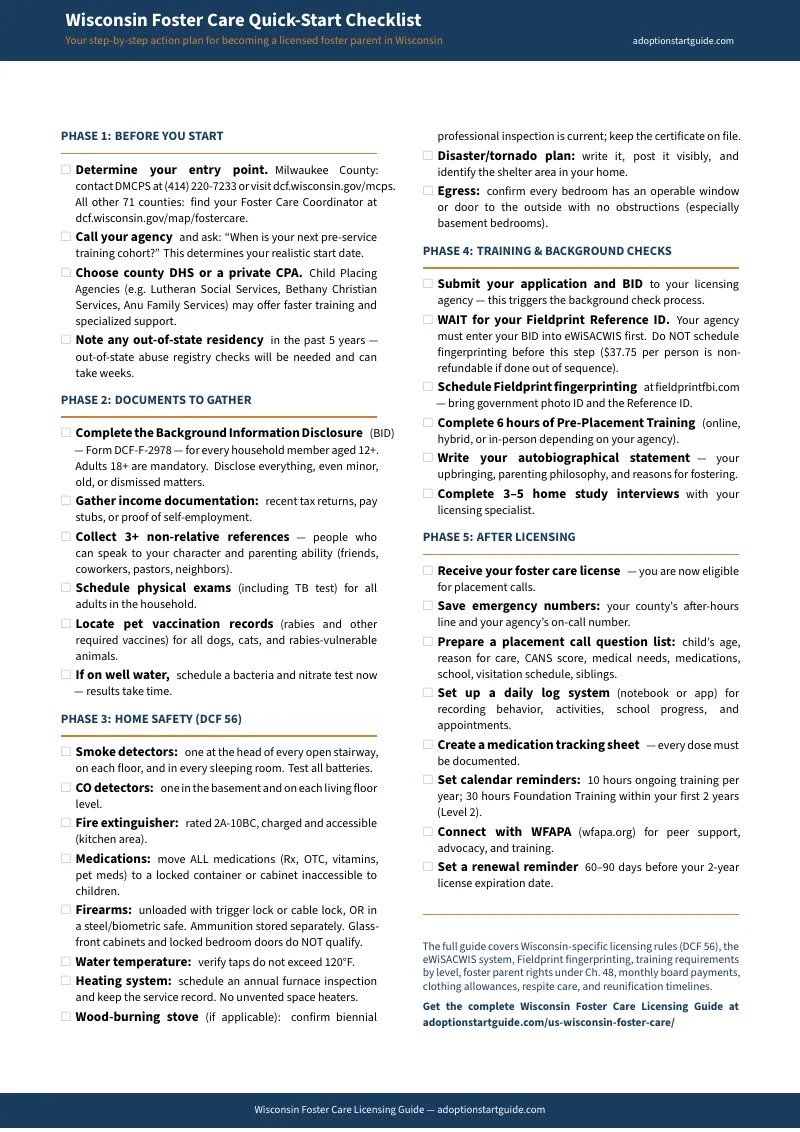
The free Quick-Start Checklist
Download the Wisconsin Foster Care Quick-Start Checklist for a one-page overview of the licensing process, from initial inquiry through certification. Free, no commitment. It includes the Milwaukee vs. county first-call decision and the BID/Fieldprint sequence — the two items that cause the most delays. If you want the full guide with the county-by-county timelines, DCF 56 room-by-room walkthrough, LOC pre-assessment, WICWA guide, financial breakdown, and printable worksheets, click the button in the sidebar.
— less than one wasted Fieldprint appointment
The typical Wisconsin applicant spends weeks navigating the DCF website, calling the wrong offices, and piecing together the licensing process from county brochures, CPA websites, and forum posts — and still doesn't know whether they're following the right sequence until something goes wrong. This guide distills the most critical decisions into a weekend-ready roadmap. A Fieldprint appointment booked without the Reference ID wastes $37.75 and two weeks. One chapter prevents that. A failed DCF 56 inspection because of an uncertified wood stove or missing well water test delays your licensing by a month or more. One checklist prevents that.
If the guide doesn't deliver, reply to your download email at any time for a full refund. No forms. No justification required.