Wyoming has the fewest people in the country, some of the most rural geography on the continent, and counties where there are literally zero licensed foster homes. The DFS website tells you the requirements. It doesn't tell you how to actually get licensed when your nearest district office is a two-hour drive.
You decided to foster. Maybe your pastor mentioned the need at a community supper. Maybe a grandchild or a neighbor's kid was just removed by DFS and you got the call at midnight. Maybe you've watched Wyoming's foster care shortage get worse every year and finally searched "how to become a foster parent in Wyoming." Whatever brought you here, you went to the dfs.wyo.gov website looking for a clear starting point.
What you found was a collection of FAQ pages, references to Chapter 12 regulations, and links to DCI background check forms scattered across multiple state agencies. You found the phrase "contact your local DFS office" repeated throughout — as though every district office in this state operates the same way, on the same timeline, with the same staffing. They don't. Some districts run PRIDE training twice a year. Others run it when they have enough applicants to fill a cohort. In Sublette County, there were periods with zero foster homes in the entire county. Zero.
What you didn't find was a plain-language answer to the question every Wyoming family asks first: what exactly do I need to do, in what order, and how long will this take?
So you turned to Reddit and Facebook. "Foster Parents of Wyoming." You posted your question and got the response that defines this system: "It depends — call your caseworker." But you don't have a caseworker yet. That's the whole problem. You're in the gap between wanting to foster and knowing how to start — and in the least populous state in America, nobody is meeting you there.
The Wyoming Children's Society does valuable adoption work. Uplift Wyoming provides family advocacy. But their materials are built for families who are already in the system. If you haven't completed PRIDE training yet — if you're still trying to figure out how to get fingerprinted in a town with no LiveScan location — their support is several steps ahead of where you are. National foster care books on Amazon will prepare your heart for fostering. They will not tell you how to fill out the CCL-108 fingerprint cover letter correctly, where to get a money order when DCI won't accept personal checks, or what happens when your PRIDE cohort doesn't start for four months because your district doesn't have enough applicants.
The Wyoming Foster Care Licensing Roadmap
This guide is built for the Wyoming DFS system and nobody else's. Every chapter, every checklist, every regulation reference is grounded in Title 14 of the Wyoming Statutes, the DFS Chapter 12 licensing standards, and the operational realities of district offices that stretch from Cheyenne to Jackson to Gillette — offices that serve a state nearly the size of the entire United Kingdom with fewer people than a mid-sized suburb. It covers the gap between what DFS posts online and what you actually need to know to get from "interested" to "licensed" without unnecessary delays, rejected fingerprint cards, or months of silence from a district office that never explained the next step.
What's inside
- Step-by-Step Licensing Process — Wyoming's licensing process has distinct stages, from initial inquiry through certification issuance. This guide walks you through each one in order: orientation, application, PRIDE training, DCI and FBI background checks, home study, and final approval. You'll know what's coming before your caseworker tells you — because in many districts, caseworkers are managing 20+ cases and don't have the bandwidth to walk you through it proactively.
- DCI Fingerprinting Walkthrough — The Division of Criminal Investigation background check is the single most common delay in Wyoming licensing. This chapter covers the CCL-108 cover letter, the two blue FBI fingerprint cards, why you need a cashier's check or money order (personal checks are rejected and restart the clock), how to mail everything correctly to the Background Check Unit in Cheyenne, and what to do during the 31-to-60-day processing window. If you live in a rural area where the nearest fingerprinting location has limited hours, this chapter shows you how to plan so one missed detail doesn't cost you two months.
- PRIDE Training Preparation — The mandatory 30-hour PRIDE (Parents Resource Information Development Education) training is the biggest time commitment in the process — and in rural districts, the biggest scheduling challenge. Cohorts run infrequently. A family that decides to foster in January may not find a training slot until May. This chapter breaks down all PRIDE sessions, explains what trainers evaluate at each stage, covers the new virtual instructor-led option for remote families, and shows you how to use Foster Parent College for approved online continuing education. If the "PRIDE gap" is the reason you haven't started, this chapter closes it.
- Rural Property Inspection Guide — This is not a generic baby-proofing checklist. Wyoming homes are working properties — ranches, farms, acreages with wells, septic systems, livestock, and outbuildings. This chapter covers the DEQ "Know Your Well" water testing requirements (coliform bacteria, nitrates, arsenic), septic pumping certification within three years, livestock enclosure safety for children, water heater temperature limits (120 degrees Fahrenheit maximum), and the winter preparedness expectations that DFS inspectors look for in a state where a storm can isolate your property for days. Walk your property with this chapter before the licensing worker walks it for you.
- Home Study Preparation — The home study is the most personally intensive part of the process. Wyoming requires at least three interviews — individual sessions for each applicant and a joint session with all household members — plus five references including three non-relatives who have known you for at least two years. This chapter explains what the licensing worker is actually evaluating: motivation, relationship stability, discipline philosophy, trauma-informed capacity, and support systems. It reframes the home study from an interrogation to what it really is — a process designed to help you succeed, not screen you out.
- Financial Reality Breakdown — Current Wyoming maintenance rates by age group and care level, including enhanced rates for therapeutic foster care. Wyoming Medicaid coverage for every foster child — and the reality that in rural counties, the nearest Medicaid-accepting pediatrician or dentist may be a hundred miles away. Child care assistance for working families. Clothing allowances. The financial difference between emergency kinship TANF payments and full licensed board rates. Wyoming has no state income tax, and the board payment is not income — it's a reimbursement for the child's expenses. This chapter gives you the full financial picture so you can foster sustainably.
- Kinship Care Fast-Track — If a grandchild, niece, nephew, or family friend's child was placed with you after a DFS removal, you're already parenting under an emergency placement. You didn't plan for this, and you may not be receiving full financial support because you're not yet certified. This chapter explains the emergency relative placement process, the path from temporary kinship care to full licensure, and the significant financial difference between TANF kinship payments and full board rates. In a state this small, kinship placements keep children in their community, in their school, near their people.
- Wyoming ICWA and Wind River Reservation — Wyoming's 2023 Indian Child Welfare Act (SF0094) codifies protections for children with Northern Arapaho and Eastern Shoshone tribal affiliation that go beyond federal ICWA. This chapter covers the "Active Efforts" standard (higher than the federal "Reasonable Efforts"), exclusive tribal court jurisdiction for children on the Wind River Reservation, placement preferences that prioritize extended family and tribal members, and how to work with tribal DFS offices. Whether you're a tribal family, a non-tribal family near the reservation, or fostering a child who may have tribal eligibility, this chapter is essential.
- Foster-to-Adopt Pathway — For families entering the system with adoption as their ultimate goal. How concurrent planning works in Wyoming, what "legal risk" placements mean, when a foster family receives first consideration for adoption, and how Termination of Parental Rights (TPR) unfolds in Wyoming District Court. This chapter also addresses the hardest truth: reunification is the legal and philosophical priority, and Wyoming's Multidisciplinary Team process means you'll be actively participating in a plan that may not end with adoption — and you must genuinely support that.
- Therapeutic Foster Care — Enhanced-level placements for children with significant behavioral health, developmental, or medical needs. How to become a therapeutic foster parent, what additional training and home standards are required, and the higher maintenance rates that come with specialized care. Also covers fostering teenagers — the population most in need and least likely to find placement in a state where the foster home shortage is most acute.
- Working with DFS and the Court System — How Wyoming's Multidisciplinary Team (MDT) process works, your rights and responsibilities as a foster parent under DFS policy, the mandatory reporting obligations under W.S. 14-3-205, how to navigate the DFS problem-solving and hearing process if you disagree with a decision, and how to maintain a productive relationship with your caseworker when turnover is high and caseloads are heavy.
Printable standalone worksheets included
- Home Safety Self-Inspection Checklist — Room-by-room walkthrough of every physical requirement under Wyoming's Chapter 12 licensing standards. Smoke detectors, carbon monoxide detectors, fire extinguisher ratings, firearms storage, water temperature, well water testing, septic status, livestock enclosures, winter preparedness. Walk your property with this before the licensing worker visits.
- Required Documents Checklist — Every form, clearance, and supporting document organized by when you need it: before orientation, with your application, for DCI and FBI background checks, for the home study, and for ongoing post-licensing compliance. Includes the CCL-108 fingerprint cover letter requirements so you get it right the first time.
- Background Check Tracking Log — DCI state criminal history, FBI national fingerprint check, DFS Central Registry, National Sex Offender Registry, out-of-state abuse/neglect checks — track submission dates, processing windows, result dates, and clearance status for every adult in your household.
- PRIDE Session Tracker — All PRIDE sessions listed with space to record completion dates, key takeaways, and questions for your trainer. Includes tracking for ongoing annual in-service training hours (18-24 hours required).
- Monthly Caseworker Visit Log — Document every visit, every topic discussed, every concern raised, every MDT meeting attended. This log protects you and ensures continuity when caseworkers turn over — which in Wyoming's current staffing climate, they will.
- Key Contact Information Sheet — DFS district office, licensing worker, child's caseworker, Wyoming Children's Society, Uplift Wyoming, tribal DFS contacts (Northern Arapaho and Eastern Shoshone), school, pediatrician, respite provider, DFS statewide hotline — all in one printable page.
Who this guide is for
- First-time prospective foster parents — You've been thinking about this for months or years. You saw the need in your community, attended a DFS orientation, or heard about Sublette County having zero foster homes and thought: that could be my county next. You went to the DFS website and found regulatory fragments where you expected a step-by-step guide. You need someone to lay out the process in plain language and tell you what to do this week.
- Ranch and rural families — You have the space, the stability, and the heart to foster, but you live on a working property with a well, a septic system, livestock, and outbuildings — and you're not sure any of it will pass a state inspection. It will. This guide shows you exactly how DFS evaluates rural properties so you can prepare with confidence instead of anxiety.
- Kinship caregivers — A grandchild, niece, nephew, or family friend's child was placed with you after a DFS removal. The child is already in your home. You didn't plan for this. Now you need to get certified to access full board payments and support services, and you're navigating a system you never expected to enter on a timeline you didn't choose.
- Foster-to-adopt families — You're entering the foster care system with the hope of eventually providing a permanent home. You need to understand how Wyoming handles concurrent planning, the TPR process, and the MDT's role in determining permanency — and why getting licensed is the prerequisite for everything that follows.
- Families near the Wind River Reservation — If you're Northern Arapaho or Eastern Shoshone, or if you live in Fremont County and a child in your care may have tribal eligibility, the ICWA chapter explains how state and tribal jurisdiction interact, what "Active Efforts" means in practice, and how to connect with tribal child welfare resources.
Why the free resources fall short
The DFS website publishes FAQ pages and links to Chapter 12 regulations — documents designed for caseworkers and licensing staff, not for a family sitting at the kitchen table trying to figure out if their ranch qualifies. It tells you what the rules are. It doesn't tell you which rules trip people up, why the DCI fingerprinting process derails more applications than any other step, or what your licensing worker is actually evaluating during the home study.
The Wyoming Children's Society provides adoption services. Uplift Wyoming offers family advocacy. But their materials assume you're already in the system. If you're pre-licensing — stuck in the most confusing window of the entire journey — their resources are several steps ahead of where you are.
Facebook groups and Reddit threads are valuable for community, but the constant refrain is "call your caseworker" — which is exactly what you can't do when you don't have a caseworker yet. National foster care books describe a generic process that doesn't account for Wyoming's DCI fingerprinting workflow, the rural property inspection realities of a ranch state, the PRIDE training scarcity in districts that serve counties the size of some eastern states, or Wyoming's own 2023 ICWA law that goes beyond federal protections. A guide written for a national audience will tell you to "contact your local agency." In Wyoming, that means figuring out which district office serves your county, understanding that your caseworker may be managing cases across hundreds of miles, and knowing what to say when you call — and nobody has published that in plain language.
The free Quick-Start Checklist
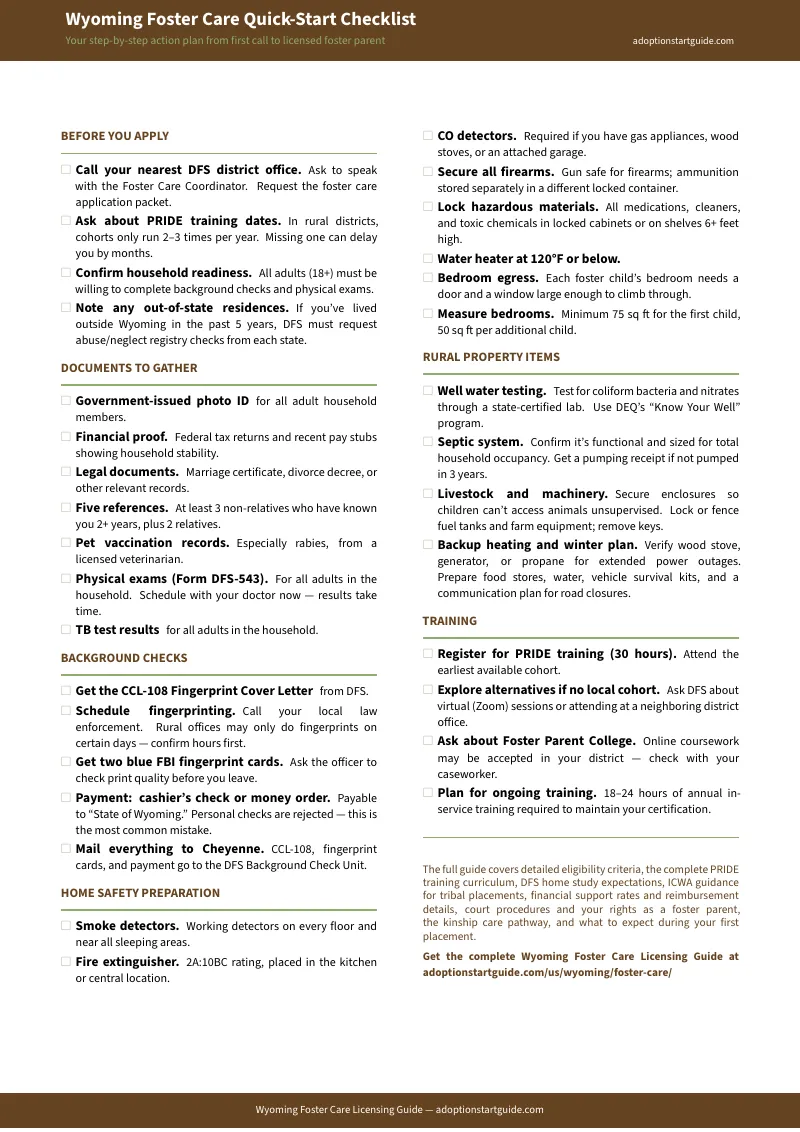
Download the Wyoming Foster Care Quick-Start Checklist for a four-phase overview of the licensing process, from your first DFS inquiry through home study preparation. Free, no commitment. If you want the full guide with the DCI fingerprinting walkthrough, PRIDE training preparation, rural property inspection guide, financial breakdown, kinship fast-track, ICWA chapter, and all six printable worksheets, click the button in the sidebar.
— Less Than a Tank of Gas in Sublette County
A rejected DCI fingerprint card because you used a personal check instead of a money order — or because you didn't know about the CCL-108 cover letter — delays your licensing by 60 days or more. That's two months of board payments you didn't receive for a mistake that costs nothing to avoid if you know about it in advance. One chapter on the DCI process prevents that. One walkthrough of the rural property inspection saves you the anxiety that makes good families quit before they finish. In a state where some counties have zero licensed foster homes, one family getting licensed isn't a statistic. It's a child staying in their school district instead of being sent three hours away.
If the guide doesn't deliver, reply to your download email at any time for a full refund. No forms. No justification required.