You've decided to adopt in Queensland. Then you discovered that DCSSDS, the Children's Court, and the Adoption Act 2009 each assume you already understand the other two.
Queensland is not like other Australian states. Your Expression of Interest expires after two years whether DCSSDS has contacted you or not -- there is no automatic renewal, no extension on request, no explanation of why you weren't selected. The Blue Card system requires every adult in your household to pass a screening check before you can even submit an EOI -- one negative notice for a flatmate or adult child and your entire application is disqualified before a social worker reads a word of it. Private adoption is illegal in Queensland and carries severe penalties, so every pathway runs through the department. And the DCSSDS website, which families describe as "designed to satisfy government reporting requirements rather than user needs," scatters adoption information across multiple pages without ever mapping the steps in the order a parent actually completes them.
You've already done the research. You found the DCSSDS website, which covers the four adoption pathways -- local, intercountry, foster care, and step-parent -- across separate pages that don't explain how they connect. You found the Queensland Adoption Handbook, a dense administrative document that explains the rules in department language but never tells you the order of operations as a family. You found Adopt Change, which provides a helpful national overview but doesn't address the Queensland-specific quirks like the two-year EOI expiration or the dual state-and-federal assessment for intercountry adoption. And you found Facebook groups where well-meaning strangers mix up Queensland's Blue Card rules with New South Wales Working with Children checks and Victoria's adoption consent periods in the same thread.
The information exists. It's scattered across the Adoption Act 2009, DCSSDS fact sheets, Blue Card Services application forms, the Commonwealth Intercountry Adoption Branch, Children's Court practice directions, and Jigsaw Queensland support group resources. Piece it together yourself and you'll burn weeks reading documents that explain the rules but never tell you what to do first, second, and third as a prospective parent.
The Adoption Act 2009 Roadmap
This is a complete, Queensland-specific adoption guide built around the problem every family in this state hits: navigating a system where DCSSDS, the Children's Court, Blue Card Services, and the Commonwealth's Intercountry Adoption Branch each own a piece of the process but none of them explain how the pieces connect. Not a national overview. Not a government handbook designed for departmental compliance. Every chapter, every checklist, every cost figure is grounded in the Adoption Act 2009 (Qld), current DCSSDS policies, Blue Card requirements, and the real-world experience of families who have adopted in the Sunshine State.
What's inside
- Four-pathway comparison table -- Local infant adoption, intercountry adoption through Hague Convention partners, adoption from foster care, and step-parent or relative adoption, mapped side by side. Costs, timelines, eligibility requirements, and realistic wait expectations for each pathway so you choose the right one before investing months in the wrong direction. The local assessment fee is $791. Intercountry official state fees total over $8,000 before travel, with total costs reaching $30,000 to $50,000. Step-parent applications start at $97 but the Family Court leave process alone costs $5,000 to $15,000 in legal fees. That decision deserves more than a caseworker's one-sentence summary.
- The EOI expiration decoder -- Queensland's Expression of Interest register is not a queue. It's a pool. DCSSDS selects families based on "anticipated placement needs" -- the specific ages, cultural backgrounds, and medical needs of children currently in care -- not the date your EOI was filed. If you are not selected within two years, your EOI expires and you start over. This chapter explains the selection criteria, what makes an EOI stand out, how to manage the wait without letting it consume you, and the renewal process that the department website barely acknowledges.
- Blue Card household audit guide -- Since August 2020, Queensland operates one of the strictest Working with Children screening systems in Australia. Every adult household member -- your 18-year-old, your mother-in-law in the granny flat, your housemate -- must hold a valid Blue Card. A negative notice for any one of them disqualifies your adoption application immediately, regardless of your own suitability. This chapter walks you through the CRN requirement from Transport and Main Roads, the application process through Blue Card Services, and a room-by-room household audit so no one in your home triggers a disqualification you didn't see coming.
- The permanency gap explained -- The department often steers families toward Long-Term Guardianship or Permanent Care Orders because these orders are faster and simpler to obtain than adoption. But LTG and PCO end at age 18. They do not change the child's birth certificate. They do not make you the child's legal parent. This chapter provides a side-by-side comparison of Adoption Orders, Permanent Care Orders, Long-Term Guardianship, and Parenting Orders -- the legal rights, the identity implications, the "18-Year Cliff" -- so you understand what each order actually gives you before you accept one.
- The comprehensive assessment preparation guide -- The home study is the most invasive phase of Queensland adoption. Social workers evaluate background checks (criminal, traffic, domestic violence, and child protection), medical reports, financial stability, and personal interviews with every household member. Your referees will be interviewed. Your emotional readiness and "lifestyle stability" will be assessed. This chapter explains what DCSSDS social workers are looking for, how to prepare for the home visits, and the difference between "performing suitability" and genuinely demonstrating it.
- Intercountry adoption dual-system navigator -- If you're adopting from overseas, you must satisfy Queensland's Adoption Act 2009 and the Commonwealth's Intercountry Adoption Branch requirements simultaneously. Then the partner country -- Thailand, Philippines, or others -- adds its own age, marital duration, and health criteria. The assessment fee alone is $5,684, paid in two instalments, with a mandatory $2,436 post-placement supervision fee on top. This chapter maps the "matrix of eligibility" across all three layers -- state, federal, and international -- so you know your actual eligibility before you pay a dollar.
- Step-parent adoption guide -- You've been raising your partner's child for years. You assume the process is straightforward because everyone agrees. It isn't. Queensland requires you to obtain "leave" from the Family Court of Australia before DCSSDS will even begin the assessment. That Family Court process costs $5,000 to $15,000 in legal fees depending on whether the other birth parent consents. Then you need a home study, a suitability recommendation from the Chief Executive, and a final order from the Children's Court. This chapter covers the Family Court leave application, the consent requirements under the Adoption Act, and the full timeline from first legal consultation to finalisation.
- The eight-stage process map -- From the initial eligibility filter through EOI submission, selection for assessment, the comprehensive home study, the suitability recommendation, the placement proposal, the 12-month supervision period, and the final adoption order in the Children's Court. Eight stages, each with specific milestones, documents, and realistic timeframes, so the process stops feeling like an "administrative black hole" and starts feeling like a path with a destination.
- Financial planning framework -- Current 2025/2026 DCSSDS fees for every pathway, legal costs for court appearances and Family Court leave, intercountry travel estimates, the federal adoption tax offsets, and the hidden costs that the department website doesn't list. No surprises at the wrong stage.
Who this guide is for
- Couples and de facto partners exploring adoption for the first time -- You've been together for at least two years, you may have come through IVF or another path to get here, and you're staring at the DCSSDS website trying to figure out where to start. The guide maps your pathway before you commit to the wrong one and lose months.
- Step-parents who need legal standing -- You've been parenting this child every day. You want the same legal rights as a biological parent -- medical decisions, school enrolment, inheritance, a name on the birth certificate. The guide walks you through the Family Court leave process, the consent or dispensation requirements, and the DCSSDS assessment so one missed filing doesn't cost you a year.
- Foster carers pursuing adoption from care -- The child in your home has had reunification ruled out. You want to convert your foster care placement into a permanent adoption, but you're worried about the difference between a Permanent Care Order and a full Adoption Order. The guide explains the "permanency gap," the TPR process, and the transition from carer to legal parent.
- Single applicants -- Queensland allows single people to adopt. The eligibility criteria are the same, but the assessment emphasis on support networks and parenting capacity is different. This guide addresses the single-applicant pathway specifically, not as a footnote.
- Families considering intercountry adoption -- You want to adopt from overseas but the dual state-and-federal system feels impenetrable. The guide maps the Queensland DCSSDS requirements, the Commonwealth Intercountry Adoption Branch requirements, and the partner country criteria in one place, so you don't discover you're ineligible after paying $5,684 in assessment fees.
Why the free resources aren't enough
The DCSSDS website covers the four adoption pathways across separate pages. It explains EOI requirements, information sessions, and departmental contacts. But it provides no linear roadmap. Key details -- whether the EOI register is currently accepting new applicants, what the current median wait time is, how the selection criteria actually work -- are either buried or absent. Families describe the experience as "trying to read a map that's been cut into pieces and shuffled."
The Queensland and Intercountry Adoption Handbook is the definitive administrative document. It is also 200-plus pages of departmental language written for compliance, not clarity. It tells you the rules. It does not tell you the order of operations, the likely timeline, or how to avoid the common mistakes that delay applications by months.
Adopt Change provides excellent national advocacy and a high-level overview of adoption in every Australian state. But their Queensland page does not address the two-year EOI expiration strategy, the Blue Card household audit, the specific intercountry assessment fee structure, or the Family Court leave process for step-parents. Jigsaw Queensland provides critical emotional support for the lifelong issues of adoption -- identity, search and reunion, the "inner journey." Their focus is post-adoption wellbeing, not the tactical steps of the initial application.
Facebook groups and Reddit threads give you emotional support and anecdotal experience. They also mix Queensland's irrevocable Blue Card disqualification rules with New South Wales's WWCC system in the same thread, recommend relocation to Tasmania or the ACT as a way to "bypass red tape," and offer advice based on adoption processes that changed when the 2009 Act replaced the 1964 legislation. In a state where one negative notice for a household member disqualifies your application immediately, secondhand advice from the wrong jurisdiction is worse than no advice at all.
Printable standalone worksheets included
The guide comes with printable standalone PDFs designed for real-world use:
- Pathway Comparison Card -- All four Queensland adoption pathways on one page. Local infant, intercountry, foster care, and step-parent. Costs, timelines, eligibility, and the first steps for each route. Print it, sit down with your partner, and make the decision that shapes everything else.
- Blue Card Household Audit Checklist -- Every adult in your household mapped against the Blue Card requirements. CRN status, application status, potential disqualifying offences, and a completion tracker so you submit your EOI knowing every household member is cleared.
- Home Study Document Checklist -- Every document the social worker will request during the comprehensive assessment, organised by category. Criminal checks, medical reports, financial records, reference contacts, and home safety requirements. Nothing missing when the assessor arrives.
- Post-Finalisation Action Plan -- New birth certificate application, Medicare enrolment, Centrelink updates, tax offset filing, and every other administrative step after the Children's Court signs the final order, in sequence, with contacts and processing times.
The free Quick-Start Checklist
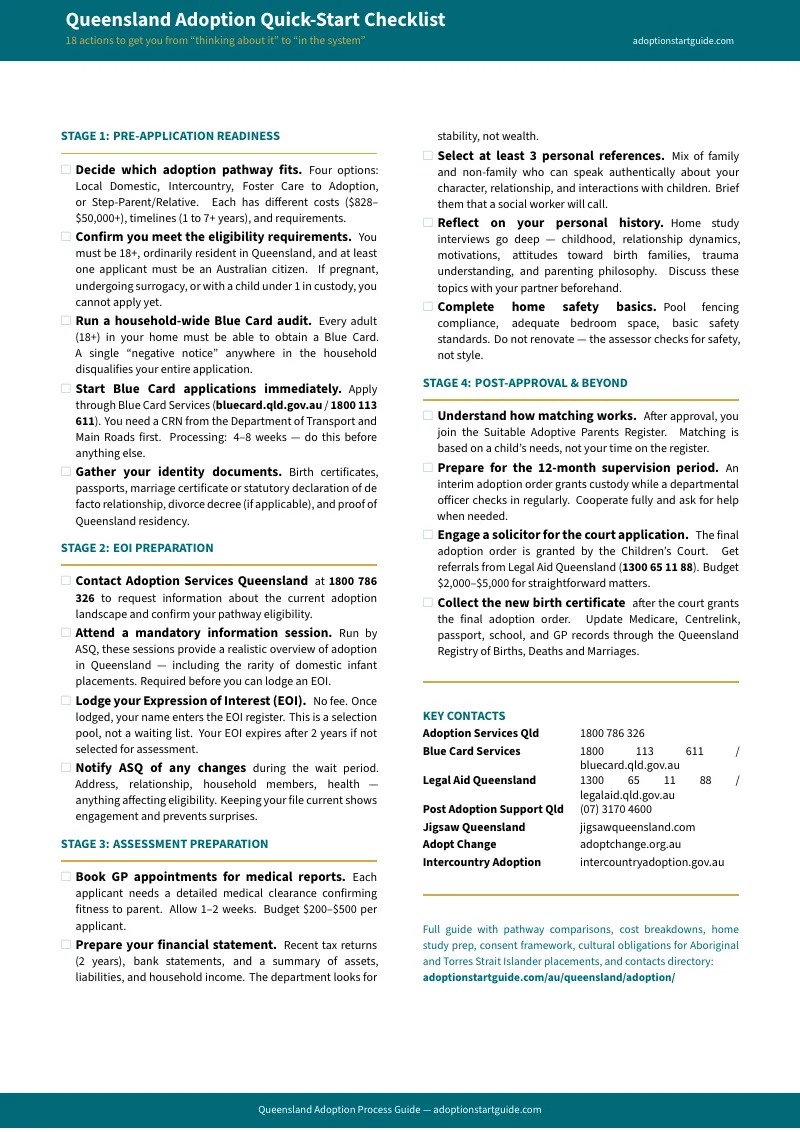
Download the Queensland Adoption Quick-Start Checklist for a one-page overview of the key steps from first inquiry to finalisation. Free, no commitment. If you want the full guide with the four-pathway comparison, the EOI expiration decoder, the Blue Card household audit, the intercountry dual-system navigator, and all the printable worksheets, click the button in the sidebar.
-- less than a single hour of a Brisbane family lawyer's time
The average family lawyer in Brisbane charges $300 to $450 per hour. The Family Court leave application alone for step-parent adoption runs $5,000 to $15,000 in legal fees. Intercountry adoption assessment fees start at $5,684 before you book a single flight. The Adoption Act 2009 Roadmap doesn't replace your lawyer. It makes sure you don't pay your lawyer to teach you the basics of Queensland adoption law, and it makes sure you don't learn about the two-year EOI expiration, the Blue Card household rule, or the "18-Year Cliff" after it's already cost you.