99% of children in NWT care are Indigenous. The government manual that explains your cultural obligations is 500 pages long and written for social workers.
The Northwest Territories has roughly 140 active foster homes for the entire territory — 33 communities scattered across 1.3 million square kilometres. There are fewer licensed foster parents in the NWT than there are students in a single Yellowknife school. And nearly every child who enters this system is Indigenous: First Nations, Inuvialuit, Tlicho, Metis, or Dene. That statistic is not background context. It defines the legal framework you'll operate under, the cultural obligations you'll carry, and the daily decisions you'll make as a caregiver.
The Department of Health and Social Services website gives you the basics: per diem rates, application forms, a link to the Child and Family Services Standards and Procedures Manual. What it doesn't give you is the operational layer — which regional office to contact, how four overlapping legal frameworks (the CFSA, Bill C-92, the Inuvialuit Family Way of Living Law, and ACARA) affect your specific situation, or why the $65 daily rate in Sachs Harbour has roughly the same purchasing power as the $33 rate in Yellowknife once you account for the Community Price Index.
The Foster Family Coalition of the NWT is an essential advocacy organization. Their support groups, peer networks, and helpline are genuinely valuable — once you're in the system. If you're still at the stage where you don't know whether to call the Yellowknife regional office, the Tlicho Community Services Agency, or the Beaufort-Delta office in Inuvik, the FFCNWT assumes a baseline of knowledge you haven't built yet. Their publicly available guide predates the 2021 Inuvialuit child welfare law and the 2024 coordination agreement between Canada, the GNWT, and the IRC.
Generic Canadian foster care guides describe a national process that doesn't exist. They don't account for northern housing standards where homes run on oil heat and trucked water. They don't mention egress window requirements for fuel-heated bedrooms. They describe per diem rates from Ontario or Alberta that have nothing to do with the community-indexed system in the NWT. A guide written for southern Canada will tell you to contact your local Children's Aid Society. The NWT doesn't have one.
The Northern Caregiver's Roadmap: Your Plain-Language Guide to NWT Foster Care
This guide is built for the Northwest Territories and nobody else's system. Every chapter, every checklist, every contact number is grounded in the Child and Family Services Act, Bill C-92, the Inuvialuit Qitunrariit Inuuniarnikkun Maligaksat, the Aboriginal Custom Adoption Recognition Act, and the northern realities that shape fostering in a territory where the nearest specialist may be a plane ride away and winter temperatures drop below minus 40. This is not a repurposed national handbook. It's the operational layer that sits between what HSS posts online and what you actually need to know to get licensed and keep a child safe in the North.
What's inside
- NWT Legal Framework Navigator — Four overlapping legal systems govern child welfare in this territory: the territorial CFSA, federal Bill C-92, the Inuvialuit Family Way of Living Law, and the Aboriginal Custom Adoption Recognition Act. This chapter explains each one in plain English, maps which laws apply to which children based on their Indigenous governance, and tells you what it means for your daily obligations as a foster parent. If you're wondering how the 2024 Canada-GNWT-IRC coordination agreement affects placements in your community, this chapter gives you a straight answer.
- Regional Office and Agency Guide — The NWT delivers child welfare through regional authorities and the Tlicho Community Services Agency. This chapter maps every regional office — Beaufort-Delta in Inuvik, Sahtu in Norman Wells, Dehcho in Fort Simpson, Tlicho in Behchoko, Yellowknife, Hay River, and Fort Smith — with phone numbers, key contacts, and guidance on which office to call based on where you live. If you're in a Tlicho community, your pathway goes through the TCSA, not NTHSSA. This chapter explains the difference.
- SAFE Home Study Preparation — The Structured Analysis Family Evaluation is where most applicants feel the most anxiety. This chapter explains what your social worker is actually assessing during the in-home interviews: your family history, your discipline philosophy, your understanding of residential school trauma and intergenerational effects, and your concrete willingness to support Indigenous cultural identity. It addresses the question non-Indigenous applicants ask most: "Will I be approved to foster Indigenous children?" The answer is yes — but with specific cultural obligations this chapter prepares you for.
- Northern Home Safety Standards — A room-by-room walkthrough of every requirement under NWT standards, adapted for northern housing: bedroom minimums, egress windows in fuel-heated homes, carbon monoxide detectors for oil and wood heat, firearm storage, water and sanitation for trucked-water communities, emergency kits for power outages at minus 40, and satellite communication requirements in communities without cell service. Catch issues before your inspector arrives — a failed inspection delays your licence by months when the inspector's next visit is a scheduled flight.
- Community-Indexed Financial Breakdown — NWT foster care per diems are scaled to community cost of living, from $33 in Yellowknife to $65 in Sachs Harbour. This chapter covers every rate by community, age-based supplements ($5 to $7 per day), clothing allowances for northern gear, specialized needs funding for Level 2 and Level 3 placements, Jordan's Principle access, medical travel coverage, and the CRA tax treatment. It also explains the financial reality nobody mentions at orientation: the $65 rate in Sachs Harbour buys roughly the same basket of groceries as the $33 rate in Yellowknife because the Community Price Index in remote communities is nearly double.
- Indigenous Cultural Obligations — When 99% of children in care are Indigenous, cultural safety is the defining obligation of fostering in the NWT. This chapter covers what you are expected to do in practice: facilitating land-based education and traditional food access, supporting Dene, Inuvialuktun, or Tlicho language development, maintaining Elder connections, attending drum dances and community ceremonies, and understanding the Inuvialuit "right of return" principle for children from the Settlement Region. It explains HSS Standard 10.15 in caregiver language, not bureaucratic language.
- Navigating the System — With a 24.7% vacancy rate in Child and Family Services positions, social workers are overworked and turnover is high. This chapter gives you the conflict escalation pathway — from your assigned worker to their supervisor, to the regional COO, to the NWT Human Rights Commission — and explains why you need to become the lead coordinator for every child in your care. It covers the FFCNWT's advocacy role, the private Facebook support group, and your specific rights as a foster parent, including the right to advance notice before anyone is brought to your home.
Printable standalone worksheets included
- Licensing Timeline Tracker — Every milestone from initial regional office inquiry through licence approval, with fill-in date fields. Print it, update it after every contact, and always know where you stand in the six-to-twelve-month process.
- Northern Home Safety Inspection Checklist — Room-by-room walkthrough of every physical requirement, including NWT-specific items: carbon monoxide detectors for fuel-burning heat, emergency heating plans, water and sanitation for trucked-water homes, and satellite communication. Walk your house with this before the inspector visits.
- Document Organization Sheet — RCMP Vulnerable Sector Check, Child Protection Records Check, medical clearance, three non-family references, First Aid and CPR certificates — every document you need, in the order you need it, with processing time estimates for Yellowknife and remote communities.
- Child Information Tracker — Health card numbers, medication schedules, social worker contacts, family visit logs, cultural activity records, and incident notes in one printable sheet. When your social worker rotates out and the new one asks you to start from scratch, this tracker ensures continuity for the child.
Who this guide is for
- Yellowknife professionals considering fostering — You moved north for work in the GNWT, mining, or healthcare. You've survived two winters and you want to contribute to your community in a meaningful way. You've heard about the need for foster homes but the system feels opaque. You need someone to explain the territorial process, the cultural obligations, and what fostering an Indigenous child actually requires day to day — without the bureaucratic language.
- Kinship and customary care providers — A grandchild, niece, nephew, or community member's child is already in your care informally. You need to get formally licensed to access daily maintenance payments and the support services that come with them. You're navigating a process you didn't plan for, in a system that often assumes you already know how it works.
- Remote and regional community families — You live in Inuvik, Hay River, Fort Simpson, Behchoko, or one of the smaller communities. You have the stability and willingness to foster, but you're unsure how the process works outside Yellowknife. It works — and your community has a critical, unmet need for local foster homes that keep children connected to their land and their people.
- Non-Indigenous residents fostering Indigenous children — You know that nearly every child who enters care in the NWT is Indigenous. You want to help, but you're worried about getting the cultural obligations wrong. This guide gives you the practical framework — land-based education, traditional food, Elder connections, language support, ceremony attendance — so you can foster with respect and confidence rather than anxiety.
- Foster-to-adopt families — You're entering the system hoping to provide a permanent home. You need to understand how the NWT handles the transition from foster placement to permanency, including custom adoption under ACARA, departmental adoption, and the Extended Support Services Agreement for youth aging out of care.
Why the free resources fall short
The HSS website publishes the Child and Family Services Standards and Procedures Manual. It runs to hundreds of pages of regulatory language designed for staff, not applicants. It tells you what the rules are. It does not tell you which rules trip people up, how the four legal frameworks interact, or what your social worker is actually evaluating during the SAFE home study.
The FFCNWT provides peer support, a private Facebook group, and a helpline for foster families. Their publicly available guide was written in 2019 — before the Inuvialuit child welfare law, before the Canada-GNWT-IRC coordination agreement, and before the most recent per diem rate increases. If you're still in the pre-licensing phase, their resources assume you already understand the system you're trying to enter.
National foster care books on Amazon describe a process built for southern provinces. They don't know about the community-indexed per diem system, the Tlicho "Strong Like Two People" model, northern housing inspections for fuel-heated homes, or the cultural obligations that come with fostering in a territory where Indigenous children are 99% of the children in care.
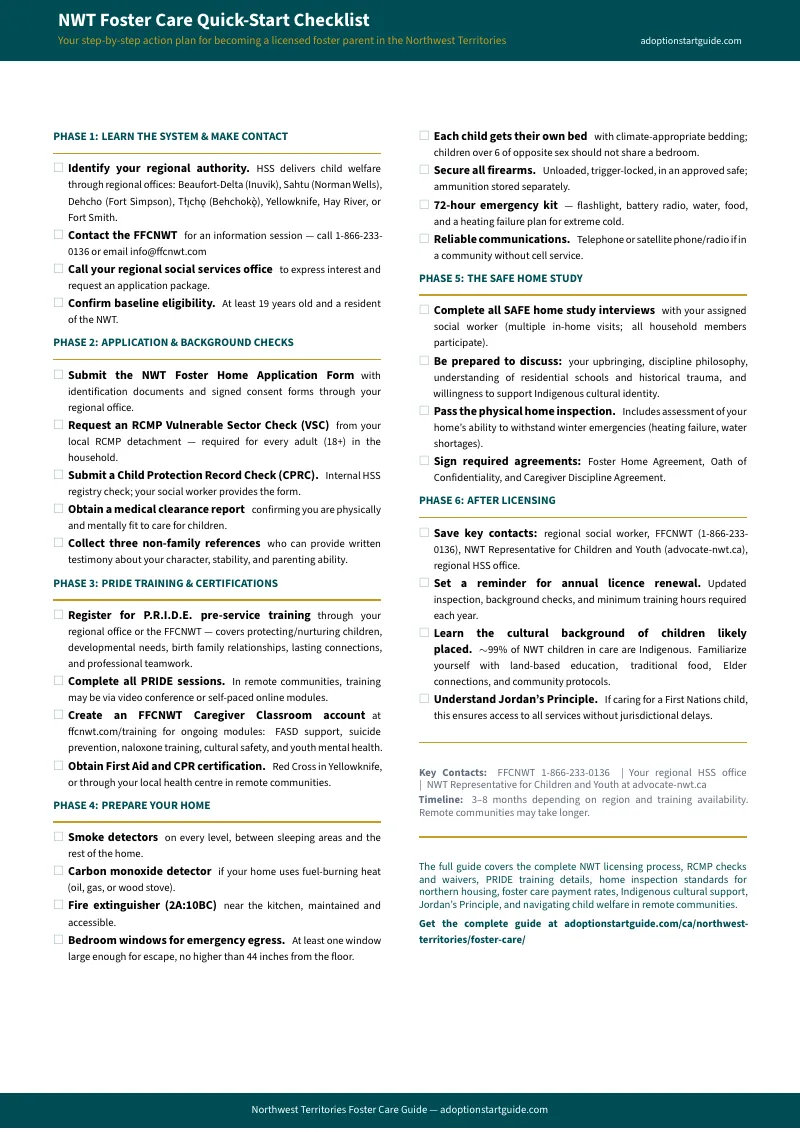
The free Quick-Start Checklist
Download the Northwest Territories Foster Care Quick-Start Checklist for a step-by-step overview of the licensing process, from regional office contact through post-licensing obligations. Free, no commitment. If you want the full guide with the legal framework navigator, SAFE home study preparation, community-indexed financial breakdown, and printable worksheets, click the button in the sidebar.
— less than a bag of groceries in Inuvik
The typical NWT applicant spends months piecing together the licensing process from scattered government pages, outdated coalition guides, and dense procedural manuals written for social workers. This guide distils the most critical steps into a weekend-ready roadmap. A failed home inspection — missing carbon monoxide detector, inadequate egress window, no documented emergency heating plan — delays your licence by months when the inspector has to fly back in. One checklist prevents that.
If the guide doesn't deliver, reply to your download email at any time for a full refund. No forms. No justification required.