50 Agencies. Zero Roadmap. Until Now.
You want to foster a child in Ontario. So you Googled it, found the OACAS website, clicked a few links, and landed on a "CAS Locator" that told you to call your local agency. You called. You got a voicemail. You tried a different number. Turns out there are four Children's Aid Societies in Toronto alone — and the one you called doesn't cover your postal code.
Welcome to Ontario's decentralized child welfare system: 50+ independent Children's Aid Societies, each with its own intake process, its own training schedule, and its own interpretation of what "financially self-sufficient" means. The Ministry of Children, Community and Social Services sets the rules, but it doesn't answer the phone. And the guides you've found online? The Etsy planners are built for American states. The Amazon eBooks still say "Crown Ward" — a term Ontario replaced in 2017. The Reddit threads are helpful until you realize the advice is from someone in Ohio.
The Ontario Foster Care Guide is the CAS Navigator System for the province's entire child welfare process. It's the reference that tells you which of the 50+ agencies covers your address, what the SAFE home study actually asks, what all 9 PRIDE training modules cover, and what financial support you're entitled to — written specifically for Ontario's CYFSA framework, not adapted from a generic Canadian template.
What's Inside
The 50-CAS Navigation Map — Ontario doesn't have one foster care office. It has a patchwork of geographic, religious, cultural, and Indigenous agencies. The guide maps the entire ecosystem: which CAS covers your area, the difference between the CAS of Toronto and the Catholic CAS and Jewish Family and Child Service, how to identify your correct agency in the GTA suburbs, and what to do in rural and Northern Ontario where a single society covers hundreds of kilometres. Stop calling the wrong office.
SAFE Home Study Demystified — The Structured Analysis Family Evaluation is the part that terrifies everyone. It's not an exam you can fail — it's a structured conversation. The guide breaks down exactly what Questionnaire 1 and Questionnaire 2 cover, the psychosocial areas the worker is assessing, how many home visits to expect (typically 2 to 4), and what your biological children will be asked. You'll walk into your first interview knowing the format, not guessing.
All 9 PRIDE Training Modules Explained — Ontario requires 27 hours of Parent Resources for Information, Development, and Education training before you can be licensed. The guide walks through all nine modules — from protecting and nurturing children through professional teamwork — so you know what each session covers before you sit down. Many agencies now offer hybrid online and in-person delivery, and the guide explains how that works too.
Party Status and Your Legal Rights — Here's something no free resource mentions: under Section 79 of the CYFSA, foster parents who've cared for a child continuously for six months can apply for "Party Status" in court proceedings. This gives you the legal right to be heard, to be represented by counsel, and to participate in decisions about the child's future. The Ontario Court of Appeal has confirmed this right. The guide explains the process, the case law, and when it matters most — particularly in foster-to-adopt situations.
Real Per Diem Rates by Care Level — Ontario's financial support isn't a salary. It's a tax-free per diem that varies by agency and the child's needs. Basic care runs $39 to $65 per day. Enhanced care for children with moderate behavioural or medical needs: $65 to $90. Treatment-level care: $90 to $115. The guide breaks down each tier, explains what each rate is meant to cover, details the additional allowances (initial placement, birthday, holiday, school supplies, recreational funding), and clarifies why you must be financially self-sufficient before any of this applies.
CYFSA 2017 — Current Law, Current Terminology — If your resource mentions "Crown Wards," it's using law that was replaced nearly a decade ago. The guide is built on the Child, Youth and Family Services Act, 2017 — covering Extended Society Care, the raised age of protection (16 to 18), identity-based placement matching, and the rights of children to have their race, ancestry, sexual orientation, and gender identity considered in every decision. It also covers O. Reg. 156/18 and O. Reg. 155/18 in plain English.
The Ready, Set, Go Program — Since April 2023, Ontario replaced the old CCSY program with Ready, Set, Go, which supports youth leaving care with monthly payments from age 18 ($1,800/month) through 22 ($500/month), plus a $500 educational bonus starting at 20. If you're fostering a teenager, you need to understand what this means for their transition plan — and yours.
Indigenous Child Welfare and Customary Care — Ontario has a network of Indigenous-led agencies — Tikinagan, Dilico, Native Child and Family Services of Toronto, Kina Gbezhgomi, and others — operating under both the CYFSA and federal Bill C-92. The guide explains how customary care works, how jurisdictional authority is shifting, and how Jordan's Principle funding (1-855-JP-CHILD) applies to First Nations children in your care.
Who It's For
- First-time prospective foster parents anywhere in Ontario who need the real steps, not a voicemail and a pamphlet
- GTA families confused by multiple overlapping agencies in Toronto, Peel, York, and Durham — who need to know which CAS covers their address
- Couples and singles considering foster-to-adopt who want to understand how Extended Society Care works and what the legal pathway to adoption looks like
- Empty nesters in suburban and rural Ontario — Hamilton, Ottawa, Waterloo, Thunder Bay — with space and experience who need to understand what "complex needs" actually means in practice
- Kinship caregivers already looking after a relative's child who want to formalize their arrangement and access the per diem supports they've been missing
- Anyone who's been put off by the bureaucracy, the jargon, or the sheer size of the system and wants one clear document that cuts through all of it
Why Not the Free Resources?
The OACAS website has a CAS locator. It tells you which agency to call. It does not tell you what to say when they answer, what the SAFE home study will ask, or how much you'll receive per day. Each of the 50+ CAS websites is different — some have detailed PRIDE schedules, others have a "contact us" form and nothing else.
The Ministry of Children, Community and Social Services publishes the legislation. It's written in legal prose for lawyers and policymakers, not for a parent trying to figure out if their spare bedroom meets the ventilation requirements under O. Reg. 156/18.
The Ontario Foster Parent Society supports active foster parents. If you're still at the "thinking about it" stage, their resources assume knowledge you don't have yet.
Reddit and Facebook groups fill some gaps with real stories, but they mix Ontario-specific advice with American procedures, outdated terminology, and personal experiences that may not apply to your CAS. And the paid Etsy planners? They're US-centric record-keepers — medical logs and visitation trackers — not Ontario system navigation tools.
The Ontario Foster Care Guide exists in the space between the locator and the legislation. It's the document the system should give you on day one but doesn't.
What You Get
- The Complete Guide — Step-by-step from first inquiry through placement matching, covering CAS navigation, eligibility, PRIDE training, the SAFE home study, financial supports, legal rights, Indigenous child welfare, and the Ready, Set, Go program
- Home Safety Checklist — Ontario-specific items aligned with O. Reg. 156/18 and the Ontario Fire Code: smoke alarms on every level, CO detectors, medication lockbox, water temperature, pool fencing, firearms storage, and bedroom ventilation requirements
- First Placement Arrival Checklist — Fillable form for capturing the child's medical information, school details, Plan of Care goals, family visit schedule, and cultural or dietary needs
- Daily Log Template — Track meals, school attendance, medical appointments, behavioural notes, family contact, and incidents — this is a legal document your CAS will expect
- Training Log — Track all 9 PRIDE modules and ongoing professional development hours for annual licence renewal
— Less Than One Hour with a Family Lawyer
A one-hour consultation with a family lawyer in Ontario runs $250 to $400. The guide covers the legal framework, your Party Status rights, the complaint mechanisms (Internal Complaints Review Panel, Child and Family Services Review Board, Ombudsman Ontario), and the CYFSA provisions that affect your daily life as a foster parent — for a fraction of one billable hour.
Every purchase includes free updates as provincial policy changes. When Ontario updates its per diem rates, revises the PRIDE curriculum, or amends the regulations, your guide stays current.
Start with the free checklist
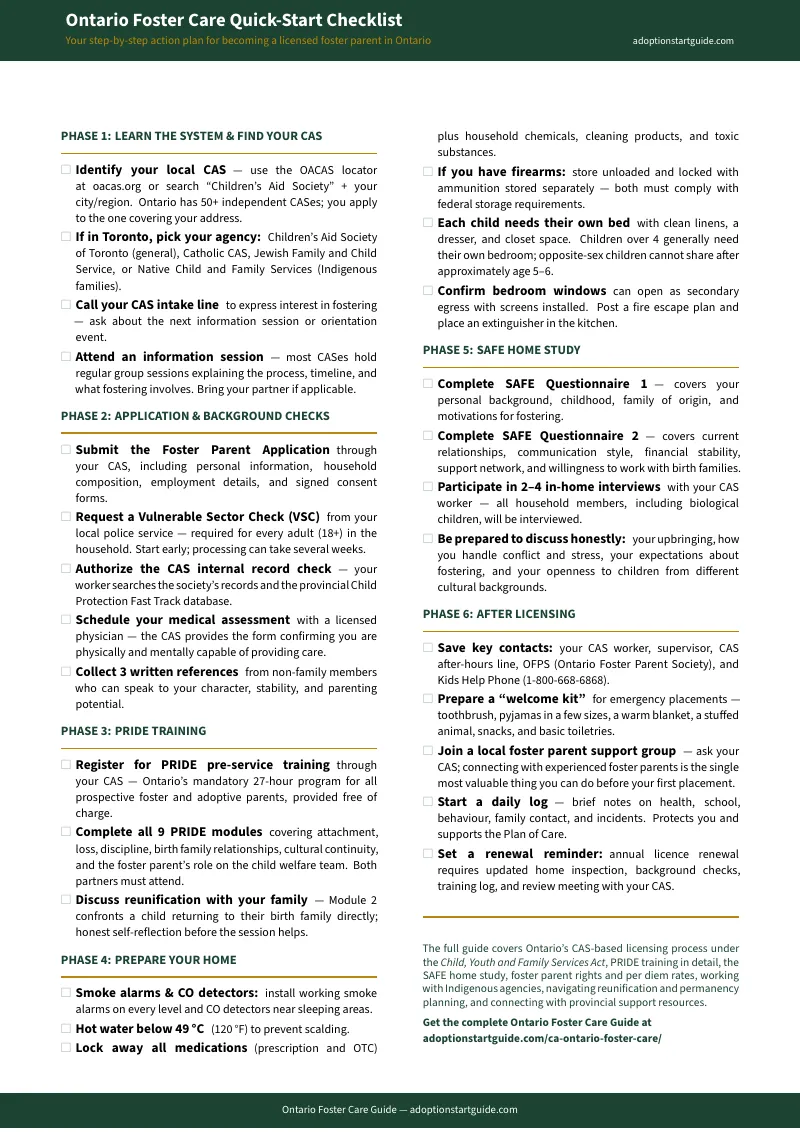
Not ready to commit? Download the Ontario Foster Care Quick-Start Checklist — a step-by-step action plan covering the key phases of the application process, with CAS contact guidance and the documents you'll need to gather. It's the fastest way to see what's ahead before you invest in the full guide.