You're ready to become a parent. The system wasn't built for you to know that.
You've spent weeks reading state adoption statutes, scanning HRC's agency index, and searching for someone who can tell you plainly whether the agency in your county will treat you like any other applicant or steer you into a side process they reserve for families they're less comfortable placing with. Nobody gives you a straight answer. The agency website says "all families welcome." The Google reviews tell a different story. And the adoption attorney you called charges $350 an hour to explain what a second-parent adoption is — information you could use before you've committed to a $30,000 process that might require one.
Meanwhile, the legal landscape is fracturing. Twelve states have enacted religious exemption laws that let agencies refuse to work with LGBTQ+ families — and more legislation is pending. In those states, the agency that appears on HRC's "welcoming" list might be the only option in your county, and they might still route you to a subcontractor with different values. In states without explicit protections, your rights depend on case law that varies by circuit. The Obergefell ruling secured your right to marry. It did not secure your right to adopt without a legal challenge to your parentage six years later.
The free resources you've found each cover a piece of this. Lambda Legal publishes state-by-state legal summaries — for lawyers. Family Equality has advocacy toolkits — for policy campaigns. HRC's All Children All Families index rates agencies — but gives you a score, not a system for deciding whether that score means the agency will actually fight for your placement when a birth parent's attorney objects. The adoption books on Amazon were published before the current wave of religious exemption legislation and describe a process that no longer exists in a dozen states. You're assembling a puzzle from five different boxes, and the picture on none of them matches the one you're trying to build.
The Affirming Pathway System: Your Complete Guide to LGBTQ+ Adoption and Foster Care
This guide consolidates the legal research, agency vetting, home study preparation, and financial planning that LGBTQ+ families need into a single operational resource. It's not an advocacy document. It's not a legal pamphlet. It's the playbook you bring to every meeting, every phone call, and every decision point in the adoption or foster care process — built specifically for the questions that only come up when the system wasn't designed with your family in mind.
The Affirming Pathway System is the structural framework that runs through every chapter: a method for evaluating agencies beyond their marketing, preparing for home study questions that straight couples never face, building a legal protection stack that survives changes in state law, and making decisions based on where the legal landscape actually is — not where you wish it were.
What's inside
- 10-Point Agency Vetting System — HRC's All Children All Families index tells you which agencies have completed their training program. It does not tell you how many LGBTQ+ families that agency has actually placed with, whether their social workers ask invasive questions about your relationship during the home study, or what happens when the agency's religious affiliation conflicts with its public diversity statement. This chapter gives you ten specific evaluation criteria — with the exact questions to ask on your first call — so you can distinguish between agencies that check a box and agencies that will advocate for your family when it matters.
- Word-for-Word Home Study Scripts — The home study is where the process gets personal, and LGBTQ+ applicants report being asked questions that straight couples never encounter. "How will you explain your family structure to the child?" "What role models of the opposite gender will be in the child's life?" "How does your extended family feel about your decision to adopt?" These questions are legal. They are also minefields if you answer defensively. This chapter provides rehearsed, confident responses for every common and uncommon question — not evasions, but answers that demonstrate exactly the stability and self-awareness the evaluator is trained to look for.
- State-by-State Legal Protection Roadmap — Every state's current legal status for LGBTQ+ adoption in one consolidated reference: explicit statutory protection, case law protection only, no protection, or active religious exemption laws. For each category, you get the specific statutes or rulings that apply, what they mean in practice, and the concrete legal steps you should take to protect your parentage. This is not Lambda Legal's overview repackaged — it's the operational layer that tells you what to do with the legal information, not just what the law says.
- Second-Parent and Stepparent Adoption Guide — In many states, the non-biological or non-adoptive parent has no legal relationship to the child until a second-parent adoption is finalized — even if you're married. If you move to a state that doesn't recognize your adoption decree, if your partner dies, if a grandparent challenges custody, the non-legal parent can lose all rights. This chapter covers which states require second-parent adoption, the process and typical costs ($1,500 to $5,000), and why it's the single most important legal protection you can get even when you think you don't need it.
- International Adoption Analysis — Most countries that allow international adoption explicitly prohibit placement with same-sex couples. A handful allow single applicants, which some LGBTQ+ individuals use as a workaround — but the legal and ethical implications are significant. This chapter maps which countries are realistically open, which use "single applicant" as a de facto pathway, the Hague Convention complications, and the re-adoption requirements when you return to the US. It's the honest assessment that agencies marketing international adoption programs won't give you.
- Foster Care Licensing for LGBTQ+ Families — Foster care is often the most accessible path to parenthood for LGBTQ+ families, but the same religious exemption laws that affect adoption agencies also affect foster care agencies in states with privatized systems. This chapter covers state-by-state licensing requirements, how to navigate faith-based agency placements, your rights when a caseworker's personal beliefs conflict with state policy, and the specific documentation that protects you if a placement is challenged.
- Financial Planning with LGBTQ+-Specific Considerations — The federal adoption tax credit ($17,280), employer adoption benefits, grants from LGBTQ+-affirming organizations (the Bossier-Hall Family Fund, the Human Rights Campaign Foundation, Gift of Adoption Fund), and the cost differences between the four main pathways — foster-to-adopt ($0-$5,000), domestic private ($30,000-$60,000), international ($25,000-$50,000), and independent ($15,000-$40,000). Plus the often-overlooked costs that hit LGBTQ+ families harder: second-parent adoption legal fees, birth certificate amendment costs, and the travel expenses when your nearest affirming agency is three hours away.
- Building Your Support Network — The adoption process can be isolating even for families who have every structural advantage. For LGBTQ+ families navigating a system that wasn't built for them, community is not optional — it's infrastructure. This chapter connects you to LGBTQ+ adoptive parent networks (national and regional), affirming therapists who specialize in adoption adjustment, and organizations that provide ongoing post-placement support rather than disappearing after the finalization order.
Printable standalone worksheets included
- Agency Vetting Scorecard — The 10-point evaluation system as a printable fill-in sheet. Take it to every agency information session and first phone call. Compare agencies side by side with consistent criteria instead of gut feelings.
- Home Study Preparation Worksheet — Every document you need, organized in the order evaluators expect them, plus a section specifically for the additional materials LGBTQ+ families are sometimes asked to provide.
- Legal Protection Checklist — A decision tree for your state: Do you need second-parent adoption? A co-parent agreement? A pre-birth order? Updated birth certificates? Walk through it once, and you'll know every legal step your family needs.
- Financial Planning Worksheet — Costs by pathway, tax credit eligibility, grant applications, employer benefits, and a tracking sheet for expenses — including the LGBTQ+-specific legal costs that generic adoption budgets don't account for.
Who this guide is for
- LGBTQ+ couples starting the adoption process — You've decided to grow your family but the sheer volume of conflicting information — which states are safe, which agencies are genuinely affirming, whether you need a second-parent adoption even though you're married — is paralyzing. You need one resource that takes you from research to finalization with the legal, logistical, and emotional ground covered.
- Single LGBTQ+ individuals pursuing adoption — The process is different when you're doing it alone. Some agencies treat single applicants differently. Some international programs are only open to singles. The financial burden is undivided. This guide addresses single-parent adoption directly, not as an afterthought.
- LGBTQ+ families considering foster care — You want to provide a home for a child who needs one, and foster care is the most accessible pathway. But you've heard the stories about faith-based agencies, hostile caseworkers, and placements being challenged. You need to know what's real, what's rare, and how to protect yourself and the child in your care.
- Families in religious exemption states — You live in one of the twelve states where agencies can legally refuse to work with you. You need to know which agencies in your area will still serve your family, what your legal options are if you're turned away, and whether working with an out-of-area agency is a viable alternative.
- Families who need to secure second-parent adoption — Your child is already home. Your partner has no legal parental rights. Every day without a second-parent adoption is a day your family is legally vulnerable. You need the process, costs, and timeline — not a lecture about why you should have done this sooner.
Why the free resources aren't enough
Lambda Legal's state-by-state guides are excellent legal references — written for attorneys and advocates. They tell you what the law says. They don't give you a script for the home study question about opposite-gender role models, a system for vetting whether an agency's "welcoming" rating translates to actual affirming practice, or a decision framework for whether to pursue second-parent adoption in a state where the law is ambiguous.
Family Equality and GLAAD produce advocacy materials and policy briefs. They're fighting for systemic change, which matters enormously — but their resources are written for legislators and media, not for a couple sitting at the kitchen table trying to decide which agency to call first.
HRC's All Children All Families index rates agencies on a point system. It's the best agency directory available. But a rating is not a vetting system. It doesn't tell you what to ask on the phone, how to interpret evasive answers, or what to do when the highest-rated agency in your area has a two-year wait and the alternative has no rating at all.
The books — Rosswood's "Our Family," Goldberg's research — are foundational. They're also published. The religious exemption laws that have reshaped the adoption landscape in twelve states are newer than the latest editions. A book that doesn't mention South Carolina's 2023 exemption expansion or Michigan's ongoing legal battles is a book that might leave you unprepared for the system you're actually entering.
This guide doesn't replace those resources — it builds the operational layer on top of them. The legal research, translated into action steps. The agency ratings, turned into a vetting system. The advocacy victories and setbacks, converted into a state-by-state roadmap for your family's specific situation.
The free Quick-Start Checklist
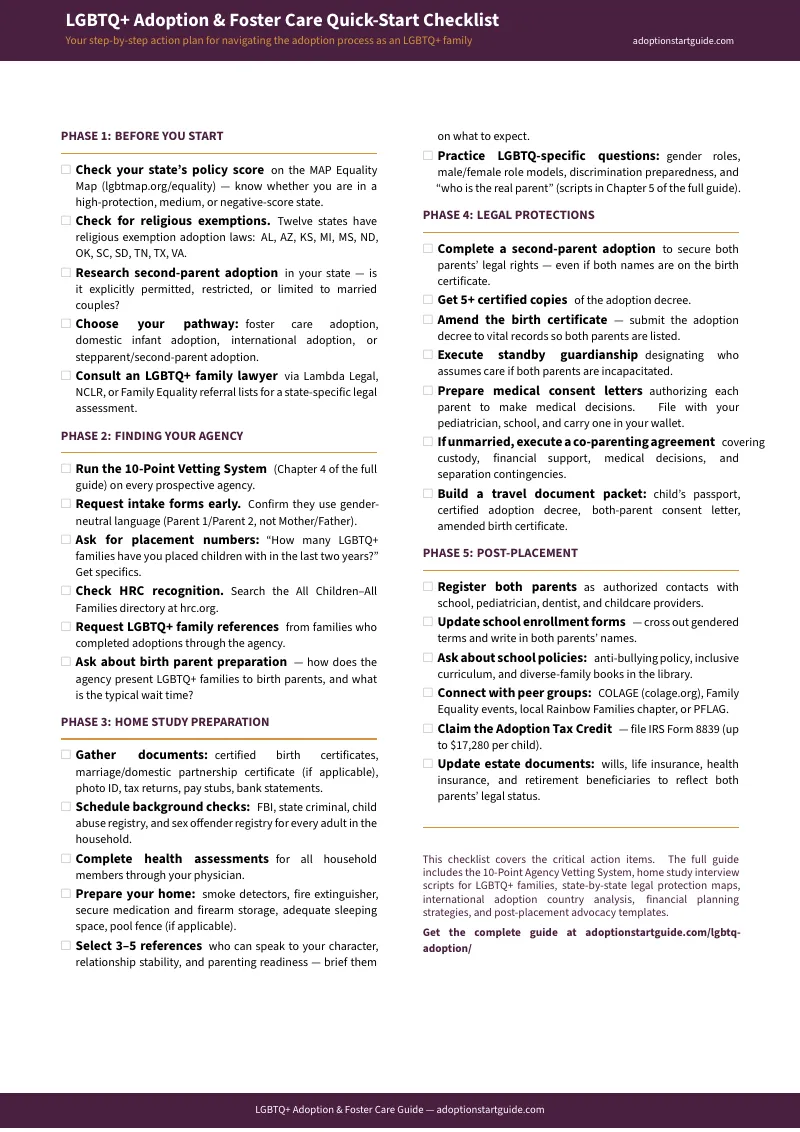
Download the LGBTQ+ Adoption Quick-Start Checklist for a one-page overview of the key milestones, legal considerations, and first steps. Free, no commitment. If you want the complete guide with the Affirming Pathway System, 10-point agency vetting, home study scripts, state-by-state legal roadmap, and printable worksheets, click the button in the sidebar.
— less than thirty minutes with a family lawyer
The typical LGBTQ+ prospective parent spends months piecing together legal requirements from Lambda Legal, agency options from HRC, financial aid from scattered grant databases, and home study advice from Reddit threads that may or may not reflect current law in their state. This guide puts the entire process in one place — the legal protections, the agency evaluation system, the home study preparation, and the financial planning — so you can move forward with clarity instead of anxiety.
An agency that looks affirming on paper but isn't in practice can cost you six months and thousands of dollars before you start over. One vetting system prevents that. A home study question you weren't prepared for can shake your confidence at the worst possible moment. One set of scripts prevents that. A missing second-parent adoption can leave your family legally vulnerable for years. One checklist prevents that.
If the guide doesn't deliver, reply to your download email at any time for a full refund. No forms. No justification required.