
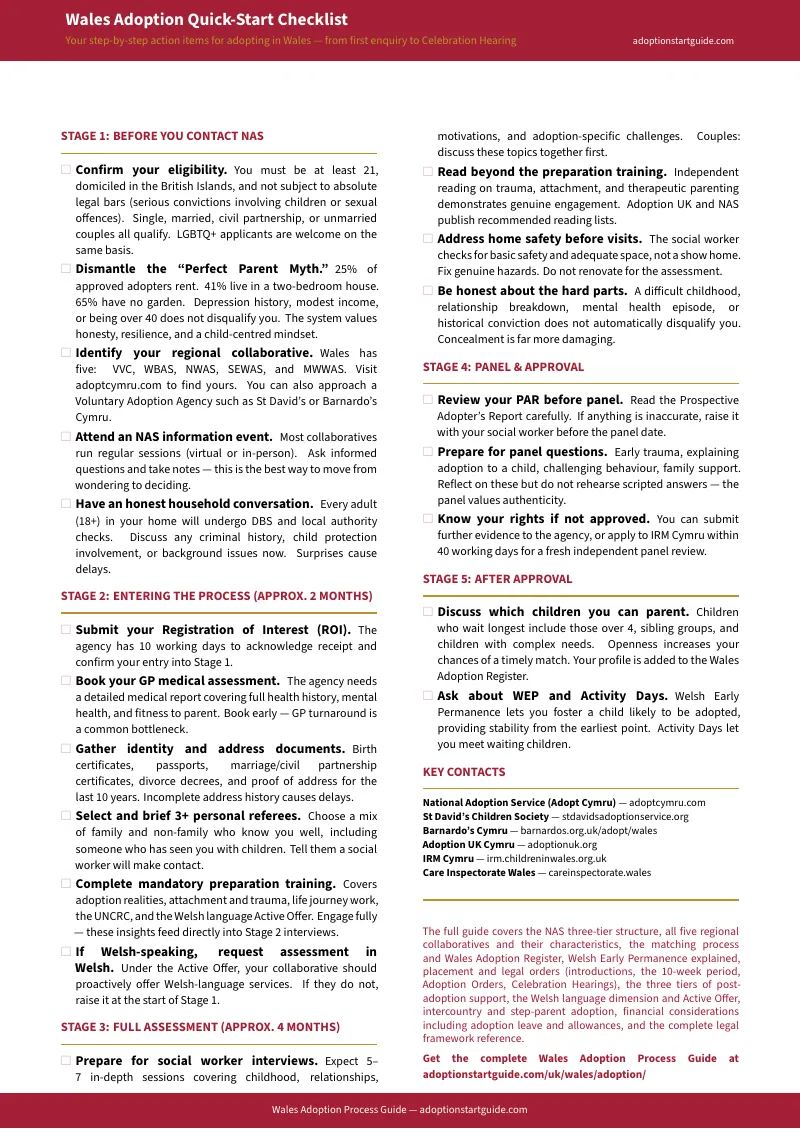
You want to adopt in Wales. But the NAS process feels less like a pathway and more like a test you haven't studied for.
Eighty-three percent of the Welsh public views adoption positively. Eighteen percent have seriously thought about it. The gap between "thinking about it" and contacting NAS is not information -- the NAS website has information. The gap is confidence. You're not sure your two-bedroom terrace in the Valleys is big enough. You're not sure how to explain the anxiety you managed in your twenties. You're not sure what happens when a social worker sits in your living room and asks why you want to be a parent. And you've heard the process takes eight months of assessments that feel less like preparation and more like an investigation into whether you're good enough.
Here's the reality the NAS website won't frame this plainly: 86% of adoptive parents worried they needed a "perfect home" to pass the assessment. In practice, 41% of approved adopters live in a two-bedroom house. 65% don't have a garden. 25% live in rented accommodation -- and in the Valleys, where renting is common, that number matters. The system is not looking for perfection. It is looking for families who understand what adoption means for a child and can demonstrate that they are prepared for the realities of therapeutic parenting. The problem is that nobody tells you how to demonstrate that until you're already sitting in front of the panel.
You've already started researching. You found the NAS Wales website, which walks you through the stages in the kind of language designed to reassure rather than prepare -- polished, positive, and light on the details that actually keep you up at night. You found the St David's Children Society information pack, which is thorough on Stage 1 and Stage 2 structure but reads like a formal briefing document, not a guide written for someone who's nervous. You found Adoption UK's resources, which cover the UK as a whole but don't address the Welsh-specific system -- the five regional collaboratives, the Adoption Register Wales, the Welsh Early Permanence pathway, or the Welsh Government's distinct financial support entitlements. And you found Reddit threads and Facebook groups where people mix up English Regional Adoption Agency rules with the Welsh NAS model, confuse Special Guardianship Orders with adoption, and offer advice based on processes that predate the 2014 restructure.
The information exists. It's scattered across the NAS website, five regional collaborative websites, Care Inspectorate Wales reports, the Adoption and Children Act 2002 (as amended for Wales), Welsh Government policy documents, Adoption UK's Barometer report, and St David's information pack. Piece it together yourself and you'll spend weeks reading documents that each explain their corner of the system without ever mapping the full process in the order a family in Wales actually completes it.
The Approval Readiness System
This is a complete, Wales-specific adoption guide built around the problem every family in this country hits: navigating a system where the National Adoption Service, your regional collaborative, the Adoption Panel, and the Welsh courts each own a piece of the process but none of them explain how the pieces connect from a family's perspective. Not a government website designed to recruit rather than prepare. Every chapter, every checklist, every timeline is grounded in Welsh law, current NAS policies, Care Inspectorate Wales standards, and the real experience of families who have adopted through the Welsh system.
What's inside
- The two-stage process decoded -- Stage 1 (your self-directed preparation: initial enquiry, information event, Expression of Interest, medical, DBS checks, referee interviews) and Stage 2 (the social worker-led assessment: Prospective Adopter's Report, home visits, skills-to-parent analysis) mapped step by step with realistic timelines. The combined process typically takes eight months. 62% of Welsh adopters report delays caused by administrative processes. This chapter tells you which delays are within your control to prevent and which ones aren't -- so you stop blaming yourself for the system's bottleneck.
- The five regional collaboratives navigator -- North Wales Adoption Service, Vale Valleys and Cardiff, South East Wales, Western Bay, and Mid and West Wales each deliver the NAS framework slightly differently. Assessment pace, therapeutic support availability, Welsh Early Permanence activity, and post-adoption services vary by region. This chapter maps those differences so you know what your regional collaborative actually offers before your first conversation with them.
- Panel preparation guide -- The Adoption Panel is the single most feared stage in the Welsh process. It feels like a courtroom. It isn't. This chapter covers who sits on the panel, what questions they actually ask, how the Agency Decision Maker uses the panel's recommendation to make the final approval decision, and how to present your Prospective Adopter's Report so the panel sees a prepared family, not a nervous applicant.
- The Welsh language dimension -- Strategic guidance for both Welsh-speaking and non-Welsh-speaking families. Under the UNCRC and Cymraeg 2050, NAS social workers must consider a child's linguistic heritage in matching decisions. If you speak Welsh, you'll understand how that affects your matching options without being steered toward cases solely because of your language skills. If you don't, you'll understand exactly how the language factor works so it stops being a source of anxiety.
- Adoption vs. SGO vs. fostering explained -- Adoption gives you full legal parenthood and a new birth certificate. A Special Guardianship Order gives legal responsibility but not full parental status, and it ends when the child turns 18. Fostering provides care but no legal permanence at all. Wales has a specific "No Detriment" policy for foster-to-SGO transitions that complicates the picture further. This chapter lays out the legal rights, the financial implications, and the identity consequences of each route side by side -- because the terminology alone stops families from understanding their real options.
- Welsh Early Permanence (WEP) guide -- WEP allows a child to be placed with prospective adopters while the court proceedings are still ongoing. It's the fastest route to placement in Wales, but it comes with uncertainty: the court may decide the child should return to their birth family, and families need to understand that possibility before committing. This chapter explains how WEP works, which regional collaboratives are most active in WEP placements, and how to make an informed decision about whether it's the right path for your family.
- Financial entitlements and support -- The Pupil Development Grant for adopted children, the Welsh Government's Adoption Support Fund, adoption leave and pay entitlements, the Adoption Allowance, and the post-adoption support commitment. Welsh adoptive families are entitled to financial support that many never claim because they don't know it exists. This chapter lists every entitlement with eligibility criteria and how to apply.
- Home study and assessment preparation -- What social workers are actually evaluating during the Stage 2 home visits, the Prospective Adopter's Report structure, and how to address questions about past relationships, mental health, finances, and parenting motivation honestly without being unprepared. There is a difference between being transparent and being caught off guard -- this chapter teaches you the first so you never experience the second. Every document you'll need, organised in the order the assessment requires them.
Who this guide is for
- Couples who've come through fertility treatment and are starting over -- You've spent years on NHS waiting lists or private IVF. Adoption feels like it should be simpler. It's not simpler -- it's a different kind of rigorous. The guide prepares you for an assessment system that asks different questions than a fertility clinic, so the transition doesn't blindside you.
- Single applicants -- Wales explicitly allows single people to adopt. The eligibility criteria are the same, but the assessment focuses more heavily on your support network and resilience. This guide addresses the single-applicant pathway directly, not as a footnote on the couples page.
- Same-sex couples -- Welsh law has permitted same-sex adoption since 2005. The legal framework is settled, but the assessment still asks questions about how you'll handle a child's questions about their birth family and identity. The guide covers this specifically.
- Families over 40 -- There is no upper age limit for adoption in Wales. The assessment considers your health and energy, not your birth certificate. The guide explains how the medical and health assessment works for older applicants so your age stops feeling like a disqualifier.
- Foster carers considering adoption -- The child in your care has had reunification ruled out. You want to convert your placement into a permanent adoption, but the legal transition from foster carer to adoptive parent involves a new assessment, a new panel, and a different legal framework. The guide maps the foster-to-adopt pathway in Wales specifically.
- Kinship carers exploring legal options -- You're already raising a family member's child. You're weighing adoption against a Special Guardianship Order against continuing as a kinship foster carer. The guide's permanence comparison chapter was written for exactly this decision.
Why the free resources aren't enough
The NAS Wales website covers the adoption stages with warmth and encouragement. That's its job -- it's designed to recruit, not to prepare. It tells you the process takes "approximately eight months" without explaining that 62% of adopters face delays, what causes those delays, or which ones you can prevent. It explains the two stages without telling you what social workers are actually looking for in the Stage 2 assessment. It mentions the Adoption Panel without describing what the panel meeting feels like or what questions they ask.
The St David's Children Society information pack is the most structured voluntary agency resource available in Wales. It covers Stage 1 and Stage 2 well. It also reads like a briefing document prepared by professionals for professionals -- formal, careful, and not written for someone sitting at their kitchen table at 10pm trying to figure out whether their past anxiety diagnosis will disqualify them.
Adoption UK provides excellent support for established adoptive families across the United Kingdom. Their Barometer report is the best data source on the challenges Welsh families face after adoption. But their process guidance covers the UK broadly -- it doesn't address the five Welsh regional collaboratives, the Adoption Register Wales, Welsh Early Permanence, the Welsh Government's specific financial entitlements, or the UNCRC framework that makes Welsh adoption law distinct from England's.
Reddit, Mumsnet, and Facebook groups give you emotional solidarity and personal stories. They also mix up the English RAA model with the Welsh NAS system, confuse SGO entitlements with adoption entitlements, and offer advice based on pre-2014 processes that no longer apply. In a system where your regional collaborative, your legal rights, and your financial entitlements are all Wales-specific, advice from the wrong jurisdiction doesn't just miss the mark -- it actively misleads.
Printable standalone worksheets included
The guide comes with printable standalone PDFs designed for real-world use:
- Stage 1 and Stage 2 Timeline Planner -- Both stages mapped on one page with milestones, typical durations, and the documents required at each step. Pin it to the fridge so both partners can track where you are in the process.
- Home Study Document Checklist -- Every document the social worker will request during the Stage 2 assessment, organised by category: identity, medical, financial, employment, references, and household. Nothing missing when the assessor arrives.
- Panel Preparation Worksheet -- Common panel questions, space for your answers, and a framework for presenting your Prospective Adopter's Report with confidence.
- Financial Entitlements Tracker -- The Pupil Development Grant, Adoption Support Fund, adoption leave, and Adoption Allowance mapped with eligibility criteria, application steps, and deadlines.
The free Quick-Start Checklist
Download the Wales Adoption Quick-Start Checklist for a one-page overview of the key steps from initial enquiry to court order. Free, no commitment. If you want the full guide with the two-stage process breakdown, the regional collaboratives navigator, the Panel preparation guide, the Welsh language dimension, and all the printable worksheets, click the button in the sidebar.
-- less than one hour of a Welsh family solicitor's time
A family solicitor in Wales charges between £150 and £300 per hour. The Approval Readiness System doesn't replace legal advice. It makes sure you don't pay a solicitor to explain the basics of Welsh adoption law, and it makes sure you don't discover the Stage 2 assessment requirements, the Panel process, or your financial entitlements after the stress of not knowing has already cost you months of worry and false starts.