You're ready to adopt in Georgia. Then you discovered that DFCS, the Superior Court, and your attorney all assume you already understand the other two.
Georgia is not like most states. It uses "surrender" -- not "consent" -- and the forms prescribed under OCGA Section 19-8-26 must be executed under oath before a notary and witness, with false swearing penalties attached. The birth mother can sign immediately in an independent adoption, but must wait 24 hours in an agency placement -- and nobody explains why. A four-day revocation window follows, counted by consecutive days starting the day after signing, but if the fourth day lands on a weekend or holiday the deadline extends to 5:00 PM the next business day. Miss the mechanics of that count by one day and the placement you've spent months building collapses.
You've already done the research. You found the DFCS website, which covers foster-to-adopt orientations and the "It's My Turn Now Georgia" photolisting but says nothing about private or independent adoption. You found the Georgia Superior Court self-help pages, which tell you where to file but not in what order. You found the State Bar of Georgia, where Atlanta adoption attorneys bill $450 or more per hour and even the statewide average sits at $369. And you found Facebook groups where well-meaning strangers confuse Georgia's surrender process with the consent models used in South Carolina and Florida, and reference putative father registries as though they all work the same way.
The information exists. It's scattered across DFCS orientation packets, OCGA Title 19, Superior Court filing rules, Department of Public Health vital records procedures, and agency brochures that explain their pathway but never the other two. Piece it together yourself and you'll burn weeks reading documents that describe the rules but never tell you the order of operations as a parent.
The OCGA Title 19 Roadmap
This is a complete, Georgia-specific adoption guide built around the problem every family in this state hits: navigating a system where DFCS, the Superior Court, licensed agencies, and independent attorneys each own a piece of the process but none of them explain how the pieces connect. Not a national overview. Not an agency brochure designed to funnel you into one program. Every chapter, every checklist, every cost figure is grounded in the Official Code of Georgia Annotated (OCGA Title 19, Chapter 8), current DFCS policies, the SAFE home study methodology, and the real-world experience of families who have adopted in Georgia.
What's inside
- Three-pathway comparison table -- Foster-to-adopt through DFCS, private agency adoption through a licensed child-placing agency, and independent adoption managed by a Georgia Bar attorney, mapped side by side. Costs, timelines, eligibility, and the realistic wait for each pathway so you choose the right one before investing months in the wrong direction. DFCS foster-to-adopt runs $0 to $500, most of it reimbursable. Private agency adoption costs $20,000 to $45,000. Independent adoption runs $5,000 to $15,000 after a match. That decision deserves more than a caseworker's one-sentence summary.
- The surrender process decoder -- Georgia doesn't use "consent." It uses "surrender" -- a formal, notarized act under OCGA Section 19-8-26 that permanently terminates parental rights once the four-day revocation window closes. This chapter breaks down the exact surrender forms, explains the critical difference between agency surrenders (24-hour post-birth waiting period) and independent surrenders (no waiting period), walks you through the four-day revocation count including the business-day extension rule, and identifies the documentation gaps that give rise to fraud or duress challenges. No agency orientation covers this because no agency has an incentive to explain the alternative pathways.
- The Putative Father Registry navigator -- Georgia maintains a Putative Father Registry through the Department of Public Health. When a man registers, he's entitled to notice of adoption proceedings and has exactly 30 days to file a petition for legitimation. Miss that window and his right to object is permanently lost. But if nobody checks the registry -- or the birth father was never informed of the pregnancy -- this becomes the single largest legal vulnerability in a Georgia adoption. This chapter gives you the documentation checklist that prevents a future challenge.
- SAFE home study and background clearance preparation -- The Structured Analysis Family Evaluation is Georgia's mandated home study methodology, administered through a two-questionnaire process with at least three home visits on separate days. This chapter covers the Q1 and Q2 questionnaire sequence, the 911-call disclosure requirement for the past five years, the pet vaccination documentation, the GBI and FBI fingerprint process through Live Scan, the DFCS Central Registry search, and the five-year out-of-state child abuse registry clearance that catches families who have recently moved to Georgia. Includes the one-year validity window and what triggers a required update.
- Superior Court process map -- From filing the petition in the county of your residence to the finalization hearing, mapped by county. Includes Fulton County's $218 filing fee and 2-to-6-month timeline, DeKalb's $217 fee, Gwinnett's 120-day statutory target, and the procedural differences between metro Atlanta courts and rural Superior Courts. Covers the 60-day filing deadline after surrender, the attorney's affidavit of costs, and the post-decree process for obtaining a new birth certificate through the Department of Public Health Vital Records.
- HB 154 and Andee's Law explainer -- Two recent legislative changes that reshape Georgia adoption. HB 154 (2021) lowered the minimum petitioner age from 25 to 21, expanding eligibility for younger relatives pursuing kinship adoption. Andee's Law (SB 100) opens sealed birth records for adult adoptees effective July 2025, transforming the landscape for families navigating openness agreements. This chapter explains both statutes, who they affect, and how they change the planning calculus for families adopting today.
- Advertising restrictions and allowable expenses -- OCGA Section 19-8-24 restricts adoption advertising to three categories: licensed agencies, State Bar attorneys, and prospective parents with an approved home study. Every advertisement must include a license or bar number. Allowable birth parent expenses are limited to medical costs, counseling, and reasonable living expenses paid through an attorney trust account -- anything beyond that is a felony. This chapter explains the rules so you don't accidentally violate them when networking for a match.
- LGBTQ+ and single-parent pathways -- Georgia's adoption code permits adoption by any single adult or married couple meeting the age and residency requirements. This chapter covers second-parent adoption, joint adoption, and the legal strategies for securing parentage recognition that holds up across state lines. Includes the practical realities of navigating agency selection in a state where some faith-based agencies have religious exemption policies.
- Kinship and stepparent fast tracks -- OCGA Section 19-8-7 governs relative adoptions and Section 19-8-6 covers stepparent adoption. This chapter covers the specific surrender requirements for each, the conditions under which consent can be waived for an absent parent, and the financial assistance available when a relative's child enters the system through DFCS. Stepparent adoptions typically run $1,500 to $5,000 and finalize in 3 to 6 months -- but only if the paperwork is filed correctly the first time.
- Financial assistance and subsidies -- Georgia adoption assistance through DFCS for children adopted from foster care, including monthly payments (capped at the child's previous foster care rate), the one-time $1,500 non-recurring reimbursement for legal costs, special services funding for therapeutic needs, the federal adoption tax credit, and Title IV-E subsidies for special-needs children. The critical rule: the Adoption Assistance Agreement must be signed before finalization or you lose eligibility permanently.
- Military family adoption guide -- Georgia hosts Fort Moore, Fort Eisenhower, Fort Stewart, and Robins AFB. Military families face unique challenges: PCS cycles that interrupt home studies, ICPC requirements for interstate placements, and the question of which state's laws govern when you're stationed in Georgia but domiciled elsewhere. This chapter covers the ICPC process, the portability of Georgia home studies, and how to time your adoption around military assignments.
Who this guide is for
- Atlanta metro professionals exploring private adoption -- You work in Fulton, DeKalb, Gwinnett, or Cobb County. You navigate complex systems for a living. But adoption involves a system where DFCS, licensed agencies, and the Superior Court each assume you already understand the other two. This guide is the briefing document you'd write for yourself if you had the time.
- Faith-based families answering the call -- You're connected through Wellroot Family Services, Georgia Baptist Children's Homes, Catholic Charities Atlanta, or your congregation's Overflow initiative. The calling is clear. The IMPACT training, the SAFE home study, and the DFCS process are not. This guide maps the foster-to-adopt pathway from first orientation to finalization hearing so the legal process doesn't derail your mission.
- Kinship caregivers who need legal security -- You've been raising your grandchild, niece, or nephew for months or years. You lack legal standing. The child's parent has abandoned them or is involved with DFCS. This guide covers the kinship adoption pathway under OCGA Section 19-8-7, the termination of parental rights process through Juvenile Court, and the subsidies you're entitled to.
- Stepparents adopting a spouse's child -- The absent parent hasn't been involved in years. OCGA Section 19-8-6 governs your pathway, including the surrender requirements and the conditions under which consent can be waived. This guide walks you through the home study, the surrender or waiver process, and the Superior Court finalization hearing.
- Military families stationed in Georgia -- You're at Fort Moore, Fort Eisenhower, Fort Stewart, or Robins AFB. Your next PCS could come before the finalization hearing. This guide explains how ICPC works for interstate placements, how to maintain your home study across moves, and how to time the legal process around your military schedule.
- Families adopting from foster care through DFCS -- The child in your care just had reunification ruled out. You've been told to "start the adoption paperwork," but the transition from foster license to adoption petition involves different documents, a mandatory supervision period, and an Adoption Assistance Agreement that must be executed before the judge signs the decree. This guide maps that transition.
Why the free resources aren't enough
DFCS's website is solid for the public foster-to-adopt pathway. It explains orientations, IMPACT training requirements, and the "It's My Turn Now Georgia" photolisting. But it provides zero guidance on private agency or independent adoption. If you're not fostering first, DFCS has nothing for you.
Georgia Superior Court websites tell you where to file the adoption petition and what the filing fee costs. They do not explain the sequence from surrender to petition to finalization hearing, the 60-day filing deadline, or what happens after the decree when you need the Department of Public Health to issue a new birth certificate.
The State Bar of Georgia connects you with adoption attorneys. It does not provide the educational baseline you need to make those $369-per-hour consultations efficient. Families routinely spend their first billable hour covering foundational questions this guide answers in Chapter 1.
Agency orientation sessions explain their pathway. Wellroot covers foster-to-adopt. Bethany covers domestic infant. Georgia Baptist covers older youth and special needs. None of them explain the other agencies' pathways, the independent adoption option, or how costs compare across all three routes. Each one assumes you've already decided to go with them.
National adoption books mention "state adoption laws" without explaining that Georgia uses surrender, not consent, that the revocation window is four days with a business-day extension rule, or that the Putative Father Registry operates through the Department of Public Health with a 30-day legitimation deadline. They reference "home studies" but not the SAFE methodology, the Q1/Q2 questionnaire sequence, or the 911-call history disclosure.
Printable standalone worksheets included
The guide comes with printable standalone PDFs designed for real-world use:
- Pathway Comparison Card -- Three pathways side by side on one page. DFCS foster-to-adopt, private agency, and independent adoption with costs, timelines, and first steps for each. Print it, sit down with your partner, and make the decision that shapes everything else.
- Background Clearance Tracker -- GBI fingerprints, FBI checks, DFCS Central Registry, sex offender registry, and out-of-state abuse registry clearances. Submit dates, follow-up dates, and the one-year home study validity window that prevents your approvals from expiring before placement.
- Court Filing Checklist -- Every document required for the Georgia adoption petition in Superior Court. Give it to your attorney and save yourself a billable hour of foundational questions.
- Post-Finalization Action Plan -- New birth certificate through DPH Vital Records, Social Security update, insurance enrollment, estate planning. Every administrative step after the decree, in order, with contacts and processing timelines.
The free Quick-Start Checklist
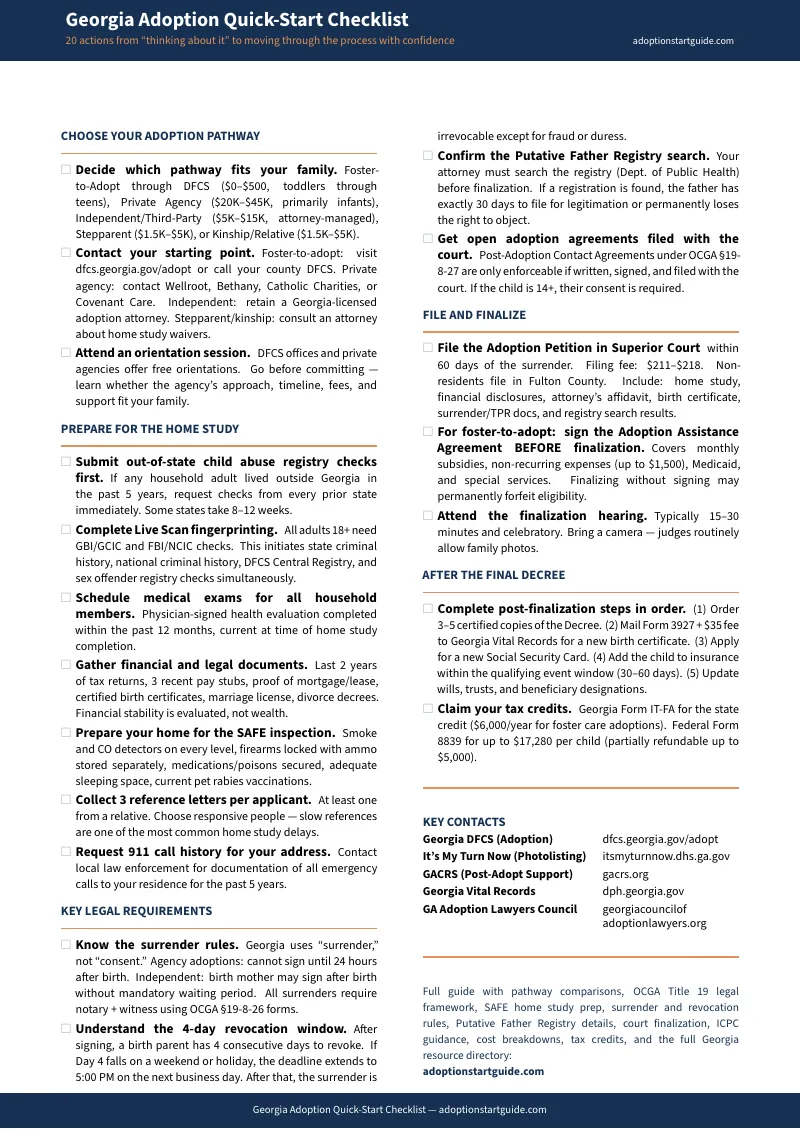
Download the Georgia Adoption Quick-Start Checklist for a one-page overview of the key steps from first inquiry to finalization. Free, no commitment. If you want the full guide with the three-pathway comparison, the surrender process decoder, the Putative Father Registry navigator, the HB 154 and Andee's Law explainer, and all the printable worksheets, click the button in the sidebar.
-- less than three minutes of a Georgia adoption attorney's time
The average adoption attorney in Georgia bills $369 per hour. Atlanta partners charge $450 or more. Families routinely spend their first billable hour covering foundational questions this guide answers in Chapter 1. The OCGA Title 19 Roadmap doesn't replace your attorney. It makes sure you don't pay your attorney to teach you the basics of the Georgia adoption code.