You've decided to adopt in Idaho. Then you discovered that DHW, the District Courts, and Idaho Code Title 16 each assume you already understand the other two.
Idaho is not like neighboring states. Consent is signed before a judge and it is irrevocable -- there is no cooling-off period, no 30-day revocation window, no second chance. The Indian Child Welfare Act applies to six federally recognized tribes in Idaho, and a single missing tribal notice can allow an adoption to be vacated years after finalization. LDS Family Services, once the default for thousands of East Idaho families, no longer operates as a full-service placement agency -- they provide counseling and referrals, but you need your own attorney, your own home study provider, and your own understanding of the District Court process. And the DHW website covers foster-to-adopt but says almost nothing about private, independent, or kinship adoption.
You've already done the research. You found the DHW website, which families describe as "an absolute nightmare to navigate" -- scattered across multiple pages with outdated information and no clear pathway for private adoption. You found LDS Family Services, which used to handle everything but now refers you out for legal work and home studies. You found the Idaho Bar Association, where Boise adoption attorneys bill $200 to $350 per hour. And you found Facebook groups and Reddit threads where well-meaning strangers mix up Idaho's irrevocable consent rules with Utah's and Washington's revocation windows in the same comment.
The information exists. It's scattered across DHW fact sheets, Idaho Code Sections 16-1501 through 16-2015, Bureau of Vital Records forms, tribal enrollment offices, and agency orientation packets. Piece it together yourself and you'll burn weeks reading documents that explain the rules but never tell you the order of operations as a parent.
The Idaho Code Title 16 Roadmap
This is a complete, Idaho-specific adoption guide built around the problem every family in this state hits: navigating a system where DHW, the District Courts, private agencies, and tribal authorities each own a piece of the process but none of them explain how the pieces connect. Not a national overview. Not an agency brochure designed to funnel you into one program. Every chapter, every checklist, every cost figure is grounded in Idaho Code Title 16, current DHW policies, home study requirements, and the real-world experience of families who have adopted in the Gem State.
What's inside
- Four-pathway comparison table -- DHW foster-to-adopt, LDS Family Services, licensed private agency, and independent adoption through an attorney, mapped side by side. Costs, timelines, eligibility, and the realistic wait for each pathway so you choose the right one before investing months in the wrong direction. Foster-to-adopt runs $0 to $2,000. Private agency fees range from $15,000 to $40,000. LDS Family Services charges $4,000 to $10,000 on a sliding scale. Independent adoption costs $8,000 to $15,000 in attorney and home study fees. That decision deserves more than a caseworker's one-sentence summary.
- The irrevocable consent decoder -- Idaho has the strongest consent finality in the country. Once a birth parent signs consent before a judge, it cannot be revoked -- no grace period, no exceptions. This chapter explains the 72-hour post-birth waiting period before consent can be signed, what happens in the courtroom, and how to prepare for the most consequential legal moment in your adoption. Families from California, Oregon, and Washington are routinely blindsided by this because their former states allow revocation periods of 30 to 90 days.
- ICWA compliance guide for Idaho's six tribes -- The Coeur d'Alene Tribe, Kootenai Tribe, Nez Perce Tribe, Shoshone-Bannock Tribes, Shoshone-Paiute Tribes, and Northwestern Band of the Shoshone Nation each have their own enrollment offices and designated tribal agents. ICWA applies when a child is eligible for membership, not just when a child lives on a reservation. This chapter includes the tribal contact directory, the notice requirements, and the documentation that prevents your finalized adoption from being challenged years later. National guides treat "tribes" as a monolith. This guide treats them as six sovereign nations with specific contact agents.
- The LDS Family Services transition navigator -- Since their restructuring, LDSFS no longer acts as a full-service adoption agency. They provide counseling, matching profiles, and referrals, but families must find their own legal representation and home study providers. This chapter explains what LDSFS still covers, what it doesn't, the sliding-scale fee structure, and how to bridge the gap between church resources and the Idaho District Court requirements. For families in Idaho Falls, Rexburg, and Pocatello, this chapter answers the question their ward bishop cannot.
- Home study preparation guide -- What the social worker evaluates, the documents you need before the first visit, how to choose between DHW-approved providers and independent Certified Adoption Professionals, and the cost differences between agency home studies and independent evaluations. Organized so nothing is missing when the social worker arrives.
- District Court process map -- From filing the adoption petition under Idaho Code Section 16-1504 to the finalization hearing, mapped for both the 4th District (Boise, where private agency filings dominate) and the 7th District (Idaho Falls, where LDS-mediated adoptions are most common). Includes the post-placement supervision period, the Termination of Parental Rights process under Idaho's 2025 accelerated TPR provisions, and the timeline from decree to amended birth certificate.
- Birth certificate and post-finalization navigator -- The District Court does not handle your new birth certificate. The Idaho Bureau of Vital Records requires a specific "Report of Adoption" form, a $20 legal amendment fee, and a multi-step process that most families don't learn about until after finalization. This chapter covers every administrative step after the decree: Vital Records, Social Security, insurance enrollment, and the federal adoption tax credit.
- Kinship and stepparent adoption guide -- You've been raising your grandchild, niece, or stepchild for months or years. You assume the process is simple because the birth parent agrees. It isn't. Even "simple" adoptions require a home study (unless waived by a judge), a formal Termination of Parental Rights, and a District Court hearing. One missed filing delays your child's legal name change for months. This chapter covers consent waivers, TPR when a parent has abandoned the child, and the expedited process available for qualifying kinship placements.
- Financial planning framework -- DHW reimbursement for nonrecurring adoption expenses (up to $2,000), the federal adoption tax credit, Title IV-E subsidies for special-needs children adopted from foster care, and the critical rule: the Adoption Assistance Agreement must be signed before finalization or you lose eligibility permanently. Most families don't know the $2,000 DHW reimbursement exists because the website buries it.
Who this guide is for
- Treasure Valley families exploring private adoption -- You moved to Boise, Meridian, or Nampa from a state with large full-service agencies. Idaho's agency market has five to seven primary players with waitlists. This guide maps the landscape so you stop comparing Idaho to the system you left behind and start working with the system you're in.
- East Idaho LDS families navigating the LDSFS transition -- Your ward community talks about adoption in the language of eternal families and temple sealings. The legal process speaks a different language -- TPR hearings, home study certifications, and District Court filings. This guide bridges those two worlds so the legal process doesn't derail your faith-based journey.
- Kinship caregivers who need legal standing -- You've been raising a relative's child after a crisis -- incarceration, substance abuse, or DHW removal. You lack legal custody. This guide covers the kinship adoption pathway, the TPR process when a parent has abandoned the child, and the subsidies most kinship families don't know they qualify for.
- Stepparents adopting a spouse's child -- The absent parent hasn't been involved in years. Idaho Code Section 16-2005 governs the conditions under which the court can waive consent. This guide walks you through the home study, the consent or TPR process, and the finalization hearing so one missed filing doesn't cost you months.
- Foster families ready to adopt -- The child in your care just had reunification ruled out. The transition from foster license to adoption petition involves different documents, a mandatory post-placement supervision period, and the Adoption Assistance Agreement that must be executed before the judge signs the decree. This guide maps that transition.
Why the free resources aren't enough
The DHW website covers the foster-to-adopt pathway. It explains orientations, training, and regional contacts. But it provides minimal guidance on private, independent, or kinship adoption. If you're not fostering first, DHW has little for you.
LDS Family Services provides counseling and matching profiles for church members. Since their restructuring, they no longer handle legal filings, home studies, or court representation. Families who assume LDSFS "handles everything" discover the gap when they need an attorney and a home study provider and have no idea how to choose one.
National adoption books discuss "state adoption laws" without explaining that Idaho's consent is irrevocable, that Idaho has six specific tribes requiring ICWA notice, or that the 4th and 7th Judicial Districts have different filing cultures. They reference "cooling-off periods" that don't exist here. They mention home studies without covering the Idaho-specific provider market.
Reddit and Facebook groups give you emotional support and anecdotal experience. They also mix Idaho law with Utah and Washington statutes in the same thread, assume ICWA only applies to children living on reservations, and offer advice based on other states' revocation windows. In Idaho, where consent is irrevocable before a judge, that distinction is the difference between a secure adoption and a contested one.
Boise adoption attorneys charge $200 to $350 per hour. Rural attorneys run $150 to $250. A single orientation consultation costs $300 to $500. Families routinely spend their first billable hour covering foundational questions this guide answers in Chapter 1.
Printable standalone worksheets included
The guide comes with printable standalone PDFs designed for real-world use:
- Pathway Comparison Card -- Four pathways side by side on one page. DHW foster-to-adopt, LDS Family Services, private agency, and independent. Costs, timelines, and the first steps for each route. Print it, sit down with your partner, and make the decision that shapes everything else.
- ICWA Tribal Notice Tracker -- All six Idaho tribes with designated tribal agents, mailing addresses, and notice deadlines. Fillable date fields so you can document compliance the way the District Court requires.
- Home Study Document Checklist -- Every document your home study provider will request, organized by category. Financial records, medical clearances, reference letters, and home safety requirements. Nothing missing when the social worker arrives.
- Post-Finalization Action Plan -- Amended birth certificate through the Bureau of Vital Records, Social Security update, insurance enrollment, tax credit filing, and the $2,000 DHW reimbursement claim. Every administrative step after the decree, in order, with contacts and processing timelines.
The free Quick-Start Checklist
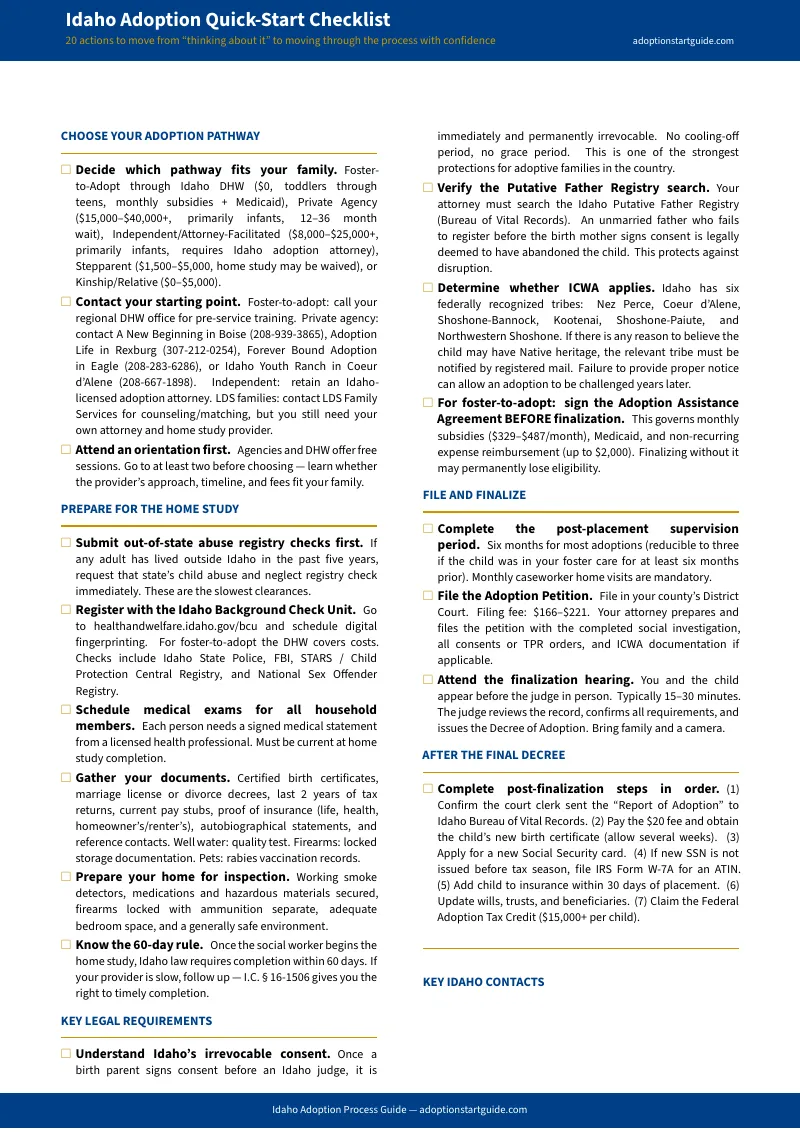
Download the Idaho Adoption Quick-Start Checklist for a one-page overview of the key steps from first inquiry to finalization. Free, no commitment. If you want the full guide with the four-pathway comparison, the irrevocable consent decoder, the ICWA tribal compliance guide, the LDS Family Services transition navigator, and all the printable worksheets, click the button in the sidebar.
-- less than one minute of a Boise adoption attorney's time
The average adoption attorney in Idaho bills $200 to $350 per hour. A single orientation consultation runs $300 to $500. Families routinely spend their first billable hour covering foundational questions this guide answers in Chapter 1. The Idaho Code Title 16 Roadmap doesn't replace your attorney. It makes sure you don't pay your attorney to teach you the basics of Idaho adoption law.