You're ready to adopt in Louisiana. Then you discovered nobody can translate the civil law.
Louisiana is the only state in the country that runs adoption through a civil law framework. The other 49 states use common law. Louisiana uses the Children's Code, the Civil Code, and a Napoleonic tradition where consent is an "Act of Surrender" executed before a notary and two witnesses as an authentic act. If you Google "how to adopt in Louisiana," you'll get national guides that assume common-law terminology and skip everything that makes this state different. The DCFS website reads like it was written for federal compliance auditors. The Children's Code — Title XII, Articles 1101 through 1270 — is dense civil law legalese that assumes you already know what "authentic forms" and "strict construction" mean.
Meanwhile, the practical details that will actually shape your experience are scattered across a dozen disconnected sources. Catholic Charities Archdiocese of New Orleans and Catholic Charities Diocese of Baton Rouge have different programs with different fee structures, but both are hidden behind "contact us" forms. The Putative Father Registry at the Department of Health requires a certificate search for every single adoption, and nobody tells you the fee or timeline until you call. Your parish determines which court handles your case — Orleans and Jefferson have dedicated Juvenile Courts, East Baton Rouge uses Family Court, and the other 60+ parishes run adoptions through District Court sitting in juvenile session. An adoption attorney in Baton Rouge or New Orleans bills $250 to $400 an hour and won't call you to explain why the Act of Surrender has a three-day waiting period for agency placements but a five-day waiting period for private ones.
The information exists. It's buried in Children's Code titles, DCFS administrative regulations, agency orientation packets, parish court clerk websites, and the occasional post in a Louisiana adoptive parents Facebook group from someone in a completely different parish. Piece it together yourself and you'll burn weeks reading documents that explain the rules but never tell you how to navigate them as a parent in a civil law state.
The Civil Law Translator
This is a complete, Louisiana-specific adoption guide built around the problem every family hits: the Children's Code is written in civil law language that doesn't match anything you'll read in a national adoption book. Not a generic overview. Not a DCFS brochure designed to satisfy federal reviewers. Every chapter, every checklist, every cost figure is grounded in the Louisiana Children's Code (Articles 1101–1270), current DCFS policies, and the real-world experience of families who have adopted in this state's unique legal system.
What's inside
- Five-pathway comparison table — Foster-to-adopt through DCFS, private agency, independent "notarial" adoption, stepparent, and kinship adoption mapped side by side. Costs, timelines, eligibility, and the realistic wait for each pathway so you choose the right one before investing months in the wrong one. Foster-to-adopt runs $0 to $500. Private agency adoption costs $25,000 to $70,000. Independent notarial adoption falls between $15,000 and $40,000. That decision deserves more than a caseworker's one-sentence summary.
- Act of Surrender decoder — Louisiana doesn't use "consent." It uses an Act of Surrender, an authentic act executed before a notary and two witnesses. This chapter explains the three-day waiting period for agency adoptions, the five-day waiting period for private adoptions, why a father can sign before birth but remains revocable until day five, the mandatory pre-surrender counseling under Article 1120, and what "irrevocable" actually means in civil law — including the 90-day fraud-or-duress window that is the only path to annulment.
- Parish court navigator — Orleans Parish Juvenile Court, Jefferson Parish Juvenile Court, Caddo Parish Juvenile Court, East Baton Rouge Family Court, and District Courts in juvenile session for the remaining 60+ parishes. This chapter tells you exactly where to file, which clerk's office handles adoption petitions, and how procedures differ between a dedicated juvenile court and a district court that hears adoption cases twice a month. Parish-by-parish notes for the six highest-volume parishes.
- Putative Father Registry compliance — RS 9:400 requires a registry search and a certificate from the Department of Health for every adoption. Skip it and the adoption is legally vulnerable to a later challenge. This chapter walks you through the search request process, the fees, the timeline, and what happens if a putative father has registered — including the notice requirements under Articles 1130 through 1143 that your attorney will bill you to explain.
- Louisiana agency comparison guide — Catholic Charities Archdiocese of New Orleans, Catholic Charities Diocese of Baton Rouge (with its sliding-scale fees), Volunteers of America Southeast Louisiana, Beacon House Adoption Services in Baton Rouge, A Bond of Life Adoptions in Mandeville, and DCFS-direct. Program profiles, geographic focus, denominational orientation, fee structures, and what each agency's process actually looks like from the parent's side. No agency website will give you this comparison because no agency has an incentive to.
- DCFS foster-to-adopt pipeline — Louisiana's dual certification process, the CINC (Child in Need of Care) adjudication under Title VI, the 15-of-22-months timeline that triggers TPR, and how your case transitions from Title VI through Title X to Title XII. Eight grounds for involuntary termination under Article 1015, each one explained in plain English with the burden of proof the state must meet. Written for foster parents who need to understand what is happening in court, not just what their caseworker tells them is happening.
- Adoption assistance rates and the subsidy cliff — Monthly maintenance rates from $407 to $501 depending on the child's age, Medicaid continuation, and the $1,000 non-recurring expense reimbursement. But you must negotiate and sign the agreement before the adoption is finalized. After the judge signs the decree, these benefits are locked or gone. This chapter gives you the timeline, the qualifying conditions, and the conversation to have with your DCFS worker before you set a court date.
- Louisiana cost map — A realistic breakdown from $0 (foster-to-adopt through DCFS) to $70,000+ (private agency with birth mother expenses). Includes the expenses nobody warns you about: the home study fee ($1,000 to $3,000 in the private sector), background checks for every household member, the birth parent's independent legal counsel that you may pay for in private adoptions, court filing fees that vary by parish, and the $15 original birth certificate application fee that most families don't know exists until finalization. Plus the 2025 federal tax credit — up to $17,280 per child with $5,000 now refundable under the One Big Beautiful Bill Act.
- ICWA and Louisiana tribal compliance — The Chitimacha, Coushatta, Jena Band of Choctaw, and Tunica-Biloxi tribes are all federally recognized in Louisiana. If a child is a member of or eligible for membership in any of these tribes, the Indian Child Welfare Act requires active efforts, tribal notification, and potential transfer to tribal court. This chapter explains the compliance steps for both Native and non-Native families so the adoption isn't vulnerable to a later ICWA challenge.
- Original birth certificate access after the 2022 law — Louisiana adoptees age 24 and older now have unrestricted access to a non-certified copy of their original birth certificate. The age-24 threshold aligns with Louisiana's unique forced heirship laws. This chapter explains the application process through Vital Records, the $15 fee, and what this means for adoptive families navigating open adoption conversations. For those under 24, the Louisiana Voluntary Adoption Registry (LVAR) is covered as well.
- Court finalization walkthrough — The six-month post-placement supervisory period, the three required social worker visits, the petition filing deadline (30 days from placement for agency and private adoptions), and exactly what happens on finalization day. The judge's "best interest" standard, the requirement to solicit the wishes of any child 12 or older, and the post-decree steps — the amended birth certificate, the new Social Security card, and the passport application. Written in plain language, not Children's Code citations.
Who this guide is for
- Foster parents moving toward adoption — The child in your care has been adjudicated CINC and the 15-of-22-months clock is ticking toward TPR. You've been told to "start thinking about adoption," but nobody explained how your case transitions from Title VI to Title XII or why the dual certification you already hold doesn't automatically make you the adoptive placement. This guide maps that pipeline from CINC through TPR through finalization and makes sure the subsidy is locked in before the decree.
- Families pursuing private infant adoption — You're working with Catholic Charities in New Orleans or an attorney in Baton Rouge and the costs are climbing past $30,000. This guide helps you understand the Act of Surrender timing, the pre-surrender counseling requirement, how the Putative Father Registry protects your placement, and what you're paying for versus what you can navigate yourself.
- Families considering independent "notarial" adoption — Louisiana is one of the few states where you can match directly with a birth parent through an attorney without an agency intermediary. But the legal requirements are stricter — five-day waiting period instead of three, independent legal counsel for the surrendering parent, and a home study still required through a licensed agency or DCFS. This guide covers the notarial adoption process end to end so you understand both the flexibility and the legal exposure.
- Kinship adopters — You took in a grandchild, niece, or nephew during a family crisis in Shreveport, Lake Charles, or Lafayette. You assumed the process would be simpler because you're family. It isn't. Louisiana requires the same background checks, the same home study, and the same court finalization regardless of your biological connection. The intrafamily pathway under Articles 1243 through 1257 has its own requirements — including the six-month no-support-or-contact rule for involuntary consent. This guide covers the kinship-specific path without the $300-per-hour price tag.
- Stepparent adopters — The absent parent hasn't paid support or visited in years. Article 1245 requires either voluntary consent or proof of six months of failed support and communication without just cause. This guide walks you through the involuntary consent process, the investigation report, and the hearing — including what to do if the absent parent suddenly resurfaces after you file.
- Catholic families navigating faith-aligned agencies — Louisiana's adoption landscape is deeply shaped by Catholic institutions. If you're working with Catholic Charities or a diocesan agency, this guide helps you understand how faith-based programs intersect with the civil law framework — what's doctrinal preference versus legal requirement, and how to evaluate whether a faith-aligned agency or a secular pathway better fits your situation.
Why the free resources aren't enough
The DCFS website — dcfs.louisiana.gov — is technically accurate but written for federal reviewers and internal staff, not families. It explains that a home study is required. It doesn't explain how to prepare for one, what the social worker evaluates, or how the 75-square-foot bedroom minimum under the Louisiana Administrative Code actually gets measured.
The Louisiana Children's Code is the legal authority, but it's 170+ articles of civil law drafted for attorneys. It uses terms like "authentic act," "tutorship," and "strict construction" that have precise legal meanings unique to Louisiana's civil law tradition. Reading it without a civil law translator is like reading a French contract with a Spanish-English dictionary — the words look familiar but they don't mean what you think.
Catholic Charities websites in New Orleans and Baton Rouge are lead-generation tools for their own programs. They describe their services warmly but won't compare themselves to Volunteers of America, Beacon House, or DCFS-direct. They won't tell you that Baton Rouge uses a sliding-scale fee and New Orleans doesn't, because no agency has an incentive to send you to a competitor.
AdoptUSKids Louisiana points you to the DCFS photolisting and the 1-800-259-3567 inquiry line. It covers the basics of foster-to-adopt but misses the civil law distinctions that make Louisiana different — the Act of Surrender, the authentic act requirement, the Putative Father Registry, the parish court variations. It's a national resource applied to a state that doesn't work like the other 49.
Generic adoption books on Amazon cover federal ICWA but don't know the four Louisiana tribes or how ICWA interacts with the Children's Code's own termination procedures. They mention "consent" when Louisiana uses "surrender." They reference "the court" as if there's one system. In Louisiana, your parish determines whether you're in a dedicated Juvenile Court, a Family Court, or a District Court sitting in juvenile session — and the procedural experience is different in each.
Facebook groups — Louisiana Adoptive Families, Adoptive Parents of Louisiana — give you anecdotes from someone in Bossier Parish that may be completely wrong for yours. One parent's experience with Catholic Charities in New Orleans tells you nothing about Beacon House in Baton Rouge or a DCFS-direct placement in Calcasieu Parish.
Printable standalone worksheets included
The guide comes with 6 printable standalone PDFs designed for real-world use:
- Pathway Comparison Card — Five pathways side by side on one page. Print it, sit down with your partner, and make the decision that shapes everything else.
- Home Study Document Checklist — Every document the Louisiana home study requires, with the form types, where to obtain them, and the order that prevents delays. Hand it to your social worker so you're both working from the same list.
- Cost Map Worksheet — Every expense for every pathway, a hidden costs checklist with fill-in fields, adoption assistance rates by age, and the federal tax credit calculation. Take it to your financial planning conversation.
- Court Filing Checklist — Every document and certificate you need for the adoption petition in your parish court. Give it to your attorney and save yourself a billable hour of "what do we need?" questions.
- Subsidy Negotiation Worksheet — Fill-in template for your adoption assistance meeting with DCFS. Qualifying conditions, monthly rates, Medicaid, non-recurring expenses, and the pre-decree deadline — all in one printable sheet.
- Adoption Timeline Tracker — Every milestone from initial inquiry through court finalization and post-decree steps, with fill-in date fields so you always know where your case stands.
The free Quick-Start Checklist
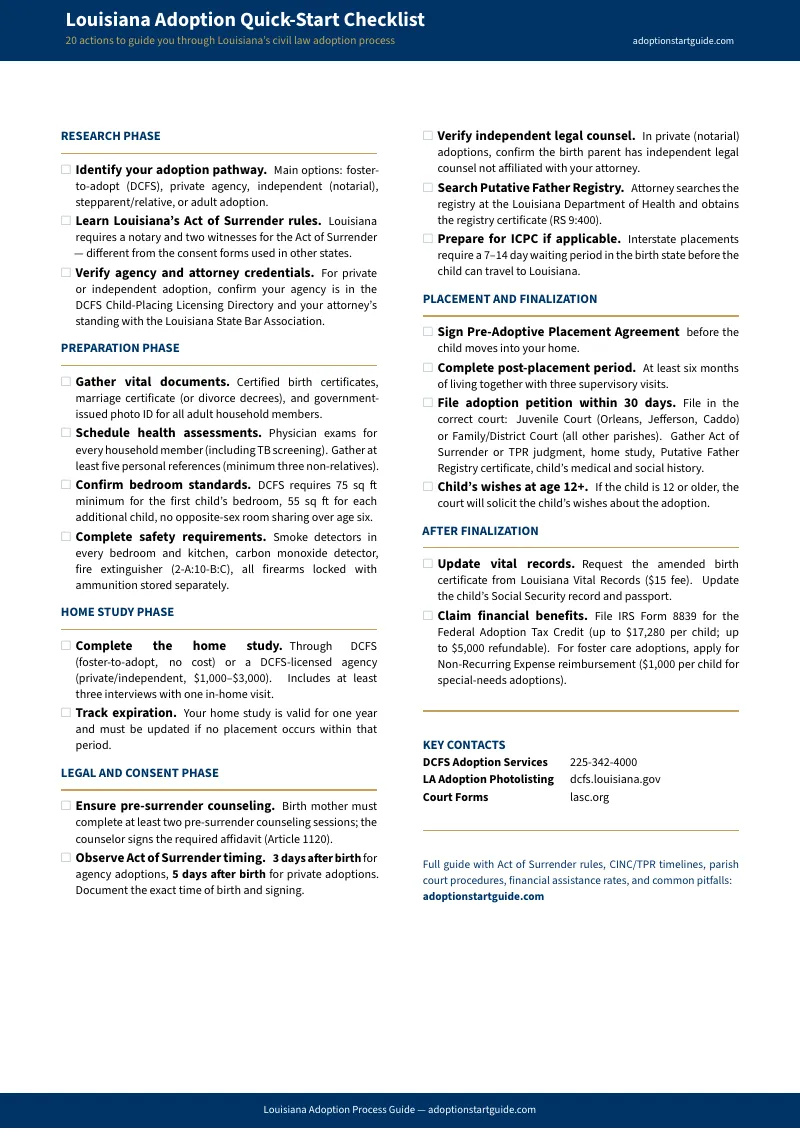
Download the Louisiana Adoption Quick-Start Checklist for a one-page overview of the key steps from first inquiry to finalization. Free, no commitment. If you want the full guide with the civil law decoder, the Act of Surrender walkthrough, agency comparisons, subsidy timelines, ICWA compliance, parish court navigator, and all the printable worksheets, click the button in the sidebar.
— less than 20 minutes of a Baton Rouge adoption attorney's time
A single consultation with an adoption attorney in Baton Rouge or New Orleans starts at $250 per hour. Families routinely spend the first billable hour covering foundational questions this guide answers on page one. The Civil Law Translator doesn't replace your attorney. It makes sure you don't pay your attorney to teach you how Louisiana adoption works differently from every other state in the country.