You're spending $40,000 to build your family. The IRS owes you up to $17,280 back. Most families file it wrong.
The agency sent you a fee schedule with numbers that made your stomach drop. You googled "adoption tax credit" and found a dozen articles that all say different things. Your accountant shrugged and said they'd "look into it." A forum post from 2019 told you the credit isn't refundable, so it won't help if you don't owe enough in taxes. That post is now wrong — the law changed in 2025 — but it's still the top result.
Meanwhile, you're trying to figure out how to fund a $30,000 to $70,000 adoption without drowning in debt, how to time your grant applications around your home study, whether your employer even offers adoption benefits, and what happens to your money if the match falls through. The IRS instructions for Form 8839 are 12 pages long and contradict the IRS's own online tools. A Government Accountability Office audit found that 41% of adoption tax credit returns that were examined resulted in adjustments — meaning nearly half of families who claimed the credit got it wrong.
The stakes are real. Every dollar you leave on the table is a dollar your family needed. Every filing mistake is a refund delayed by months or a credit lost entirely. And every week you spend piecing together information from outdated books, generic CPA advice, and conflicting government websites is a week you could have spent focused on the part that actually matters — bringing your child home.
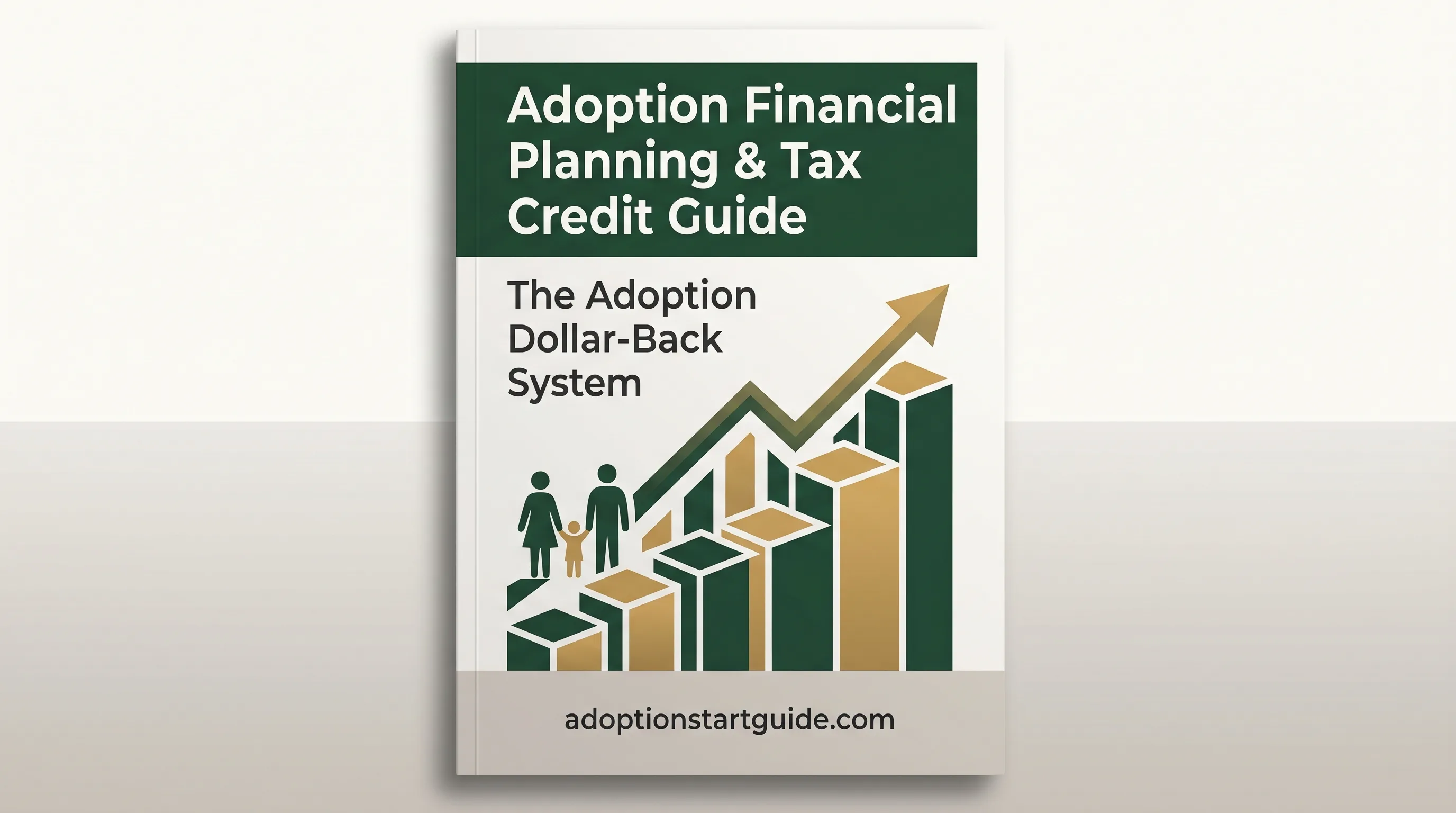
The Adoption Dollar-Back System: A Complete Financial Playbook for Every Stage of the Process
The Adoption Financial Planning & Tax Credit Guide is built around a single principle: every dollar that exists to help your family should reach your family. Not the portion your accountant happens to know about. Not the fraction you stumble across in a Facebook group. Every dollar — from the federal tax credit and employer exclusion stacking strategy that can return over $34,000, to the foster care "full credit" rule that pays $17,280 on $0 of expenses, to the failed match recovery provision that most adoption professionals have never heard of.
The guide is called the Adoption Dollar-Back System because it works in reverse from where most financial resources start. Instead of beginning with "here's what adoption costs" and ending with "good luck," it starts with every dollar available to come back to you and builds your financial plan around recovering the maximum amount in the shortest time. Tax credits, employer benefits, grants, subsidies, military reimbursement, state non-recurring expense programs — sequenced in the right order, claimed at the right time, on the right forms.
Every figure, threshold, form reference, and deadline in this guide reflects the 2025-2026 tax years, including the landmark partial refundability change that took effect in 2025.
What's inside
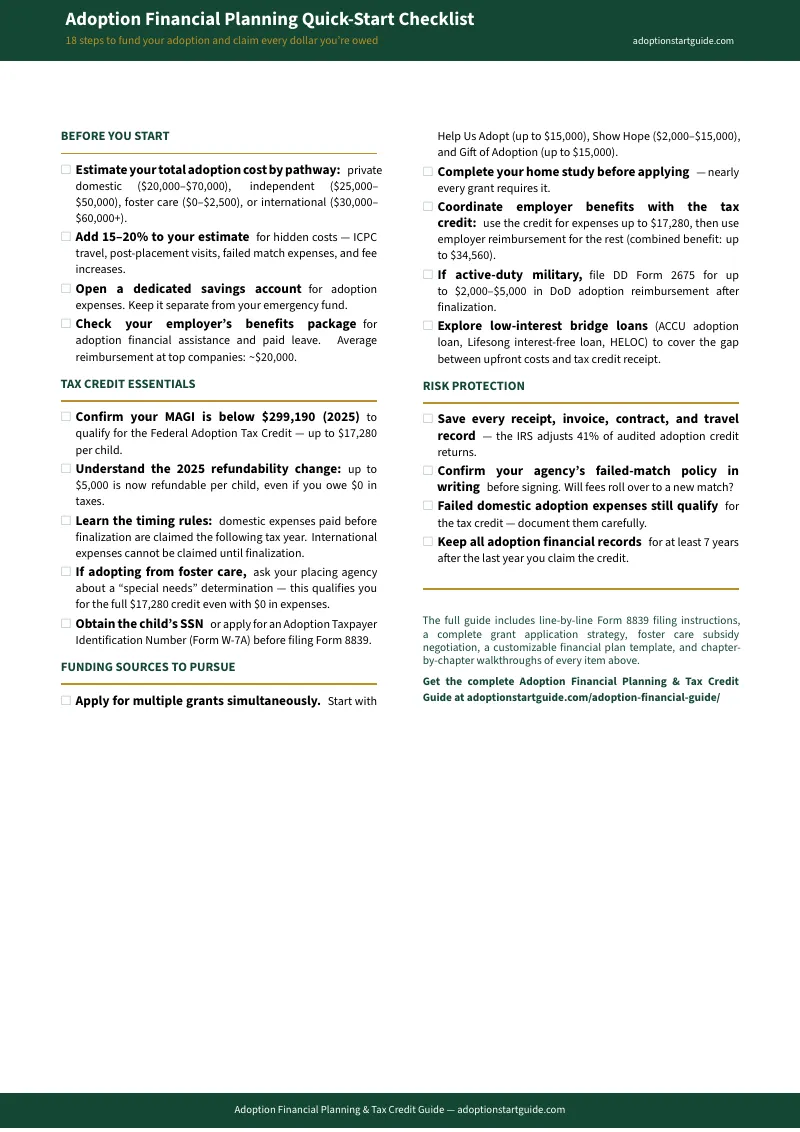
- The 2025 Refundability Breakthrough — Up to $5,000 of the Adoption Tax Credit is now refundable per child, meaning you can receive a direct check from the IRS even if your tax liability is zero. This is the most significant change to adoption tax law in over a decade, and most families (and their accountants) don't know it exists yet. The guide explains exactly who qualifies, how the per-child calculation works for sibling groups, why carryforward credits from prior years don't count, and how the refundable amount is projected to increase to $7,500 for 2026.
- The Special Needs Full-Credit Rule — If you're adopting from foster care and your child has a "special needs" determination — which includes factors like age, sibling group status, and race, not just medical conditions — you're entitled to the full $17,280 credit regardless of your actual out-of-pocket expenses. A family that adopts from foster care for $0 can still claim the full credit. The guide covers the exact documentation required (the Adoption Assistance Agreement), the recent IRS clarification extending this to tribal government determinations, and the specific mistake that triggers an audit if you check the wrong box without the paperwork.
- The Employer Benefit Stacking Strategy — The tax credit and employer adoption benefits are two separate programs with separate $17,280 limits. If your total expenses exceed $17,280, you can split them: claim the credit on one portion, exclude the employer reimbursement on the other, for a combined tax benefit of up to $34,560. The guide walks through the math, the double-counting prohibition, the FICA implications, and the specific order that maximizes your total recovery.
- Failed Match Financial Recovery — If a domestic placement falls through after you've spent $5,000 to $20,000 on birth parent expenses, travel, and legal fees, that money is not necessarily gone. The IRS allows you to claim the Adoption Tax Credit for expenses from domestic adoptions that were never finalized. The guide explains the timing rules, the documentation requirements, and how to combine this with your agency's rollover policy to recover as much as possible from a devastating situation.
- Line-by-Line Form 8839 Filing — A complete walkthrough of every section of the IRS form used to claim the credit, including the TIN problem (when you don't have the child's Social Security Number yet), the paper-vs-electronic filing conflict the GAO identified, the timing rules that differ for domestic and international adoptions, and the five most common mistakes that lead to the 41% audit adjustment rate.
- The Grant Application Playbook — Detailed profiles of every major adoption grant organization (Help Us Adopt, Show Hope, Gift of Adoption, National Adoption Foundation, A Child Waits, Brittany's Hope, Lifesong for Orphans), with award ranges, eligibility criteria, application deadlines, and a strategy for applying to multiple grants simultaneously. Plus a personal statement framework that moves your application from "we need help" to "here's exactly what this grant will unlock."
- Foster Care Financial Benefits Deep Dive — Title IV-E monthly subsidies, Medicaid continuation, non-recurring expense reimbursement, and the special needs determination process explained in full. Includes how to negotiate your adoption assistance agreement before finalization (the one meeting where most families accept the first offer because they don't know what's negotiable).
- Military and Federal Civilian Benefits — DoD adoption reimbursement (up to $2,000-$5,000 per child), DD Form 2675 filing deadlines, federal civilian reimbursement under 5 U.S.C. 5943, 12 weeks of Paid Parental Leave, and how all of these stack with the federal tax credit without double-counting.
Printable standalone worksheets included
- Financial Planning Worksheet — A 4-page fillable worksheet that walks you through cost estimation by pathway, tax credit calculation, funding source inventory, timeline mapping, and the employer benefit stacking math. Print it, fill it in at the kitchen table, and bring it to every financial planning conversation.
- Quick Reference Card — Every key number for 2025 (credit amounts, MAGI thresholds, employer exclusion limits, military reimbursement caps) plus every essential IRS form and document — on a single landscape page. Keep it in your adoption folder or tape it to your desk.
- Audit Protection Checklist — The complete document collection checklist, the five most common Form 8839 filing mistakes, and the paper-vs-electronic filing decision guide. Designed to hand to your CPA before tax season.
Who this guide is for
- Families facing the "first fee quote" and wondering how to afford a $20,000 to $70,000 adoption — You need a funding strategy, not a pep talk. The guide builds a layered plan using savings, grants, employer benefits, bridge loans, and the tax credit, sequenced so each source arrives when you need it.
- Foster-to-adopt families who don't realize what they're owed — If your child has a special needs determination, you may be eligible for $17,280 in federal tax credits plus ongoing monthly subsidies and Medicaid — even if your out-of-pocket adoption cost was zero. The guide walks you through exactly how to claim it.
- Families preparing to file Form 8839 for the first time — The form is short. The mistakes are expensive. The guide's line-by-line walkthrough and audit-protection checklist are designed for families who want to file correctly without paying $400/hour for a specialist CPA to do it.
- Active-duty military and federal employees pursuing adoption — Your benefits exist in a separate bureaucracy from the IRS. The guide maps DoD reimbursement, federal civilian benefits, and Paid Parental Leave alongside the tax credit so nothing falls through the cracks.
- Families who experienced a failed match and don't know their expenses are still claimable — The emotional devastation is enough. The financial loss doesn't have to be permanent. The guide covers exactly how to recover what you can.
Why free resources and existing books fall short
The IRS website provides a high-level overview of the Adoption Tax Credit. It does not tell you what to do when their own Interactive Tax Assistant contradicts the Form 8839 instructions — which the GAO confirmed happens. NACAC and the Dave Thomas Foundation publish excellent general guides. They don't include the line-by-line filing walkthrough or the stacking math that turns $17,280 into $34,560.
Adopt Without Debt by Julie Gumm is a solid fundraising resource. It focuses on creative ways to raise money — yard sales, crowdfunding, cutting expenses — not on tax credit optimization, employer benefit stacking, or the 2025 refundability change that didn't exist when it was published. Fund Your Adoption by Jeremy Resmer is excellent for grant seekers. It doesn't cover Form 8839 line by line, the special needs full-credit loophole, or the failed match recovery provision.
Your CPA may be competent at general tax preparation. Unless they regularly file Form 8839, they likely don't know about the paper-vs-electronic TIN conflict, the domestic-vs-international timing difference, or the special needs documentation requirement that triggers audits when it's missing. The GAO report exists because even the IRS can't keep its own guidance consistent.
This guide is current to the 2025-2026 tax years, covers every adoption pathway and funding source in a single document, and is built specifically for the family sitting at the kitchen table at 11 PM trying to figure out how to make the numbers work.
— less than fifteen minutes of a tax attorney's time
A single consultation with a CPA who specializes in adoption tax issues runs $200 to $500 per hour. Most families need at least two sessions to cover the credit, the timing rules, and the employer benefit interaction. The Adoption Financial Planning & Tax Credit Guide doesn't replace professional advice for complex situations. It makes sure you don't spend your first $800 learning things you could have read in an hour.
If the guide doesn't deliver, reply to your download email at any time for a full refund. No forms. No justification required.