Nevada has three foster care systems running in parallel, and the state website doesn't tell you which one you belong to.
You searched "how to become a foster parent in Nevada" expecting a checklist. What you found was a maze. Clark County has its own Department of Family Services. Washoe County runs a separate Human Services Agency. The remaining fifteen rural counties fall under the state Division of Child and Family Services. Three different agencies, three different application processes, three different training calendars — and if you apply to the wrong one because your zip code falls outside the jurisdiction you assumed, you lose four to six weeks before anyone tells you.
The official DCFS website publishes the Nevada Administrative Code Chapter 424 — fifty-plus pages of regulatory language written for caseworkers, not families. It tells you a home must be "safe." It does not tell you that NAC 424.420 requires a reaching pole with a life hook and a ring buoy beside every pool, that your water heater must be set below 120 degrees, or that expired pet vaccinations can stall your home inspection. Clark County's recruitment page is polished and urgent — they need over 1,000 additional foster beds — but it only covers Clark County procedures. If you live in Sparks, Pahrump, or Elko, that recruitment brochure is for someone else's system.
Then there is the training. TIPS-MAPP is Nevada's required pre-service program, and the standard track meets on weekday evenings for eight to eleven weeks. If you work swing shift at a resort-casino, graveyard at a hospital, or rotating schedules in gaming, that weekday commitment is a wall. Expedited weekend tracks and evening options through community partners like 180 Community Wellness Centers exist — but good luck finding them on any government website.
National foster care books on Amazon don't know that Nevada's system is state-supervised but county-administered. They describe a single state agency that doesn't exist here. The private adoption consultants who do understand Nevada charge $250 to $500 per hour, and a single consultation with a Las Vegas family law firm runs $600. You shouldn't need to spend that kind of money to understand a process the state should have explained clearly in the first place.
The Jurisdictional Routing System: Your Strategic Guide to Nevada Foster Care
This guide is built for Nevada's three-agency foster care system and nobody else's. Every chapter, every checklist, every recommendation is grounded in the current Nevada Administrative Code Chapter 424, NRS 432B statutes, and the county-specific realities that determine whether your licensing takes four months or ten. It is not a repurposed national handbook with "Nevada" swapped into the title. It is the operational layer between what DCFS posts online and what you actually need to know to get licensed — in your jurisdiction, under current conditions, on your schedule.
What's inside
- Zip-Code-to-Agency Routing Matrix — This is the tool that should exist on the state website but doesn't. Enter your location and know in ten seconds whether you're filing with Clark County DFS, Washoe County HSA, or DCFS Rural — before you spend a single hour on the wrong application. The chapter also maps the tradeoffs between going through your assigned county agency versus a private provider like Olive Crest, including placement priority, support levels, and which path actually has capacity in your area right now.
- NAC 424 Home Inspection Walkthrough — The home safety assessment is where Nevada trips up the most families, and pool fencing is the centerpiece. NAC 424.420 requires five-foot fencing with self-closing, self-latching gates that open away from the water, plus a reaching pole with a life hook and a ring buoy within reach. But the code also covers door alarms on pool-access doors, water heater temperature, firearm storage, medication lockup, and your disaster evacuation plan. This chapter translates all of it into a room-by-room walkthrough with the specific items that actually fail inspections in Clark, Washoe, and rural counties — so you fix everything before the inspector arrives, not after a failed visit sets you back months.
- Background Check Pre-Screen Guide — Every adult in your household must clear FBI fingerprints, a Nevada Central Registry check, and a domestic violence check. That process takes six to eight weeks, and a single hit — even a dismissed misdemeanor or an old arrest without conviction — can trigger a waiver review. Most applicants don't learn what qualifies as a "disqualifying offense" versus a "waivable offense" until the rejection letter lands. This chapter walks you through what the Central Registry actually searches, how to request a waiver for minor or dated offenses, and how to prepare your documentation before you submit fingerprints so a routine flag doesn't derail your entire timeline.
- Shift-Worker Training Finder — TIPS-MAPP doesn't have to be a ten-week Tuesday night obligation. Clark County offers expedited weekend tracks. Community partners like 180 Community Wellness Centers run evening cohorts. Washoe County schedules sessions on different cycles than Clark. This chapter maps every current training option across all three jurisdictions — with dates, formats, and contact information — specifically for families whose work schedules don't fit the standard government calendar. If you work at the Wynn, Sunrise Hospital, or any 24-hour operation, this chapter exists because of you.
- Kinship Emergency Placement Guide — When a child in your family is removed by CPS and placed with you overnight, the clock starts immediately. Nevada has separate licensing standards for kinship caregivers that are designed to be faster and more flexible than the traditional path, but most relatives don't know these standards exist until weeks into the process. This chapter walks you through the emergency placement protocol, explains the financial difference between unlicensed kinship care (low Child-Only TANF grants) and licensed kinship care ($850 to $960 per child per month), and gives you the exact steps to move from emergency caregiver to fully licensed as fast as the system allows.
- Financial Reality by Care Level — Nevada's basic foster care rate runs $33 to $38 per day depending on the child's age. Advanced Foster Care homes receive $50 or more per day. Clark County's Interim Care (ICare) program and Washoe County's specialized rates follow different schedules. Then there are clothing allowances, Medicaid coverage, the Chafee Independent Living program for older youth, and the Nevada Fostering Success financial aid toolkit that includes Pell Grant access up to $7,395 for youth who age out of care. This chapter lays out every payment tier, every supplemental benefit, and the real out-of-pocket costs nobody mentions at orientation — transportation for birth family visits, childcare gaps during court dates, and the career disruption from Child and Family Team meetings scheduled during your shift.
- Foster-to-Adopt Pathway — If your goal is adoption through the foster care system, Nevada requires you to be licensed as a foster parent first. The guide explains how concurrent planning works — supporting reunification with the birth family while preparing for the possibility of permanency — and what the legal timeline looks like from TPR (Termination of Parental Rights) through finalization. It also addresses the emotional reality that most orientations skip: the primary goal of Nevada's system is reunification, and understanding that from day one shapes everything.
- ICWA, Tribal, and Cultural Considerations — Nevada is home to 27 federally recognized tribes, and the Indian Child Welfare Act imposes specific placement preferences and procedural requirements for Native American children that override standard foster care rules. This chapter explains ICWA's "active efforts" standard, what it means for your placement if a child has tribal affiliation, and how to work within these legal requirements respectfully and effectively.
Printable standalone worksheets included
- Licensing Timeline Tracker — Every milestone from initial agency contact through receiving your foster care license, with fill-in date fields for each jurisdiction's process. Print it, update it after every call, and always know where you stand.
- Home Safety Inspection Checklist — Room-by-room walkthrough of every NAC 424 requirement, including the pool fencing specifics, firearm storage rules, and disaster plan items that cause the most failed inspections in Nevada. Walk your house with this before the inspector does.
- Document Organization Sheet — Application forms, fingerprint receipts, Central Registry clearance, health statements, CPR certification, training records, reference letters, and disaster plan — every document you need, organized by phase with checkboxes.
- Financial Planning Worksheet — Daily rates by care level, county-specific supplements, clothing allowances, and hidden costs in one printable sheet. Take it to your household budget conversation.
Who this guide is for
- First-time prospective foster parents in Clark County — You live in Las Vegas, Henderson, or North Las Vegas. You've seen the Child Haven reports. You've heard Clark County needs over 1,000 more beds. You attended an orientation or saw a Facebook ad, and you left feeling inspired but not informed. You need the DFS process translated into specific steps with realistic timelines.
- Reno and Sparks families — Washoe County's HSA runs a different system with different training schedules, different bed availability, and different contact points than Clark County. The statewide recruitment messaging doesn't distinguish between the two. This guide does.
- Rural Nevada families — If you live in any of the fifteen counties outside Clark and Washoe, your licensing runs through DCFS Rural in Carson City — not through the county websites that dominate Google results. This guide routes you to the right agency and explains the rural-specific process.
- Shift workers in hospitality, gaming, and healthcare — Your schedule doesn't fit the standard TIPS-MAPP calendar, and nobody at orientation mentioned the alternatives. The guide maps every expedited, weekend, and evening training option across all three jurisdictions.
- Kinship and relative caregivers — A child in your family was placed with you on an emergency basis. You didn't plan for this. You need to understand the separate kinship licensing standards, the financial support you're entitled to, and the fastest path to full licensure so you can keep that child out of a stranger's home.
- Foster-to-adopt families — You entered this process hoping to build your family permanently. You need to understand how Nevada's reunification-first mandate works, what concurrent planning looks like in practice, and when adoption becomes a legal possibility.
Why the free resources aren't enough
The DCFS website publishes NAC 424 in full — fifty-plus pages of administrative code written for regulators and caseworkers. It tells you what the rules are. It does not tell you which rules cause the most failed inspections, how Clark County's process differs from Washoe County's in practice, or what to do when your fingerprint clearance takes eight weeks instead of three and nobody at the agency returns your calls.
Clark County's recruitment materials are designed to get you to attend orientation, not to get you through licensing. They showcase the need — 3,000 children in care, 1,000-bed deficit, 36 sibling groups waiting — and they do it effectively. But after the orientation applause fades, you're handed an application packet and told to start training. Which training track? How long will the background check really take? What exactly does the inspector look for in your pool area? Orientation doesn't cover any of it.
Foster Kinship does exceptional work for relative caregivers, but their resources are focused on kinship placements specifically. If you're a traditional prospective foster parent — not caring for a relative — their materials aren't built for your path.
Reddit and Facebook groups give you emotional truth, but one poster's experience in Henderson contradicts another's in Reno because they're in different jurisdictions with different caseworkers interpreting the same NAC 424 differently. Crowdsourced advice is generous and contradictory.
National foster care books describe a single-agency state system that Nevada doesn't have. They skip the three-jurisdiction routing, the NAC 424 pool-fencing specifics, and the shift-worker training alternatives. A guide written for a national audience will tell you to "contact your local agency." In Nevada, that sentence has three possible answers, and picking the wrong one costs you a month.
The free Quick-Start Checklist
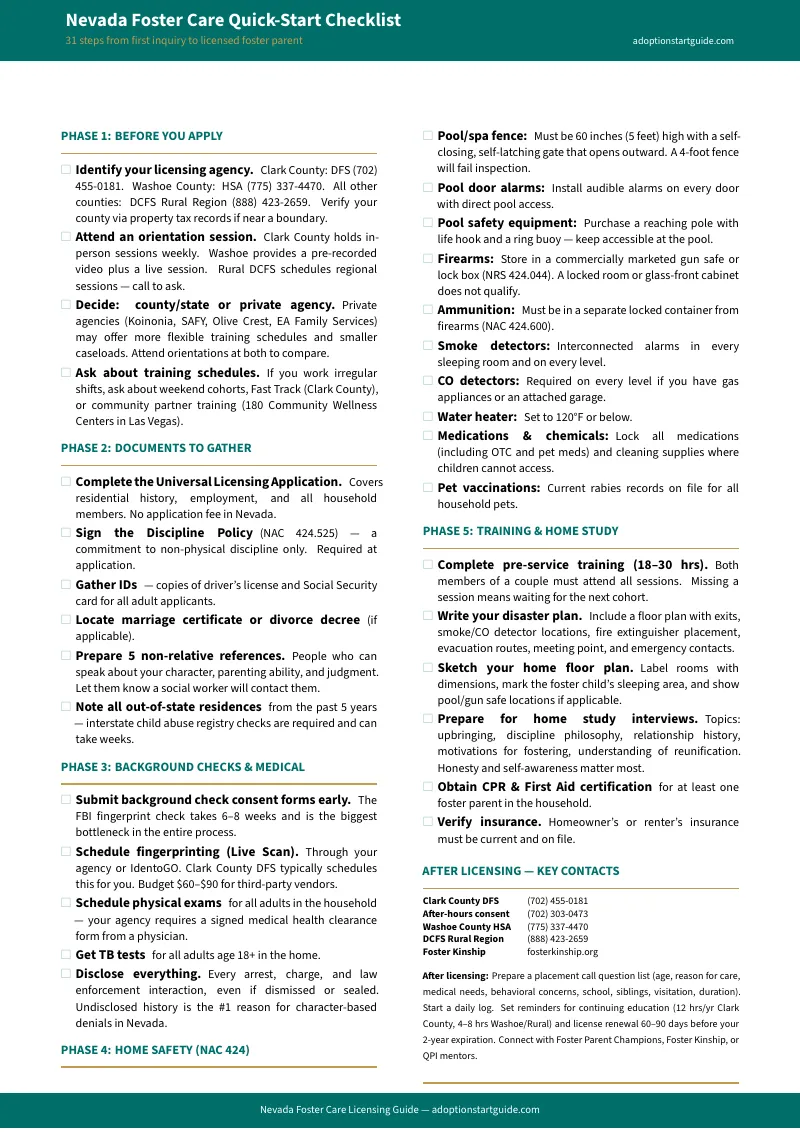
Download the Nevada Foster Care Quick-Start Checklist for a one-page overview of the licensing process, from identifying your jurisdiction through receiving your license. Free, no commitment. If you want the full guide with the Jurisdictional Routing Matrix, NAC 424 home inspection walkthrough, background check pre-screen, shift-worker training finder, financial breakdown, and printable worksheets, click the button in the sidebar.
— less than one hour with a Las Vegas family attorney
The typical Nevada applicant spends 40 to 60 hours piecing together the licensing process from three different agency websites, NAC 424 regulatory text, Facebook groups, and outdated national guides — and still doesn't know whether they applied to the right jurisdiction until weeks in. A single consultation with a Las Vegas family law firm runs $600. This guide distills the most critical decisions into a weekend-ready roadmap for a fraction of what you'd spend on parking at the courthouse. A failed home inspection because you didn't know about the reaching pole requirement delays your licensing by months. One checklist prevents that. An application submitted to the wrong agency because nobody explained the three-jurisdiction system burns four to six weeks. One routing matrix prevents that.
If the guide doesn't deliver, reply to your download email at any time for a full refund. No forms. No justification required.