You want to adopt in Manitoba. You just didn't expect a system with four separate authorities and no clear starting point.
Manitoba is the only province in Canada where your adoption process is routed through an Authority Determination Protocol before anything else happens. Not a regional office. Not a single intake number. An entire triage system that assigns your file to one of four Authorities — General, Southern First Nations, Northern First Nations, or Metis — based on "cultural appropriateness" criteria that no government website explains in plain language. If you call the wrong office first, your file can sit in transfer limbo for months before a social worker even reads your name.
And that's just the front door. Once you're inside the system, you face three fundamentally different adoption pathways — Crown Ward through the public system, private domestic through a licensed agency, and kinship adoption — each with its own costs, legal requirements, and wait times. Crown Ward adoption is nearly free and comes with ongoing maintenance payments under M.R. 21/99. Private domestic through an agency like Adoption Options starts at $15,000 and can exceed $30,000 when you add the mandatory home study, birth parent legal fees, and placement supervision disbursements. The Manitoba Adoption Resource Registry lists children waiting for permanent families, but families confuse it with the Post-Adoption Registry and end up searching for birth relatives instead of available children.
Then there's the SAFE home study. The Structured Analysis Family Evaluation is a psychological deep dive into your childhood, your relationships, your discipline philosophy, and your capacity to parent a child who has experienced trauma. Manitoba social workers are required to ask questions about your intimate relationships, your childhood punishments, and the "weak points" in your marriage. No government website tells you what the assessor is actually looking for, because the people who wrote those websites are the same people doing the assessing.
Meanwhile, approximately 91% of children in Manitoba's care system are Indigenous. The 2025 decolonization mandates and federal Bill C-92 are actively reshaping how placements work. Customary Care arrangements offer permanency for Indigenous children without severing the birth bond, but no publicly available resource explains how Customary Care Certificates interact with the Indian Act or what legal rights they provide. Non-Indigenous families feel uncertain about whether the system is even open to them. Indigenous families wonder whether formalized adoption is the right path or whether Customary Care serves their child better.
Nobody in the system is working against you. But your Designated Intake Agency's job is child protection, not applicant education. Your adoption lawyer in Winnipeg charges $300 to $400 for a consultation that mostly covers basics you could learn on your own. Licensed agencies represent the best interests of the child, which is not the same as coaching you through the process. This guide is the one resource built entirely around your perspective as a prospective adoptive parent in Manitoba.
The Four-Authority Navigator
This is a complete, Manitoba-specific adoption guide written for the current legal framework — the Adoption Act, the Child and Family Services Act as amended under the 2025 decolonization mandates, and federal Bill C-92. Not a repurposed national overview that mentions "CAS offices" as though every province works the same way. Every chapter, every checklist, every cost figure is grounded in Manitoba's unique four-authority model and the real-world experience of families who have navigated this system.
What's inside
- Four-Authority model navigation — How the Authority Determination Protocol works, which Authority covers your family, and how to avoid the file-transfer delays that cost families 12 to 24 months. The guide explains the General Authority, Southern First Nations Authority, Northern First Nations Authority, and Metis Authority in plain language, including the "cultural appropriateness" criteria and how non-Indigenous families are routed through the system. This is the step that no generic Canadian guide even acknowledges.
- Three-pathway comparison — Crown Ward adoption (nearly free with ongoing subsidies), private domestic through a licensed agency ($15,000 to $30,000+), and kinship adoption compared side by side. Costs, timelines, eligibility, realistic wait times, and the practical trade-offs. The public infant waitlist runs 8 to 10 years. The Manitoba Adoption Resource Registry has children waiting right now. This chapter prevents you from spending months researching the wrong path.
- SAFE home study preparation — What the assessor actually evaluates during the Structured Analysis Family Evaluation, the documents you need assembled before the first visit, the questions about your childhood and relationships that catch families off guard, and the attitudes that score positively versus the red flags that delay your file. The $2,800 home study fee through private licensees is the second-largest single expense in the process — this chapter makes sure you pass the first time.
- Complete cost breakdown by pathway — Every expense mapped line by line. The $525 agency registration fee. The $2,800 home study. The birth parent's mandatory independent legal counsel ($400+ per hour, often paid by the adoptive family). The $2,000 placement supervision fee. The $4,000 to $5,000 in legal fees for a private uncontested adoption. Crown Ward adoption at nearly $0. Every hidden disbursement in one place so you stop budgeting on guesses.
- Financial assistance decoded — Manitoba's adoption maintenance payments under M.R. 21/99 for permanent wards, the federal Adoption Expenses Tax Credit, and which receipts to save from day one. Most families don't learn about the M.R. 21/99 subsidy until after finalization. The guide ensures you negotiate the right rate before the paperwork is signed.
- MARR matching system explained — How the Manitoba Adoption Resource Registry actually works as a matching tool for children designated as permanent wards. The difference between MARR and the Post-Adoption Registry. How to register, what the non-identifying profiles tell you and what they leave out, and how the matching process connects families with children who are waiting now — not in 10 years.
- Customary Care and Indigenous considerations — How Customary Care provides permanency without severing the birth family bond. How Customary Care Certificates work and what legal rights they confer. How Bill C-92 affects placements involving Indigenous children. Written for both Indigenous families exploring their options and non-Indigenous families who want to understand the cultural framework they're entering.
- Court finalization walkthrough — What happens at the Court of Queen's Bench hearing, the documentation your lawyer needs, the six-month residency requirement, the post-adoption birth certificate process, and the Adult Adoption pathway for kinship families formalizing a lifetime bond. Written in plain language, not legalese.
- Child Abuse and Adult Abuse Registry guide — How Manitoba's registry checks work, why they currently take up to 12 weeks to process, and how to submit your application early so you're not stalled at the most frustrating bottleneck in the system.
Printable standalone worksheets included
The guide comes with printable standalone PDFs designed for real-world use:
- Pathway Comparison Card — Crown Ward, Private Domestic, and Kinship adoption side by side on one page. Costs, timelines, and eligibility at a glance. Print it, sit down with your partner, and make the decision that shapes everything else.
- SAFE Document Checklist — Every document your assessor needs, organized in the order they'll request them. Background checks, medical reports, financial records, reference letters, and home safety items. Bring it to your first meeting so nothing is missing.
- Manitoba Cost Map — Every expense for every pathway in one printable sheet. Take it to your financial planning conversation.
- Authority Determination Worksheet — Walk through the ADP criteria step by step so you contact the right Authority on your first call, not your third.
Who this guide is for
- Couples moving from infertility to adoption — You've spent years and thousands of dollars on fertility treatments at clinics in Winnipeg or Brandon. This guide shows you the fastest path from "considering adoption" to "adopt-ready" so you can regain some control over a timeline that has been out of your hands for too long.
- Foster parents pursuing permanency — The child in your care just received a Permanent Order of Guardianship. You need to understand the legal transition from foster parent to adoptive parent and how your existing bond with the child shapes the matching process, the court application, and the post-adoption maintenance payments you may be entitled to.
- Single applicants in Manitoba — The Adoption Act explicitly allows single adults to adopt. No legal barrier. But the SAFE home study has specific questions for solo applicants about financial stability, backup care plans, and support networks. This guide addresses those directly so you walk into the assessment prepared.
- Kinship and relative adopters — You've been caring for a grandchild, niece, or nephew during a family crisis. You assumed formalizing the adoption would be simpler because you're family. Manitoba still requires the same background checks, registry clearances, and SAFE assessment. This guide covers the "de facto" adoption process and what it means for inheritance, medical coverage, and legal security.
- Families in Northern Manitoba — Living in Thompson, The Pas, or a remote community shouldn't disqualify you from adopting. The guide addresses the reality of northern geography — the travel to Winnipeg for mandatory seminars, the social worker shortage, and the specific strategies that remote applicants use to move through a system that is designed for the south.
Why the free resources aren't enough
The Department of Families website is the primary source of truth for the Adoption Act. It's organized around case categories — AdA, CS, PA — that are meaningless to a prospective parent. It tells you what the rules are without explaining how to navigate them. It won't tell you which Authority covers your family or how to position yourself as a strong candidate in the matching process.
The General Authority and Metis Authority have separate websites with varying degrees of clarity. The Northern and Southern First Nations Authorities focus on Customary Care and child protection services, burying adoption information under "Permanency Planning" pages that few families find.
Licensed agencies like Adoption Options provide excellent services, but their information is gated behind a $1,500 education seminar. If you're in the "exploration" phase, that price point is prohibitive. And agencies represent the child's best interests, not your strategic interests as an applicant navigating costs and wait times.
Facebook groups and Reddit threads give you anecdotes — "we waited five years," "our CFS worker changed three times." They don't give you context about which pathway gets you to finalization fastest, how to prepare for the SAFE questions about your intimate relationships, or why Manitoba's four-authority system means advice from Ontario or BC families is actively misleading.
Generic Canadian adoption books are written with an Ontario or BC lens. They ignore the Authority Determination Protocol, miss the specific M.R. 21/99 financial assistance regulations, and don't account for the 12-week Child Abuse Registry processing bottleneck that stalls Manitoba applicants. Using one of those guides here is like navigating Winnipeg with a map of Toronto.
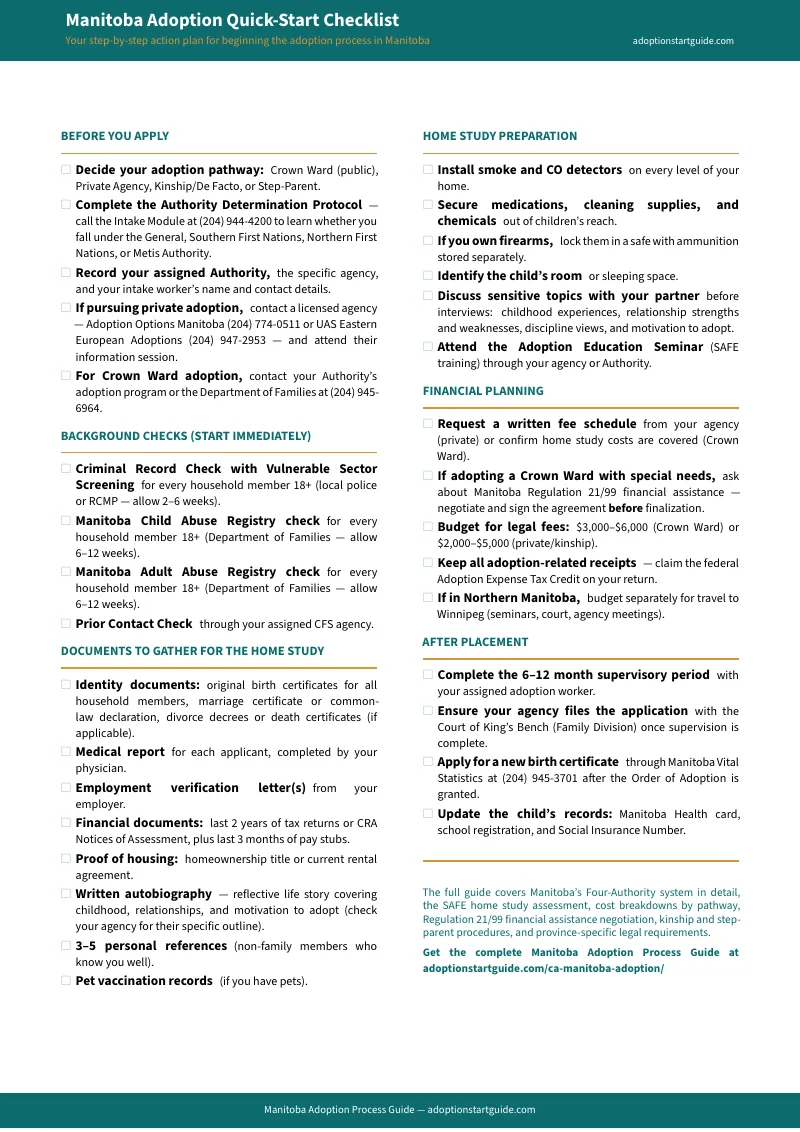
The free Quick-Start Checklist
Download the Manitoba Adoption Quick-Start Checklist for a one-page overview of the key steps from your first Authority contact to court finalization. Free, no commitment. If you want the full roadmap with four-authority navigation, pathway comparisons, cost maps, SAFE preparation, financial assistance details, and Customary Care explanation, click the button in the sidebar.
— less than ten minutes of a Winnipeg adoption lawyer's time
A single consultation with a family lawyer in Winnipeg starts at $300 to $400 per hour. Families routinely spend the first billable hour covering foundational questions this guide answers on page one. The Four-Authority Navigator doesn't replace your lawyer. It makes sure you don't pay your lawyer to explain the difference between the General Authority and the Metis Authority, or to walk you through the SAFE home study process, or to tell you that M.R. 21/99 subsidies exist. You arrive at that first consultation ready to discuss strategy, not basics.