The adoption system was built for couples. You're not waiting for one.
You've already done the late-night research. You've typed "can a single person adopt" into a search bar more times than you'd admit. You've read the agency websites that say "all family types welcome" and then noticed the stock photos are exclusively couples holding hands over a crib. You've sat through a phone call with an intake coordinator who kept circling back to your marital status as if it were a problem to solve rather than a fact about your life.
The system isn't hostile to single applicants. It's worse than that — it's indifferent. Agencies design their processes, their paperwork, their fee structures, and their timelines around two-income, two-parent households. When you show up as one person, you don't get rejected. You get routed into the same pipeline with half the assumptions working against you: home study questions that probe your dating life as if it's a risk factor, birth mother profiles that default to "married couple preferred," and financial evaluations that treat a single income as a deficiency instead of a budget you manage alone every month already.
The free resources don't help the way you need them to. Agency guides walk you through their process — the one that conveniently ends with signing their contract. The adoption books on Amazon are memoirs written by people who adopted a decade ago, before China closed its program to non-relatives, before religious exemption laws reshaped agency access in a dozen states, before digital matching platforms changed how birth mothers choose families. The Reddit threads are honest but contradictory — one person's "amazing agency" is another person's "they ghosted me after intake." You're building a plan from fragments, and none of the fragments were written for someone doing this alone.
The Solo Adopter's Playbook: Your Complete Guide to Single-Parent Adoption
This is a 15-chapter operational guide built specifically for single men and women navigating the adoption and foster care system without a partner. Not a chapter tacked onto a couples' guide. Not an inspirational memoir about one person's journey. The actual decision frameworks, agency vetting criteria, home study scripts, financial strategies, and country-by-country eligibility rules that solo applicants need — organized in the order you'll encounter them, written for the questions only single parents have to answer.
The Solo Adopter's Playbook is the system that runs through every chapter: a method for choosing between foster care, private domestic, and international adoption based on your real resources (not theoretical ones), preparing for the specific home study questions social workers ask single applicants, identifying agencies that genuinely welcome solo parents rather than tolerating them, and building the legal and financial infrastructure that a single-parent household requires from day one.
What's inside
- Agency Selection System for Solo Applicants — Not all agencies treat single parents the same. Some put you on the back burner behind couples. Some charge identical fees for fewer services. Some are genuinely invested in placing with single parents — especially in foster care, where one in three adoptions goes to an unmarried individual. This chapter gives you the specific questions to ask on your first call, what the answers reveal about how they actually treat solo applicants, and how to identify the agencies where your single status is an asset rather than a footnote.
- Home Study Preparation for Single Applicants — Social workers ask single parents questions that couples never face. "What's your plan if you start dating someone?" "Who takes the child if you're hospitalized?" "How will you provide role models of the opposite sex?" These questions are legal, expected, and deeply personal. This chapter gives you prepared, confident responses for every common question — not evasions, but answers that demonstrate the stability, self-awareness, and planning that evaluators are trained to look for. The difference between a rehearsed answer and an improvised one is visible, and preparation reads as readiness.
- Birth Mother Matching Strategy — In private domestic adoption, birth mothers choose. The fear that no birth mother will pick a single parent over a couple is the number one anxiety solo adopters report. The reality is more nuanced: some birth mothers specifically seek single parents, valuing the undivided attention the child will receive. This chapter covers how to write an adoption profile that connects with birth mothers authentically, the five things birth mothers actually evaluate when reviewing profiles, and how to present your solo status as the strength it is rather than the limitation you've been told it is.
- Three-Path Decision Framework — Foster care adoption (often free, most accessible for singles, 6-18 month timeline), private domestic infant adoption ($20,000-$50,000, 1-5 year wait, more competitive for singles), and international adoption ($25,000-$60,000, country-specific eligibility that changes every year). Each path gets its own full chapter with honest pros and cons for solo applicants — not the sales pitch from an agency that only offers one of them.
- Financial Planning on a Single Income — The federal adoption tax credit now reaches $17,280 per child (2025), with partial refundability that matters more when you're filing as a single taxpayer. This chapter covers grants specifically available to single parents, employer adoption assistance benefits (over 250 companies offer them), solo-income budgeting for adoption costs and the first year of parenting, and how to handle the financial evaluation portion of the home study without a second income to lean on.
- International Adoption Country-by-Country Eligibility — Some countries welcome single applicants. Some quietly close the door. Some have age, income, or health requirements that disproportionately affect solo adopters. This chapter maps which countries are realistically open to single parents as of 2026, including the Hague Convention requirements, typical timelines, cost ranges, and the specific restrictions you'll encounter. It also covers what changed when China ended its program — and where the alternatives actually are.
- The Village Blueprint — Every home study for a single applicant will evaluate your support network. This chapter shows you how to build the "village" that satisfies your social worker and actually sustains you through the first year: formalizing commitments from your inner circle, creating a legal guardianship plan, identifying backup childcare, and connecting with single-parent adoption support communities. Not the vague advice to "build a village" — the specific structure, documented in a way that evaluators take seriously.
- Attachment, Trauma, and Therapeutic Parenting Solo — Children who have experienced separation, neglect, or institutional care often test their new parent's limits. When there's only one of you holding the line at 2 a.m., the strategies have to be different. This chapter covers attachment challenges specific to adoption, how to manage "testing" behaviors without a partner to tag in, when to seek professional support, and the self-care infrastructure that prevents solo-parent burnout from becoming a crisis.
Printable standalone worksheets included
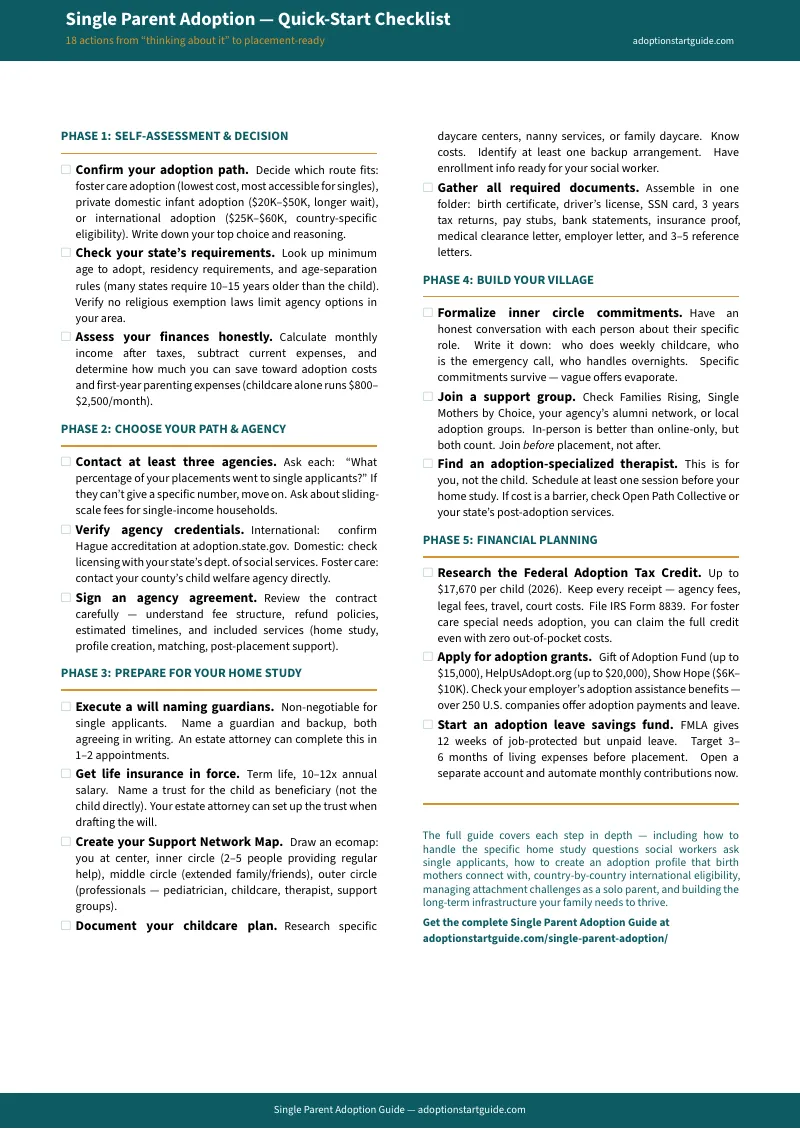
- Quick-Start Checklist — The 18-step action plan from self-assessment through placement, organized by phase. Track your progress from first decision to bringing your child home.
- Support Network Ecomap — A visual mapping tool for your inner circle, extended support, and professional resources. Fill it in before your home study and bring it to the meeting.
- Financial Planning Worksheet — Costs by pathway, tax credit eligibility, grant applications, employer benefits, and a solo-income budgeting tracker that accounts for adoption leave without a second paycheck.
Who this guide is for
- Single women considering adoption — You've hit the point where waiting for the "right partner" feels like waiting for permission you don't need. You're financially stable, emotionally ready, and tired of assembling a plan from agency brochures, outdated books, and anonymous Reddit threads. You need one resource that takes the guesswork out of the process — from choosing a path to bringing your child home.
- Single men pursuing adoption — You face a level of scrutiny that women don't. Agencies ask different questions. Birth mothers have different assumptions. The foster care system is more welcoming than private infant adoption, but the navigation is still complex. This guide addresses the specific challenges single male adopters face, directly, not as a footnote.
- Divorced individuals ready to build their family — Your marriage ended, but your desire to be a parent didn't. You're wondering whether your divorce history will affect your home study, whether agencies treat divorced applicants differently from never-married ones, and how to frame your situation in your adoption profile. This guide covers all of it.
- Anyone exploring foster care as a single person — Foster care is the most accessible adoption path for single parents. Nearly 30% of foster care adoptions go to unmarried individuals. But the emotional toll of fostering-to-adopt, the uncertainty of reunification timelines, and the behavioral challenges that older children may bring require specific preparation. This guide gives you the honest picture — not the recruitment brochure version.
Why the free resources aren't enough
Agency guides are designed to funnel you toward signing a contract with the agency that published them. They won't tell you how to switch agencies if you feel deprioritized. They won't mention that some agencies charge solo applicants the same fees as couples while providing fewer matching services. They won't explain why the agency three counties over might cut your wait time in half. Their job is to convert you into a client, not to give you the information you'd need to evaluate whether they deserve your business.
The adoption books are memoirs. Inspiring ones, often. But "Adopting On Your Own" was published before digital matching platforms, before China's program closure, before religious exemption laws became a real factor in a dozen states. "Choosing Single Motherhood" focuses primarily on donor insemination, not the specific legalities and tactics of adoption. "Now I Am Known" is a powerful story, but stories don't come with checklists, agency vetting criteria, or financial worksheets. You finish the book feeling moved. You still don't know which agency to call.
The free online resources — Dave Thomas Foundation, American Adoptions — provide step-by-step overviews. They're accurate and well-meaning. They also treat single parents as a subset of the general adoption population rather than a group with fundamentally different logistical needs. The question "How will you handle emergencies alone?" requires a different kind of preparation than "How will you and your spouse share parenting responsibilities?" A guide that doesn't distinguish between those two questions isn't a guide built for you.
The free Quick-Start Checklist
Download the Single Parent Adoption Quick-Start Checklist for an 18-step action plan covering self-assessment, agency selection, home study preparation, financial planning, and building your support network. Free, no commitment. If you want the complete guide with the Solo Adopter's Playbook, agency vetting system, home study scripts, birth mother matching strategy, country-by-country eligibility, and printable worksheets, click the button in the sidebar.
— less than one hour with an adoption attorney
The typical single prospective parent spends months researching agencies that may or may not welcome solo applicants, reading outdated books that don't reflect the current legal landscape, and piecing together home study advice from forum threads where nobody knows their state's specific requirements. This guide puts the entire process in one place — the agency vetting system, the home study preparation, the financial strategy, the birth mother matching tactics, and the country-by-country international eligibility — so you can move forward with a plan instead of a collection of browser tabs.
An agency that deprioritizes single applicants can cost you a year of waiting and thousands of dollars before you realize you should have been somewhere else. One vetting system prevents that. A home study question you weren't ready for can shake your confidence in a meeting that determines your candidacy. One set of prepared responses prevents that. A missing guardianship plan or life insurance policy can raise red flags that delay your entire process. One checklist prevents that.
If the guide doesn't deliver what you need, reply to your download email at any time for a full refund. No forms. No justification required.