You've decided to adopt in Tasmania. Then you discovered that DECYP, the Magistrates Court, and the Adoption Act 1988 each assume you already understand the other two.
Tasmania is not like other Australian states. Local infant adoptions happen in the low single digits per year -- some years fewer than five across the entire state. The Department for Education, Children and Young People (DECYP) is the sole gatekeeper to every adoption pathway, and private adoption is not an option. You cannot shop around, you cannot hire an independent facilitator, you cannot expedite the process with a lawyer. Every family enters through the same door: the Adoptions and Permanency Services intake line. And the DECYP website, which families describe as "written for departmental compliance rather than actual parents," scatters adoption information across multiple pages without ever mapping the steps in the order you actually complete them.
You've already done the research. You found the DECYP website, which explains the legal requirements in clinical language but never tells you the sequence of operations as a prospective parent. You found Legal Aid Tasmania and the Tasmanian Law Handbook, which provide solid legal summaries of the Adoption Act 1988 but offer no tactical advice on how to prepare for the DECYP assessment, how to write a non-identifying profile that birth parents actually choose, or how the 30-day consent revocation period works in practice. You found Adopt Change, which provides a helpful national overview but doesn't address Tasmania's RWVP requirements, the Magistrates Court process, or the reality that "Permanent Care" is now more common than traditional adoption. And you found Reddit threads where the prevailing sentiment is that adoption in Australia is "almost impossible" -- mixing up Tasmania's rules with Queensland's Blue Card system and Victoria's consent periods in the same conversation.
The information exists. It's scattered across the Adoption Act 1988, the Adoption Regulations 2016, DECYP fact sheets, Service Tasmania's RWVP application process, the Department of Justice's identity document requirements, the Magistrates Court practice directions, and Centacare Tasmania's limited public guidance. Piece it together yourself and you'll burn weeks reading documents that explain the rules but never tell you what to do first, second, and third as a family trying to bring a child home.
The Adoption Act 1988 Roadmap
This is a complete, Tasmania-specific adoption guide built around the problem every family in this state hits: navigating a system where DECYP controls every pathway, the Magistrates Court handles the legal orders, the Department of Justice manages the RWVP screening, and no single resource explains how these pieces connect. Not a national overview. Not a government handbook written for departmental compliance. Every chapter, every checklist, every cost figure is grounded in the Adoption Act 1988 (Tas), current DECYP policies, RWVP requirements, and the real-world experience of families who have adopted in the Apple Isle.
What's inside
- Five-pathway comparison table -- Local infant adoption, intercountry adoption through Hague Convention partners, carer adoption from foster care, step-parent adoption, and long-term guardianship, mapped side by side. Costs, timelines, eligibility requirements, and realistic availability for each pathway so you choose the right one before investing months in the wrong direction. Local adoption fees total $3,518.22. Intercountry fees reach $4,473.22 before travel. Step-parent adoption requires proving "special circumstances" that Family Court orders are insufficient. And carer adoption -- increasingly the most common domestic form -- requires an existing foster care placement. That decision deserves more than a caseworker's one-sentence summary.
- The DECYP assessment decoder -- DECYP's assessment process is described by families as "head-spinning" in its intrusiveness. Social workers evaluate criminal history, medical fitness (including mental health), financial stability, relationship quality, parenting philosophy, and your attitudes toward open adoption and birth family contact. This chapter explains what DECYP assessors are actually looking for, how to prepare for the home visits, and the difference between "performing suitability" and genuinely demonstrating it. The guide covers the specific eligibility criteria including Tasmania's age gap regulations and the factors that delay or disqualify applications.
- RWVP fast-track checklist -- Every prospective adoptive parent in Tasmania must hold a current Registration to Work with Vulnerable People before DECYP will progress their application. The RWVP process runs through the Department of Justice, requires a visit to a Service Tasmania centre, demands a specific combination of identity documents, and takes up to six weeks to process. This chapter provides the exact document requirements, the step-by-step application process, and a checklist so you complete the registration before DECYP asks for it -- not after, when the delay costs you months.
- The non-identifying profile formula -- In Tasmania's system, birth parents who make a voluntary adoption plan are actively involved in selecting the adoptive family based on non-identifying profiles. In a state of 570,000 people, families fear that "non-identifying" details -- "we live in a coastal town and work in healthcare" -- will inadvertently reveal their identity in a close-knit community. This chapter covers how to craft a profile that appeals to birth parents' values around religion, lifestyle, and parenting philosophy while maintaining genuine privacy in a small-state environment.
- The 30-day revocation navigator -- Under the Adoption Act 1988, a birth parent has 30 days after signing consent to withdraw it. During this period, the Secretary of DECYP holds legal guardianship of the child -- not you. For families, this creates an agonising limbo where a child may be in your home but you have no legal security. This chapter explains the legal framework of the revocation period, what happens if consent is withdrawn, and the emotional and practical strategies for navigating the first month of placement without losing your footing.
- The permanency gap explained -- Tasmania increasingly steers families toward Long-term Guardianship under the Children, Young Persons and Their Families Act 1997 because these orders are faster and simpler to obtain than full adoption. But guardianship does not change the child's birth certificate. It does not make you the child's legal parent. And it ends when the child turns 18. This chapter provides a side-by-side comparison of Adoption Orders, Permanent Care, and Long-term Guardianship -- the legal rights, the identity implications, the inheritance consequences, and the "18-Year Cliff" -- so you understand what each order actually gives you before you accept one.
- The Magistrates Court blueprint -- Many families believe adoption involves a high-stakes hearing in the Supreme Court. It doesn't. In Tasmania, adoption orders are made by the Magistrates Court (Children's Division), and the process is largely administrative. The Secretary of DECYP files the application on the family's behalf, and the Magistrate often makes the order based on the department's reports without a formal hearing. This chapter demystifies the court process, explains what actually happens from application to final order, and removes the "trial" anxiety that keeps families awake at night.
- Intercountry adoption dual-system guide -- If you're adopting from overseas, you must satisfy Tasmania's Adoption Act 1988 and the Australian Central Authority's requirements simultaneously. Then the partner country adds its own age, marital duration, and health criteria. The state assessment fees alone total $4,473.22, and wait times average four years nationally. This chapter maps the eligibility requirements across all three layers -- state, federal, and international -- so you know your actual eligibility before you pay a dollar.
- The fee breakdown and hardship waiver guide -- The Adoption Regulations 2016 set out a fee schedule that totals $3,518.22 for local adoption and $4,473.22 for intercountry adoption. Registration of application: $382.00. Assessment: $1,799.22. Post-placement service: $955.00. Court application preparation: $382.00. What the DECYP website doesn't prominently explain is that the regulations allow fees to be reduced or waived in cases of hardship. This chapter breaks down every fee, explains what each one covers, and provides the process for applying for a hardship waiver -- potentially saving you thousands of dollars.
Who this guide is for
- Couples and partners exploring adoption for the first time -- You may have come through years of IVF, pregnancy loss, or the quiet realisation that biological parenthood isn't your path. You've looked at the DECYP website and felt overwhelmed by a system that seems designed for compliance officers rather than parents. The guide maps your pathway before you commit to the wrong one and lose months you can't afford, especially if the 40-year age gap regulation is narrowing your window.
- Foster carers pursuing adoption from care -- The child in your home has had reunification ruled out. You want to convert your foster care placement into a permanent adoption, but you're navigating the difference between a full Adoption Order and Long-term Guardianship. The guide explains the permanency gap, the carer adoption pathway through DECYP, and the transition from carer to legal parent under the Adoption Act 1988.
- Step-parents who need legal standing -- You've been parenting this child every day. You want the same legal rights as a biological parent -- medical decisions, school enrolment, inheritance, a name on the birth certificate. But step-parent adoption in Tasmania requires proving "special circumstances" that Family Court orders are insufficient. The guide walks you through the consent requirements, the DECYP assessment, and the Magistrates Court process so one missed requirement doesn't cost you a year.
- Single applicants -- Tasmania allows single people to adopt. The eligibility criteria are the same, but the assessment emphasis on support networks and parenting capacity is different. This guide addresses the single-applicant pathway specifically, not as a footnote.
- Families considering intercountry adoption -- You want to adopt from overseas but the dual state-and-federal system feels impenetrable. The guide maps Tasmania's DECYP requirements, the Australian Central Authority requirements, and the partner country criteria in one place, so you don't discover you're ineligible after paying thousands in assessment fees.
Why the free resources aren't enough
The DECYP website covers the adoption pathways across separate pages. It explains the legal framework, the role of Centacare Tasmania as the only approved non-government agency, and the departmental contacts. But it provides no linear roadmap. Key details -- the practical RWVP application sequence, what makes a non-identifying profile compelling to birth parents, how the hardship fee waiver actually works, how the 30-day revocation period plays out in real life -- are either buried in legislation or absent entirely. Families describe the experience as "reading a legal manual for a journey that nobody has drawn the map for."
Legal Aid Tasmania and the Tasmanian Law Handbook provide rigorous legal summaries of the Adoption Act 1988. They explain the law clearly and accurately. They do not tell you the order of operations, the likely timeline, the assessment preparation that makes or breaks an application, or how to write the non-identifying profile that a birth parent will choose in a state where everyone seems to know everyone.
Adopt Change provides excellent national advocacy and a high-level overview of adoption in every Australian state. But their Tasmania page does not address the RWVP registration process, the Magistrates Court procedure, the specific fee structure and hardship waiver opportunity, the non-identifying profile strategy, or the permanency gap between adoption and guardianship. Their focus is national policy, not Tasmanian procedure.
Reddit and online forums give you emotional support and anecdotal experience. They also tell you adoption in Australia is "almost impossible," mix up Tasmania's RWVP requirements with Queensland's Blue Card system in the same thread, and offer advice based on adoption processes that changed when the 1988 Act replaced the 1968 legislation. In a state where local infant adoptions number in the single digits per year and the assessment process is profoundly personal, secondhand advice from the wrong jurisdiction is worse than no advice at all.
Printable standalone worksheets included
The guide comes with printable standalone PDFs designed for real-world use:
- Pathway Comparison Card -- All five Tasmania permanency pathways on one page. Local adoption, intercountry, carer adoption, step-parent, and long-term guardianship. Costs, timelines, eligibility, and availability for each route. Print it, sit down with your partner, and make the decision that shapes everything else.
- RWVP Registration Checklist -- The exact identity documents, application steps, and Service Tasmania requirements for obtaining your Registration to Work with Vulnerable People, organised in the order you complete them so the six-week processing time starts now, not after DECYP asks for it.
- Home Study Document Checklist -- Every document the DECYP social worker will request during the assessment, organised by category. Criminal checks, medical reports, financial records, reference contacts, and home safety requirements. Nothing missing when the assessor arrives.
- Post-Finalisation Action Plan -- New birth certificate application, Medicare enrolment, Centrelink updates, and every other administrative step after the Magistrates Court signs the final order, in sequence with contacts and processing times.
The free Quick-Start Checklist
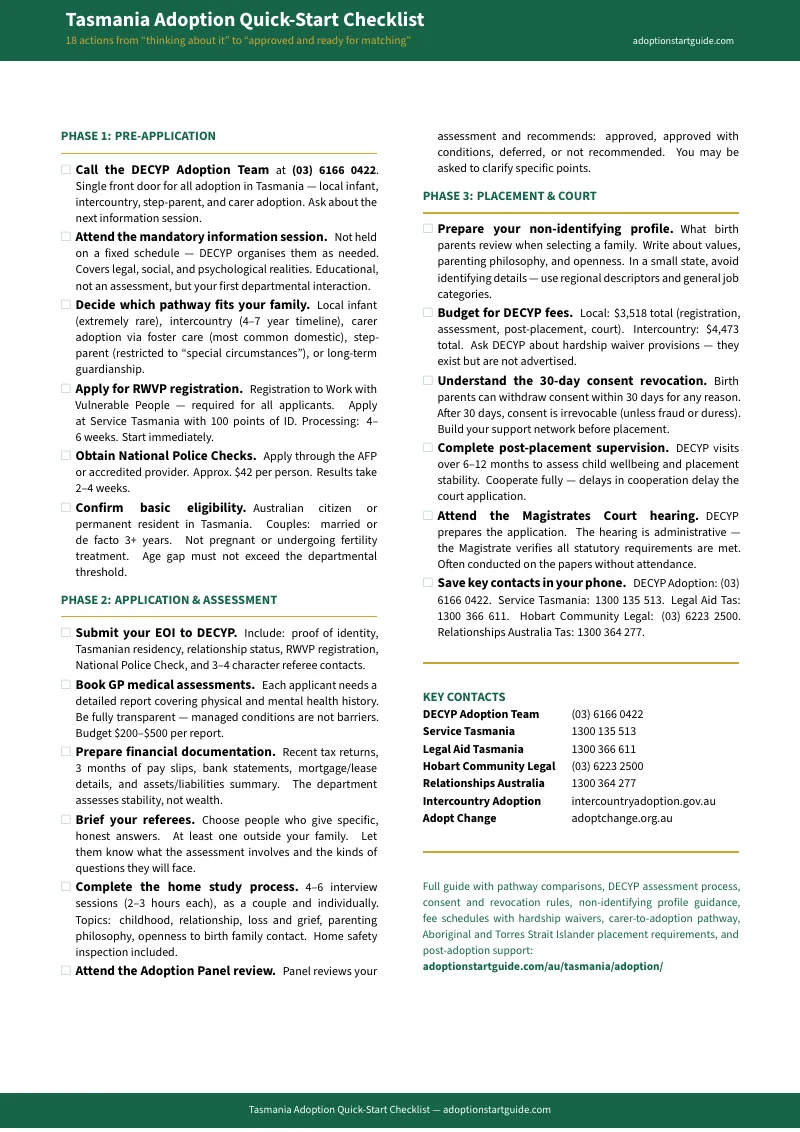
Download the Tasmania Adoption Quick-Start Checklist for a one-page overview of the key steps from first inquiry to finalisation. Free, no commitment. If you want the full guide with the five-pathway comparison, the DECYP assessment decoder, the RWVP fast-track checklist, the non-identifying profile formula, and all the printable worksheets, click the button in the sidebar.
-- less than a single hour of a Hobart family lawyer's time
The average family lawyer in Hobart charges $300 to $400 per hour. DECYP's assessment fees alone total $3,518.22 for local adoption and $4,473.22 for intercountry. Many families arrive at this process after spending $40,000 or more on IVF. The Adoption Act 1988 Roadmap doesn't replace your lawyer or your social worker. It makes sure you don't pay your lawyer to teach you the basics of Tasmanian adoption law, and it makes sure you don't learn about the RWVP requirement, the 30-day revocation period, the hardship fee waiver, or the permanency gap after it's already cost you.