You know what to say to your child about adoption. You have no idea what to say to their birth parent.
You read the books. You learned the language — "birth parent," not "real parent." "Was placed," not "was given up." You rehearsed the adoption story you'd tell your child someday, and you meant every word of it.
Then the annual update letter came due and you stared at a blank screen for forty-five minutes. Because how do you share that your daughter said her first word — "Mama" — to a woman whose grief over that word is something you can imagine but will never fully understand? How do you mention the family vacation without sounding like you're rubbing it in? How do you write something warm and authentic when every sentence feels like a landmine?
Or maybe the problem isn't the letter. Maybe it's the visit where she corrected your parenting in front of your child. The text at 10 PM asking if she can "just stop by tomorrow." The Facebook post with your child's full name and school uniform that you found because a friend sent you a screenshot. The request for money framed as "just this once." The silence that replaced the monthly calls — and the three-year-old who keeps asking when she's going to hear from her birth mother again.
Your agency taught you how to complete a home study, navigate matching, and finalize the adoption. They did not teach you how to maintain a decades-long relationship with a person you didn't choose, in a role that has no precedent, with stakes that include your child's identity and emotional health. They said "keep the lines of communication open." They didn't give you the lines.
The Communication Confidence System: Scripts for Every Conversation in Open Adoption
The Communication Confidence System is built on a simple premise from three decades of adoption research: when the parents have the right words, the hard conversations become manageable. Not easy — manageable. This guide gives you the exact words for every stage of the open adoption relationship, from the profile letter that gets you noticed to the reunion conversation twenty years later.
Twelve chapters plus eight standalone printable tools — 10 PDFs total. Word-for-word scripts you can use tonight. Letter templates you can adapt in fifteen minutes. A fillable PACA builder you can bring to your attorney. Boundary frameworks that protect your family without severing the relationship. A social media agreement ready to share with the birth family. A post-visit decompression plan for the fridge. And a developmental guide that tells you what your child understands about adoption at every age, so you never have to guess whether they're ready for the truth.
What's inside
- Post-Adoption Contact Agreement (PACA) Builder — Which of the 29+ states make PACAs legally enforceable, which treat them as voluntary good-faith agreements, and what that means for your specific situation. A fill-in template covering visit frequency, communication channels, social media terms, gift protocols, and the "evolution clause" that lets the agreement grow with your child instead of becoming a source of conflict at every milestone. Includes child consent thresholds by state for when your child reaches the age where their voice becomes part of the legal conversation.
- The Letter Template Library — Word-for-word templates for the communications that paralyse adoptive parents: annual updates that share milestones without triggering grief, holiday letters that feel personal rather than performative, difficult-news letters when the year hasn't gone well, and the dreaded first post-placement letter where you're trying to say "thank you" without reducing a human being's sacrifice to a transaction. Each template includes the phrases that build trust and flags the phrases that quietly erode it.
- Dear Expectant Parent Profile Frameworks — In a market where up to 36 families compete for every placement, your profile letter is the single most important document in your adoption journey. This chapter strips away the "cookie-cutter" agency advice and gives you frameworks for writing something that stands out because it's honest — not because it's polished. Covers what agencies actually mean by "be authentic" and what that looks like on paper.
- The Boundary Blueprint — The "Hinge, Not Wall" framework for setting limits that can flex without breaking. A green-amber-red boundary spectrum for mapping your own comfort levels. Pre-written scripts for the five conversations adoptive parents dread most: the unannounced visit, the financial request, the parenting critique, the social media violation, and the demand for more contact than you can sustain. Each script comes with the reasoning behind it, so you understand why it works and can adapt it to your situation.
- De-Escalation Scripts for Difficult Situations — What to do when a birth parent is struggling with addiction and contact becomes unpredictable. When she stops responding and your child is asking why. When socioeconomic gaps make every interaction feel loaded with unspoken tension. When a birth relative says something inappropriate in front of your child and you have three seconds to respond. Scripts that protect the relationship without sacrificing your family's stability.
- In-Person Visit Protocols — Before, during, and after frameworks for every visit format: neutral locations, your home, their home. Duration guidelines by your child's age. How to handle cancellations, no-shows, and last-minute changes when your child is already dressed and waiting by the door. And a step-by-step post-visit decompression plan for the emotional dysregulation that follows — because post-visit sadness isn't proof that openness is failing; it's proof that your child is processing something enormous.
- Social Media Agreement Template — A complete, customisable agreement covering tagging, posting photos, friend requests, direct messaging, and the "first post" conversation that needs to happen before anyone shares anything. Platform-specific privacy settings. Scripts for addressing violations after they happen — calmly, directly, and without shaming.
- Age-by-Age Identity Conversation Guide — What your child understands about adoption at each developmental stage, the questions they will ask, and honest answers that honour both families. From the toddler who doesn't yet grasp the concept through the adolescent experiencing what researchers call "genealogical bewilderment." Includes how to handle the "Why did she give me away?" question at every age — because your three-year-old needs a different answer than your thirteen-year-old.
- Foster Care Birth Family Contact — Different dynamics when the birth family includes people with histories of substance abuse, incarceration, or neglect. Safe contact protocols with five levels from direct visits to agency-mediated letters. Sibling connections. Loyalty conflicts. How to transition from state-supervised visits to a private relationship after finalisation, when the caseworker is gone and there's no one standing between you.
- Search and Reunion Scripts — When your teenager wants to find their birth family independently. How to support the search without feeling displaced. Managing expectations for reunion — the initial euphoria, the potential disappointment, and the long relationship negotiation that follows. Word-for-word scripts for the first phone call and the first meeting.
Who this guide is for
- Prospective adoptive parents drafting their profile letter or navigating the matching phase — You know the profile letter matters more than almost any other document in the process. You've seen the examples your agency provides and they all sound the same. You want to stand out because you're genuine, not because you hired a copywriter. You need a framework, not a fill-in-the-blank form.
- Newly placed families figuring out the "rules" for a relationship that has no template — The first annual update is overdue. The first visit is next month. You've been putting both off because you don't know how to strike the tone — warm enough to honour the commitment, honest enough to feel real, boundaried enough to protect your family's rhythm. You need the actual sentences.
- Parents whose open adoption has developed friction — Boundary erosion. Financial requests. Inconsistent contact that leaves your child confused. Social media violations. Parenting critiques delivered in front of your child. Your child's identity questions are getting more complex and you're not sure your answers are keeping up. You need scripts for specific situations, not general advice about "honest communication."
- Foster-to-adopt families transitioning out of state supervision — The court ordered the visits. The caseworker supervised them. Now the adoption is final and the state is gone, and you're navigating a relationship with someone who may have a complicated history — on your own, without a framework, in a parking lot. You need protocols for contact that work when there's no judge behind them.
Why the free resources aren't enough
Your agency gave you a pamphlet. It said open adoption is "a spectrum" and encouraged you to "maintain open communication." It did not tell you what "open communication" sounds like when honest communication means telling a grieving birth mother that her unannounced visits are destabilising your child's bedtime routine. It did not give you the words.
The forums are full of people in crisis sharing contradictory advice. Half will tell you that boundaries are essential; the other half will tell you that your boundaries are "adoptive parent entitlement." You'll find twelve opinions before breakfast and none of them will come with a script you can use on Tuesday night when the text arrives.
The books — Holden, Eldridge, the clinical literature — are excellent for understanding the philosophy. They'll help you develop the right mindset. They will not help you at 9 PM when something just happened and you need to know what to type right now.
Adoption-competent therapy runs $150 to $250 per session. Most families spend the first several sessions building the same communication skills this guide puts in your hands on page one. The guide doesn't replace your therapist. It means your therapy sessions focus on the deep work instead of the fundamentals.
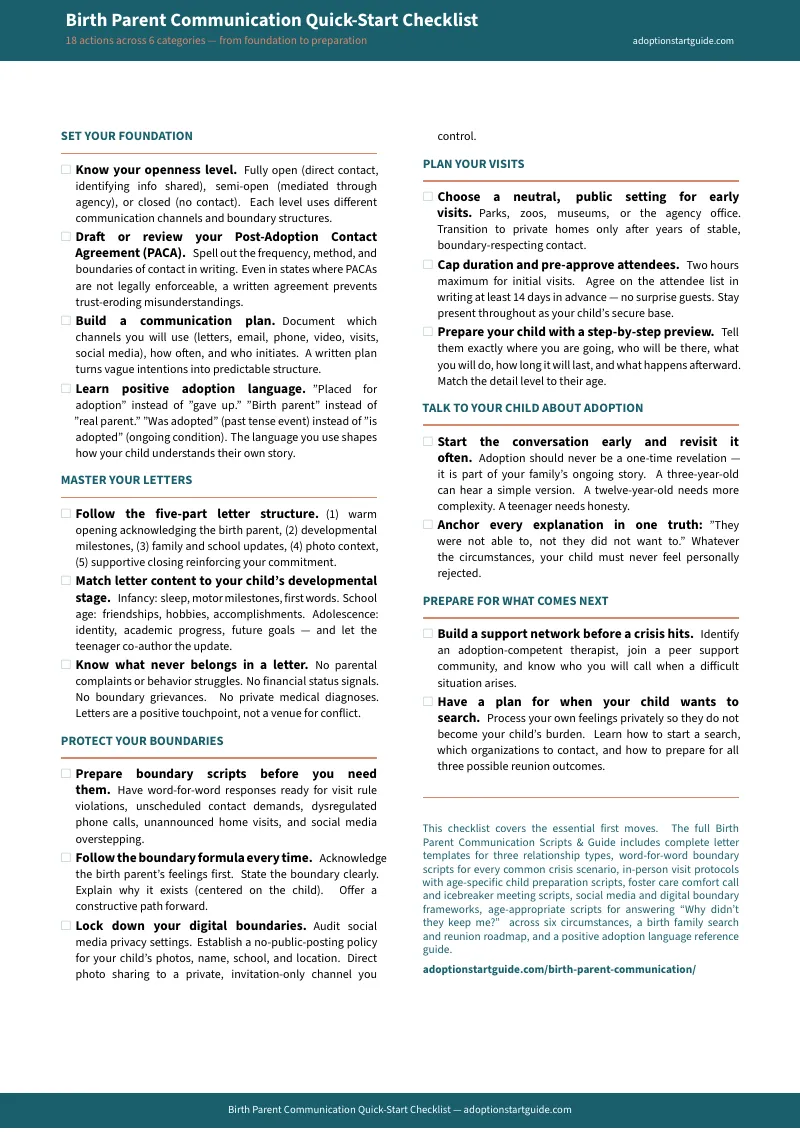
The free Quick-Start Checklist
Download the Birth Parent Communication Quick-Start Checklist for a one-page overview of the essential boundaries, letter-writing principles, and visit preparation steps. Free, no commitment. If you want the full Communication Confidence System with all twelve chapters of scripts, templates, and frameworks, click the button in the sidebar.
— less than one session with an adoption therapist
A single session with an adoption-competent therapist runs $150 to $250. The scripts, templates, and boundary frameworks in this guide cover the communication fundamentals that most families spend weeks of sessions learning. Your therapist handles the deeper emotional work. This guide makes sure you're not paying therapy rates for logistics.
If the guide doesn't deliver, reply to your download email at any time for a full refund. No forms. No justification required.