
You got the call on a Tuesday. By Thursday, you were a parent again -- with no legal authority, no financial support, and no idea what to do first.
Maybe it was CPS. Maybe it was your daughter's neighbor. Maybe it was a text from your grandson's school saying nobody picked him up. However it happened, you said yes -- because what else would you say? -- and now you are raising someone else's child with none of the paperwork, none of the funding, and none of the training that foster parents receive before a child ever walks through their door.
You cannot get him into the pediatrician because you are not his legal guardian. The school wants documents you do not have. You are spending your retirement savings on diapers and groceries for a household that doubled overnight. Your daughter calls at midnight, sometimes crying, sometimes hostile, and you do not know whether to answer. The caseworker -- if you even have one -- returns calls on their own schedule. And every time you try to research your options, you hit a wall of legal jargon written for policy analysts, not for a grandmother sitting at her kitchen table at 2 AM trying to figure out how to enroll a seven-year-old in school by Monday.
You are not a foster parent. You are not an adoptive parent. You are somewhere in between -- in the "gray area" where 2.5 million American children live with relatives who have no legal standing, no financial safety net, and no single place to find answers. You are saving the state over $10,500 per year per child that they would otherwise spend on foster care. And in return, you get a TANF child-only grant of $328 a month -- if you can figure out how to apply for it. Eighty-eight percent of kinship families never do.
The Gray Area Roadmap: Legal Authority, Financial Recovery, and a Clear Path Forward for Kinship Families
The Kinship & Relative Care Navigation Guide is the reference you open when you need to know what to do next -- not what the policy says, not what the advocacy organizations are lobbying for, but what you personally need to file, sign, call, and claim to protect the child in your home and keep your own life from falling apart.
It was built for the caregiver who does not have a caseworker. For the grandmother who is not in the system. For the aunt who took in her niece "temporarily" six months ago and still has no legal standing. For the family friend who said yes to a weekend and is now raising a teenager. The guide covers the full spectrum -- informal care, formal kinship foster care, subsidized guardianship, and kinship adoption -- so that wherever you are on that continuum, you can see exactly what your next step is and what it costs you (in time, money, and family peace) to take it.
What's inside
- The Legal Authority Ladder -- A plain-English walkthrough of every level of legal standing available to kinship caregivers: Caregiver Authorization Affidavit, Power of Attorney, temporary guardianship, permanent guardianship, and kinship adoption. Each level explains what it lets you do (enroll in school, consent to surgery, claim tax credits), what it costs, how long it takes, and when to step up to the next rung. No legal jargon. No assumptions about what you already know.
- The Financial Recovery Blueprint -- Why 88% of kinship families miss the TANF child-only grant and how to apply without triggering a review of your own income. How to claim the Child Tax Credit ($2,000 per child), the Earned Income Tax Credit (up to $7,830 for working caregivers), and the Child and Dependent Care Credit. How to apply for SSI if the child has a disability. How to access your state's Kinship Navigator program -- the federally funded one-on-one support service that most relatives do not know exists.
- The September 2023 Federal Rule -- The most significant change in kinship policy in a decade. The U.S. Administration for Children and Families now allows states to create separate, kin-specific foster care licensing standards with relaxed non-safety requirements. This means relatives who were previously denied licensure over bedroom size or square footage may now qualify for full foster care maintenance payments -- $1,622 per month instead of $328. The guide explains the rule, which states have implemented it, and exactly how to ask your agency about it.
- School and Medical Enrollment -- State-by-state requirements for enrolling a child in school without legal custody, including which states accept a Caregiver Authorization Affidavit and which require a court order. How to consent to medical care, immunizations, and mental health treatment when you are not the legal parent. What to do when the school says no and the ER asks who you are.
- Trauma-Informed Parenting for Kinship Caregivers -- Why the child in your home may hoard food, lie about small things, rage at bedtime, or push you away when you try to comfort them. The basics of attachment disruption explained for caregivers who did not grow up with parenting apps and do not need another acronym -- just an understanding of what the behavior means and what to do about it tonight.
- Managing the Birth Parent -- Scripts and boundaries for the most emotionally loaded relationship in kinship care: your relationship with the child's parent, who is usually your own child or close relative. How to handle visitation without a court order, what to do when the birth parent shows up unannounced, how to protect the child without severing the family, and how to manage the guilt of parenting your grandchild while your own child struggles.
- The Guardianship Assistance Program (GAP) -- The federal program that pays kinship guardians a monthly subsidy comparable to foster care payments while giving you full legal authority and getting the child out of the system. Available in 43 states. The guide covers eligibility, application steps, and how GAP compares to adoption in terms of rights, benefits, and finality.
- Self-Care for Aging Caregivers -- You are not 30. Your body reminds you of that every morning. This chapter addresses the health, energy, and emotional costs specific to caregivers in their 50s, 60s, and 70s -- including caregiver burnout recognition, respite care options, the grief of losing your retirement plans, and how to maintain your own medical appointments when you are scheduling three for the child.
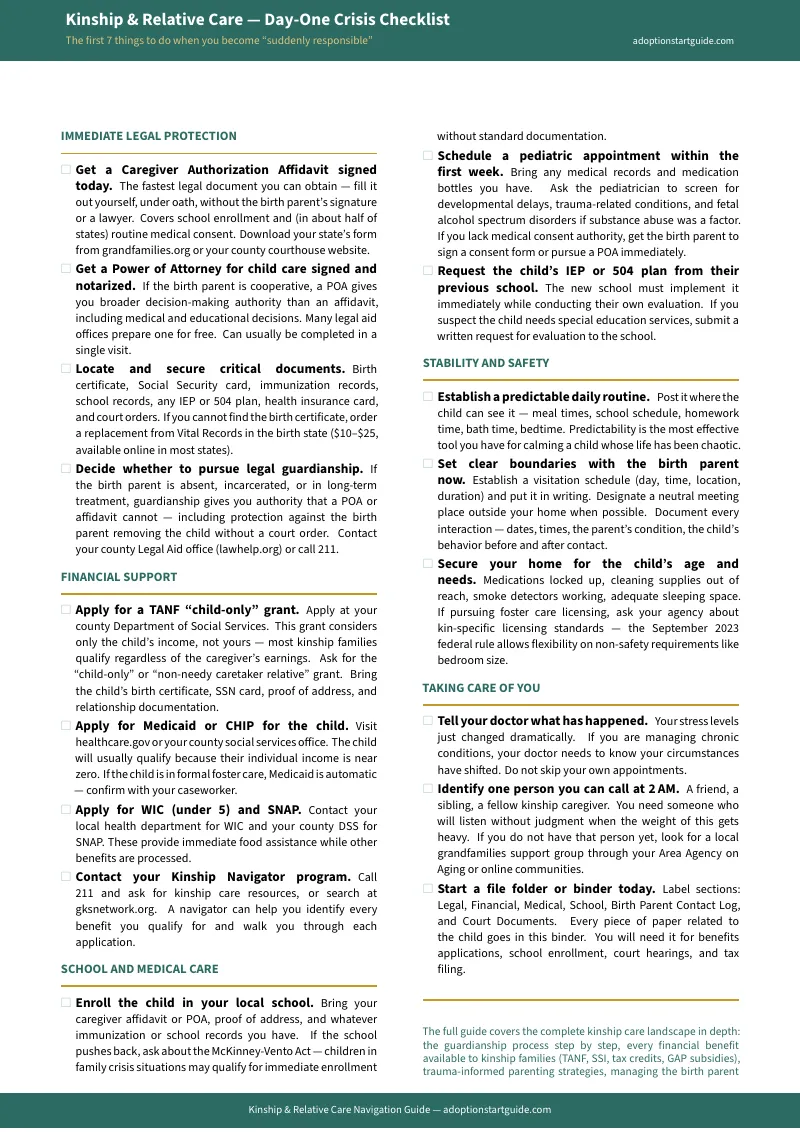
- Day-One Crisis Checklist -- A printable, step-by-step list of everything to do in your first 72 hours and first 30 days: get a Caregiver Authorization Affidavit signed, apply for Medicaid or CHIP, gather the child's documents (birth certificate, Social Security card, immunization records), enroll in school, find your state's Kinship Navigator program, and apply for TANF. Designed to go on your refrigerator.
Standalone printables you can take with you
The guide also includes six printable reference sheets -- designed to go with you to the DSS office, the school, the pediatrician, or the lawyer. Print the one you need, leave the rest for later.
- Legal Authority Ladder -- Two-page reference card showing all six levels of legal standing, what each one lets you do, what it costs, and when to step up. Includes the decision framework.
- Financial Recovery Blueprint -- All 14 financial benefits on two pages with estimated values, eligibility, and application steps. Includes a fillable benefits tracker.
- Guardianship Process Checklist -- Seven steps from filing to court order, with a documents-to-gather list and free legal help resources.
- School & Medical Enrollment -- What to bring to the school office, what authority each medical decision requires, and the laws to cite when someone says no.
- Birth Parent Boundary Scripts -- Word-for-word responses for five difficult scenarios, visitation ground rules, and a fillable documentation log.
- Resource Directory -- One-page fridge sheet with national organizations, legal aid sources, Kinship Navigator lookup, crisis hotline numbers, and online communities.
Who this guide is for
- Grandparents who are suddenly full-time parents again -- You expected retirement. You got a second round of parenting with none of the support. You need legal standing, financial help, and a clear plan -- not another 300-page book about the foster care system.
- Aunts, uncles, and older siblings stepping in during a family crisis -- Your sibling or relative cannot care for their child right now. You said yes. Now you need to know your rights, your options, and what financial help exists for relatives who are not foster parents.
- Family friends and fictive kin -- You are not related by blood, but you are the person the child trusts. The system was not built for you. This guide covers the specific legal instruments available to non-relatives providing kinship-like care.
- Informal caregivers considering formalization -- You have been caring for the child without any legal paperwork. Things are stable enough now to think about the next step -- guardianship, licensing, or adoption. The Legal Authority Ladder shows you what each option means and helps you decide whether to climb.
- Caregivers already in the formal system who feel unsupported -- You have a caseworker, but they are overloaded and you are still figuring things out on your own. The guide fills the gaps between what the agency tells you and what you actually need to know.
Why not piece it together from free resources?
You could. Generations United publishes annual reports. AARP has a caregiving section. GrandFamilies.org maintains a state-by-state legal database. Your state may have a Kinship Navigator program. These are legitimate, authoritative organizations doing important work.
The problem is that they were built for policymakers and advocates, not for you. The Generations United report is 80 pages of legislative analysis. The AARP guides cover all caregiving -- elder care, disability care, kinship care -- in broad strokes. GrandFamilies.org is a legal research tool, not a step-by-step roadmap for a grandmother who needs to enroll a child in school by Monday. The Kinship Navigator programs are excellent when they exist in your state and when you can get through the waitlist, but they are not available at 2 AM when the questions are loudest.
The books on Amazon are either memoirs (comforting but not actionable), clinical guides written for social workers (accurate but impenetrable), or general foster care manuals that mention kinship in a single chapter. None of them are built specifically for the relative caregiver who needs a checklist, a form, and a phone number -- right now.
This guide is the translation layer. The federal policy is distilled into what it means for your household. The legal options are organized into a ladder you can climb one rung at a time. The financial benefits are listed with application steps, not just eligibility criteria. One document, structured so the caregiver who has no time and no energy left can turn to the right section and find what they need in under five minutes.
Satisfaction guarantee
If the guide does not deliver what this page promises, email [email protected] for a full refund. No questions, no hassle.
-- Less Than One Day of the Support You Are Owed
A TANF child-only grant pays $328 per month -- if you know how to apply. The Child Tax Credit is worth $2,000 per child per year -- if you have the right legal standing. The September 2023 federal rule may qualify you for foster care maintenance payments of $1,622 per month instead of $328 -- if you know it exists and ask your agency about it. This guide does not replace a lawyer or a caseworker. It gives you the knowledge to make every conversation with a lawyer or caseworker more productive, and the checklists to handle the rest on your own.
Download the free Kinship Care Quick-Start Checklist to see the first 15 actions. Or get the complete guide and start building legal authority, recovering financial support, and restoring order to the life that changed with a phone call.