
A stranger is about to evaluate your home, your marriage, your childhood, and your parenting potential. You get one shot at a first impression.
You signed up. You sat through orientation. Then you got the packet — a stack of forms, a list of "requirements" written in social-worker shorthand, and a date on the calendar when someone from the agency will walk through your front door, sit on your couch, and ask you to explain the hardest moments of your life.
You turned to the internet. One blog said to deep-clean everything. A Reddit thread said they don't care about dust. A forum post from 2021 said your guns need to be in a locked safe with a trigger lock. Your state's website said something slightly different. Your agency's handout covered fire extinguishers but didn't mention pool fencing. Nobody told you what to actually say when the social worker asks why you got divorced in 2018, or what your partner should say when they're interviewed alone and asked how you handle conflict.
The stakes are real. Home studies cost $900 to $4,500 for private adoptions. A failed or delayed study means paying for updates, additional visits, or starting over. In the UK, 53% of prospective adopters say the process is so difficult they wonder if they can continue. And every month of delay is a month your child is waiting.
You don't need more blog posts. You need a system that covers every element social workers actually evaluate — the house, the paperwork, the interview, and the conversations you've been avoiding — in one place, built for families who want to walk in prepared.
The Home Study Confidence System: Preparation That Covers What Agency Checklists Leave Out
The Home Study Preparation Toolkit is a structured preparation system that works backwards from what social workers are trained to assess. Not "tips for a clean house." Not "be honest and be yourself." The actual evaluation criteria — physical safety standards, documentation requirements, interview assessment domains, and disclosure best practices — translated into checklists, scripts, and worksheets you can work through in a weekend.
The toolkit covers US, UK, Canada, and Australia requirements because the core assessment framework is remarkably similar across English-speaking countries, even though the specific regulations differ. Where requirements diverge — firearms storage in the US, Cultural Safety Plans in Australia, DBS checks in the UK — the guide flags exactly what applies to you.
What's inside
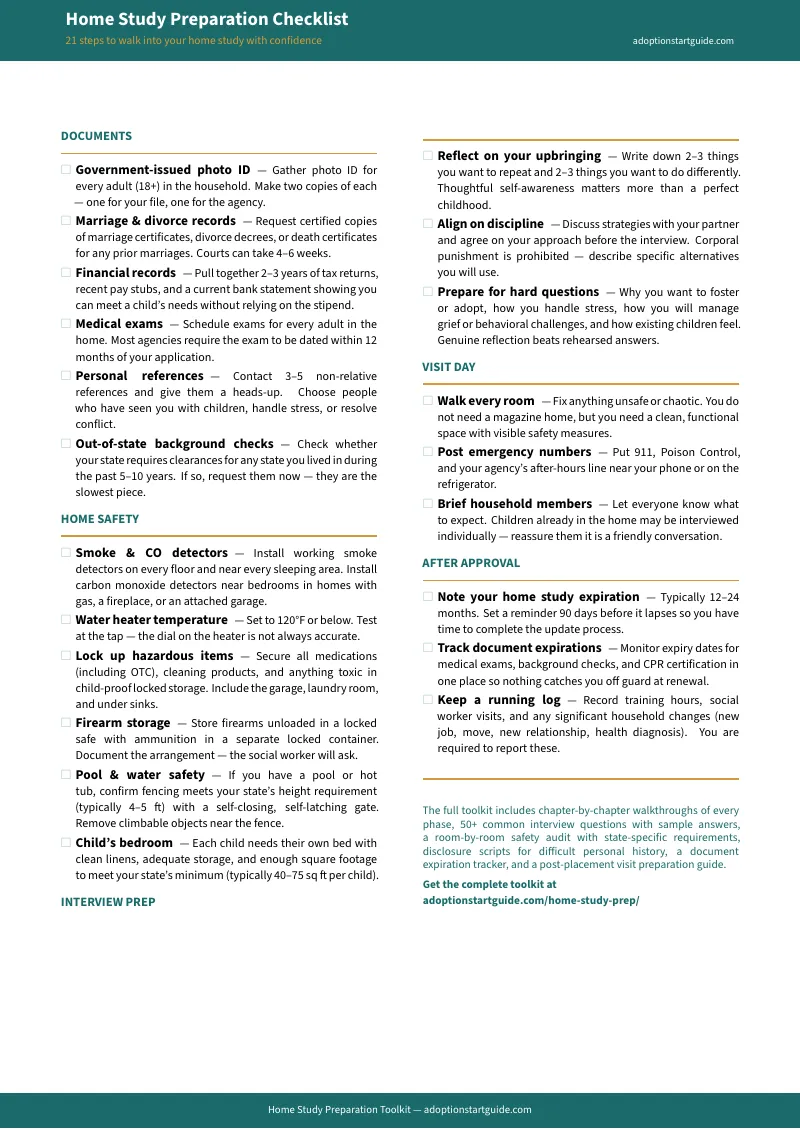
- Room-by-Room Safety Audit — Every room in your home checked against the standards social workers actually use. Not a generic "childproof your house" list — the specific items that trigger failed inspections: unsecured cleaning products under the kitchen sink, a missing lock on the medicine cabinet, fire extinguisher placement that meets code but not agency standards, carbon monoxide detector gaps, and the pool fencing requirements that vary by jurisdiction. Walk through every room with this audit and you'll spot the three things your agency checklist didn't mention.
- 50+ Interview Questions with Answer Frameworks — The real questions social workers ask in joint interviews, individual interviews, and child interviews. Not sanitised FAQ from the agency website — the questions about your childhood discipline, how you handle marital disagreement, your views on birth parent relationships, and whether you've thought through what happens when a child in your care hoards food at 2 AM. Each question comes with a framework for answering honestly while demonstrating the self-awareness and emotional readiness that social workers are trained to identify.
- The Document Tracker — Every document you need, where to get it, how long it takes to arrive, and when it expires. FBI fingerprints, state background checks, child abuse registry clearances, medical exams, financial statements, pet vaccination records, reference letters, training certificates — all mapped to a timeline so nothing expires before your appointment. Renewal families use the same tracker to catch the documents that lapsed while they were waiting for a match.
- Difficult History Disclosure Scripts — Past mental health treatment, a DUI from your twenties, a bankruptcy, a previous divorce — none of these automatically disqualify you, but discussing them badly raises flags. These frameworks are built from what social workers report they're actually looking for: evidence of growth, self-awareness, and current stability. Not a script to memorise. A structure for telling your story so it demonstrates readiness instead of triggering follow-up assessments.
- Spousal Alignment Worksheets — When couples are interviewed separately, inconsistent answers about discipline philosophy, financial management, or motivation for adopting are the single fastest way to trigger additional visits. These worksheets surface the conversations you need to have before the social worker has them for you. Covering parenting approach, division of responsibilities, extended family attitudes, and how you'll handle the specific stresses of fostering or adopting.
- Trauma-Informed Preparation Chapter — The home study doesn't just assess your house. It assesses whether you understand what you're signing up for. Social workers evaluate your knowledge of trauma-informed parenting, your expectations for the child's behaviour, and your support network. This chapter covers what "trauma-informed" actually means in the home study context, the specific behaviours (food hoarding, hypervigilance, regression, aggression) you should be prepared to discuss, and how to demonstrate readiness without sounding like you're reciting a textbook.
- Post-Placement Visit Guide — Your approval isn't the end. Social workers return for post-placement visits before the adoption is finalised — and they happen when you're sleep-deprived, adjusting to a new child, and least prepared for another evaluation. The guide covers what's assessed at each visit, how to prepare when you barely have time to eat dinner, and the documentation that should be ready before the doorbell rings.
7 standalone printables included
Every major tool in the guide is also available as a separate, printable PDF — so you can print the safety audit and walk through your house, hand the interview questions to your partner, or pin the document tracker to your binder without carrying the full guide around:
- Room-by-Room Safety Audit Checklist
- 50+ Interview Questions Reference
- Document Tracker with Expiration Dates
- Difficult History Disclosure Scripts
- Spousal Alignment Worksheets
- Home Visit Day Quick Reference
- Post-Placement Checklist
Who this toolkit is for
- First-time foster or adoptive parents facing their initial home study — You've never done this before. The agency gave you a packet, but it doesn't tell you what the social worker is really looking for, what questions they'll ask your partner in a separate room, or which safety items trip up 90% of first-time applicants. The toolkit walks you through every stage so nothing catches you off guard.
- Kinship caregivers who got the call and now need to pass a home study fast — A relative's child needs a home. You said yes. Now you have weeks, not months, to get your house, documents, and interviews ready. The toolkit gives you the same preparation structure in a compressed timeline.
- Families renewing an expired home study — Your study lapsed while you waited for a match. You need to update documents, re-pass the safety inspection, and go through another round of interviews. The Document Tracker flags exactly what's expired and what needs refreshing.
- Couples who need to get on the same page before separate interviews — You agree on the big picture. But can you both articulate your discipline philosophy, describe how you'll handle contact with birth parents, and explain your financial plan without contradicting each other? The Spousal Alignment Worksheets are built for exactly this.
- International adoption families navigating Hague Convention requirements — Inter-country home studies carry additional requirements around cultural competency plans, travel readiness, and institutionalisation awareness. Chapter 9 covers what's different and what's the same.
Why free resources leave you guessing
Agency websites tell you what to provide. They don't tell you how — how to organise 30+ documents so nothing expires before your appointment, how to answer the question about your childhood discipline without raising flags, how to prepare your existing children for their own interview, or what to do when your partner's honest answer about "why adoption" sounds different from yours.
Reddit threads give you one person's experience in one state with one agency. The advice that worked in California in 2022 may actively hurt you in Texas in 2026. Blog posts cover the "top 10 tips" without mentioning the specific fire code requirements, medication storage standards, or pool fencing regulations that actually fail inspections.
Etsy binder templates give you pretty organisational pages. They don't include interview preparation, disclosure frameworks, or the trauma-informed content that separates families who pass from families who get asked back for more visits.
This toolkit covers the entire evaluation — the physical inspection, the documents, the interview, the difficult conversations, and the post-placement follow-up — in one resource, current to 2025-2026 standards across four countries.
— less than the cost of one missing fire extinguisher that delays your approval by six weeks
A single home study runs $900 to $4,500 for private adoptions. An update or re-do after a failed inspection costs hundreds more. A consultation with an adoption social worker runs $150 to $300 per hour. The Home Study Preparation Toolkit doesn't replace your agency's process — it makes sure you don't waste your first visit discovering requirements you could have handled last weekend.
If the toolkit doesn't deliver, reply to your download email at any time for a full refund. No forms. No justification required.