You want to formalize an adoption in Nunavut. You just didn't expect a system the Auditor General calls "in crisis" with no agencies, no clear process map, and a court that flies into your community a few times a year.
Nunavut is the only jurisdiction in Canada where 93% of adoptions happen through customary practice before any legal paperwork exists. Inuit families have been raising relatives' children for thousands of years under traditions rooted in Inuit Qaujimajatuqangit. The adoption has already happened in the eyes of your community. But the federal government doesn't recognize it until you have a certificate under the Aboriginal Custom Adoption Recognition Act, and that certificate requires finding your community's Custom Adoption Commissioner, getting statements from all parties, and registering the result with the Nunavut Court of Justice. No government website walks you through this in plain language. Most families don't realize their community-recognized arrangement is invisible to the Passport Office, the Canada Revenue Agency, and NTI's beneficiary enrollment program until an administrative deadline forces the issue.
And customary adoption is only one of four pathways. Departmental adoption through the Department of Family Services handles Crown ward placements for children in permanent custody. Private domestic adoption operates under the Adoption Act with a 21-day consent revocation period. Step-parent adoption formalizes blended family arrangements. Each pathway has different legal requirements, different costs, and different timelines. There are no private adoption agencies anywhere in the territory. DFS is your only institutional resource, and the 2023 and 2025 Auditor General reports document a department with a 25% staff vacancy rate, high social worker turnover, and regional disparities where communities in the Kitikmeot or Kivalliq may have no consistent caseworker for months at a time.
Then there's the circuit court. The Nunavut Court of Justice is a single-level trial court that travels to 25 communities by plane. Iqaluit and Rankin Inlet see the court five to seven times a year. Cambridge Bay gets four visits. Smaller communities like Gjoa Haven or Arctic Bay see the court twice or three times a year. If you miss a filing deadline for one circuit visit, your adoption finalization doesn't slip by a week. It slips by three to six months, because that's when the judge next flies in. Every day of preparation you lose is measured in seasons, not business days.
Meanwhile, the home study process must account for Nunavut's housing crisis. There is no expectation that you own a four-bedroom suburban house. But social workers still need to assess your home for safety, and the assessment includes a cultural competency evaluation for non-Inuit families that no southern guide even mentions. Bill C-92 mandates that Indigenous children have a right to cultural continuity, and the home study is where that mandate becomes a concrete set of questions about language preservation, Elder mentorship, and land connection that you need to answer convincingly.
Nobody in the system is working against you. But the DFS website lists adoption types without explaining how any of them actually work step by step. Legal Aid Nunavut focuses on criminal and high-conflict family matters, and you may wait months for a consultation about an administrative process that doesn't rank as urgent on their docket. A private lawyer in Iqaluit charges $200 to $400 per hour, assuming you can find one who handles adoption. If you live outside Iqaluit, the consultation alone requires thousands of dollars in airfare. This guide is the one resource built entirely around your perspective as a family trying to formalize an adoption in the Arctic.
The Dual-Track Navigator
This is a complete, Nunavut-specific adoption guide written for the territory's current legal framework: the Aboriginal Custom Adoption Recognition Act, the Adoption Act, the Child and Family Services Act, and federal Bill C-92. Not a repurposed national overview that assumes every province has licensed agencies and a courthouse down the street. Every chapter, every checklist, every contact directory is grounded in Nunavut's dual-track system of customary law and territorial statute, the reality of a circuit court, and the experience of families who have navigated this process in a territory of 40,000 people spread across 25 communities.
What's inside
- ACARA custom adoption walkthrough — How the Aboriginal Custom Adoption Recognition Act works in plain language, from identifying your community's Custom Adoption Commissioner to gathering the required statements from biological and adoptive parents to registering the certificate with the Nunavut Court of Justice. This is the pathway that covers 93% of adoptions in the territory, and no other guide explains it step by step. You'll know exactly what the Commissioner needs from you, what the certificate means legally, and how to use it for passports, tax benefits, health cards, and school enrollment.
- Four-pathway comparison — Custom adoption under ACARA, departmental adoption through DFS, private domestic under the Adoption Act, and step-parent adoption compared side by side. Costs, timelines, eligibility, legal requirements, and the practical trade-offs between each. Many families don't realize they qualify for more than one pathway, or that the subsidized departmental route includes financial support that continues until the child turns 19. This chapter prevents you from spending months on the wrong track.
- Circuit court schedule and readiness strategy — How the Nunavut Court of Justice circuit works, how often the court visits your community, and exactly what documents must be filed before the court party arrives. The guide includes a readiness checklist calibrated to the circuit timeline so you can work backward from your community's next scheduled sitting. Miss the filing window and you wait three to six months for the next one. This chapter ensures you don't.
- Commissioner directory with communities and term dates — A compiled directory of active Custom Adoption Commissioners across Nunavut, including the communities they serve and their current appointment dates. This information is scattered across Nunavut Gazette appointments that no family has time to search. The directory tells you who to contact in Baker Lake, Kugaaruk, Rankin Inlet, Iqaluit, Pond Inlet, and other communities so you can start the ACARA process without weeks of phone calls to find the right person.
- NTI beneficiary enrollment process — How to enroll your adopted Inuit child as a beneficiary under the Nunavut Agreement through Nunavut Tunngavik Inc. The enrollment protects the child's access to wildlife harvesting rights, Inuit-specific educational benefits, and health programs. The guide walks you through the Adopted Inuit Children Application Form, the Community Enrolment Committee process, and the documentation NTI requires. Families who skip this step risk their child losing access to rights that are part of their birthright.
- Adoption subsidy negotiation — Nunavut's subsidized departmental adoption program provides monthly financial support to families adopting children from permanent custody. But subsidies are negotiated individually with the Director of Adoptions, and they must be agreed upon before finalization. Once the adoption order is signed, your leverage disappears. The guide explains the eligibility criteria, the review cycle, and how to document the financial case that gets the subsidy approved at the right level.
- Home study preparation for the Arctic context — What DFS social workers assess during the home study, how to prepare your home within Nunavut's housing realities, and the cultural competency questions that non-Inuit families must be ready to answer. The guide covers the RCMP Vulnerable Sector Check, the Interprovincial Child Protection Background check, the physician's medical report, and the autobiographical statement. It also addresses how video assessments work for remote communities where in-person visits require flying in a social worker.
- Cultural Connection Plan framework — For non-Inuit families or families adopting outside their home community, Bill C-92 requires a concrete plan for preserving the child's connection to their culture, language, and kinship ties. The guide provides a framework covering Inuktitut or Inuinnaqtun language arrangements, Elder mentorship, traditional land activities, and ongoing contact with the biological family. This isn't a checkbox exercise. It's the section of your application that demonstrates you understand what cultural continuity means in practice.
- Complete document checklist by pathway — Every form, certificate, background check, and legal filing organized by adoption type. The ACARA Statement of Custom Adoption. The NCJ Form 8B, 8C, and Form 39. The RCMP Vulnerable Sector Check. The physician's report. Birth certificates. Marriage or common-law declarations. Organized in the order each pathway requires them so nothing is missing when the court arrives or the Commissioner sits down with your file.
Printable standalone worksheets included
The guide comes with printable standalone PDFs designed for real-world use:
- Pathway Comparison Card — Custom, Departmental, Private, and Step-Parent adoption side by side on one page. Costs, timelines, eligibility, and legal requirements at a glance. Print it, sit down with your family, and make the decision that shapes everything else.
- ACARA Preparation Checklist — Every document and statement the Custom Adoption Commissioner needs, organized in the order they'll ask for them. Commissioner contact information, biological parent statements, and registration steps on one printable sheet.
- Circuit Court Readiness Tracker — A timeline worksheet you fill in with your community's next court visit dates, then work backward through filing deadlines and document preparation milestones. Designed so you can tape it to your fridge and track progress week by week.
- Cultural Connection Plan Template — A structured template for non-Inuit families or cross-community placements covering language, mentorship, land connection, and kinship contact. Fill it in before the home study so you walk into the assessment with a concrete plan, not good intentions.
Who this guide is for
- Inuit families formalizing a customary adoption — You've been raising your grandchild, your niece, or a relative's child for years. Your community recognizes the arrangement. But the Passport Office doesn't. The CRA doesn't. NTI's enrollment program requires legal documentation you don't have yet. This guide walks you through the ACARA process so you can protect the child's access to benefits, travel, and inheritance without hiring a lawyer you can't afford or find.
- Non-Inuit professionals in Iqaluit — You're a teacher, nurse, or government worker who has built a life in the North. You want to adopt a child in Nunavut, but you're acutely aware of the history of Indigenous child removal and you want to do this right. The guide provides the legal pathway under the Adoption Act and the cultural framework for honoring Inuit Qaujimajatuqangit, including the Cultural Connection Plan that the home study will evaluate.
- Long-term foster parents pursuing permanency — The child in your care has a Permanent Custody order. You want to give them a legal family, not another temporary placement. The guide explains the departmental adoption pathway, the subsidy negotiation that must happen before finalization, and the transition from foster care per diems to adoption support so you can make the financial decision with full information.
- Cross-community Inuit families — You're adopting an extended family child from a different community or region. The logistics are significant: different DFS regional offices in Baffin, Kivalliq, or Kitikmeot, different Community Enrolment Committees for NTI status, and a circuit court schedule that may require filing in a community where neither you nor the child currently lives. The guide maps the cross-regional coordination so you don't lose months to jurisdictional confusion.
- Families in remote communities — Living in Gjoa Haven, Arctic Bay, Grise Fiord, or any community outside the regional hubs shouldn't mean your adoption takes twice as long. But the court visits your community two or three times a year, and the nearest DFS office with a consistent social worker may be a flight away. The guide is designed for families who need to be their own advocates in a system that was not designed for the geography it serves.
Why the free resources aren't enough
The Department of Family Services website lists four types of adoption — Aboriginal Custom, Private, Departmental, and International — with brief descriptions of each. It tells you adoption exists. It does not walk you through how to actually complete one. There is no plain-language process map for the ACARA path. There is no explanation of how to find your community's Commissioner or what happens after the certificate is issued. The website assumes a functioning system with available social workers, and the Auditor General has documented that assumption is wrong.
Legal Aid Nunavut provides representation to eligible residents, but their caseload is dominated by criminal matters and urgent child protection hearings. An adoption application — especially a custom adoption that is administrative rather than adversarial — is not a priority. Families report waiting months for a consultation, and when they get one, the lawyer's expertise is often in court-heavy processes rather than the community-based ACARA pathway that most families actually need.
Generic Canadian adoption guides are written for provinces with licensed agencies, regional intake offices, and courthouses within driving distance. They don't mention ACARA because it doesn't exist outside Nunavut and the Northwest Territories. They don't account for the circuit court because southern courts sit year-round. They don't address NTI beneficiary enrollment because it's not relevant in Ontario or BC. Using a southern adoption guide in Nunavut is like navigating the tundra with a map of downtown Toronto.
Facebook groups and community networks give you anecdotes and emotional support, which matters. But they don't give you the Commissioner directory, the circuit court readiness strategy, the subsidy negotiation timeline, or the Cultural Connection Plan framework. They tell you someone else eventually got through the system. This guide tells you how.
The free Quick-Start Checklist
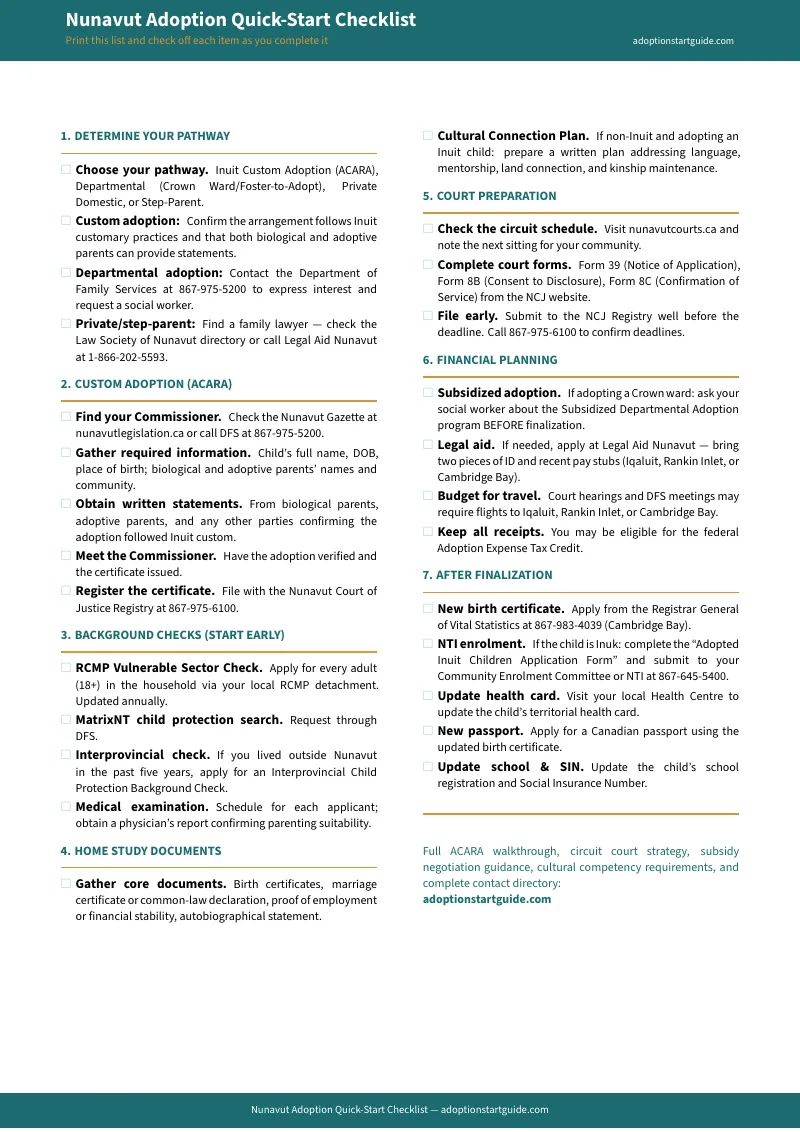
Download the Nunavut Adoption Quick-Start Checklist for a one-page overview of the key steps from identifying your adoption pathway to court finalization or Commissioner certification. Free, no commitment. If you want the full roadmap with ACARA walkthrough, circuit court strategy, Commissioner directory, subsidy negotiation guidance, NTI enrollment process, Cultural Connection Plan framework, and printable worksheets, click the button in the sidebar.
— less than fifteen minutes of a Nunavut lawyer's time, if you can even find one
A single consultation with a private lawyer in Iqaluit starts at $200 to $400 per hour. If you live outside Iqaluit, the airfare alone to get legal advice costs thousands of dollars. Families routinely spend that first billable hour covering foundational questions this guide answers on page one. The Dual-Track Navigator doesn't replace your lawyer. It makes sure you don't pay your lawyer to explain the difference between ACARA and the Adoption Act, or to tell you how to find your Commissioner, or to describe the circuit court schedule you could have looked up yourself. You arrive at that first consultation — if you need one at all — ready to discuss strategy, not basics. And for the majority of families formalizing a customary adoption, this guide may be the only resource you need.