
You Want to Foster in Quebec. The System Wasn't Built for You to Understand It.
You Googled "how to become a foster parent in Quebec." You found the quebec.ca page. It told you to contact your regional CISSS or CIUSSS. So you searched for your local CIUSSS website, clicked the English link, and got a page with three sentences and a phone number. You called. The voicemail was in French. You tried a different number. Turns out Montreal alone has five separate CIUSSS jurisdictions, and the one you called doesn't handle youth protection for your borough.
You went back to Google. The top results were guides for Ontario and BC — full of terms like "Children's Aid Society," "PRIDE training," and "Crown Ward." None of those exist in Quebec. This province runs on civil law, not common law. The agency is the DPJ, not CAS. The training program is the PFFA, not PRIDE. The home study uses Quebec's own psychosocial assessment framework, not SAFE. And the pathway to permanency goes through reconnaissance, tutelle, and Banque Mixte — concepts that don't translate because they don't have English equivalents in other provinces.
You checked Reddit. Someone in r/Quebec said to call Batshaw. Someone else said Batshaw only covers the West Island. A third person said the whole system changed after the Laurent Commission. Nobody agreed on anything, and the thread was four years old.
The Quebec Foster Care Guide is the English-language system map for Quebec's entire youth protection process. It translates the logic of the DPJ — not just the words — so you can navigate reconnaissance, training, placement, and financial support without cross-referencing five CIUSSS websites, three provincial statutes, and a French-language collective agreement.
What's Inside
The 16-Region CISSS/CIUSSS Map — Quebec doesn't have a single foster care office. It has 16 regional health authorities, each with its own DPJ intake line and its own administrative quirks. The guide maps the entire network: which institution covers your address, which ones are designated for English-language services (Batshaw, Jeffery Hale, CIUSSS West-Central Montreal), and what "designated" actually means for your application. If you're in Montreal, it breaks down the five CIUSSS jurisdictions on the Island so you stop calling the wrong office.
The DPJ's 7-Step Process in Plain English — Quebec's youth protection system follows a rigid seven-step intervention sequence: receipt of report, assessment, immediate protective measures, choice of measures, implementation, review, and end of intervention. Every foster placement exists within this framework. The guide explains each step, what the caseworker is doing at each stage, and where you fit in as the foster resource. No other English resource walks through this sequence.
Quebec's Training Program (PFFA) Explained — Forget PRIDE. Quebec uses the Programme de formation des familles d'accueil, built on a four-competency framework: committed attitude, secure family environment, personal and family balance, and ecosystem collaboration. The guide explains what each module covers, how training is delivered through your regional institution, and where English-language training is available. It also covers the mandatory First Aid and CPR certification requirement.
The Psychosocial Evaluation (Not SAFE, Not a Home Study) — Quebec doesn't use the SAFE model. It uses its own provincial assessment framework across four to five in-depth meetings with a professional evaluator. The guide breaks down what each meeting covers — values and lifestyle, marital and family dynamics, child characteristics matching, and home compliance with the 80-square-foot bedroom rule. You'll know the format before your first session, not after.
Banque Mixte, Tutelle, and Reconnaissance Decoded — These aren't just French words for English concepts. They're distinct civil law mechanisms that work differently from anything in Ontario or BC. Reconnaissance is how you become a recognized resource. Tutelle is a permanency option that grants parental authority without severing biological filiation. Banque Mixte is the foster-to-adopt pathway for children unlikely to return home. The guide explains the legal logic behind each one, including the six-month adoption placement period and the 30-day consent window under the Civil Code.
Real Compensation Rates by Age and Care Level — Quebec's financial support is a non-taxable daily rate that varies by the child's age: $26.47 per day for ages 0 to 4, up to $41.22 for ages 16 to 17. Supplements add $2.97 to $20.36 per day depending on the child's needs. The guide breaks down every tier, explains the $6.00 daily lump sum, the $5.00 personal expenses allowance, annual clothing allowances ($327 to $517), school supply supplements, and the $783 annual respite allowance. It also clarifies why you won't receive the Canada Child Benefit and what happens with Retraite Quebec's family allowance.
Your English-Language Rights Under Bill 96 — This is the section no free resource covers honestly. Bill 96 has created real anxiety among English speakers about accessing government services. The guide explains the exceptions that protect you: health and public safety provisions, acquired English-education rights, and the designated institution framework that keeps Batshaw and other bilingual centres operating in English. You'll know your legal standing before your first phone call.
Indigenous Child Welfare and Bill C-92 — Quebec's Indigenous child welfare landscape includes the Cree Board of Health (James Bay), the Nunavik regional authority, and First Nations communities asserting jurisdiction under Bill C-92. The Atikamekw of Opitciwan signed a landmark self-governance agreement in 2025. The guide explains how these parallel systems interact with the provincial DPJ and what cultural continuity requirements apply to all placements.
Who It's For
- English-speaking prospective foster parents anywhere in Quebec who need the real steps in their language, not a three-sentence webpage and a French voicemail
- Montreal families confused by five overlapping CIUSSS jurisdictions on the Island — who need to know which DPJ office covers their postal code and which ones provide English services
- Allophone families who navigate complex systems in English and need plain-language explanations of civil law concepts that don't exist in their home countries
- Couples and singles considering foster-to-adopt who want to understand how the Banque Mixte program works and what the legal pathway from reconnaissance to adoption looks like
- West Island, Eastern Townships, and Outaouais families who know English services exist in their region but can't find clear information about how to access them
- Kinship caregivers already looking after a relative's child who want to formalize their famille d'accueil de proximite status and access the daily compensation they've been missing
- Anyone who's been put off by the language barrier, the civil law complexity, or the sheer opacity of the system and wants one clear English document that cuts through all of it
Why Not the Free Resources?
The quebec.ca website lists the criteria for becoming a foster family. It does not explain the timeline, the training content, or what the psychosocial evaluation meetings actually ask. The page for "contact information for institutions" gives you 16 regional phone numbers with no guidance on which ones offer English services or what to say when you call.
The CIUSSS websites vary wildly. Batshaw (West Island) has a decent English section. The CISSS de Lanaudiere has almost nothing in English. The CISSS des Laurentides links to a generic youth protection page. If you don't already know which institution covers you, you're guessing.
Justice Quebec published a summary of the DPJ's intervention process. It's written for lawyers and policymakers, not for a parent trying to figure out whether their 10-by-10 spare bedroom meets the 80-square-foot minimum under the recognition regulation.
The FFARIQ (Quebec's foster family association) supports active foster parents. If you're still at the "thinking about it" stage, their resources assume you're already recognized and placed. And the Reddit threads? They mix Quebec-specific advice with American procedures, outdated terminology, and personal experiences from provinces that operate under completely different legislation.
The Quebec Foster Care Guide exists in the space between the phone number and the legislation. It's the document the system should give you at your first information session but doesn't.
What You Get
- The Complete Guide — Step-by-step from first inquiry through placement matching, covering the 16-region CISSS/CIUSSS map, English-language rights, eligibility, the PFFA training program, the psychosocial evaluation process, financial supports and daily rates, civil law permanency (tutelle, Banque Mixte, adoption), Indigenous child welfare, and Bill 96 protections
- Home Safety Checklist — Quebec-specific items aligned with the recognition regulation and the Quebec Fire Safety Act: smoke detectors, CO detectors, fire extinguisher, locked medication storage, 80-square-foot bedroom with exterior window, and pool fencing requirements (1.2m fence compliant by September 2027)
- First Placement Arrival Checklist — Fillable form for capturing the child's RAMQ card, medical history, emergency contacts, authorized visitor list, and the signed service determination form required within 72 hours of arrival
- Daily Log Template — Track behaviours, health observations, medications administered, family contact, school feedback, and incidents — this is a professional journal your CISSS/CIUSSS expects as part of the clinical record
- Training Log — Track PFFA modules and ongoing professional development hours, including First Aid/CPR certification renewal dates
— Less Than 5 Minutes with a Youth Protection Lawyer
A consultation with a lawyer specializing in youth protection in Quebec runs $200 or more per hour. The guide covers the legislative framework (LPJ, Civil Code, Bill 96), your English-language rights, the complaint mechanisms (Protecteur du citoyen, Commission des droits de la personne et des droits de la jeunesse), and the civil law provisions that affect your daily life as a foster parent — for a fraction of one billable hour.
Every purchase includes free updates as provincial policy changes. When Quebec updates its daily compensation rates, revises the PFFA curriculum, or amends the recognition regulation, your guide stays current.
Start with the free checklist
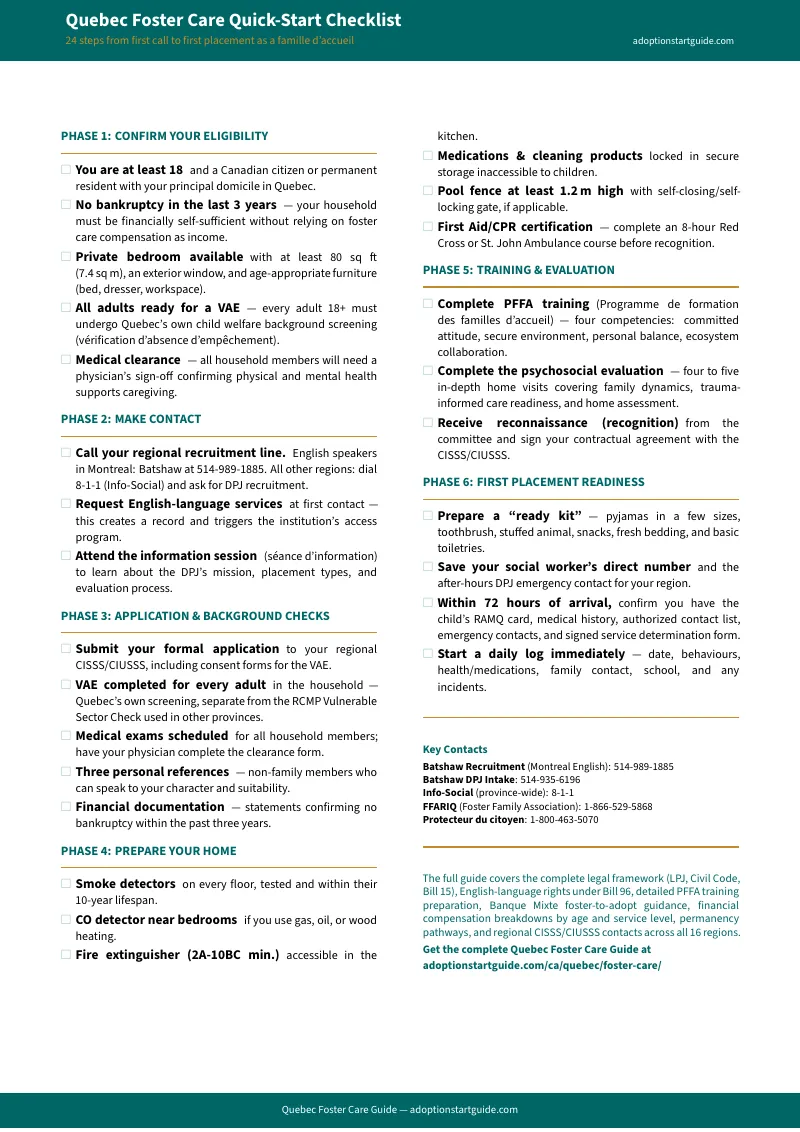
Not ready to commit? Download the Quebec Foster Care Quick-Start Checklist — a step-by-step action plan covering the key phases of the application process, with guidance on identifying your CISSS/CIUSSS and the documents you'll need to gather. It's the fastest way to see what's ahead before you invest in the full guide.