You said yes to open adoption. Nobody told you what happens after the first visit.
You agreed to openness because the agency said it was best for the child. The research backed them up. You meant it — you wanted your child to know where they came from, to have access to their story, to never feel like a piece was missing.
Then the birth mother posted a photo of your child on Facebook without asking. Or she texted at 10 PM wanting to "just stop by." Or she didn't show up for the visit your three-year-old had been talking about for two weeks, and you spent the rest of the night holding a child who doesn't have the words for what they're feeling but has all the feelings anyway.
Or maybe the problem isn't dramatic. Maybe it's the slow creep — the gift that's a little too expensive, the comment that's a little too parental, the request for money framed as "just this once" that you know won't be once. You want to say something. You don't know how to say it without blowing the whole relationship up. So you say nothing, and the resentment builds, and now the openness you chose for your child's sake is something you dread.
Your agency prepared you for the home study, the matching process, and the legal finalization. They did not prepare you for the relationship that comes after — the one that has no job description, no precedent in your life, and no off switch. The one where you're supposed to co-exist with the person your child also belongs to, indefinitely, with love and boundaries and grace, while nobody gives you a script for any of it.
The Boundary Blueprint: A Relational Framework for Open Adoption
The Boundary Blueprint is the operating manual for the relationship your agency didn't train you for. It's built on a single insight from the Minnesota Texas Adoption Research Project — the longest-running longitudinal study on open adoption outcomes: when the parents aren't confused, the children aren't confused. Your child's peace depends on your clarity. This guide gives you that clarity.
The core framework is the Contact Clarity System — a structured approach to defining, communicating, and evolving the terms of your open adoption relationship across four levels of openness: Fully Open, Semi-Open, Information Only, and Kinship Open. Each level has its own communication protocols, boundary templates, and safety indicators. You don't pick one level forever. You learn how to move between them as the relationship — and your child — changes.
What's inside
- The Contact Agreement Builder — A step-by-step process for drafting a Post-Adoption Contact Agreement that actually works. Which states make PACAs legally enforceable, which treat them as voluntary good-faith commitments, and why the distinction matters less than you think. Includes fill-in templates for visit frequency, communication channels, social media terms, gift protocols, and the "evolution clause" that lets the agreement grow with your child instead of becoming a source of conflict at every birthday.
- The Script Library — Word-for-word responses for the conversations that keep you up at night. What to say when the birth parent asks for money. How to address a social media boundary violation without shaming. How to re-initiate contact after a period of silence. How to tell a birth parent that visits need to be less frequent — or more structured — without making them feel punished. Fourteen scripts, each mapped to a specific scenario from real adoptive family experiences.
- The Post-Visit Decompression Protocol — Your child is dysregulated after visits. They're clingy, or angry, or hyperactive, or withdrawn. This isn't a sign that openness is failing — it's a sign that your child is processing something enormous. This chapter gives you a structured emotional regulation toolkit: what to say in the car on the way home, how to create a "landing ritual," when to let them talk and when to just be present. Based on the developmental reprocessing research that shows short-term dysregulation after visits actually correlates with better long-term identity outcomes.
- The Naming and Titles Framework — What your child calls the birth mother matters. What the birth mother calls herself matters. What you call her in front of your child matters most of all. This chapter eliminates the "territory war" over names and titles with a clear protocol based on the child's developmental stage. Covers first-name usage, "Tummy Mommy" and its problems, the "two mothers" conversation at school, and how to handle it when the birth parent introduces herself as "Mom" to your child's friends.
- The Safety Spectrum — Openness is not all-or-nothing. When a birth parent is struggling with addiction, incarceration, or mental health crises, you don't have to choose between full access and slamming the door. This chapter maps five levels of safe contact — from direct visits to mediated letters through the agency — and gives you clear criteria for when to move up, when to move down, and how to pivot to contact with stable birth-relatives (grandparents, siblings, aunts) when the birth parent themselves is temporarily unsafe. Includes red flag indicators and the specific language to use when you need to pull back without permanently closing the door.
- The Financial Request Buffer System — Money is the fastest way to corrode an open adoption relationship. This chapter covers the "Agency Shield" (redirecting financial requests to your adoption counselor), the "Non-Cash Pivot" (offering specific provisions instead of cash), and the legal boundaries around financial assistance that protect both families. Includes the specific phrases that say no with compassion and without guilt.
- The Identity Bridge — Your child will ask "Why did she give me away?" before they can understand the answer. This chapter covers the age-by-age conversation framework for talking about adoption, birth family, and identity — from toddler-appropriate language through the adolescent identity crisis that adoption researchers call "genealogical bewilderment." Includes how to gather and share birth family medical history, cultural heritage, and the personal story that belongs to your child.
- The Holiday and Milestone Playbook — Birthdays, Mother's Day, the first day of school, graduations. Every milestone is a potential flashpoint in an open adoption. This chapter gives you a framework for deciding which events include the birth family, how to set expectations in advance, and how to handle the emotional weight of celebrations that carry loss for someone in the room.
Printable standalone worksheets included
- Contact Agreement Template — Fill-in PACA template covering visit frequency, communication channels, social media terms, gift boundaries, and the evolution clause. Print it and bring it to your next conversation with your agency or attorney.
- Post-Visit Decompression Checklist — One-page reference for the car ride home and the first two hours after a visit. Behavior on the left, response on the right. Laminate it.
- Openness Level Assessment — A structured self-assessment to determine which of the four openness levels fits your current situation, with indicators for when it's time to adjust.
- Age-by-Age Conversation Guide — Key phrases and developmental considerations for talking about adoption and birth family at each stage: toddler, early childhood, school age, pre-teen, and adolescent.
Who this guide is for
- Hopeful adoptive parents who just matched and are terrified of getting the relationship wrong — The expectant mother wants visits twice a month and you said yes because you were afraid saying anything else would cost you the match. You need a framework for negotiating contact terms that honor everyone — before the placement happens and the power dynamic shifts.
- Families in the first two years of placement who are figuring out the "rules" in real time — The first visit went fine. The third one went sideways. You don't have a template for this relationship because no relationship in your life has ever looked like this. You need structure — not theory, not "just communicate openly," but actual protocols for the specific situations you're facing.
- Parents whose open adoption has hit a maintenance-stage wall — Your child is school-age now. The birth parent missed the last three visits. Or the birth parent wants more contact than you agreed to. Or your child is asking questions you don't know how to answer. The arrangement that worked when your child was an infant doesn't work anymore, and you need a way to renegotiate without starting a war.
- Foster-to-adopt families transitioning from state-managed contact to a private relationship — The court ordered visits. The caseworker supervised them. Now finalization is done and the state is gone, and you're standing in the parking lot of a McDonald's trying to figure out how to have a relationship with this person on your own terms. You need a framework for contact that doesn't have a judge behind it.
Why the free resources aren't enough
Your agency gave you a pamphlet about openness. It said open adoption is "a spectrum" and encouraged you to "communicate honestly." It did not tell you what to do when honest communication means telling a grieving birth mother that her unannounced visits are destabilizing your child. It did not give you the words.
The adoption forums are full of people in crisis. Half of them will tell you to set firm boundaries; the other half will tell you that boundaries are "adoptive parent entitlement." You'll find twelve contradictory opinions before breakfast and none of them will come with a framework you can actually use on Tuesday night when the text arrives.
Adoption-competent therapy is excellent — and runs $150 to $250 per session. Most families need months of sessions before they develop the relational skills this guide puts in your hands on page one. The guide doesn't replace therapy. It makes sure you're not paying a therapist to teach you the fundamentals.
The Boundary Blueprint sits in the gap between all of these. Professional. Balanced. Built on the research. And structured enough that you can open it at 9 PM when something just happened and find the script you need before the situation gets worse.
The free Quick-Start Checklist
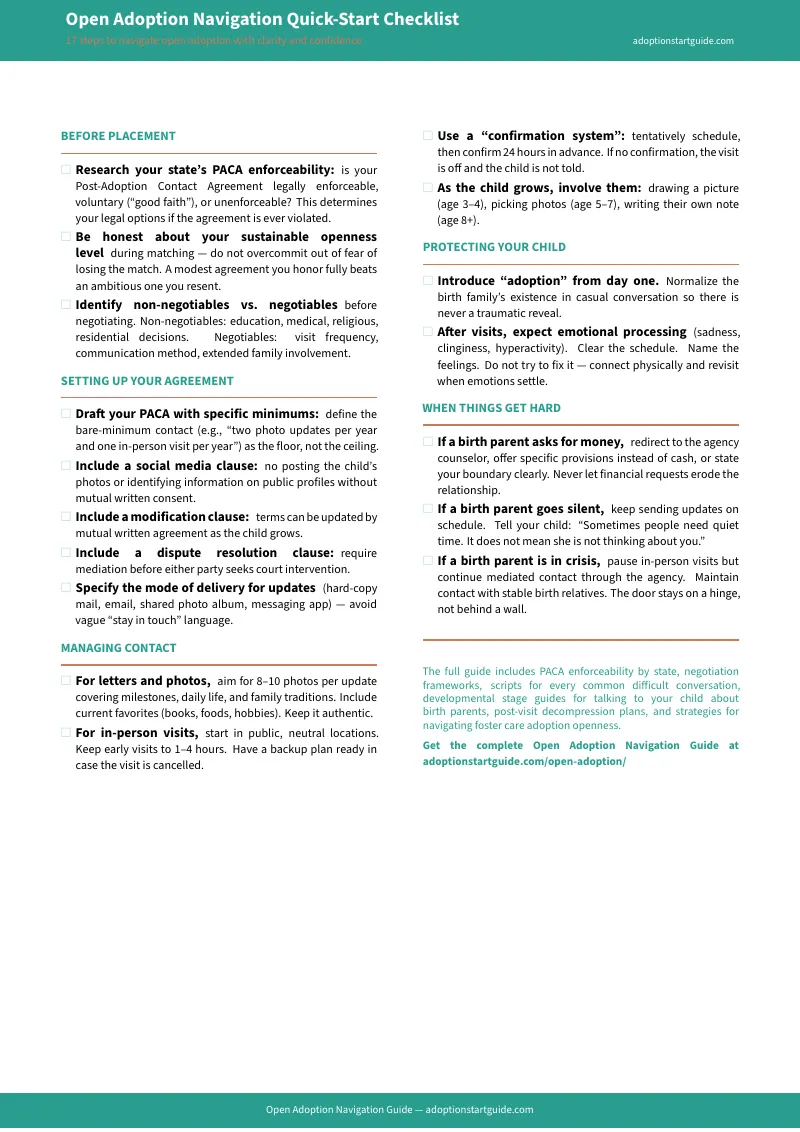
Download the Open Adoption Quick-Start Checklist for a one-page overview of the key boundaries, conversation starters, and contact-level assessment. Free, no commitment. If you want the full Boundary Blueprint with the Contact Agreement Builder, Script Library, Post-Visit Decompression Protocol, Safety Spectrum, and all four printable worksheets, click the button in the sidebar.
— less than one session with an adoption therapist
A single session with an adoption-competent therapist runs $150 to $250. Most families spend the first several sessions working through the same boundary-setting and communication fundamentals that the Boundary Blueprint covers in structured, ready-to-use form. The guide doesn't replace your therapist. It means you don't spend your therapy sessions on logistics.
If the guide doesn't deliver, reply to your download email at any time for a full refund. No forms. No justification required.