
You read the books. You took the training. You did everything right. And your child still screams "I hate you" at bedtime, rages over a broken crayon, and acts like a stranger to the family who chose them.
You knew adoption would be hard. You did not know it would feel like this.
The honeymoon ended weeks or months ago. Now your mornings start with defiance and your evenings end with meltdowns that leave you shaking. You have tried time-outs, reward charts, consequences, reasoning, begging. Nothing works. Traditional parenting advice does not just fail with your child -- it makes things worse. And nobody around you understands why, because at school or at church or at Grandma's house, your child is perfectly charming.
You are pouring love into a child who pushes it away. You are trying to bond with someone whose brain was wired to reject the very thing they need most. And the darkest part -- the part you cannot say out loud -- is that some days you feel nothing. Not angry. Not frustrated. Just empty. You wonder whether something is wrong with you, whether you made a mistake, whether this will ever feel like the family you imagined.
There is a clinical term for what you are experiencing. It is called blocked care -- a neurobiological shutdown that happens when a parent's empathy circuits are overwhelmed by chronic rejection. Up to 30% of adoptive parents also experience Post-Adoption Depression, a condition that society barely acknowledges because adoptive parents are expected to feel nothing but gratitude.
You are not broken. Your child is not broken. But traditional parenting was built for children who already trust their caregivers -- and your child's brain has not gotten there yet.
The Survival-Mode Parenting Guide: Scripts, Strategies, and Self-Repair for When Love Is Not Enough
This is not another book about attachment theory. This is the field manual you open at 3 AM when your child is in crisis and you have nothing left.
The Post-Adoption Support & Attachment Guide was built for exhausted parents who have already read the theory and need to know exactly what to say, exactly what to do, and exactly how to keep themselves from falling apart in the process. It covers the neuroscience in plain language -- just enough to understand why your child's brain works differently -- and then gives you the practical scripts and daily strategies that translate that science into something you can use tonight.
The guide is structured so you never have to read it cover to cover. In active crisis? Go straight to the crisis chapter. Child just came home? Start with daily routines. Traditional parenting stopped working? Start with the scripts. Struggling emotionally? Start with the chapter on parental self-care -- because your nervous system is the primary therapeutic tool in your child's healing, and it needs maintenance before it can do its job.
What's inside
- Why Your Child's Brain Works Differently -- The "smoke detector" that never turns off, the three-story brain model, the difference between "being safe" and "feeling safe," and why your child's stress response system produces outsized reactions to small triggers. Just enough neuroscience to understand the behavior -- no jargon, no overwhelm.
- Age-Specific Attachment Indicators -- What attachment difficulties actually look like at every stage from infant to adolescent, including the ADHD misdiagnosis trap (trauma-affected children are three times more likely to be misdiagnosed with ADHD) and when to suspect RAD versus DSED.
- Scripts for the Heat of the Moment -- Word-for-word phrases for when your child screams "I hate you," lies about something obvious, rages over something small, pushes you away, hurts a sibling, hoards food, or melts down at bedtime. Each script comes with the explanation of what the behavior actually means and why the script works.
- The PACE and CAPPD Frameworks -- Two practical models you can memorize and use in real time. PACE (Playfulness, Acceptance, Curiosity, Empathy) for daily interactions. CAPPD (Calm, Attuned, Present, Predictable, Don't Escalate) for crisis moments. Five words to remember when you cannot remember anything else.
- Time-Ins, Re-Dos, and Choices -- Why time-outs reinforce your child's deepest fear (abandonment when they are difficult), and three replacement strategies that maintain boundaries while building trust. Includes step-by-step instructions for each technique.
- The Parent as Healing Agent -- Post-Adoption Depression screening, blocked care recognition and recovery, secondary traumatic stress management, the physiological sigh (the fastest evidence-based calm-down technique), the cold water reset, the 5-4-3-2-1 grounding method, and the tag-out protocol for when you are about to lose it. This chapter treats your well-being as infrastructure, not luxury.
- Evidence-Based Therapy Comparison -- TBRI, DDP, Theraplay, EMDR, and Child-Parent Psychotherapy compared side by side: what each does, who it works best for, and how to access it. Plus red flags for dangerous "attachment therapies" to avoid and the five questions that reveal whether a therapist actually understands adoption.
- School Advocacy and Education Support -- IEP and 504 plan request templates, specific classroom accommodations to ask for, what to tell the teacher (and what you do not owe them), trauma-sensitive school evaluation checklist, and how to handle adoption-insensitive assignments like family trees and baby photo projects.
- Birth Family Connections and Life Story Work -- How to navigate open adoption contact, create a life book, manage loyalty conflicts, and talk about birth parents in ways that heal rather than harm. Includes scripts for the hardest questions your child will ask.
- Crisis Management -- Safety planning, what to do during violent episodes, when to call for help, and adoption disruption prevention. Written for the parent who is standing at the edge and needs someone to say: this crisis is not the end of the story.
- Printable Quick-Reference Scripts -- A one-page sheet of the most critical scripts, designed to be cut out and posted on your fridge for 3 AM access.
Who this guide is for
- Parents in the first year of placement -- You are past the honeymoon phase and the testing behaviors have started. Traditional parenting is failing and you need a different framework before things escalate further.
- Families in active crisis -- Your child is violent, your home is no longer peaceful, and you are searching for answers at midnight. The crisis chapter gives you a safety plan and the scripts chapter gives you something to say right now.
- Parents experiencing emotional shutdown -- You feel flat, empty, or detached from your child. You might be experiencing blocked care or Post-Adoption Depression. This guide names what is happening and gives you specific steps to address it.
- Families navigating school problems -- Your child holds it together at school and falls apart at home, or they have been suspended, expelled, or misdiagnosed. The education chapter gives you the advocacy tools and accommodation requests to get the right support in place.
- Parents who have read the books but need the "what to say" version -- You have read The Connected Child or Beyond Consequences and you understand the philosophy. What you need now is a quick-reference playbook of scripts and strategies you can use in the moment without rereading 300 pages.
- Foster-to-adopt families, international adoptive families, kinship caregivers, and transracial adoptive families -- Attachment disruption and trauma responses do not vary by adoption type. This guide works across all pathways because the neuroscience is the same.
Why not piece it together from free resources?
You could. The Attachment & Trauma Network has articles. Reddit has threads from parents who have been where you are. Your agency probably gave you a reading list. TBRI has online modules. There are books -- many of them excellent -- that explain the science of attachment and trauma.
The problem is not a lack of information. The problem is that you are too exhausted to synthesize it. You are reading 300-page books at midnight between meltdowns, trying to translate theory into something you can actually say when your child is throwing chairs. You are scrolling Reddit threads from three years ago that may or may not reflect current clinical thinking. You are watching TBRI webinars that teach the philosophy but do not give you the exact words to use when your child spits at you and says they want their "real mom."
This guide is the translation layer. The science is distilled into plain language. The strategies are distilled into scripts. The therapy options are compared in one place. The self-care is treated as mandatory, not optional. One document, structured so the parent who has no time and no energy left can turn to the right page and find what they need in under two minutes.
Satisfaction guarantee
If the guide does not deliver what this page promises, email [email protected] for a full refund. No questions, no hassle.
-- Less Than One Hour of Therapy
A single session with an adoption-competent therapist runs $150 to $250 per hour -- and the waitlist is often months long. This guide does not replace therapy. It gives you the strategies to use in the months between sessions and the frameworks that make each session more productive. It covers what most parents spend their first three therapy appointments learning: why traditional parenting backfires, what the behavior actually means, and what to do instead.
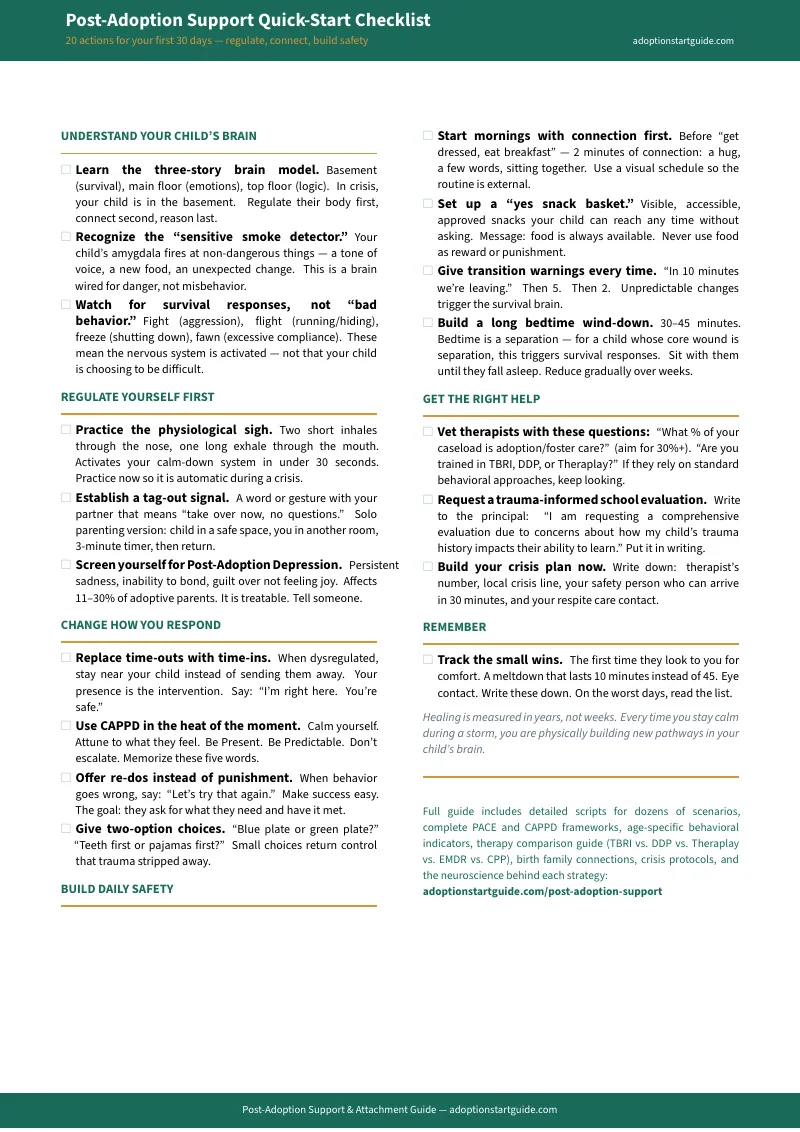
Download the free Post-Adoption Support Quick-Start Checklist to see the first 18 actions. Or get the complete guide and start changing how your family responds to crisis tonight.