
You Felt the Pull. Then the Fear Arrived.
You saw a child's face on a photolisting — maybe a seven-year-old with cerebral palsy who loves puzzles, or a sibling group of three whose caseworker mentioned "some behavioral concerns" without explaining what that means for your Tuesday evening.
Something in your chest said yes. And then your brain started running scenarios.
Will this destroy my marriage? What happens when the behaviour escalates and traditional parenting doesn't work? Can my other kids handle it? What does "prenatal substance exposure" actually look like at age eight? Will we go broke paying for therapy that insurance won't cover?
You've searched. You've found two kinds of content: inspirational stories that skip the hard parts, and Reddit threads so bleak you close the tab and wonder if you're making a terrible mistake.
Neither gives you what you actually need — a clear-eyed operational plan.
The Placement Readiness System
The Special Needs Adoption Guide is built for the gap your agency training never filled. It's structured around the real sequence: financial architecture first (because sustainability isn't optional), then diagnosis-specific parenting strategies, then school advocacy, then the daily systems that keep your family intact when things get hard.
This isn't a feel-good book about "love is enough." It's the manual that shows you exactly how the subsidy system works, why traditional discipline backfires with trauma-affected children, and what to demand in your Adoption Assistance Agreement before you sign it.
What's Inside — and Why It Matters
The complete guide plus 8 standalone printables — worksheets, reference cards, and one-page teacher handouts you can bring to meetings, hand to caregivers, or post on your fridge.
Subsidy Negotiation Worksheet — because the first offer from your caseworker is almost never the best one. Title IV-E Adoption Assistance, state supplemental programs, Medicaid continuation, the Federal Adoption Tax Credit (up to $17,280), non-recurring expense reimbursements — mapped step by step so you can negotiate from knowledge, not hope. Includes a fillable worksheet with AAP rate tables, the 4-step negotiation process, expense tracker, and an Adoption Assistance Agreement checklist to bring to your caseworker meeting.
Diagnosis-by-Diagnosis Parenting Strategies — RAD (Reactive Attachment Disorder), FASD (Fetal Alcohol Spectrum Disorder), prenatal drug exposure, complex developmental trauma, and the "invisible" disabilities agencies describe with euphemisms. For each diagnosis: the clinical reality, the parenting approach that works, the approach that backfires. Plus standalone one-page RAD and FASD quick references designed to hand directly to your child's teacher or caregiver.
Pre-Adoption Medical Review Checklist — how to read a referral document like a clinician instead of a terrified parent. Which details require a specialist consult (and which are common institutional care artefacts that resolve with family placement). How to find an adoption medicine physician at University of Minnesota, CHOP, or Tufts and what a $550–$950 pre-adoption review actually reveals. Includes a standalone checklist with the post-arrival lab screening table and pediatrician evaluation criteria.
IEP vs. 504 Comparison Card + Classroom Strategy Sheet — your child has a legal right to a Free Appropriate Public Education. This section shows you how to trigger the 60-day evaluation timeline with one written request, how to distinguish an IEP from a 504 Plan, what "least restrictive environment" means in practice, and how to document everything so the district can't stall. Comes with a standalone IEP vs. 504 comparison card for school meetings and a one-page trauma-informed classroom strategy sheet ready to photocopy for every teacher.
First Year Home Roadmap — felt safety setup checklist, the honeymoon-to-testing timeline explained, co-regulation steps for meltdowns, sensory regulation strategies, and daily routine essentials. The standalone roadmap is designed to print and post on your fridge as a daily reference during the transition period.
Respite Care & Support Team Planner — how to find and vet respite providers, build a support team before you need one, and recognise the warning signs of burnout in yourself and your partner. Includes a fillable contact sheet, special time schedule for existing children, and a family safety plan. The families who last aren't the ones who tough it out — they're the ones who build systems before the crisis hits.
Who This Is For
- Families browsing the photolisting — you've felt the pull but need to understand what you're actually signing up for before you call the caseworker
- Foster parents facing permanence — your foster child's status changed to "adoptable" and you need the financial and legal roadmap for the transition
- Matched families who feel underprepared — PRIDE training covered "special needs" in a single afternoon and you're about to parent a child with FASD, RAD, or a trauma history spanning their entire life
- International adoptive families — incomplete health records, institutional care effects, and referral documents in unfamiliar clinical frameworks
- Families who already adopted and are struggling — the honeymoon ended, behaviours escalated, and your insurance-covered therapist doesn't understand attachment trauma
Why Free Resources Fall Short
The information exists — scattered across state DCFS policy manuals, academic journals, adoption forums, special education law blogs, and agency handouts written to meet compliance requirements, not to prepare you for what actually happens.
State subsidy rates are buried in documents designed for caseworkers. FASD parenting strategies live in research papers behind paywalls. IEP rights are explained on sites that never mention adoption-specific complications. The Connected Child gives you attachment theory but not the financial architecture. Agency training gives you licensing hours but not the diagnosis-specific strategies.
The problem isn't a lack of information. It's that assembling it yourself takes months of research — months you don't have when a caseworker is waiting for your answer by Friday.
This guide pulls the financial, medical, legal, and behavioural pieces into one operational framework. One download. One read. Then you act.
Our Guarantee
Read the guide. Work through the checklist. If it doesn't give you the clarity and confidence you need to make your next decision — whether that's saying yes, requesting more information, or deciding this particular child isn't the right match for your family — email us and we'll refund your purchase. No questions, no justification required.
Less Than a Single Therapy Co-Pay
Adoption-competent therapists charge $150–$250 per session. Most insurance plans don't cover them. Agency training courses run $240+ for packages that cover a fraction of what's in this guide.
For , you get the complete financial playbook, diagnosis-specific strategies, IEP templates, and transition roadmap — the resource you reach for at 11 PM when your child just had their worst night yet and you need to know whether this is normal, what to do right now, and who to call tomorrow.
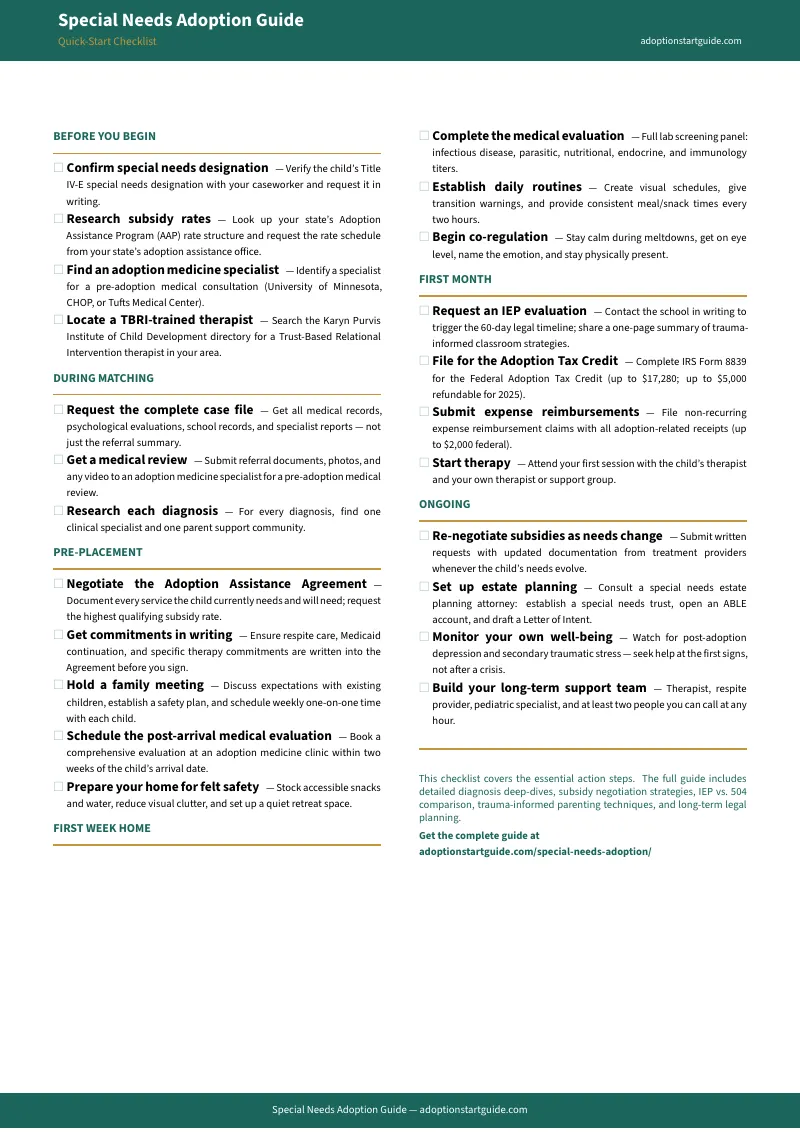
The free checklist gives you 20 action items to start tonight. The full guide gives you the system to sustain your family for years.