You want to foster a child in Delaware. The state's own website has "Coming Soon" where the Foster Parent Portal should be.
You went to kids.delaware.gov and found the Division of Family Services foster care page. It told you about information sessions, background checks, and PRIDE training. It also told you to use the Foster Parent Portal and the Background Check Request Portal. Both links say "Coming Soon." They've said "Coming Soon" for months. You're ready to start. The system isn't ready for you.
So you tried calling the DFS office at 1825 Faulkland Road in Wilmington. You were told to attend the next monthly information session. You asked when that was. The answer depended on which county you live in. You live in New Castle but work in Philadelphia. You asked whether your Pennsylvania employment affects your Delaware license. The person on the phone said they'd need to transfer you. You waited. Nobody picked up.
Then you looked into the background check. Delaware requires an SBI fingerprinted check, an FBI check, and a Child Protection Registry check. You found the IdentoGO website to schedule digital fingerprinting, but it lists dozens of service codes for different Delaware agencies. The code for "Foster Parent - DFS" isn't on the main list. If you pick the wrong code, your prints get routed to the wrong division. You won't find out for weeks. You'll pay again and start over.
Meanwhile, you learned that PRIDE pre-service training is 30 hours spread over multiple sessions. You live in Sussex County. The training sessions are in Georgetown or Dover. That's a significant drive each way, scheduled during hours that conflict with your work. Nobody has published the full schedule in one place. You're supposed to piece it together by calling DFS and Prevent Child Abuse Delaware separately. If you miss a session, you wait for the next cycle.
You asked a Facebook group whether to go through DFS directly or a private agency like Children & Families First or Children's Choice. Half the group said DFS, half said private. Nobody explained which agencies actually hold state contracts for foster care placement versus which ones only handle adoption. Nobody mentioned that private agencies may charge upfront fees that DFS does not. The advice was sincere, contradictory, and unverifiable.
The First State Licensing Blueprint: Your Complete Delaware Foster Care Guide
This guide is built for how the Delaware foster care licensing process actually works in 2026 -- the Division of Family Services regulations under 9 DE Admin. Code 201, the three-county operational reality, the IdentoGO fingerprinting system specific to DFS, the 30-hour PRIDE curriculum managed by Prevent Child Abuse Delaware, the home study requirements that apply in this state and no other, and the board rate structure that most public resources still show at 2009 levels. Every chapter reflects current Delaware law, the Diamond State Health Plan coverage for foster children, and the county-by-county logistics that differ between Wilmington, Dover, and Georgetown. It is not a generic fostering handbook with "Delaware" in the title. It is the operating manual for this state's system.
What's inside
- DFS vs. Private Agency Decision Framework -- Delaware has two paths to licensure: directly through the Division of Family Services (high volume, state-managed) or through a contracted private agency (specialized support, different timelines). The guide identifies which agencies hold current DFS contracts for foster care placement, which ones focus only on adoption, and what each path means for your training schedule, caseworker ratio, and placement timeline -- so you don't commit to an agency that can't actually place state foster children with you.
- Background Check Walkthrough with IdentoGO Service Codes -- Delaware requires an SBI check, an FBI fingerprinted check, and a Child Protection Registry screening. If you've lived outside Delaware, you also need an out-of-state registry check from every state you've resided in during the past five years. For New Castle County residents who work in Pennsylvania or New Jersey, this means coordinating multi-state clearances that can triple your wait time if not handled in the correct sequence. The guide provides the exact IdentoGO service code for "Foster Parent - DFS," explains the SBI 212B online submission process, and walks you through the timing so your clearances arrive together instead of stalling in sequence.
- 30-Hour PRIDE Training Navigator -- The pre-service training requirement is 30 hours across ten IHS Foundation Modules, managed through Prevent Child Abuse Delaware. Each module requires an 85% passing score. The guide maps training availability across all three counties, explains the five post-licensing training levels (from Caregiver's Voice and CPR through Crisis De-escalation), and identifies which sessions tend to fill first and which offer the most flexible scheduling -- so Sussex County families don't drive to Dover for a session that was already full.
- Home Study Preparation with 9 DE Admin. Code 201 Standards -- The home study involves at least two home visits and interviews with every household member. The guide decodes the physical standards from regulatory language into a room-by-room walkthrough: separate beds for each child, separate rooms for children over age one of the opposite sex, firearms and ammunition in separate locked storage, alcohol secured, working carbon monoxide and smoke detectors, safe drinkable water (including the well-water testing protocol for Sussex County homes), and plumbing in good working condition. Know what the inspector checks before they walk through your door.
- Delaware Board Rate Tables (2024-2026 with COLA Adjustments) -- Most free resources still reference the 2009 payment schedule. The guide includes current Individual Sponsor Rates, Personal Needs Allowances, child-specific daily clothing and incidental allowances by age bracket, the one-time Initial Clothing Payment, and the infant "Baby Rate." It explains the Level of Care (LOC) and GFT rate structure, current COLA adjustments, and what these payments actually cover -- because board payments are reimbursements for the cost of care, not income, and your household must demonstrate financial stability independent of these funds.
- Diamond State Health Plan (DSHP) Navigation -- Every foster child in Delaware receives medical coverage through the Diamond State Health Plan. The guide explains how DSHP coverage works from day one of placement, what it covers (medical, dental, behavioral health, prescriptions), how to access care before the child's Medicaid ID card arrives, and what to do when a provider or pharmacy doesn't recognize the DSHP foster care category.
- County-by-County Logistics -- New Castle County applicants dealing with cross-state employment and the Wilmington DFS office. Kent County families navigating the administrative proximity to Dover headquarters without the assumed processing speed. Sussex County residents managing the geographic distance to Georgetown training centers, well-water testing requirements, and the rural-coastal divide in available support services. Each county's specific friction points addressed with specific solutions.
- Visitation Host Protocol and Placement Readiness -- Delaware's Visit Host policy allows designated individuals to supervise family visits in lieu of a caseworker being present. The guide explains how this affects your home privacy and scheduling after placement, what the Visit Host guidelines require, and how to prepare your household for the reality of supervised visits -- something most orientation materials skip entirely.
Who this guide is for
- New Castle County professionals and commuters -- You work in Philadelphia or across the state line in New Jersey, but you're building your family in Delaware. You need to know how your out-of-state employment affects background checks, which DFS office handles your application, and how to coordinate multi-state clearances without adding months to your timeline.
- Kinship caregivers who just got the call -- DFS placed your grandchild, your niece, or a family friend's child with you. You have a limited window to complete licensing requirements and you need to know which forms to file, what the income threshold is for kinship care, and what training grace periods apply to relatives -- tonight, not after weeks of phone calls.
- Kent County families near Dover -- You live near the state capital and assumed proximity to DFS headquarters would make things faster. It doesn't. The bureaucratic silos are the same. You need the step-by-step process that the DFS trifold brochure doesn't provide and the "Coming Soon" portal can't deliver.
- Sussex County rural and coastal families -- You're making a significant commitment to drive to Georgetown or Dover for every training session and DFS appointment. The guide maps the logistics so you can plan childcare, work schedules, and travel around mandatory sessions instead of discovering conflicts after you've already enrolled.
- LGBTQ+ families building through foster care -- Delaware's non-discrimination protections make it one of the most welcoming states for LGBTQ+ foster parents. The guide addresses dual licensing requirements, how the home study handles same-sex couples, and the specific Child Protection Registry and suitability checks so you enter the process with clarity, not anxiety.
- Foster-to-adopt families -- If adoption is part of your long-term plan, the guide covers concurrent planning, how Delaware handles the transition from foster care to adoption, and the ICPC process if you're working across state lines -- because many Delaware families interact with the Pennsylvania and New Jersey systems whether they planned to or not.
Why the free resources fall short
The DFS website at kids.delaware.gov publishes the legal framework and a trifold brochure. It also has placeholder links for the Foster Parent Portal and Background Check Request Portal that have said "Coming Soon" for months. The Delaware Foster Parent Association provides community support for already-licensed parents but has no pre-service navigation tools. Facebook groups offer real-time advice that is sincere, emotional, and frequently wrong -- particularly on board rates, where people regularly cite the 2009 payment schedule as current. Private agencies like Children & Families First and Children's Choice provide personalized support, but only for their own recruitment pipeline -- they don't explain the DFS direct path or compare it honestly to the agency path.
National foster care books describe a generalized process that doesn't account for Delaware's three-county DFS structure, the IdentoGO service code specific to "Foster Parent - DFS," the 30-hour PRIDE curriculum managed by PCAD, the well-water testing protocol for Sussex County, the Visit Host policy, or the cross-state background check coordination that New Castle County commuters face. A book written for Texas or Florida won't tell you that the DFS office at 1825 Faulkland Road handles walk-ins differently than phone inquiries, or that your Kent County application processes through the same bottleneck as the state capital's administrative offices.
The free Quick-Start Checklist
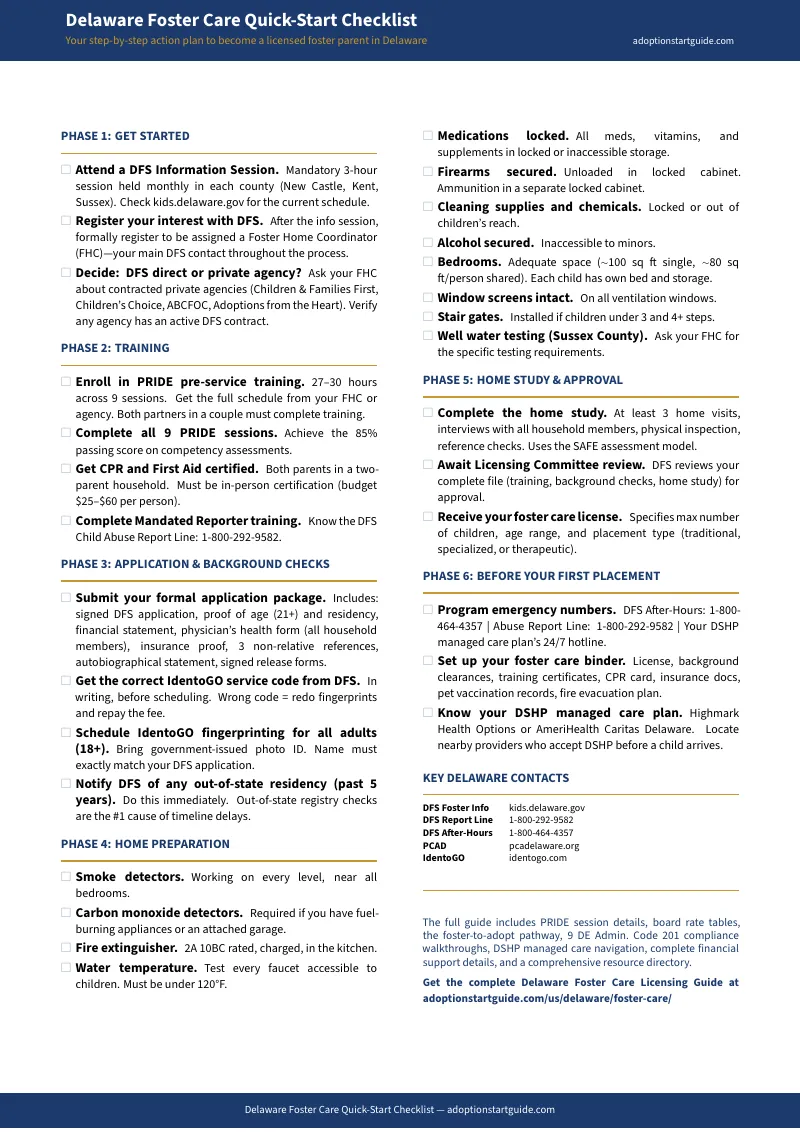
Download the Delaware Foster Care Quick-Start Checklist for the essential actions that move you from first inquiry to moving through the DFS system -- including the home safety items and document requirements that cause the most delays in the state. Free, instant download, no commitment. If you want the full guide with the DFS vs. agency decision framework, the background check walkthrough with IdentoGO codes, the PRIDE training navigator, the home study standards decoded from 9 DE Admin. Code 201, the 2024-2026 board rate tables, Diamond State Health Plan navigation, county-by-county logistics, and the Visit Host protocol, click the button in the sidebar.
-- less than the gas for one round trip to Dover
One wrong IdentoGO service code costs you weeks and a second fingerprinting fee. One missing out-of-state clearance from Pennsylvania or New Jersey adds months to your timeline. One failed home inspection because nobody told you about the well-water testing protocol or the separate ammunition storage requirement means rescheduling around the DFS inspector's calendar, not yours. This guide puts the entire Delaware foster care licensing process in your hands for less than what a Sussex County family spends driving to Georgetown for a single training session. Families who understand the system before they enter it call the right office on the first try, pass the home study on the first visit, and walk into their first placement prepared.
If the guide doesn't deliver, reply to your download email within 30 days for a full refund. No forms. No justification required.