Florida privatized its entire child welfare system, criminalized adoption advertising, and built a consent process with no take-back window. This guide makes sure none of that catches you off guard.
You started researching adoption in Florida and immediately hit the wall. The DCF website gave you a list of Community-Based Care agencies and told you to call your local one. You called, got voicemail, and when someone finally called back, they explained the foster-to-adopt track — which is not what you were looking for if you want to adopt a newborn. You Googled "private adoption Florida" and found agencies quoting $30,000 to $60,000 without explaining why. You found an attorney in Miami charging $450 per hour. You found a Facebook group where someone mentioned posting about wanting to adopt and another member warned them that is literally a crime in Florida. You searched for "Florida adoption advertising law" and found §63.212 — a statute that makes it a second-degree misdemeanor, per day, for any unlicensed person to publish or broadcast an adoption advertisement. Including social media. Including your personal Instagram story.
And then you discovered there is no "change of mind" period. In many states, a birth mother has days or weeks to reconsider. In Florida, under §63.082, once consent is signed before two witnesses and a notary — which can happen as early as 48 hours after delivery — it is binding and irrevocable. There is no cooling-off window. No court-ordered waiting period. The finality is absolute.
Meanwhile, you learned that Florida runs its child welfare system differently from every other large state. DCF does not manage foster care cases directly. Sixteen Community-Based Care lead agencies — each a separate nonprofit — handle the day-to-day operations across the state's judicial circuits. The quality, responsiveness, and wait times vary dramatically from one CBC to the next. Families in Miami-Dade work with Citrus Family Care Network. Families in Jacksonville work with Family Support Services of North Florida. The process on paper is the same. The experience on the ground is not.
An adoption attorney in Miami charges $350 to $600 per hour. In Tampa and Orlando, $250 to $450. Every hour you spend asking "What is the Putative Father Registry?" or "Can I post on Facebook about wanting to adopt?" or "What happens if the birth father surfaces?" is an hour billed at rates that add up before the real legal work even begins. Private adoptions in Florida run $30,000 to $60,000 through an agency and $20,000 to $45,000 independently. Foster-to-adopt costs families little to nothing — but you still need to understand the system well enough to negotiate the Adoption Assistance subsidy before finalization, because once the judge signs the decree, the state has no obligation to negotiate.
This guide does not replace your attorney. It makes sure you need fewer billable hours of one.
The Chapter 63 Protection System: Your Complete Florida Adoption Roadmap
This guide is built around the legal structure Florida families actually navigate — Chapter 63 of the Florida Statutes, the privatized CBC system, the specific traps that catch unprepared families, and the financial realities that vary by judicial circuit. Every chapter reflects current Florida law, the 2024-2025 legislative changes including SB 558 (Post-Adoption Contact Agreements) and DCF's Adoption Transparency reporting requirements, and the operational differences between Florida's 16 CBC lead agencies. This is not a national adoption handbook with the state name swapped in. It is the operational layer between what DCF posts online and what you actually need to know to bring your child home.
What's inside
- All Three Adoption Pathways Compared — Foster-to-adopt through your local CBC ($0-$3,000 with ongoing subsidies), private agency ($30,000-$60,000), and independent attorney-facilitated ($20,000-$45,000), plus simplified processes for stepparent, kinship, and adult adoption. Realistic costs, timelines, legal requirements, and the Chapter 63 and Chapter 39 citations that govern each pathway so you choose the right track before spending money on the wrong one.
- The §63.212 Advertising Trap — Florida makes it a second-degree misdemeanor for any unlicensed person to publish or broadcast an adoption advertisement. Each day the ad remains live is a separate offense. This includes Facebook posts, Instagram stories, Craigslist, flyers at church, and the "hopeful adoptive parent" profile you were about to create. This chapter explains exactly what is and is not permitted, who can legally advertise on your behalf, and why some out-of-state "adoption consultants" are breaking Florida law by operating here without a license.
- The Putative Father Registry (§63.054) — Before any termination of parental rights can proceed, the Putative Father Registry must be searched. This chapter covers the Form DH 1963 filing process, the $9 fee, the mandatory search protocol, the strict timelines, and why this single step is the most important legal safeguard protecting your adoption from being overturned by a birth father who surfaces later.
- The 48-Hour Consent Rule and Irrevocability — A birth mother cannot sign consent until 48 hours after delivery or hospital discharge, whichever comes first. Once signed before two witnesses and a notary, consent is binding and irrevocable — no "change of mind" window. This chapter covers the exact execution requirements, the critical difference between consent in agency versus independent adoptions, and the asymmetric rules for birth mothers versus birth fathers.
- The $5,000 Expense Threshold (§63.097) — Florida law requires court authorization if birth mother living or medical expenses exceed $5,000, or if professional fees exceed $5,000. This chapter breaks down what you can and cannot pay, the documentation requirements, why cash payments are never acceptable, and how the new Adoption Transparency website lets you see what other families in your area actually paid.
- Home Study Preparation with Pool Safety Mandate — Every background check (Level 2 screening through the Care Provider Background Screening Clearinghouse — FDLE and FBI fingerprints, DCF abuse registry, sex offender registry), every document (birth certificates, tax returns, medical reports, 5 references), and the physical safety inspection including Florida's unique pool safety requirement under the Residential Swimming Pool Safety Act. If you have a pool, you need at least one approved barrier — 4-foot fence, ASTM safety cover, exit alarms, or removable mesh fence. Pet doors that provide pool access will fail your inspection.
- The Privatized CBC System Explained — All 16 Community-Based Care lead agencies mapped by judicial circuit and county, with contact information, the services each provides, and what to expect from each. The quality and responsiveness of your CBC shapes your entire foster-to-adopt experience, and no one else gives you a direct comparison.
- Post-Adoption Contact Agreements Under SB 558 — Florida's new law allowing legally enforceable agreements between adoptive parents and birth relatives for ongoing contact. What they cover, how they are structured, why they cannot undo an adoption, and how to decide whether one is right for your family.
- ICPC Interstate Compliance — If your adoption crosses state lines, both states must approve before the child travels. This chapter covers the 7-to-21-day waiting period, the paperwork sequence, and how to plan your timeline and budget so you are not stranded with a newborn in a hotel in another state.
- Costs and Financial Assistance — Adoption subsidy payments by needs level, Medicaid for adopted children, the federal Adoption Tax Credit ($17,670 per child in 2026), IRS Form 8839, employer adoption benefits, and Florida-specific grants. Plus the rule that matters most for foster-to-adopt families: the Adoption Assistance Agreement must be signed before finalization.
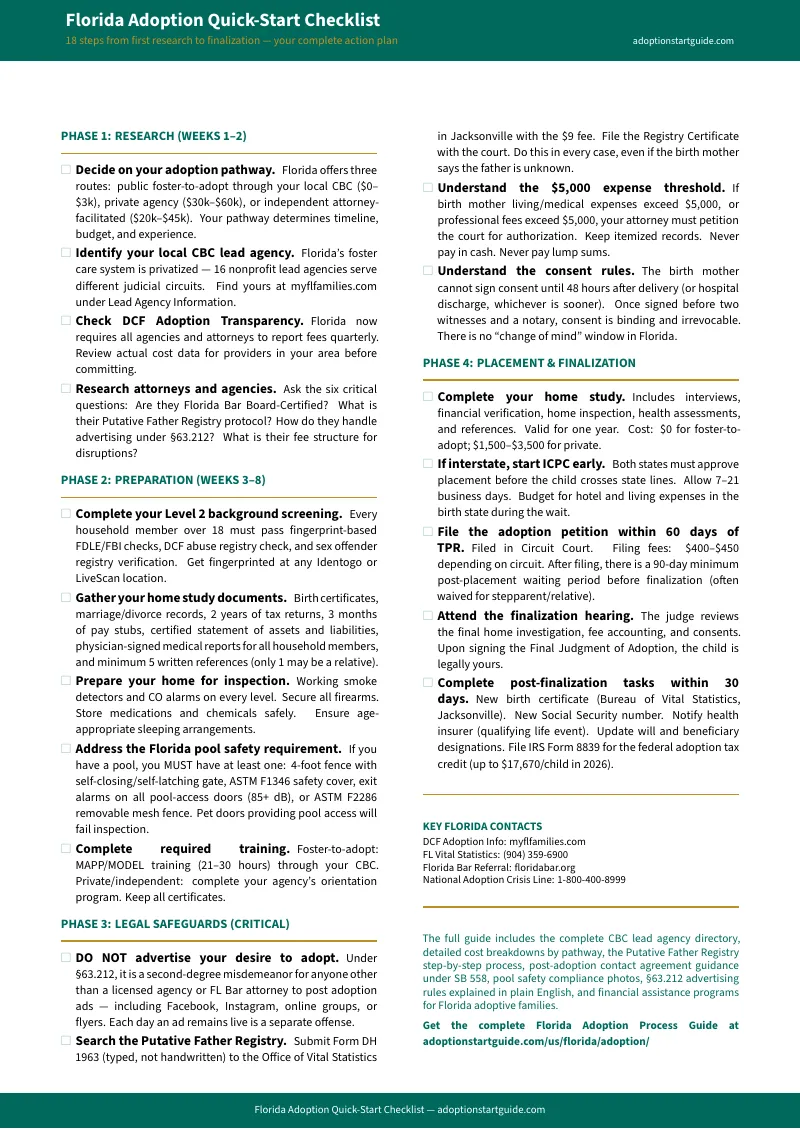
- Printable Quick-Start Checklist — 18 critical steps organized across four phases, from pathway selection through post-finalization paperwork. Print it, pin it up, and work through it in order.
- 5 Standalone Reference Sheets — Print-ready one-page cards you can bring to attorney meetings, home inspections, and CBC orientations: the Putative Father Registry search process (Form DH 1963 steps), the §63.212 advertising dos and don'ts, the §63.097 birth mother expense rules with the $5,000 threshold, a two-page home study preparation checklist with every document and safety item including pool barriers, and a CBC lead agency directory by region and county.
Who this guide is for
- Families considering foster-to-adopt through a CBC lead agency — You want to understand how Florida's privatized system actually works, which CBC serves your county, the MAPP training requirements, concurrent planning, and how to negotiate the adoption subsidy before you attend your first orientation.
- Couples or individuals pursuing private or independent adoption — You need to navigate the placement process, the 48-hour consent rule, the Putative Father Registry protocol, the advertising prohibition, attorney selection, and court procedures without spending hours at $400 per hour learning basic procedures you could have read in advance.
- Stepparents adopting a spouse's child — You want to understand the streamlined process, whether you need consent from the absent parent or a TPR petition, the specific documentation required, and the shorter timeline.
- Grandparents and relatives raising a child — You have been caring for this child and need a clear path to legal permanence through kinship adoption, with the specific filing requirements and fee waivers available to relative petitioners.
- LGBTQ+ families building through adoption — Florida provides full legal parity following the 2010 ruling. This guide covers joint adoption, second-parent adoption, and the protections that secure both parents' rights across all three pathways.
- Families relocating to Florida or adopting interstate — What worked in New York or California may get you in trouble here. Florida's advertising prohibition, irrevocable consent, and privatized CBC system are structurally different from what you are used to. This guide covers the ICPC process and the specific Florida traps that catch families transferring assumptions from other states.
Why not piece it together from free resources?
You could. DCF posts forms and regulatory language online. Your CBC lead agency has an orientation program. Reddit has threads from families in Miami and Tampa sharing experiences that may or may not reflect current law. Facebook groups — which you now know you cannot use to advertise your adoption — have well-meaning advice from people who adopted years ago under different rules.
The problem is the same one every Florida family hits: DCF gives you forms, not strategy. Your CBC explains the foster-to-adopt track but will not warn you about the advertising trap or the Putative Father Registry timing if you are pursuing private adoption. Your attorney will explain everything — at $400 per hour. Reddit gives you personal stories filtered through memory and emotion, not the current statutory framework. No single free resource covers all three adoption pathways, the §63.212 advertising prohibition, the Putative Father Registry protocol, the 48-hour consent mechanics, the $5,000 expense threshold, the pool safety mandate, the 16 CBC lead agencies by region, the SB 558 contact agreements, the ICPC interstate rules, and the financial assistance programs in one document. You end up with 30 browser tabs, conflicting advice from different years, and the persistent feeling that you are missing something important — because in Florida adoption law, the thing you miss can be a criminal charge or a contested adoption.
This guide consolidates everything into one reference. One document. One read-through to understand the full picture. One reference to keep open as you move through each phase.
Satisfaction guarantee
If the guide does not deliver what this page promises, email [email protected] for a full refund. No questions, no hassle.
— Less Than 15 Minutes with a Florida Adoption Attorney
A single consultation with an adoption attorney in Miami costs $400 per hour or more. This guide covers every question most families spend that first meeting asking — the adoption types, the costs, the consent rules, the Putative Father Registry, the advertising prohibition, the home study requirements, the court procedures — for a fraction of the price. You will still need an attorney for your adoption. But you will walk into that first meeting prepared, focused, and ready to use their time on your specific legal situation instead of basic orientation.
Download the free Florida Adoption Quick-Start Checklist to see the 18 critical first steps. Or get the complete guide and start your adoption journey with the full picture from day one.