
You Want to Foster a Child in Florida. DCF Gave You a Phone Number and Sent You to a Lead Agency You've Never Heard Of.
Florida needs foster parents. Nearly 20,000 children are in out-of-home care on any given day, and the system is chronically short of licensed homes. But when you try to start the process, you discover something most states don't do: Florida privatized its entire child welfare operation. The Department of Children and Families sets the rules, but the actual work — recruitment, training, home studies, placement — is handled by a patchwork of private nonprofit lead agencies, each covering one or more of the state's 20 judicial circuits.
Here's what that means for you:
- You search "how to become a foster parent in Florida" and land on the DCF website. DCF redirects you to your circuit's lead agency. That lead agency may redirect you to a subcontracted child-placing agency. By the third handoff, you're not sure who you're supposed to talk to.
- PRIDE training is mandatory, but class schedules are controlled by your local lead agency. Miss an enrollment cycle in some circuits and you're waiting 2-3 months for the next one — and nobody warns you.
- Florida is the drowning capital of the country. If you have a pool, spa, or hot tub, Statute 515.29 requires a barrier that meets exact specifications — height, gap dimensions, gate swing direction, latch height. Fail the pool inspection and your license is delayed weeks while you fix it and wait for a re-check.
- Level 2 background screening runs fingerprints, criminal records, abuse registries, and civil court checks. If any adult in your household lived out of state in the past five years, the Adam Walsh interstate check can add weeks or months to your timeline.
- Florida has five levels of foster care licensure. Most applicants don't know this until they're halfway through the process and realize they're pursuing the wrong level.
The free resources give you statutes and general information. They don't give you the circuit-specific operational knowledge to actually get licensed without losing months to confusion, missed training cycles, and preventable inspection failures.
The CBC Licensing Navigator — Your Circuit-by-Circuit Guide to Getting Licensed in Florida
This guide was built for Florida's specific foster care architecture — the Community-Based Care model that confuses even experienced social workers. It takes the entire licensing process and translates it from DCF regulations and Rule 65C-45 administrative code into a single document with the practical details, contact information, and preparation checklists that the state's website leaves out.
What's Inside
The 20-Circuit Lead Agency Directory — Your First Real Answer
Florida's CBC system means your licensing experience depends entirely on which circuit covers your county. The guide maps every county to its current lead agency and subcontracted child-placing agencies, with contacts and orientation information. Miami-Dade and Monroe run through Citrus Family Care Network. Hillsborough goes through Children's Network of Hillsborough. Orlando and surrounding counties go through Family Partnerships of Central Florida. Palm Beach and Broward through ChildNet. You'll know exactly who to contact before making your first call — instead of bouncing between DCF, a lead agency, and a subcontractor trying to figure out who actually handles your area.
The Licensing Process End to End — Every Step in Order
From initial orientation through license issuance, the guide walks you through each stage with the documents required, the typical timeline (3-6 months), and the three points where most applications stall: the CBC hand-off (people call DCF instead of their lead agency and lose weeks), missed PRIDE enrollment windows (some circuits only run cohorts every 2-3 months), and failed home inspections (especially pool barrier issues). You'll have the sequence right the first time instead of discovering it through trial and error.
PRIDE Training — 21 Hours That Control Your Timeline
Parent Resources for Information, Development, and Education is Florida's mandatory pre-service training. It's administered by your lead agency or their training subcontractor, which means schedules, formats, and cohort frequency vary by circuit. The guide breaks down what each session covers, how to register through your specific lead agency, virtual and in-person options, and the proactive approach to securing your spot before the next cohort fills. In circuits with infrequent sessions, a single missed enrollment window pushes your timeline back months.
Rule 65C-45 Home Safety Inspection — The Room-by-Room Self-Audit
Rule 65C-45 is the regulatory yardstick for your home inspection, and failed inspections are the most common cause of licensing abandonment in Florida. The guide provides the complete self-audit checklist: bedroom space requirements per child, sleeping arrangement rules, fire extinguisher and smoke alarm placement for every floor, medication storage requirements, water heater temperature limits, firearms storage, and the smoke-free mandate that covers e-cigarettes and vaping. Walk your home with this checklist before the inspector arrives and you eliminate the surprises that cause re-checks.
Pool Barrier Requirements (Statute 515.29) — The Florida-Specific Hurdle
Florida's Residential Swimming Pool Safety Act applies to every foster home with a pool, spa, or hot tub. The requirements are specific: minimum barrier height on the outside, maximum gap dimensions (no sphere of a specified diameter can pass through), gates that swing outward and are self-closing and self-latching, latch height minimums, and barrier-to-water-edge placement rules. The guide includes a dedicated pool safety pre-inspection checklist so you can identify and fix issues before the official visit. Most fixes cost under $100, but failing and waiting for re-inspection costs you weeks of licensing progress.
Level 2 Background Screening — The Full Process Decoded
Florida's screening covers fingerprints, statewide criminal records, child abuse and neglect registry, sex offender registry, and civil court checks for domestic violence injunctions. If any adult household member lived out of state in the past five years, the agency must run Adam Walsh interstate checks — and these can take weeks or months depending on the responding state. Household members as young as 12 must be screened for delinquency records. The guide walks through the entire screening process, lists the mandatory disqualifying offenses, explains the "weighing test" for non-disqualifying offenses, and gives you the disclosure strategy that prevents your screening from being flagged for further investigation.
Five Levels of Licensure — Which One Matches Your Goals
Florida's tiered licensure system confuses most applicants. Level I is child-specific, mainly for kinship caregivers with a bond to a specific child — less rigorous but limited to that child. Level II is the standard license for traditional foster parents. Level III covers safe foster homes specializing in human trafficking survivors. Level IV is therapeutic foster care requiring additional behavioral health training. Level V is medical foster care for children with complex health needs. The guide explains the training and requirements for each level and helps you determine which one to pursue — before you're halfway through the wrong track.
The Unified Home Study — What the Licensing Coordinator Evaluates
The home study feels like the most opaque part of the process. The guide breaks down what the licensing coordinator is actually assessing during home visits, the interview process for all household members, the autobiography requirement, reference expectations, and what evaluators look for in strong candidates. The goal is self-awareness and stability, not a perfect home — and understanding the evaluation framework transforms the home study from an anxiety source into a straightforward process.
Financial Support — Board Payments, Coverage, and the Real Costs
Florida provides monthly board payments based on the child's age group, plus clothing allowance, childcare reimbursement, Medicaid coverage for all foster children's medical, dental, and mental health services, and a Normalcy Allowance for extracurricular activities. The guide gives you the complete rate breakdown and an honest accounting of what the payments cover and what comes out of pocket. Fostering isn't free — but the financial support is more substantial than most applicants realize, and understanding the full picture prevents sticker shock in either direction.
Foster-to-Adopt — Florida's Concurrent Planning Model
If your goal is adoption, Florida's concurrent planning means the state works toward reunification and adoption simultaneously. The guide covers how this plays out in practice, the legal timeline for Termination of Parental Rights, foster parent preference in adoption proceedings, adoption subsidy continuation, and the emotional reality of supporting reunification while preparing for permanency. You'll understand what concurrent planning actually means for your family — not the optimistic version from the brochure, but the realistic timeline and process.
Military Families — MacDill, NAS Jax, and PCS Transfers
Florida is home to MacDill AFB, NAS Jacksonville, Naval Station Mayport, and dozens of other installations. Military families bring discipline and motivation but face unique challenges: PCS relocations can interrupt licensing, deployment schedules complicate home study availability, and transferring progress between states requires specific documentation. The guide covers Military OneSource foster care consultation, the EFMP support at MacDill, and strategies for maintaining licensing continuity during relocations.
ICWA and Tribal Placement — Seminole and Miccosukee Considerations
The Indian Child Welfare Act governs foster care involving children with Seminole or Miccosukee tribal eligibility. ICWA mandates tribal notification and intervention rights, establishes placement preferences that prioritize extended family and tribal members, and requires "active efforts" to prevent family separation. The guide explains what ICWA means for non-tribal foster parents in Florida, with direct contacts for both tribes' social services departments.
Plus: Printable Standalone Worksheets
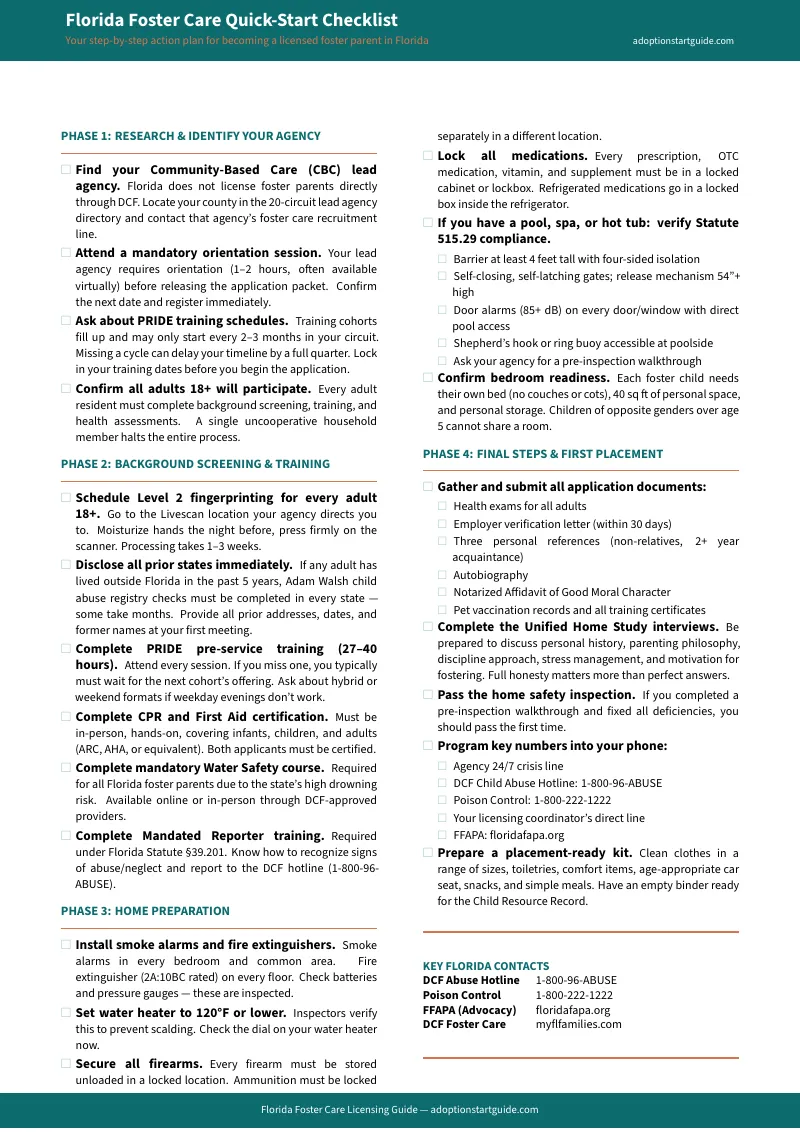
Your purchase includes standalone printable PDFs you can use independently: the Florida Foster Care Quick-Start Checklist (your step-by-step action plan), the Home Inspection Checklist (walk your home room by room against Rule 65C-45 and Statute 515.29 requirements), the Document Tracker (fillable four-phase checklist for every form and certificate), and the Communication Log (structured DCF and lead agency contact tracking for caseworker transitions).
Who This Guide Is For
- First-time prospective foster parents who want the complete roadmap before contacting DCF or a lead agency — especially if you've already been redirected between websites and phone numbers
- Families in the Big Four metros (Miami, Tampa, Orlando, Jacksonville) where the CBC agencies have the most subcontracting layers and the most bureaucratic complexity
- Pool owners who need to pass the Statute 515.29 barrier requirements the first time rather than paying for fixes and waiting weeks for a re-check
- Kinship caregivers (grandparents, aunts, uncles, family friends) who need to understand the licensing path and available financial support quickly
- Military families at MacDill, NAS Jacksonville, or other installations who need to know how PCS moves affect their licensing
- Out-of-state transplants who find Florida's decentralized CBC model completely different from the state-run system they knew
- Families who started but stalled — your application is with a lead agency that stopped responding, your licensing coordinator left, or you missed a PRIDE session
Why This Exists When DCF Has a Website
DCF publishes the statutes and administrative code. The Florida Foster & Adoptive Parent Association (FFAPA) provides excellent peer support for existing parents. Facebook groups and Reddit threads answer individual questions. None of them do what this guide does:
- Map the CBC system. Free resources give you the DCF website. They don't tell you that your licensing experience depends entirely on which of 20 circuits and which lead agency covers your county — or give you the directory to find yours.
- Prepare you for the pool inspection. Free guides say "meet safety standards." They don't walk you through every Statute 515.29 barrier specification with a pre-inspection checklist that catches the $15 latch fix before it becomes a weeks-long re-check delay.
- Decode the five licensure levels. Free resources mention "levels of care." They don't explain the five-tier system, the training requirements for each level, or help you figure out which one matches your goals before you're committed to the wrong track.
- Navigate the background screening. Free resources say screening is required. They don't explain the Adam Walsh interstate complication, the weighing test for non-disqualifying offenses, or the disclosure strategy that prevents your screening from being flagged.
- Prevent the PRIDE delay. Free resources say training is mandatory. They don't tell you that missing one enrollment window in some circuits costs you 2-3 months — or give you the proactive enrollment approach.
This guide fills those gaps with the operational detail that turns months of confusion into a clear, manageable path to licensure.
Your Investment
For , you get 5 PDFs — the complete Florida Foster Care Licensing Guide (85 pages), the Quick-Start Checklist, the printable Home Inspection Checklist, the Document Tracker, and the Communication Log. Everything from identifying your circuit's lead agency through your first placement.
A missed PRIDE cycle costs you months. A failed pool inspection means weeks of re-checking. A single call to DCF instead of your lead agency wastes weeks you could have spent moving forward. The guide pays for itself the first time it saves you from one of these setbacks.
Start with the free checklist — 20 actionable items organized across every phase of the licensing process. If you want the complete system with the 20-circuit lead agency directory, pool safety pre-inspection checklist, background screening strategy, and home study preparation, get the full guide.