You Want to Foster a Child in Kentucky. DCBS Gave You a Phone Number, a Stack of Acronyms, and No Clear Path Forward.
Kentucky has 8,735 children in out-of-home care and only 4,516 foster homes. Children are sleeping in DCBS offices, state parks, and hotel rooms because there are not enough licensed families. The state needs you. But when you try to start the process, you run headfirst into a system that was not built for first-time applicants.
You search "how to become a foster parent in Kentucky" and land on the KYFaces portal. You find a list of requirements scattered across multiple pages. You download a PDF referencing 922 KAR 1:350 and realize you are reading administrative regulations written for caseworkers, not families. You call your regional DCBS office and leave a message. Someone calls back three days later, tells you to attend an orientation, and mentions something about TIPS-MAPP training. You ask how long the process takes. They say "it depends." You ask what you need to do first. They say "come to orientation and we'll explain."
Meanwhile, you are trying to piece together timelines from five-year-old Reddit threads, Facebook groups where half the advice contradicts the other half, and a KAFAP brochure that seems designed for parents who are already licensed. You find a private agency like Sunrise Children's Services or Necco that promises a smoother path, but you are not sure if going private limits your placement options or locks you into their model. You discover that the process takes three to nine months, not the thirty days you assumed. You learn that Kentucky requires 30 hours of pre-service training, but nobody has told you which sessions are offered in your county or when the next cohort starts. You still do not know whether you need to fix the railing on your back porch or what happens if your well water does not meet state standards.
The information exists. It is just buried in SOP manuals, administrative regulations, and caseworker handbooks that were never meant for public consumption. Every hour you spend excavating it is an hour a child spends without a home.
The DCBS Licensing Roadmap: 922 KAR Translated Into Plain Language
This guide takes the entire Kentucky foster care licensing process — from your first call to DCBS through your first placement — and translates it from administrative regulations and Standards of Practice manuals into a single document written for families, not caseworkers. Every chapter is built around the specific regulations, training requirements, home study standards, and financial realities that apply in the Commonwealth. This is not a national foster care handbook with "Kentucky" stamped on the cover. It is the operational layer between what the CHFS website posts and what you actually need to know to get licensed without losing months to confusion.
What's inside
- The 6-Step DCBS Licensing Process — Start to Finish — Every stage mapped in order: initial inquiry and orientation, the DCBS-1 application, background checks (Kentucky State Police and FBI fingerprinting, Central Registry, Sex Offender Registry, National Crime Information Center), TIPS-MAPP pre-service training, the unified home study, and license issuance. With the typical timeline for each stage, the three points where most applications stall, and how to keep yours moving.
- 922 KAR 1:350 Decoded — The Home Safety Standards — The administrative regulation that governs your home inspection translated into a room-by-room checklist: bedroom square footage and sleeping arrangements, smoke detector placement (within 10 feet of every bedroom), fire extinguisher requirements, water heater temperature limits, medication and cleaning supply storage, firearm lock-up requirements, outdoor hazard fencing, and the well-water and septic standards that matter in rural counties. Walk your home with this checklist before your R&C worker arrives.
- TIPS-MAPP Training — 30 Hours That Control Your Timeline — Kentucky requires 30 hours of pre-service training through the TIPS-MAPP (Trauma Informed Partnering for Safety and Permanence — Model Approach to Partnerships in Parenting) curriculum plus supplemental modules. The guide breaks down what each session covers, how to register through your DCBS regional office, the difference between state-administered and private agency training tracks, and how to avoid the enrollment gap that pushes applicants back months when they miss a cohort cycle — especially in rural counties where sessions may only run twice a year.
- The Home Study — What Your R&C Worker Actually Evaluates — The home study is the part that generates the most anxiety because it feels opaque. The guide breaks down what the Recruitment and Certification worker is actually assessing: household stability, parenting philosophy, discipline approach, relationship dynamics, support network, motivation, and your understanding of the foster parent role within the DCBS partnership model. The evaluation framework is knowable — understanding it transforms the home study from a source of dread into a straightforward conversation.
- State vs. Private Agency — Which Licensing Track Is Right for You — DCBS-direct licensing gives you access to the full state placement pool. Private agencies like Sunrise Children's Services, Necco, KVC Kentucky, and StepStone Family & Youth Services offer additional support but may limit your placement options to their network. The guide compares both tracks on training, timeline, support services, reimbursement rates, and placement flexibility so you choose the right path before you commit.
- Kinship and Relative Care — The KinFirst Pathway — Kentucky's KinFirst initiative prioritizes relative and fictive kin placements. If you are a grandparent, aunt, uncle, or family friend who has a child placed with you or is about to, the guide covers the expedited kinship licensing process, the financial difference between licensed and unlicensed kinship care (it is substantial), the Kinship Care Program supports, and how to navigate the DCBS system when you did not choose this path — it chose you.
- Financial Support — Per Diem Rates, Reimbursements, and the Real Costs — Monthly board payments by age group, clothing allowance, childcare reimbursement for working parents, Medicaid coverage for all foster children, respite care access, the Care Plus and Medically Complex certifications that provide higher per-diem rates for children with additional needs, and an honest accounting of what the payments cover and what comes out of pocket. Plus the federal Adoption Tax Credit if you move toward permanency.
- Foster-to-Adopt — Kentucky's Concurrent Planning Model — If your goal is adoption, Kentucky works toward reunification and adoption simultaneously under KRS 625.090. The guide covers how concurrent planning works in practice, the legal timeline for Termination of Parental Rights, foster parent preference in adoption proceedings, the adoption subsidy, and the emotional reality of supporting reunification while preparing for permanency.
- Regional DCBS and KAFAP Directory — All nine DCBS service regions and 15 KAFAP regional teams mapped by county, with contact information for the offices that handle licensing in your area. Because knowing who to call — and who actually answers — is the difference between a process that moves and one that stalls.
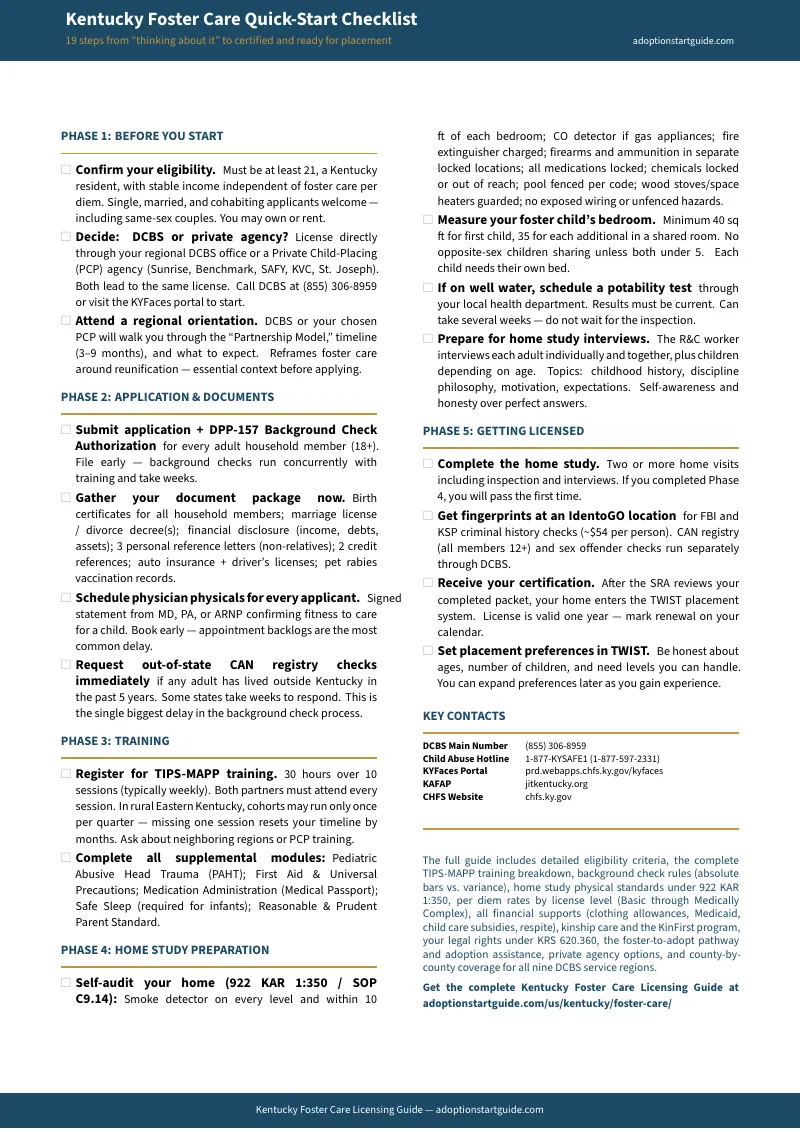
- Printable Quick-Start Checklist — Every critical action item organized across four phases: inquiry and application, training and background checks, home study preparation, and post-licensing first steps. Print it, pin it up, and work through it in order.
- Standalone Reference Sheets — Print-ready cards you can bring to your orientation and home inspection: the 922 KAR 1:350 home safety self-audit, the document tracker for every form and certificate DCBS requires, the background check status tracker, and the DCBS regional office and KAFAP team directory.
Who this guide is for
- Mission-driven families in Louisville, Lexington, and Northern Kentucky who feel called to foster and want the complete roadmap before their first DCBS orientation — especially if you have already been confused by the KYFaces portal, left unreturned voicemails, or cannot figure out whether to go through the state or a private agency
- Kinship caregivers in Eastern Kentucky and rural counties — grandparents, aunts, uncles, or family friends who are raising a relative's child and need to understand the licensing path, the financial difference between licensed and unlicensed kinship care, and how to work with DCBS when you did not have time to plan
- Church ministry families responding to a foster care call through Southeast Christian, Living Hope Baptist, First Baptist Pikeville, or any congregation involved in orphan care — who want to move from inspiration to application with a clear understanding of what the state actually requires
- Rural families who need to know whether their well water, septic system, wood stove, or multi-generational housing arrangement will pass the 922 KAR 1:350 home inspection before they start a process that takes months
- Families considering foster-to-adopt who want to understand how concurrent planning actually works in Kentucky, the realistic timeline for TPR, and what the adoption subsidy covers before committing to a track
- Families who started but stalled — your application is with DCBS and nobody has called you back, your R&C worker left and you got reassigned, or you missed a TIPS-MAPP session and do not know when the next cohort starts
Why not piece it together from free resources?
You could. The CHFS website publishes the Standards of Practice manual. KYFaces lists the certification requirements. KAFAP provides training support for approved parents. Kentucky Youth Advocates publishes policy reports. Reddit and Facebook groups have threads from families sharing their experiences.
The problem is the same one every Kentucky family hits. The CHFS website gives you regulations written for caseworkers, not applicants. KYFaces lists requirements without explaining the practical steps to meet them. KAFAP is designed for families who are already licensed — prospective parents visiting the site encounter "crisis intervention" and "critical stress debriefing" language that feels more intimidating than helpful. Private agencies explain their track without comparing it to the state track. Reddit gives you personal stories filtered through memory, not the current regulatory framework. No single free resource translates 922 KAR 1:350 into a home safety checklist, maps all nine DCBS service regions with contacts, explains the TIPS-MAPP enrollment process by region, compares state versus private agency licensing tracks, walks you through the home study evaluation framework, and covers the kinship care financial gap — in one document. You end up with a dozen browser tabs, conflicting timelines, and the persistent feeling that you are missing something important. In a system where 4,200 children are waiting for homes, the thing you miss is time.
Satisfaction guarantee
If the guide does not deliver what this page promises, email [email protected] for a full refund. No questions, no hassle.
— Less Than the Cost of Your FBI Fingerprinting Fee
The fingerprinting appointment you will need for your background check costs $54. This guide covers every question most families spend their first three months trying to answer — the licensing steps, the training requirements, the home safety standards, the financial support, the state-versus-private decision, the home study preparation — for a fraction of that. You are going to navigate this system one way or another. The question is whether you do it with a clear roadmap or through months of trial and error while children sleep in offices.
Download the free Kentucky Foster Care Quick-Start Checklist to see the critical first steps. Or get the complete guide and start your licensing journey with the full picture from day one.